


Circular motion Questions
1. Give a reason why bodies in circular motion undergo acceleration even when their speed
is constant
2. a) Define the term angular velocity
b) The figure shows a body of mass m attached to the centre of a rotating table with a string
whose tension can be measure. (the device for measuring tension is not shown in the figure)
The tension T, on the string was measured for various values of angular velocity, . The distance
r from the centre was maintained at 30cm. The results are as shown below :
Angular velocity | 2.0 | 3. | 4.0 | 5.0 | 6.0 |
Tension T (N) | 0.04 | 0.34 | 0.76 | 1.30 | 1.96 |
i) Plot the graph of T (y – axis) against2
ii) From the graph, determine the mass, m, of the body given that
T = m2 r – C Where C is a constant
iii) Determine the constant C and suggest what it represents in the set up
3. (a) A body moving in a uniform circular motion accelerates even though the speed is constant.
Explain this observation.
A fun fair ride of diameter 12m makes 0.5 revolutions per second.
(i) Determine the periodic time, T, of the revolutions.
(ii) Determine its angular velocity, .
(iii) Determine the linear velocity of the child riding in it.
(iv) If the mass of the child is 30 kg, find the centripetal force that keeps the child in the motion.
4 . Figure 6 shows a body of mass m attached to the centre of a rotating table with string
whose tension can be measured (the device for measuring the tension is not shown in


 the figure)

The tension T, on the string was measured for various values of angular velocity .
The distance r of the body from the centre was maintained at 60cm. Table 2 shows the results obtained:-
Angular velocity () (rads-1) | 2.0 | 3.0 | 4.0 | 5.0 | 6.0 |
Tension (T) (N) | 0.04 | 0.34 | 0.76 | 1.30 | 1.96 |
(i) Plot the graph of T against 2
(ii) From the graph determine the mass m of the body given that T = m2r – C,
where C is constant
(iii) Determine the constant C and suggest what it represents in the set-up
5. (a) (i) In uniform circular motion, a particle undergoes an acceleration while its speed remains
constant. Explain how the acceleration if caused
(ii) A car of mass 1.5 x 10³kg negotiates a level round about of radius 20m at a speed of
10m/s. Calculate the centripetal force acting on the car
(b) The diagram figure 15 below shows a conical pendulum:-
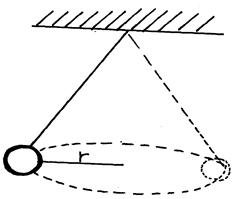 fig. 15
(i) State and explain the effect on r of increasing the speed of the pendulum, given that the
string is inextensible
(c) Explain why a cyclist going round a bend at high speed tilts inwards
6. (a) Define angular velocity
(b) The figure below shows an object of mass 0.2kg whirled in a verticle cycle of radius
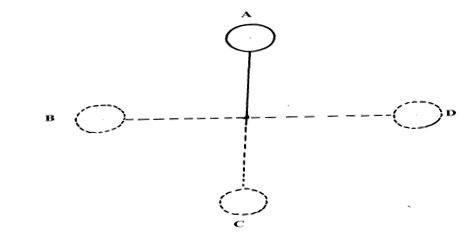 0.5m at uniform speed of 5m/s
Determine
(i) The tension in the string at position A
(ii) The tension in the string at position B
(iii) The tension in the string at position C
(c) From the values obtained in (i) (ii) and (iii) above, determine the point the string will most
likely snap. Explain
(d) A small pendulum bob having a mass of 150g is suspended by an inelastic string of length
0.5m. The mass is made to rotate in a horizontal circle of radius 0.4m and whose centre is
vertically below the point of suspension
(i) Determine the tension in the string
(ii) State one application of the pendulum
7. (a) Explain why a body moving in a circular path with constant speed is said to be accelerating
(b) (i) A wooden block of mass 200g is placed at various distances from the center of a turntable,
which is rotating at constant angular velocity. It is found that at a distance of 8.0cm from
the center, the block just starts to slide off the table. If the force of friction between the block
and the table is 0.4N, Calculate:
(I) The angular velocity of the table
(II) The force required to hold the block at a distance of 12cm from the center of the table
(c) A block of mass 400g is now placed at distance of 8.0cm from the centre of the turntable in (i)
above and the turntable rotated at the same angular velocity. State with a reason whether or
not the ball will slide off
8. A small object moving in a horizontal circle of radius 0.2m makes 8 revolutions per second.
Determine its centripetal acceleration
9. (a) The figure below shows a body of mass m attached to the centre of a rotating table with a
string whose tension can be measured. The device for measuring the tension is not shown in
the diagram:
The tension T on the string was measured for various values of angular velocity, . The distance r of the body from the centre was maintained at 30cm. The graph below shows the results obtained when Tension (y-axis) is plotted against (angular velocity )2
- Name the force represented by the Tension (T)
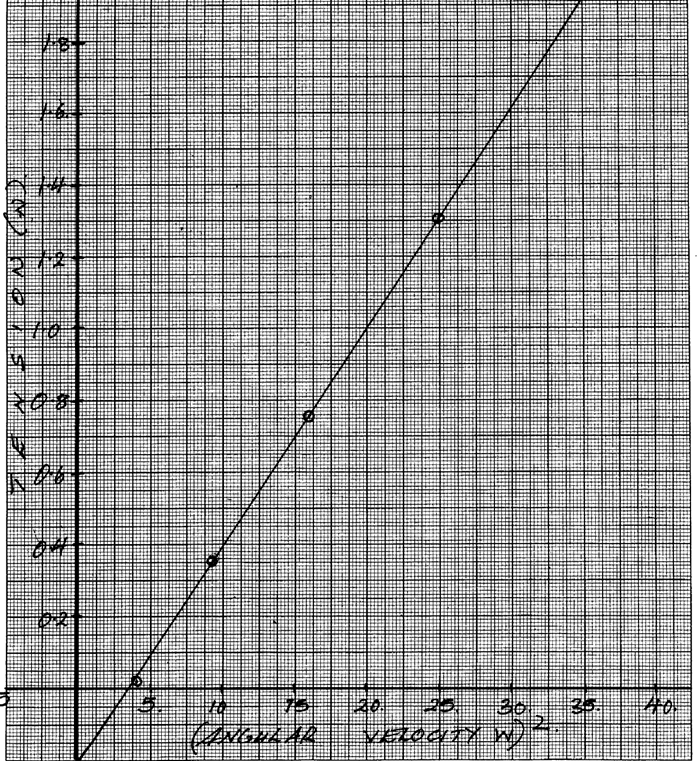 (ii) From the graph, determine the mass m, of the body given that T=M2r – c where c is a constant


(iii) Determine the constant c and suggest what it represents in the set-up
10. A mass of 2kg is attached to a string of length 50 cm. It is whirled in a circle in a vertical plane
at 10 revolution per second about a horizontal axis. Calculate the tension in the string when the
mass is at the :-
(a) Highest point of the circle.
(b) Lowest part of the circle.
11. A bucket full of water is whirled in a vertical circle of radius 1.6m, determine the
minimum speed required to keep the water intact.
1. (a). The set up in the figure below was used to investigate the variation of the centripetal
force F with the radius of a circle in which a body rotates. Various Masses were hooked
on thread passing through a glass tube to balance circular motion as shown.
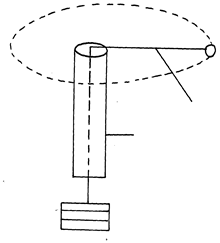






The table below shows the results obtained from the above experiment
Radius v(cm) | 15 | 25 | 34 | 40 | 50 | 61 |
Mass m(kg) | 0.02 | 0.03 | 0.04 | 0.05 | 0.06 | 0.07 |
(i). Plot a graph of tension T in the thread against radius of circular motion. (ii). Use the results above to determine the angular velocity of the body if its mass is 15g.
(b). (i). Determine the time a 3kw heater takes to melt 10kg. f ice at 0oC to water at 50oC.
Take specific latent heat of fusion for ice as 3.34 x 10⁵ j/kg while specific heat capacity of
Water as 4200j/KgoC .
(ii). State one assumption made in the kinetic theory of gases.
Circular motion Answers
1. The direction of the speed keeps changing hence the velocity at each point on the circular path is given by the tangent to the path at that point
2. a)This is the rate of change of angular displacement with pimp.
b) The tension T, on the string was measured for various values of angular velocity, რ. The
distance r from the centre was maintained at 30cm. The results are as shown below
Angular velocity რ (rad s-1) | 2.0 | 3.0 | 4.0 | 5.0 | 6.0 |
Tension T (N) | 0.04 | 0.34 | 0.76 | 1.30 | 1.96 |
W2 (rads-2) | 4 | Q | 16 | 25 | 36 |
i) Plot the graph of T (y – axis) againstრ2
ii) From the graph, determine the mass, m, of the body given that
T = რ2 r – C
Where C is a constant
Gradient = Mr M = gradient
Gradient = 0.76 – 0.04 r
16 -4 = 0.06 = 0.6 = 0.2 kg
= 0.06 N|(rad 21-2) 30/100 3
iii) Determine the constant C and suggest what it represents in the set up
C is the Y –intercept
C = – 0.2 N
3. (a) It keeps changing direction and hence must experience centripetal acceleration
(b) (i) f = 0.5HZ
T = 1/f
= 1
0.5 = 2sec
(ii) w = 2
T
= 2 x 3.142
2
= 3.142 / sec;
(iii) V = rw or
= 6 x 3.12 = 18.852m/s
(iv) F = MV2
r
= 30 x (18.852)2
6
= 1776.99N
OR F = mrw2
= 30 x 6 x (3.142)2 = 1776.99N
(c) Graph
(iii) centrifugal
 5. (a) (i) The direction of the particle is tangential to the path of any given point. There is
instantaneous change in direction of velocity, this causes acceleration of the particle.
(ii) F = mV2
 r
r
= 1.5 x 103 x 10 x 10
20
 = 7.5 x 10³N


 (b) (i) The value of r increases. Increase in speed leads to increase in centripetal force on the bob.
This leads to increase in radius of path (centripetal force is directly proportional to radius)

 (c)The cyclist leans inwards in order to have enough component of the
conact force to provide
adequate centripetal force.
6. a) The rate of change of angular displacement with time 1
b) i) TA = mv2/r – mg 1
= 0.2 X 52 – 2.0 1
0.5 = 8N 1
ii) TB = mv2/r
= 0.2 X 52
0.5 = 10N 1
iii) TC = Mv2 + mg 1
= 0.2 X 52
+ 2 1
0.5 = 12 N 1
c) At point C where tension is maximum 1
d) i) T cos Q = mg 1 T (0.3/0.5) = 1.5 T= 2.5 N 1
T cos Q = 150/1000 X 10 1 T = 1.5 X 5
3
T cos Q = 1.5
ii) Speed governor 1
7. (a) The direction of its velocity is continuously changing (1mk)
(b) (i) Fr = mw2r (1mk)
0.4 = 0.2 x w2 x 0.08
w2 = 0.4
0.2 x 0.08 (1mk)
w2=25 and 25-2
w =5 rad 6-1 (1mk)
(ii) F =mw2r
=0.2 x 5 x5x0.12
= 0.6N (must be shown
(c) The block will slide (1mk)
Frictional force (0.4N) is less than the force required to maintain it in uniform circle (1mk)
8. = rw2 = 0.2(16 )2
= 505.3m/s2
9. a) i) Centrifugal force
ii) The gradient of the graph = mass x radius
T = MW2r – C
From Mr = gradient
Mr = 1.30 – 0.76 = 0.06
25 – 16
Mr = 0.06
M x 0.3 = 0.06
M = 0.06 = 0.2kg
0.3
iii) y – intercept = -0.2N
-0.2 = -C
0.2= C
Frictional force
10. (a) at the highest point of the circle
T = Mv2 – mg
r
Mv2 = Fe = MW2R
R
∴ T = Mw2r – mg
But w = 2f 1 mk
T = (2 x 10)2 x 2kg x 0.5) – (2 x 10)
= 4002 – 20 = 3927.84 N 1 mk
b) T at the lowest point
T = Fe + Mg
= Mw2r + Mg
= 4002 + 20
= 3967.84 N 1 mk


