

WATER
Water
Water is a very important compound essential for the substance of all living things.
Occurrence of Water
Water on the Earth occurs in three main states:
- Solid
Example: Ice, snow, hail. - Liquid
Example: dew, rain. - Vapor
Example: mist, steam, clouds.
- About 97% of all the water on Earth is salty water, while only 3% is fresh water.

A cycle is a number of changes that return to the starting point. Water is never lost but is continuously recycled around the globe in a system called the water cycle.
The water cycle is made up of 4 main stages:
- Evaporation
- Condensation
- Precipitation
- Collection
Physical Properties of Water
- It is colorless, odorless, and tasteless.
- It is the only substance that occurs naturally in all three states of matter.
- Pure water freezes at 0°C and boils at 100°C.
- It is a universal solvent because it can dissolve more substances than any other liquid.
- It has a high specific heat capacity because it can absorb a lot of heat before it begins to get hot.
- It is miscible with many liquids, for example, ethanol.
Chemical Properties of Water
- Pure water is neutral; it is neither acidic nor basic.
- Cold water reacts with some metals such as potassium, sodium, and calcium to form metallic hydroxides and hydrogen gas.
Example:
Word equation:
Cold water + Potassium → Potassium hydroxide + Hydrogen
2H2O(l) + 2K(s) → 2KOH(s) + H2(g)
Calcium + Cold water → Calcium hydroxide + Hydrogen
Ca(s) + 2H2O(l) → Ca(OH)2(s) + H2(g)
3. Steam (water vapor) reacts with some metals such as zinc, titanium, and iron to produce metallic oxide and hydrogen gas.
Iron + Water vapor → Iron(III) oxide + Hydrogen
2Fe(s) + 3H2O(g) → Fe2O3(s) + 3H2(g)
Zinc + Water vapor → Zinc oxide + Hydrogen
Zn(s) + H2O(g) → ZnO(s) + H2(g)
Water Treatment and Water Purification
Water treatment: The process of making water usable for industrial, medical, and other purposes.
The aim is to remove existing contaminants in the water.
Treatment processes may be physical such as settling, chemical like disinfection, or biological.
Water Purification
Water purification is the removal of contaminants from treated water to produce drinking water pure enough for human consumption. Substances removed include bacteria, algae, fungi, minerals, and human-made chemical pollutants.
Domestic Water Purification
Common methods used at home to purify water:
- Boiling
- Commercial filters
- Use of purifiers
1. Boiling: Water is heated and left for some time before heating is stopped. This method kills disease-causing organisms. The boiled water is then allowed to cool before use.
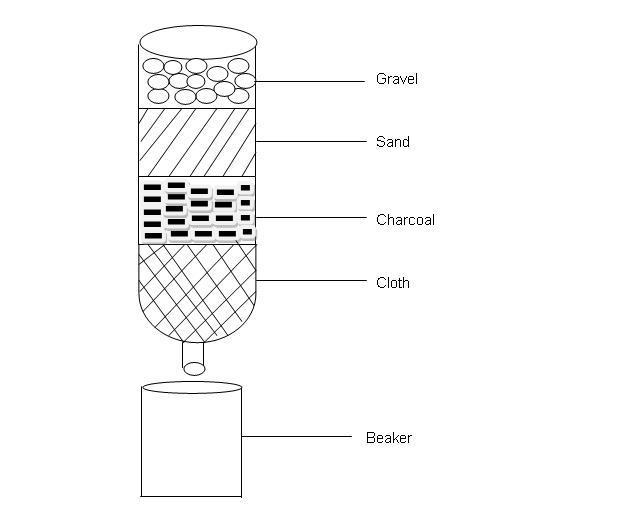
2. Commercial filter: These filters work by passing water through a charcoal element that purifies it. The filtered water is much clearer than the original muddy water.
Role of:
Gravel: To trap any floating substances.
Sand: To trap large particles.
Charcoal: To kill some harmful bacteria.
Clean cloth: To filter very tiny particles.
3. Use of purifiers: Chemical purifiers are usually in liquid form. A recommended amount of purifier is added to a specific amount of water in a container. The water is shaken (stirred) well, then left to settle for at least 20 minutes before it is safe for drinking. Examples of purifiers are Aqua guard and Water guard.
Test for Water
The presence or absence of water can be established by two methods (reagents):
- Copper (II) sulphate solution
- Cobalt chloride paper
1. Copper (II) sulphate
White anhydrous copper (II) sulphate turns blue on addition of water due to the formation of hydrated copper (II) sulphate.
2. Cobalt chloride
Blue cobalt chloride paper changes to pink when it reacts with water.
Note: The cobalt chloride test is more commonly used in solid form than as a liquid solution.
Urban Water Treatment
Water undergoes various processes before reaching its destination. The major stages are:
- Screening
- Reservoir
- Primary filtration
- Secondary filtration
- Disinfection/chlorination
- Storage
1. Screening
Once water is drawn from its sources, floating substances are removed.
2. Reservoir
Water is stored high up so that it flows by gravity.
3. Primary filtration
Large particles are removed when water is filtered through coarse sand.
Aluminum sulphate is added to remove smaller particles. How?
Aluminum sulphate causes impurities to clump together and sink to the bottom of the container. This process is called coagulation.
4. Secondary filtration
Water passes through finer sand, which removes the smallest particles.
5. Disinfection / Chlorination
Chlorine is added in moderate amounts to kill harmful bacteria.
6. Storage
This is the final stage where water is pure and safe enough to be stored for use.
Exercise
- The diagram below represents a simple water filter.
(a) Name the parts labelled A to D.
A – Cloth
B – Charcoal
C – Sand
D – Gravel
(b) What is the importance of each part?
Gravel – To trap any floating substances.
Sand – To remove large particles.
Charcoal – To kill some harmful bacteria.
Cloth – To filter very tiny particles.
(c) What would be the disadvantages of using such a filter to obtain drinking water?
– The disadvantage is that it can cause disease.
Importance of Water Treatment
Reasons why water must be treated:
- Untreated water may contain harmful parasites that cause diarrhea, typhoid, cholera, and other illnesses.
- Treated water is best for use in laboratories to ensure accurate results from experiments.
- Treated water is suitable for use in factories to ensure products are safe for consumption.
- Treated water is more efficient for cleaning in industries and domestic settings.
Conclusion: Untreated water leads to the use of larger amounts of substances such as soap for cleaning.


9 Comments