

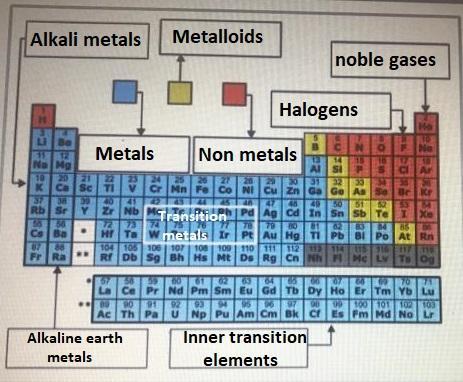
Chemical families Questions
1. Study the information in the table below and answer the questions that follow:
Element | Atomic radius (nm) | Ionic radius (nm) |
W | 0.114 | 0.195 |
X | 0.072 | 0.136 |
Y | 0.133 | 0.216 |
Z | 0.099 | 0.181 |
(a) Would these form part of a metallic or a non-metallic group? Explain
(b) Suggest an element in the table above likely to be the most reactive. Explain
2 State the reason for using Argon in electric light bulbs
3. Study the information in the table below and answer the questions that follow. The letters
do not represent the actual symbols of the elements.
Element | Electronic configuration | Boiling point |
X Y Z | 2.7 2.8.7 2.8.8.7 | -188oC -35oC 59oC |
(a) What is the general name given to the group in which the elements X,
Y and Z belong?
(b) Select two elements which are coloured gases
(c) Explain why Z has the highest boiling point
(d) Write an equation for the reaction of element Z with iron metal
(e) Element Y was dissolved in water and a piece of blue litmus paper was put into the resulting
solution. State and explain the observation that was made on the litmus paper
4. The table below shows elements A, B, C, E, F, and G. Elements in group X have a valency
of 2 while elements in group Y have a valency of 1. Use the table to answer the questions
that follow:-
| GROUP X | GROUP Y | ||||
Element | A | B | C | E | F | G |
Atomic radius (nm) | 14.0 | 19.5 | 19.7 | 5.2 | 7.9 | 11.3 |
Ionic radius (nm) | 7.6 | 10.5 | 12.4 | 12.6 | 16.1 | 19.6 |
(i) Atomic radius increases from A to C and from E to G. Explain
(ii) Explain the difference in the atomic and ionic radii of group X elements
(iii) Elements C and G belong to the same period. Explain why the atomic radius of C is
greater than that of G
(iv) Give the formula of the compound formed when B and F react
(v) What type of bonding is formed in the compound above? Explain
(vi) Starting with the least reactive, arrange the elements in group Y in the order of reactivity.
Explain:
5. The information in the table below relates to elements in the same group of the periodic table.
Study it and answer the question that follows.
Element | Atomic size (nm) |
P | 0.19 |
Q | 0.23 |
R | 0.15 |
Which element has the highest ionization energy? Explain
6. Starting with Lead (II) carbonate explain how you would prepare a pure sample of
Lead (II) sulphate
7. a) What is an isotope?
b) An element Q consists of 3 isotopes of mass 28, 29, 30 and percentage abundance of 92.2,
4.7, 3.1 respectively. Determine the relative atomic mass of the element?
8. Study the information in the table below and answer the questions that follow.
(The letters do not represent the actual symbols of the elements)
Element | Electronic configuration | Ionization energy Kj/mol) |
P | 2.2 | 1800 |
Q | 2.8.2 | 1450 |
R | 2.8.8.2 | 1150 |
(a) What is the general name given to the group in which elements P, Q and R belong?
(b) Explain why P has the highest ionization energy
(c) Write a balanced chemical equation for the reaction between element Q and water
Chemical families Answers
1. a) – Non- metallic group
– Ionic radius larger than atomic radius
b) X – has smallest atomic radius hence more electronegative
2. To prevent filament from burning out. Provides an atmosphere in which burning cannot occur
i.e. inert atmosphere
3. a) Halogens
(b) X & Y
(c) Z is the largest atom with the highest number of energy levels occupied by electrons.
The longer an atom is the higher the forces of attraction that hold the molecules of the
element together
 (d) 3Z (g) + 2Fe(s) FeZ3(s)
(e) The blue litmus paper turned red that bleached. This is because it dissolves in water to form\
an acid and bleaching solution of HO-1
4. (i) Down the group an extra energy level is added
(ii) In group x elements form ions by ionizing the outer energy levels
(iii) A cross the period an extra proton is added which increased he nuclear attraction force
(iv) BF2
(v) – Ionic /electrovalent
– Involves loosing & gaining of electrons
(vi) G, F,E
-E has smallest atomic radius hence protons can attract an electron easier than in G
5. R – has the smallest atomic √ ½ size hence its outermost electrons are more strongly held to the
nucleus resulting in high √ ½ value of ionization energy
6. – Add dilute nitric acid to lead (u) carbonate
PbCO3(s) + 2HNO3(aq) Pb(NO3)2(aq) + CO2(g) + H2O(l) √1
- React the resulting solution with solution of sodium sulphate i.e
Na2SO4(aq) + PB(NO3)2(aq) PbSO4(s) + 2NaNO3(aq) √½
- Filter to obtain lead (u) sulphate as residue. √½
- Dry the salt of lead (u) sulphate in between the filter papers or in sunshine. √½]
7. a) Is one of the atoms of the same element having a different mass number from the rest,
but same atomic number with others of the same element
b) 92.2 X 28 + 4.7 X 29 + 3.1 X 30 = 28.11 ½
100 ½ 100 ½ 100 ½
8. a) Alkaline earth metals √1
b) P has the smallest atomic radius due to electrons of P are closest to the nucleus √1
c) Q(S) + 2H2O(L) Q(OH)2(aq) + H2(g)


