


LEARNING OBJECTIVES By the end of this chapter, you should be able to: 1. (a) State: – Newton’s laws of motion and give examples for laws 1 and 3. (b) Define: – Inertia and state the effects of inertia. 2. Define and the state the SI unit of momentum. 3. (a) State: (i) – The Principle of Conservation of momentum. (ii) – The types of collision (b) Describe: – Experiments to verify the principle (law) of conservation of momentum. (c) State: – Applications of the principle of the principle of conservation. (d) Explain: – The mechanism of: (i) The rocket propulsion (ii) The jet engine 4. Solve problems involving the principle of conservation of momentum. |
12.1 Force and Motion
As we have seen in chapter five that one of the effects of force when it acts on a body is
that: (i) Make a stationary object to move.
(ii) Increase the speed of a moving object.
(iii) Decrease or slow down the speed of a moving object or bring a moving
object to a rest.
(iv) Change the direction of a moving object.
- Deform (change the shape of) an object.
The relationship between force and motion was stated by Galileo Galilli, an Italian
scientist and died before he finished. Then Sir Isaac Newton, an English Scientist,
continued the study of moving bodies which was started by Galileo Galilli.
Newton carried out series of experiments and through the experimental results; he summed
up the basic principles underlining motion in three laws. These laws are known as
Newton’s Laws of Motion.
12.11 Newton’s First Law of Motion
Newton’s First Law of Motion States that:
Every body continuous in its present state of rest or uniform (un-accelerated) motion in a
straight line unless acted on by some external force.
Common experiences have shown that objects at rest do not begin to move on their own accord or objects on motion do not come to rest instantly on their own. As a result of this, the following are sited as examples of Newton’s first law of motion.
(a) A body at rest
If a pile of coins is placed on a table, the one at the bottom can be removed without disturbing the ones on the top.
Explanation: The force applied only acts on that particular coin at the bottom. Since the rest are not acted upon by the force, they remain undisturbed.
(b) A body on motion
(i) A person riding a bicycle along a level road does not come to a rest
immediately when he stops pedaling. The bicycle continues to move
forward for some time, but eventually comes to a rest.
Explanation
The bicycle continues to move because of inertia and comes to a rest after time as a result of the retarding action of the external forces such as air resistance and frictional force between the tyre and the road surface. These external forces oppose the motion and eventually come to a rest.
(ii) Collision of two vehicles or when a sharp brake is applied to a car moving at a high velocity.
In the above incidences, passengers who do not fasten their safety belts are often injured when they jack forward and hit the wind screen.
Explanation
An external force acts on the vehicle but not on the passenger who simply continue their motion in a straight line in accordance with Newton’s first law of motion.
(iii) A bullet fired at an angle from a gun.
When a bullet is fired from a gun held at angle to the ground, the bullet
travels and eventually falls to the ground.
Explanation
The motion of the bullet is opposed by air resistance and the gravitational force,hence, sooner or later it returns to the ground.
Note: As per Newton’s first law of motion, it is supposed that, if the external forces such as friction between solid surfaces in contact, air resistance and gravitational force in the above examples were not there, the bodies would continue to move for ever.
12.12 Inertia
Definition: Inertia is the tendency of a body to remain at rest or, if moving to continue its motion in a straight line.
Or Inertia is the reluctance of a body to start moving or to stop moving once it has started.
For this reason, Newton’s first law is sometimes called “the law of inertia“.
A body of large mass requires a large force to change its speed or its direction i.e. the body has a large inertia. Thus, the mass of a body is a measure of its inertia.
12.13 Momentum
Momentum is defined as the product of mass and velocity of a body.
Mathematically, it is expressed as:
Momentum = Mass x Velocity
The SI unit of Momentum
The SI unit of momentum is kg ms-1
Since the mass of a body is constant, the momentum of a body is directly proportional to its velocity. I.e. Momentum a
Velocity
This fact explains the following observations
A heavy goods vehicle moving at high speed needs more powerful brakes to stop it than a light car moving at the same speed or velocity. This is because the heavier vehicle has greater momentum than the lighter one.
Like wise when the same force acts upon the same vehicles for the same time, the lighter one builds up a higher velocity than the heavy one. But their momenta are the same.
This important connection between force and momentum was recognized by Newton and he expressed it in his second law of motion.
12.12 Newton’s Second Law of Motion
Newton’s First Law of Motion States that:
The rate of change of momentum of a body is proportional to the applied force and takes place in the direction in which the force acts.
Newton’s second law enables us to define the unit of force and establishes the fundamental equation of dynamics, F = ma.
Derivation of the formula
Suppose a force, F, acts on a body of mass, m, for time t and causes its initial velocity, u, to change to final velocity, v. The momentum changes uniformly from mu to mv in the time interval, t.
The rate of change of momentum = 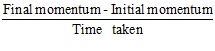
= 
By Newton’s second law, the rate of change of momentum is proportional to the applied force and hence, F a

Þ F a
 But
But  = a
= a
\ F a ma
Introducing a constant to change the sign of proportionality to equal sign, we have:
F = Constant x ma
If m = 1 kg and a = 1 ms-2, the value of the unit of force is chosen so as to make F = 1. This implies that the value of the constant = 1.
The SI unit of force is called the Newton (symbol, N) and is defined as:
The force which produces an acceleration of 1 ms-2 when it acts on a mass of 1 kg.
Or A force which give 1 kg mass an acceleration of 1m ms-2.
Thus, when F is in Newton, m in kilograms and a in metres per second squared, we have
F = ma
Worked Examples
1. A force 3 N acts on a body of mass 5 kg. Find the acceleration produced.
Solution: Mass = 5 kg, F = 3 N, a =? F = ma Þ a =  =
=  = 0.6 ms-2
2. Find the force acting on a body of mass 12 kg and making it to produce an
acceleration of 6 ms-2.
Solution m = 12 kg, F = ?, a = 6 ms-2 F = ma = 12 x 6 = 72 N
12.13 Newton’s Third Law of Motion
Newton’s third law of motion states that:
To every action there is an equal and opposite reaction.
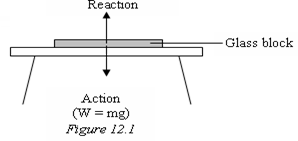 For example, a glass block placed on a table, exerts a force equal to its weight on to the
table top. This force is called action. At the same time the table top exerts an equal force on to the glass block in the opposite direction. This force acting in the opposite direction is called reaction.
Notes: – Action = Reaction
– Action and reaction react on different bodies.
–
The two forces are in opposite directions.
– The net resultant force on the glass block is zero
Examples of Newton’s third law include:
(i) A man jumping from a boat
A man jumping from a boat exerts action force on the boat and the boat exerts a
reaction force. As he jumps to the river bank, the boat moves backwards.
(ii) Propulsion of a bullet from a gun
When a bullet is fired from a gun, the energy of the explosion of the charge in the
cartridge acts on both the bullet and the gun, thus producing equal and opposite
forces acting on them. These equal forces act for the same time i.e the time taken by
the bullet to travel up the barrel of the gum. The time effect of a force is called
impulse thus the bullet and the gun are given equal and opposite impulses. In each
case, the impulse is equal to the change in momentum.
To show that Impulse is equal to momentum change of a body
Applying F = ma and substituting a =  in it we have,
= 
= 
Ft = mv – mu
The product Ft is called impulse, p, and is equal to the change in momentum.
I.e. Impulse of a force on a body = Change in momentum of a body
As the gun and the bullet were initially at rest, their initial momenta were both zero, hence the final momentum in each case is the change in momentum. Since their impulses were equal and opposite, their momenta will be equal and opposite.
The bullet leaves the gun barrel with a muzzle velocity and the gun kicks or reacts in the
opposite with a velocity called recoil velocity.
Thus; Mass of bullet x Muzzle velocity = Mass of gun x recoil velocity
Since the two velocities (muzzle and recoil velocities) and the two momenta are vector
quantities and are acting in opposite directions, their sum is zero.
The above observation illustrates an important principle called the principle of
conservation of momentum.
Worked Example
1. A car of mass 5000 kg initially moving at a velocity of 50 m/s accelerates to 100m/s in
2 seconds. Calculate the engine force on the car that caused the velocity change.
Solution: Mass of the car = 50 000 kg,
Initial velocity, u = 50 m/s, Final velocity, v = 100 m/s, Time, t = 2 s, F = ?
Hint:
– Think of a formula of force in this topic.
– See if your data has all the quantities in it.
– If one quantity is missing in the formula, check if the information in the data can
help you to calculate it.
– If yes, solve for the quantity first and then substitute in the formula to get F.
We use the formula F = ma
From the data the values of u, v and t can used to solve for ‘a’. Now let us solve for ‘a‘.
Using the formula v = u + at
a =  =
=  = 25 ms-2
Now we can now apply the formula the formula
F = ma = 50,000 x 25 = 1 250 000 = 1.25 x 10⁶ N
12.2 The Principle of Conservation of Momentum
The principle of conservation of momentum states that:
When two or more bodies act on one another, their total momentum remains constant, provided no external forces act on the colliding bodies.
Or The total linear momentum of a system of interacting bodies, on which no external forces are acting, remains constant.
For example, if two bodies of masses m1 and m2, initially moving with velocities u1 and u2 respectively collide, and after the collision their velocities change to v1 and v2, then by the principle of conservation of momentum,
The Sum of the Initial Momenta = The Sum of the Final momenta
m1u1 + m2u2 = m1v1 + m2v2
(a) Collisions
Whenever two or more bodies collide, their total momentum is conserved unless there are external forces acting on them. However, the total kinetic energy usually decreases. This is because some of the kinetic energy is converted by the impact to other forms of energy such as: heat, sound, and light or permanently distorts the bodies leaving them with an increased amount of potential energy. The total kinetic energy of the colliding system before and after impact determines the type of collision.
(b) Types of collision
There are three types of collision, namely:
– Elastic collision,
– Inelastic collision and
– Completely inelastic collision.
(i) Elastic collision
Elastic collision
is the type of collision in which there is no loss of kinetic energy. I.e. the total kinetic energy remains the same.
(ii) Inelastic collision
Inelastic collision is one in which there is loss of kinetic energy. I.e. the total kinetic energy after collision becomes less than the kinetic energy before collision.
(iii) Completely inelastic collision
Completely inelastic collision is one in which the colliding bodies stick
together on impact and move as a single body.
Notes: Using these types of collisions, the principle of conservation of momentum can be investigated.
12.1 Experiments
Experiment 12.1 To investigate the Conservation of Momentum for colliding bodies moving in the same direction.
Inelastic collision of a moving body with one at rest
Apparatus/requirements
2 trolleys, a stout pin, a cork., a ticker timer with a ticker tape, standard masses and a run way.
Procedure: – Fit trolley 1 with a stout pin and the other with a cork.
- Load trolley 1 with standard masses and weigh them.
- Attach a ticker tape passing through a ticker timer to trolley 1.
- Place the trolleys on a run way as shown in figure below.
- Give a push to trolley 1 so that it moves forward with a uniform velocity u1 and collides with trolley 2 which is at rest.

Observation:
The stout pin on trolley 1 penetrates the cork on trolley 2 and the two trolleys stick together and move on as a single body, with a common velocity v.
The ticker tape has two successive sets of equally spaced dots from which the velocities u
and v are calculated.
Both trolleys after collision Trolley 1 before collision
Gives common velocity, v Gives initial velocity, u1 of
trolley 1

Figure 12 3
Calculation:
Mass of trolley 1 = m1
kg
Mass of trolley 2 = m2
kg
Initial velocity of trolley 1 = u1
ms-1
Initial velocity of trolley 2 = u2
ms-1
= 0 (at rest)
Final velocity of both trolleys = v (common velocity since they stick together)
Total momentum before collision = m1u1
+ m2u2
= m1u1
+ m20
= m1u1
kg ms-1
Total momentum after collision = Total mass x common velocity
= (m1 + m2) v kg ms-1
If, Momentum before collision = Momentum after collision
I.e. m1u1 = (m1
+m2)v,
Then law of conservation of momentum is verified.
Experiment 12.2 Partially elastic collision of a moving body with one at rest
Apparatus/requirements
2 trolleys, a spring buffer, 2 ticker timers with a ticker tapes, standard masses and
a run way.
Procedure
- Fit trolley 1 with a spring buffer.
- Load trolley 1 with standard masses and then weigh both trolleys.
- Attach each trolley to a tape passing through a ticker timer.
- Place the trolleys on a run way as shown in figure below.
- Give a push to trolley 1 so that it moves forward with a uniform velocity u1 and collides with trolley 2 which is at rest.

Observation:
On collision, trolley 1 is slowed up while trolley 2 moved forward with a greater velocity.

Calculation: Mass of trolley 1 = m1
kg
Mass of trolley 2 = m2
kg
Initial velocity of trolley 1 = u1
ms-1
Initial velocity of trolley 2 = u2
ms-1
= 0 (at rest)
Final velocity of trolley 1 = u1
ms-1
Final velocity of trolley 2 = v2
ms-1
Total momentum before collision = m1u1
+ m2u2
= m1u1 + m20
= m1u1 kg ms-1
Total momentum after collision = m1v1
+ m2v2
Conclusion: Momentum before collision = Momentum after collision
I.e. m1u1 = m1v1
+ m2v2
Then
law of conservation of momentum is verified.
Experiment 12.3 Gun and projectile experiment
Apparatus: 2 trolleys, 2 ticker timers with a ticker tapes, standard masses and a run way.
Procedure
- Load trolley 1 with standard masses and then weigh both trolleys.
- Push in the horizontal metal rod in trolley 1 (the “gun”) against a spring held in place by a metal plate.
- Attach each trolley to a tape passing through a ticker timer.
- Place the trolleys on a level run way so that they are in contact as shown in figure
below.
- Releases the top trigger on the “gun” to fire the projectile.

Observation:
On releasing the trigger, the projectile (lighter trolley) moved forward and the heavy
trolley, the gun, moved backwards.
Note: The total momentum before and after collision is both zero.
Reason: Momentum is a vector quantity. Since the momenta are equal and opposite, then their sum equal to zero.
Calculation:
We represent distances and velocities to the right by a positive sign.
Let: The velocity of the gun = -vg (velocity in the opposite direction)
The velocity of the projectile = vp
Momentum of the gun after firing = mg x –vg
= -(mgvg) kg ms-1
Momentum of the projectile after firing = mpvp kg ms-1
The total momentum after firing = mpvp + – mgvg
= (mpvp – mgvg) kg ms-1
The total momentum before firing = 0 (Both bodies initially were at rest )
By the law of Conservation of momentum,
Momentum before collision = Momentum after collision
0 = mpvp – mgvg
mgvg = mpvp
Worked Examples
1. Two trolleys of masses 8 kg and 5 kg are traveling on the same truck with speeds 4 ms-1
and 2 ms-1
respectively in the same direction. They collided and coupled together.
(i) State the type of the collision.
(ii) Calculate the common velocity after collision.
Solution: (i) Inelastic collision
(ii) m1
= 8 kg, u1
= 4 ms-1, m2
= 5 kg, u2
= 2 ms-1
Total mass = m1
+ m2
= 8 + 5 = 13 kg,
Common velocity = v ms-1
Total momentum before collision = m1u1
+ m2u2
kg ms-1
Total momentum after collision = (m1
+ m2)v2
kg ms-1
Applying the principle of conservation of momentum,
Momentum before collision = momentum after collision
m1u1
+ m2u2 = (m1
+ m2)v
8 x 4 + 5 x 2 = (8 + 5) x v
32 + 10 = 13 v
42 = 13 v
v = 
\ v = 3.2 ms-1
2. A bullet of mass 6 g is fired from a gun of mass 500 g. If the muzzle velocity of the bullet is 300 ms-1, calculate the recoil velocity of the gun.
Solution: Let: Mass of the gun = mg = 500g =  kg
kg
Mass of bullet = mb = 6 g =  kg
kg
Velocity of gun before explosion = ug = 0
Velocity of the bullet before explosion = ub = 0
Velocity of gun after explosion = vg =?
Velocity of the bullet after explosion = vb = 300 ms-1
Applying the principle of conservation of momentum,
Momentum before firing = Momentum after firing
m1u1
+ m2u2 = m1v1
+ m2v2
mbub + mgug = mbvb
+ mgvg
0.006 x 0 + 0.5 x 0 = 0.006 x 300 + 0.5vg
0 = 1.8 + 0.5 vg
0.5 vg = 1.8
vg = -3.6 ms-1
Since velocity is a vector quantity, the minus sign indicates that the bodies move to the left (i.e. in the original direction of body B) after collision.
Therefore, the gun kicks backwards with a velocity of 3.6 ms-1
Note: To get the same answer but positive at once, we take the velocity of the gun to be
negative in the data and then substitute in the same formula as shown below.
Mass, mg, of the gun =  kg, Mass, mb, of bullet =
  kg
kg
Initial velocity, ug, of gun before firing = 0
Initial velocity, ub, of the bullet before firing = 0
Final velocity, vg, of gun after firing = ?
Final velocity, vb, of the bullet after firing = 300 ms-1
Since velocity is a vector quantity, we take the velocity of the bullet to be positive and that of the gun to be negative.
Then apply the principle of Conservation of momentum, we have;
Momentum before firing = Momentum after firing
m1u1
+ m2u2 = m1v1
+ m2v2
mbub + mgug = mbvb
+ mgvg
0.006 x 0 + 0.5 x 0 = 0.006 x 300 + 0.5 x –vg
0 = 1.8 – 0.5 vg
0.5 vg = 1.8
\ vg = 3.6 ms-1
Note: – The detailed working is to make you understand the application of the concept
of solving the problem the first principle.
– After understanding the concept, use the shortest method.
3. A gun of mass 5 kg fires a bullet of mass 50 g at a speed of 500 ms-1. Calculate the recoil velocity of the gun.
Solution: Mass of the gun, mg = 5 kg, Mass of bullet, mb
= 50 g =  kg
kg
Initial velocity, ug, of the gun = 0
Initial velocity, ub, of the bullet = 0
Final velocity, vg, of gun =?
Final velocity, vb, of the bullet = 500 ms-1
We take the direction of the bullet to be positive and that of gun to be negative.
Then we can solve the problem by using any one of the following methods.
Method I Using the first principle
We substitute the values in the data in the formula of the principle of conservation of
momentum.
Momentum before firing = Momentum after firing
m1u1
+ m2u2 = m1v1
+ m2v2
mbub + mgug = mbvb
+ mgvg
0.05 x 0 + 5 x 0 = 0.05 x 500 + 5–vg
0 = 25 + 5 –vg
5 vg = 25
vg =
\ vg = 5 ms-1
Method II Using the derived formula for gun and propectile
We substitute the values in the data in the formula:
mgvg = mbvb
5 x vg = 0.05 x 500
vg = 
= 5 ms-1
12.21 Applications of the principle of Conservation of momentum
The principle of conservation of momentum is applied in:
(i) Rocket propulsion
(ii) Jet engine
(a) Rocket propulsion
A space rocket carries tanks of liquid fuel and liquid oxygen and some chemicals which
react to produce oxygen to enable the fuel to burn.
When the fuel burns inside the rocket engine, it crates a large force which propels a blast of hot gaseous products of the combustion out through the tail nozzle with very high velocity.
By Newton’s third law of motion, the reaction to this force propels the rocket forward.
Note that although the mass of the gas emitted per second is very small, it has a very large momentum on account of its high velocity. An equal momentum is imparted on to the rocket in the opposite direction, so that in spite of its large mass, it also builds up a high velocity.
(b) Jet engine
A jet engine (used on air crafts) operates on the same principle as rocket propulsion. As the air craft does not leave the earth’s atmosphere, oxygen supply is from the air.
The fuel burns to form large quantities of gaseous products. As the blast of hot gas
molecules (burnt fuel and excess air or oxygen) is thrown out from the combustion
chamber) through the exhaust pipe with high momentum, the jet intern, acquires an equal momentum but in the opposite direction enabling it to move forward.
Self-Check 12.0
1. When a car is suddenly brought to rest, a passenger jerks forward because of
A. inertia B. friction C. gravity D. momentum
2. A boxer while training noticed that a punch bag is difficult to set in motion and difficult to stop. What property accounts for this observation?
A. Size. B. Inertia. C. Friction. D. Weight of the bag.
3. Eggs packed in a soft, shock-absorbing box are placed in a car. When the car suddenly
starts or stops moving, the eggs do not crack because
A. no force acts on them
B. the force acts on them for only a short time
C. the force is small and acts for a longer time
D. the force causes fast change of momentum.
4. A body of mass 20 kg moves with a uniform velocity of 4 m/s from rest. Find its
momentum.
A. 5 kg m/s B. 80 kg m/s C. 160 kg m/s D. 320 kg m/s
5. An object of mass 2 kg moving at 5 ms-1, collides with another object of mass 3 kg which is at rest. Find the velocity of the two bodies if they stick together after collision
A. 1.0 ms-1 B. 2.0 ms-1 C. 2.5 ms-1 D. 5.0 ms-1
6. A bullet of mass 0.1 kg is fired from a rifle of mass 5 kg. The rifle recoils at a velocity of
16 ms-1. Calculate the velocity with which the bullet is fired
A. 66 ms-1 B. 110 ms-1 C. 210 ms-1 D. 800 ms-1
7. A body of mass 20 kg moves with a uniform velocity of 4 m/s from rest. Find its
momentum.
A. 5kgm/s B.80 C.160 D. 320
8. When a person steps forward from rest, one foot pushes backwards on the ground. The
ground will as a result push that foot
A. backwards with an equal force B. forwards with an equal force
C. backwards with a smaller force D. forwards with a smaller force
9. If the forces acting on a moving body cancel each other out (i.e. are in equilibrium) the
body will
A. Move in straight line to the steady speed B. Slow down to a steady slower speed
C. Speed up a steady faster speed D. Be brought to a state of rest.
10. A body of mass 20 kg, moving with uniform acceleration, has an initial momentum of 200kg m/s and after 10s, the momentum is 300 kg m/s. What is the acceleration of the body.
A. 0.5 m/s2 B. 5 m/s2 C. 25 m/s2 D. 50 m/s2
SECTION B
1. (a) State Newton’s laws of motion.
(b) Define: (i) Inertia of a body (ii) Momentum.
(d) Explain why a passenger standing on the floor of a lorry jerks backwards when the
lorry starts moving forwards.
(e) A 7-tonne initially moving at a velocity of 50m/s accelerates to 80m/s in 3 seconds.
Calculate the force on the truck that caused the velocity change.
2. (a) (i) What is meant by linear momentum?
(ii) State the law of conservation of linear momentum.
(b) A bullet of mass 20g is fired into a block of wood of mass 400g lying on a smooth
horizontal surface. If the bullet and the wood move together with the speed of 20ms-1, calculate.
(i) The speed with which the bullet hits the wood, (ii) The kinetic energy lost.
(c) State the energy changes involved in (b) above.
3. (a) State the law of conservation of linear momentum.
(b) A water jet directed to a spot on the ground digs a hole in the ground after sometime. Explain.
(c) A moving ball P of mass 100g collides with a stationary ball Q of mass 200g. After
collision, P moves backwards with a velocity of 2ms-1 while Q moves forwards
with a velocity of 5ms-1. Calculate
(i) The initial velocity of P.
(ii) The force exerted by P on Q if the collision took 0.03s.
(d) Explain the principal of operation of a rocket engine
4. A sphere of mass 3 kg moving with velocity 4m/s collides head on with a stationary sphere of mass 2kg & imparts to it a velocity of 4.5 m/s. Calculate the velocity of the 3kg sphere after the collision.
5. A railway tracks of mass 4×10⁴ kg moving at a velocity of 3m/s collides with another truck of mass 2 x10⁴ kg which is at rest. The couplings join & the trucks move off together.
(a) State the type of collision.
(b) Calculate the common velocity after collision.


