

BIOLOGY PRACTICAL QUESTIONS – NYAMIRA DISTRICT
Each Candidate should be provided with the following:-
REQUIREMENT
- 2 Boiling tubes
- 2 test tubes
- Test tube rack
- Means of heating
- 1% copper sulphate solution
- 2M sodium hydroxide solution
- Iodine solution
- Mortar and pestle
- Scalpel
- 20% Hydrogen peroxide solution
- Fresh potato
- Droppers
- 100ml beaker
Schools should also have ordinary laboratory apparatus in addition to those listed above
1. You have been provided with specimen Q which is a fresh potato, liquid R (Hydrogen peroxide
and reagents 1% copper sulphate, 2M sodium hydroxide and iodine solution. Use them to carry
out the tests below:
- Using a scalpel, cut two small cubes measuring 1cm x1cm from the fresh potato. Place one
of the cubes in boiling water for 10minutes,then remove the cube and let it cool. Place it in
a boiling tube and label it A.
Place the fresh piece of potato cube in another boiling tube labelled B and then add equal
amounts of hydrogen peroxide to each test tube at the same time. Write your observations.
Observations:
(a) (i) Boiling tube A
(ii) Boiling tube B
(b) Explain your observations in (i) and (ii) above
(c) Crush a small piece of the remaining potato in a motar. Add a little amount of distilled water
to make a mixture. Use it to carry out food tests below:
2. X and Y are specimens obtained from plants. Study them carefully and then use them to answer
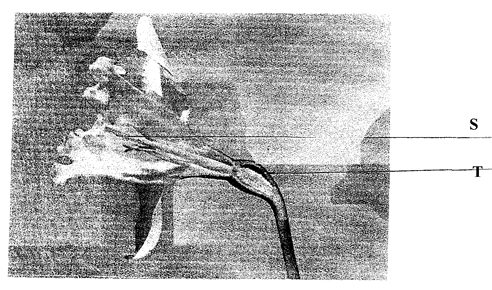 questions that follow:-
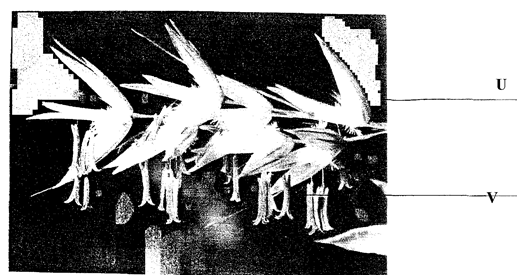
(a) Label the parts:-
S………………………………………… T………………………………………………………………….
U………………………………………………. V…………………………………………………………
(b) State with reasons the mode of pollination for specimen
X
Y:
(c) Name the part of specimen X that develops into a fruit
3. You are provided with photographs of animals which belong to the same phylum. Study the
photographs and the dichotomous key below to enable you identify the taxonomic group to
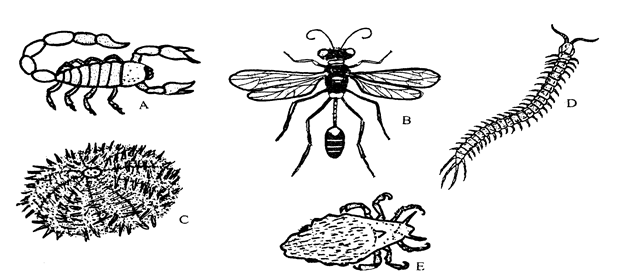 which each animal belongs:-
1. (a) Jointed legs present ……………………Go to 2
(b) Jointed legs absent ……………………Go to 7
2. (a) Three pairs of legs …………………….Go to 3
(b) More than three pairs of legs ……….go to 5
3. (a) Wings present …………………………Go to 4
(b) Wings absent…………………………..Anoplura
4. (a) One pair of wings ………………………Diptera
(b) Two pairs of wings ……………………..Hymenoptera
5. (a) Four pairs of legs ……………………….Arachnida
(b) More than ten pairs of legs…………….Go to 6
6. (a) One pair of legs in each body segment………Chilopoda
(b) Two pairs of legs in each body segment……….Diplopoda
7. (a) Body partially closed in a shell ………………Mollusca
(b) Body surface has spiny projections …….Echinodermata
(a) Using the key, identify organisms A to E giving the sequence of steps followed to arrive at the
identity of each organism
(b) (i) Using observable features only, state the phylum to which the organisms on the
photograph belong:
(ii) State one observable feature that enables you to arrive at the answer in (b) (i) above
NYAMIRA DISTRICT BIOLOGY PRACTICAL MARKING SCHEME (ANSWERS)
(b) (i) In boiled potato cube, enzyme catalase is denatured hence no reaction when
(ii) Fresh potato cube had an enzyme catalase which broke/decomposed hydrogen
peroxide to water and oxygen, hence production of gas.
(c)
Food substance | Procedure | Observation | Conclusion |
Starch | To fold substance add iodine solution | Blue colour formed | Starch present |
Proteins | To food substance as sodium hydroxide and copper II sulphate solution | Light green mixture | Proteins absent |
- (a) S – Style T – Ovary
U – Anthens V – Petal
(b) X – Mode- Insect
Reasons – Brightly coloured to attract insects.
Anthers inside the flower to be reached by pollinating agent. Stigma is above the anthers to pick pollen from the incoming pollinating agent
Y- Mode –wind
Reasons:- Long anthers exposes outside the flower to be easily reached by the
flower for pollen grain to be easily blown by wind.
- (a)
Organism | Steps followed | Identify |
A | 1a, 2b, 5a | Arachnida |
B | 1a, 2a, 3a, 4b | Hymenoptera |
C | 1a, 7b | Echinodermata |
D | 1a, 2b, 5b, 6a | Chilopoda |
E | 1a, 2a, 3b | Anaplura |
(b) (i) Arthropoda
(ii) Segmented body


