

BIOLOGY PRACTICAL QUESTIONS – KAKAMEGA EAST DISTRICT
Each candidate requires the following:-
- One large ripe tomato labelled D1
- One ripe orange/lemon fruit labelled D2
- 5ml DCPIP (1g of DCPIP dissolved in 1000cm3 of distilled water)
- Four clean test tubes
- Three droppers
- Scalpel blade
1. Study the diagrams M, N, O, P and Q below representing organisms in the environment and
use them  to answer the following questions:-


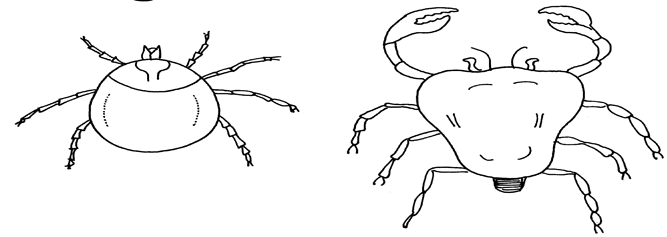




(a) With the reasons, identify the phylum to which they belong:-
(b) Identify the classes of the following organisms:-
M ………………………………………………. N ……………………………………………….
O ………………………………………….. P ………………………………………………
Q …………………………………………..
(c) Give two reasons for identifying the classes of organisms M and P
(d) What is the economic importance of the class to which M belongs?
2. You are provided with specimen D1. Make a vertical (longitudinal section through it to obtain
two equal halves)
(a) (i) Draw and label one half of D1
(ii) Calculate the magnification of your drawing (show your working)
(iii) With reasons, identify the type of fruit D1
(b) Squeeze juice from D1, into a beaker. Label two test tubes A and B. In each test tube
put 1cm3 of DCPIP
(i) To test tube A add the juice
drop by drop shaking well after each drop. Record the number
of drops required to decolourize DCPIP in the table below.
TEST TUBE | No. of drops required to decolourize DCPIP |
A | |
B |
(ii) Identify the food substance being tested
(iii) Which of he specimens P1
and P2 has high of the food substance being tested above?
(iv) What is the value of the food substance above to a growing baby?
(c) Boil the remaining juice extracted from D1 in the boiling tube for one minute and cool it.
Using a dropper, add the boiled juice into another test tube labelled B. Containing 1cm3
of DCPIP. Record the number of drops required to decolourize the DCPIP in the table above.
What is the effect of boiling the juice?
3. The diagram below represents a cross-section of a plant stem. Study it carefully and answer the

 questions that follow:-
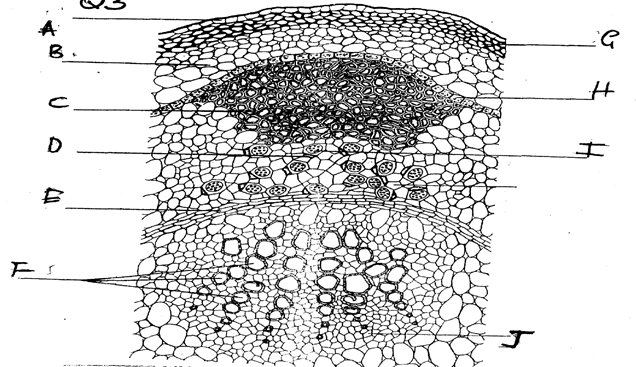


(a) Identify letters that represent tissues responsible for support and name the tissues
(b) State two ways in which the tissues named in (a) above offer support
(c) (i) Identify the part labelled H ………………………………………………………………………………..
(ii) What is the role of this part?
(d) (i) If the plant from which the section had been obtained was placed in water containing
eosin dye, which part would you expect to be stained with the dye?
(ii) Name three forces which help water containing this dye (eosin) to pass through the
dyed tissue
(e) (i) Name the tissues labelled I …………………………………………………………………………………….
(ii) What is the name of the cell C seen adjacent to tissue I?
(iii) State the function of this cell C
KAKAMEGA EAST DISTRICT BIOLOGY PRACTICAL MARKING SCHEME (ANSWERS)
1. (a) (i) Arthropoda; (Rej. Antrhopoda/Arthropods)
(ii) Have segmented bodies;
- Have appendages;
- Have exoskeleton;
(b) M – Insecta; rej. Insects
N – insecta;
O – Arachnida; rej arachnids
P – Crustacea; rej. Crustacean
Q – Chilopoda;
(c) M – 3 pairs of limbs;
– body divided into three parts/head thorax and abdomen);
– Has a pair of wings;
P – Body divided into two parts/celaphalothorax, abdomen;
– Have carapace/hard outer shell);
– Have two pairs of antennae;
– Have a specialized limb for feeding/defence/chelicera; (any two marks)
(d) – Vectors of disease causing micro-organisms /pathogens;
– bee make honey;
– are pollinating agents;
– destroy timber e.g. termites
– Crop pests e.g. weevils
2. a (i)
(ii) Magnification = length of drawing
Length of image
x ½ upto x 1½
(iii) Berry – many seeds
– Endocarp fleshy/juicy; (any one)
(b) (i)
A | 40; |
B | Numerous Not decolourite DCPIP; |
(ii) Ascorbic acid/vitamin C;
(iii) Prevents scurvy/bleeding of gums hence weak teething
(c) Boiling vapourises the vitamins/vitamin C;
3. (a) U – scelerenchyma
F- xylem tissues;
D – phloem tissues;
AT- parenchyma tissue J
(b) D – carry substances hence remain turgid; to offer supper
F- are strengthened with lignin;
T- remain turgid to outer supper (any two)_
U – provide rigidity of the (2mks) stem;
(c) (i) H – Endodermis
(ii) Demarcates cortex from central cylinder;
(d) (i) F;
(ii) Root pressure;
Transpiration pull;
Capillarity/cohesion and adhesion; rej adhesive and cohesive
(e) (i) Phloem (tissue);
(ii) Companion cell;
(iii) has mitochondria which provide energy for translocation n the phloem;


