


BIOLOGY PAPER 231/2 K.C.S.E 2001
PRACTICAL MARKING SCHEME
1. You are provided with a portion of the onion bulb. Remove one fleshy leaf from the portion. Peel the epidermis from the inner surface of the leaf. Place it in a drop of water on a slide. Place a cover slip on the epidermis. Place one drop of iodine solution at one edge of the cover slip. Using a blotting paper drain of excess iodine solution and water from the opposite edge of the cover slip. Observe the epidermis under low power, then under medium power.
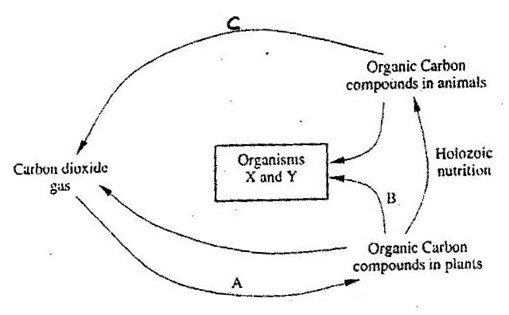 (a) Draw and label the two neighbouring cells
Accuracy:
- Outline continuous
- Cell elongated
- Double line
- Nucleus placed side
- No shading
- Mag x 20 x 25 x 40 x 50 x 60 x 75 x 100 x 150 x 225
(b) Why is the staining of the epidermis necessary?
- To make different part of the cell distinct
(c) Work out the length and the width of one cell as seen under medium power.
Diameter field of view = ( 1-2 mm)
= 1000(1-2) cm
Number of cells in the field of view = 10 – 20 across width
Width of one cell = 100 (1-2)
(10 – 20)
Length of one cell = 100(1-2)
(3-5)
Place a drop of liquid L at the edge of the cover slip. Drain the liquid form the opposite edge to allow it flow across the epidermis. Leave the set up for about five minutes. Observe under medium power.
o neighbouring cells
Account for the results in (d) above
Liquid is hypertonic (owwte) water is drawn out of the cell by osmosis
making the cytoplasm membrane shrink plasmolysed.
2. You are provided with specimen labelled M and N. examine them.
(a) Identify the specimens and state the organism from which they were obtained
Specimen Part Organism
M Gills/fish gills Fish
N Piece of lung mammal
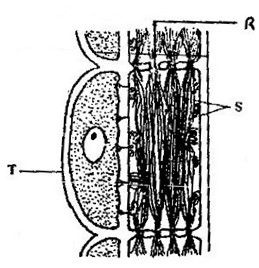 (b) Draw and label specimen M
Accuracy – continuous outline- three parts of gills drawn
No shading – Three parts gills drawn proportionality
(c) Using observable features only, explain how specimen M is adapted to its function
– Many/ numerous/ several gill filaments to increase surface area of gaseous exchange/ absorption of oxygen.
– Filament to reduce distance through which gas diffuse
– Gill bar to provide form of support or attachment of gill filament/ gill rakers
– Gill rakers prevent particles from reaching gill filament
– Long filaments increases surface area for gaseous
(d) State three distinguishing features of specimen N
Presence of bronchioles/ alveolar ducts/ pleural/ membrane, spongy/ air spaces
(e) State the functional relationship between specimens M and N
– Both for gaseous exchange
3. You are provided with specimens labelled P1, P2, P3, P4, P5 and P6. A dichotomous key shown below can be used to identify them.
1. (a) Leaves simple go to 2
(b) Leaves compound Cassia
2. (a) Leaves green go to 3
(b) Leaves purple Tradescantia
3. (a) Leaves parallel veined Zea
(b) Leaves net veined go to 4
4. (a) Leaf margin serrated go to 7
(b) Leaf margin smooth go to 5
5. (a) Leaves hairy Solanum
(b) Leaves not hairy go to 6
6. (a) Leaves ovate bouganviillea
(b) Leaves lanceolate Mangifera
7. (a) Leaves fleshy go to 8
(b) Leaves not fleshy Hibiscus
8. (a) Leaves with pointed tip Kalanchoe
(b) Leaves with rounded tip Bryophylum
(a) Use the dichotomous key to identify each of the plant specimens provided. In each case show the sequence the steps. (e.g 1a, 2b, 5b etc)
In the key that have followed t arrive at the identity of each specimen.
Specimen Steps Followed Identity
P1 1a, 2a, 3b, 4a, 7a, 7b Bryophylum
P2 1a, 2b Tradescantia
P3 1a, 2a, 3b, 4b, 5b, 6a Bougainvillea
P4 1a, 2a, 3b, 4b, 5b, 6b Mangifera
P5 1a, 2a, 3b, 4b, 5a Solanum
P6 1a, 2a, 3a Zea
(b) (i) Name the likely habitat of specimen P1
Arid/ semi arid/ desert/ dry areas/ dry land
(ii) Give a reason for your answer in (i) above
Fleshy/succulent/ (leaves) juicy/ thick cuticle
(c) State the significant of the shinny upper surface of specimen P4
– To reflect away sun rays
– To reduce transpiration/ water loss
(d) Observe the floral parts of specimen P3. What is the significance of the brightly coloured structures onto which the flowers are attached?
– To attract insects (pollination)
(e) Name two features that make specimen P5 adapted to its environment.
– Hairy (to reduce water loss)
– Presence of thorn/ spines/ spikes
(f) Name a feature that is used to classify P6 as monocotyledonous plant
– Parallel veins/ veins/ arrangements of veins
– Presence of sheath/ leaf sheath.


