


BIOLOGY PAPER 231/1 K.C.S.E 2003
SECTION A (20 MARKS)
Answer all the questions in this section in the spaces provided.
A process that occurs in plants is represented by the equation below.
 C6H12O6 → 2C2H5OH + 2CO2 + Energy
(Glucose) (Ethanol) (Carbon dioxide)
a) Name the process.
b) State the economic importance of the process named in (a) above.
 C6H12O6 → 2C2H5OH + 2CO2 + Energy
2. Name the phylum whose members possess a notochord.
3. How do the male gamete nuclei reach the ovule after pollen grains land on the stigma?
4. a) Name the bacteria found in root nodules of leguminous plants.
b) What is the role of the bacteria named in (a) above?
5. A bone obtained from a mammal is represented by the diagram below.
- Name the bone.
- Which bones articulate with the bone shown in the diagram at the notch?
Distinguish between analogous and homologous structures.
Analogous structures –
Homologous structures –
- The diagram below represents regions of a root tip.
- Name the two regions above X in ascending order.
- State the function of the part labeled X.
- State a function of the large intestine in humans.
Name the:
- Material that strengthens xylem tissue.
- Tissue that is removed when the bark of a dicotyledonous plant is ringed.
- How are leaves of submerged adapted plants suited for photosynthesis?
- Name the causative agent of typhoid.
SECTION B (40 MARKS)
Answer all the questions in this section in the spaces provided.
a) What is meant by the term sex-linkage?
b) Name two sex-linked traits in humans.
c) In Drosophila melanogaster, the inheritance of eye colour is sex-linked. The gene for red eye is dominant. A cross was made between a homozygous red-eyed female and a white-eyed male. Work out the phenotypic ratio of the F1 generation. (Use R to represent the gene for red eyes).
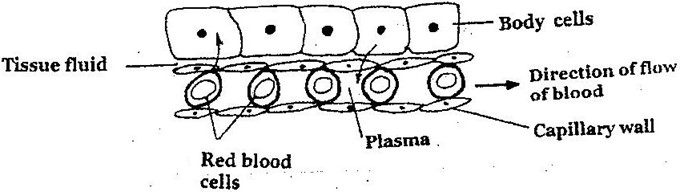
13. The diagram below shows gaseous exchange in tissues.
a) Name the gas that diffuses:
i) To the body cells
ii) From the body cells
b) Which compound dissociates to release the gas named in (a)(i) above?
c) i) What is tissue fluid?
ii) What is the importance of tissue fluid?
d) Name the blood vessel with the highest concentration of:
i) Glucose
ii) Carbon dioxide
14. a) Explain how marine fish regulate their osmotic pressure.
b) Explain the role of antidiuretic hormone when there is excess water in the human body.
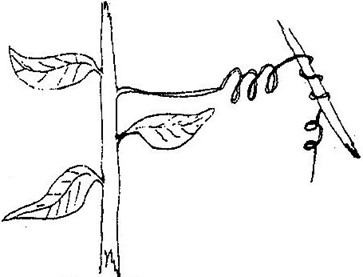
15. A response exhibited by a certain plant tendril is illustrated below.
a) i) Name the type of response.
ii) Explain how the response named in (a)(i) above occurs.
b) What is the importance of tactic responses to microscopic plants?
c) State four applications of plant hormones in agriculture.
16. a) What is meant by:
i) Autecology
ii) Synecology?
b) The number and distribution of stomata on three different leaves are shown in the table below:
| Leaf | Number of stomata | |
|---|---|---|
| Upper epidermis | Lower epidermis | |
| A | 300 | |
| B | 150 | |
| C | 02 | |
Suggest the possible habitat of the plants from which the leaves were obtained.
Leaf Habitat
A
B
C
(c) State the modifications found in the stomata of leaf C.
SECTION C (40 MARKS)
Answer question 17 (compulsory) in the spaces provided and either question 18 or 19 in the spaces provided after question 19.
17. Some students used a model to demonstrate the effect of sweating on human body temperature. Two boiling tubes A and B were filled with hot water. The temperature of water in the tubes was taken at the start of the experiment and then at 5-minute intervals. The surface of tube A was continuously wiped with a piece of cotton wool soaked in methylated spirit. The results obtained are shown in the table below.
| Time (minutes) | Temperature 0C in tubes | |
|---|---|---|
| A | B | |
| 0 | 80 | 80 |
| 5 | 54 | 67 |
| 10 | 40 | 59 |
| 15 | 29 | 52 |
| 20 | 21 | 47 |
| 25 | 18 | 46 |
a) On the same axes, plot graphs of temperature of water in the tubes against time.
b) At what rate was the water cooling in tube A?
c) Why was tube B included in the setup?
d) Account for the rate of cooling in tube A.
e) State two processes of heat loss in tube B.
f) What would be the expected results if tube A was insulated?
g) What would the insulation be comparable to in:
i) Bird
ii) Mammals?
h) Name the structures in the human body that detect:
i) External temperature changes
ii) Internal temperature changes
18. Describe the functions of the various parts of the human eye.
19. Describe how fruits and seeds are suited to their modes of dispersal.


