

BIOLOGY PAPER 231/1 K.C.S.E 1997
QUESTIONS
Answer all the questions in this section in the spaces provided
- State the functions of the following cell organelles:
- Golgi apparatus
- Ribosomes
- A student caught an animal which had the following characteristics:
Body divided into two parts
Simple eyes
Eight legs
The animal belongs to the class
- What are the three end products of anaerobic respiration in plants?
- State two ways in which xylem vessels are adapted to their function.
- In an accident, a victim suffered brain injury. Consequently, he had loss of memory. Which part of the brain was damaged?
- Oil can be applied on stagnant water to control the spread of malaria.
- How does this practice control the spread of malaria?
- Give a reason why this practice should be discouraged.
- State three structural differences between biceps muscles and gut muscles.
| Biceps | Gut Muscles |
|---|---|
| Striated | Unstriated |
| Multinucleated | Uninucleated |
| Long fibres | Short fibres |
| Cylindrical | Spindle shaped |
- A person was found to pass out large volumes of dilute urine frequently.
Name the:
- Disease the person was suffering from
- Hormone that was deficient
- State three pieces of evidence that support the theory of evolution.
- Name a disease caused by lack of each of the following in human diet:
Vitamin D
Iodine
SECTION B (40 MARKS)
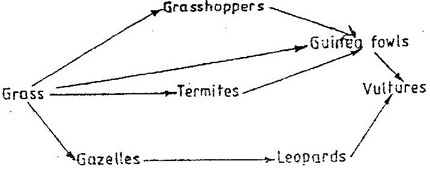
- The following represents a feeding relationship in an ecosystem:

- Write down the food chains in which the guinea fowls are secondary consumers.
- What would be the short term effects on the ecosystem if lions invaded the area?
- Name the organism through which energy from the sun enters the food web.
- A person was able to read a book clearly at arm’s length but not at normal reading distance.
- State the defect the person suffered from.
- Why was he unable to read the book clearly at normal distance?
- How can the defect be corrected?
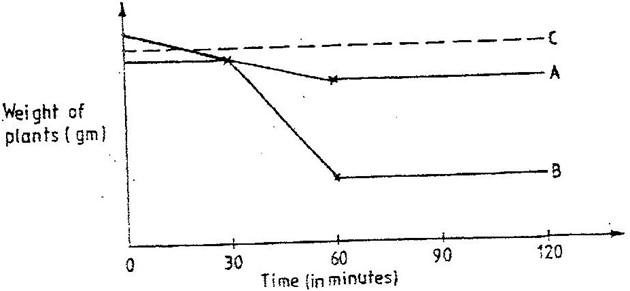
- An experiment was carried out to determine the rate of transpiration in three plants A, B, and C. Plants A and B belonged to different species while plants B and C belonged to the same species. Plant C had all its leaves removed. The three plants were of similar size and were exposed to the same environmental conditions.
The results are shown in the graphs below:
- Suggest possible environmental conditions under which the experiment was carried out between 30 and 60 minutes.
- Account for the results obtained for plant C.
- Suggest the habitat for plant A and B. Give reasons for your answer.
Habitat for plant A
Habitat for plant B
- The diagram below represents a simplified nitrogen cycle.
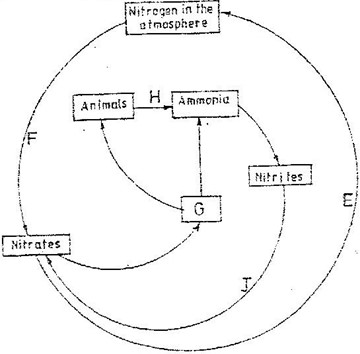
- Name the organisms that cause processes E and J.
- Name the processes represented by F and H.
- Name the group of organisms represented by G.
- The equation below represents a metabolic process that occurs in the mammalian liver:
Amino acids → Organic compounds + urea
- Name the process.
- What is the importance of the process to the mammal?
- What is the source of amino acids in this process?
- What is the difference between essential and nonessential amino acids?
- In a breeding experiment, plants with red flowers were crossed. The produced 123 plants with red flowers and 41 with white flowers.
(a) Identify the recessive character and give a reason.
(b) What was the genotype of the parent plants that gave rise to the plants with red and white flowers?
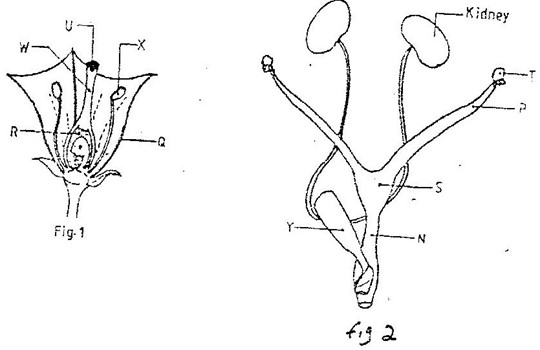
- Which letters in figures 1 and 2 represent the organs that produce female gametes?
Figure 1
Figure 2
- What is the function of the structure labeled S?
- Name the structure labeled W.
- Which letters in figures 1 and 2 represent the structures where fertilization takes place?
- Which letter in figure 1 represents the structure where male gametes are produced?
SECTION C (40 marks)
- An experiment was carried out to determine the growth rates of bamboo and a variety of maize plants in two adjacent plots. The average height and average dry weight of plants from the two populations were determined over a period of twenty weeks. The data is as shown in the table below.
| Age in weeks | Bamboo Average height (Metres) | Bamboo Average weight (Grams) | Maize Average height (Metres) | Maize Average weight (Grams) |
|---|---|---|---|---|
| 2 | 1.35 | 20.3 | 4.40 | 18.5 |
| 4 | 0.85 | 7.8 | 12.16 | 21.27 |
| 10 | 13.98 | 11.71 | 21.41 | 57.1 |
| 14 | 31.02 | 52.17 | 41.41 | 22.18 |
| 18 | 14.61 | 27.21 | 26.14 | 29.22 |
| 20 | 14.61 | 29.22 | 19.08 |
- Between which two weeks did the greatest increase in weight occur in:
- Bamboo plants
- Maize plants
(i) Which of the two types of plants had a higher productivity by the end of the experiment?
(ii) Give a reason for your answer in (i) above.
- Between weeks 14 and 18, the average height of the maize plants remained constant while average dry weight increased. Explain this observation.
- Suggest how the change in the average dry weight of bamboo and maize plants would have been at week 22 if the experiment was continued.
- Why was it appropriate for this experiment to use:
(i) Dry weight instead of fresh weight
(ii) Weight and height
- Describe how the average height and weight of the plants were determined in this experiment.
Average height
Average dry weight
- Give a reason why secondary thickening does not occur in bamboo and maize plants.
(a) What is parasitism?
(b) Describe how the tapeworm is adapted to a parasitic mode of life.
- (a) What is meant by the term digestion?
- (b) Describe how the mammalian small intestine is adapted to its function.


