

BIOLOGY PAPER 2
SECTION A (40 MARKS)
Answer all the questions in this section in the spaces provided
- When the offspring of purple and white flowered pea plants were crossed, they produced purple and white flowered plants in the ratio of 3: 1
Using letter H to represent the gene for purple colour
(a) State the genotype of:
(i) Parents ( 2 mks)
(ii) F1 Generation ( 1 mk)
(b) Work out the cross between plants in the F1 generation ( 4 mks)
(c) Account for the colour the flowers in plants of the F1 generation
( 1 mk)
- The diagram below represents the lower jaw of a mammal
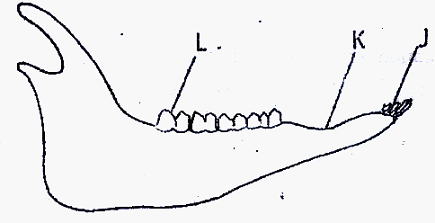
(a) Name the mode of nutrition of the mammal whose jaw is shown (1 mk)
(b) State one structural and one functional difference between the teeth labeled J and L
Structural ( 1 mk)
Functional ( 1 mk)
(c) (i) name the toothless gap labeled K. (1 mk)
(d) Name the substance that is responsible for hardening of teeth (1 mk)
- (a) what is meant by the term biological control ( 1 mk)
(i) Give an example of biological control ( 1 mk)
(b) (i) What is eutrophication? ( 3 mks)
(ii) What are the effects of eutrophication ( 3 mks)
(c) Name a substance that is responsible for acid rain ( 1 mk)
- (a) (i) Explain the changes that take place in the pupil and iris of a human eye when a person moves from a dark room to a room with bright light ( 3 mks)
(ii) What is the significance of the changes explained in (a) above (1 mk)
(b) How does the human eye obtain nutrients? ( 3 mks)
(c) Explain why images that form on the blind spot are not perceived ( 2 mks)
- (a) what happens when a wilting young plants is well watered ( 3 mks)
(b) Name a support tissue in plants thickened with
(i) Cellulose ( 1 mk)
(ii) Lignin ( 1 mk)
(c) Give three functions of pectoral and pelvic fins in a fish (3 mks)
SECTION B (40 MARKS)
Answer questions 6 (compulsory) and either question 7 or 8 in the spaces provided after questions 8
- An experiment was carried out to investigate the effect of temperature on the rate of reaction catalyzed by an enzyme. The results are shown in the table below
Temperature (0C) | Rate of reaction in mg of products per unit time |
5 10 15 20 25 30 35 40 45 50 55 60 | 0.2 0.5 0.8 1.1 1.5 2.1 3.0 3.7 3.4 2.8 2.1 1.1 |
On the grid provided draw a graph of rate of reaction against temperature
( 6 mks)
(b) When was the rate of reaction 2.6 mg of product per unit time? ( 2 mks)
(c) Account for the shape of the graph between
(i) 50 C and 400 C ( 2 mks)
(ii) 450 C and 600C ( 3 mks)
(d) Other than temperature name two ways in which the rate of reaction between 50C and 400C could be increased ( 2 mks)
(e) (i) Name one digestive enzymes in the human body which works best in acidic condition ( 1 mk)
(ii) How is the acidic condition for the enzyme named in (e) (i) above attained?
( 2 mks)
(f) The acidic conditions in (e) (ii) above is later neutralized
(i) Where does the neutralization take place?
(ii) Name the substance responsible for neutralization ( 1 mk)
- How are flowers adapted to wind and insect pollination? ( 20 mks)
- Describe the role of the liver in homeostasis in the human body ( 20 mks)


