


CELL STRUCTURE AND ORGANIZATION
The cell is the basic unit of life.
- All living things are composed of cells which carry out the processes that make the organism a living entity.
- All cells are basically the same in chemical composition. All life processes take place in the cells.
- Some organisms are made up of many cells and are called multicellular organisms, e.g., man, pine tree, locust. Others have one cell, e.g., Amoeba; they are called unicellular organisms.
- All cells are microscopic, membrane-bound, and have structures that are sites for chemical reactions called organelles.
- They have the ability to replicate since they contain genetic material. These are characteristics of cells.
TYPES OF CELLS
There are two basic types of cells:
- Prokaryotic cells
- Eukaryotic cells
Prokaryotic cells are found in organisms which do not have membrane-bound organelles; they do not have a nucleus.
Prokaryotes are mostly single-celled organisms such as bacteria and blue-green bacteria.
Eukaryotic cells are cells which have a membrane-bound nucleus. They contain specialized membrane-bound organelles.
Eukaryotic cells can be found in single-celled organisms such as Amoeba or in multicellular organisms.
ANIMAL AND PLANT CELLS
Both animals and plants differ in structure and function in order to meet the requirements of each organism.
Plant cell
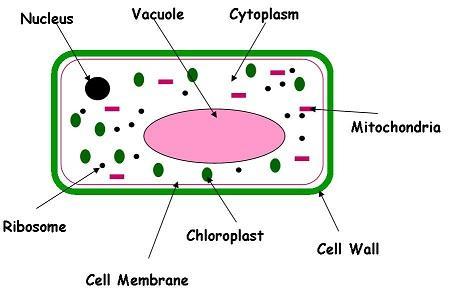
Animal cell

FUNCTION OF THE PARTS OF ANIMAL CELL
1. CELL MEMBRANE
- Also known as plasma membrane or plasma lemma.
- It is a thin layer that encloses the whole cell.
Function of cell membrane:
- Communicates with other cells.
- Allows selective movement of substances into and out of the cell. It is said to be selectively permeable or differentially permeable.
- Encloses the contents of the cell.
2. CYTOPLASM
This is a jelly-like substance made up of water and dissolved chemical substances. The cytoplasm is the site for many chemical reactions in the cell. Cell organelles such as vacuoles, nucleus, and mitochondria are suspended in the cytoplasm. The movement of cytoplasm is known as cytoplasmic streaming.
3. NUCLEUS
This is a round or oval organelle suspended in the cytoplasm. The nucleus is made up of the nucleolus and fluid called nucleoplasm. It is surrounded by a membrane called the nuclear membrane.
Functions of nucleus:
- Determines the chemical processes that take place in the cell.
- Controls the functions of all parts of the cell.
- Determines the cell size, shape, and function.
- Determines the hereditary characteristics of a cell.
4. MITOCHONDRION
The mitochondrion is the site for respiration, reactions which yield energy for the cell.
FUNCTION OF THE PARTS OF PLANT CELL
1. CELL WALL
- This is a strong covering made of cellulose.
- The cell wall is fully permeable. It allows the passage of water, minerals, and gases freely.
- Protects and gives the cell a definite shape.
2. CHLOROPLAST
- They are sites of photosynthesis.
- Contain green pigment called chlorophyll.
- Chlorophyll absorbs the light energy needed for photosynthesis.
3. VACUOLE
Vacuoles maintain a balance between water molecules and solute molecules in the cell. They contain color pigments, which give color to flowers.
The fluid inside the vacuole is known as cell sap.
4. MITOCHONDRIA
The mitochondria are the site for respiration, reactions which yield energy for the cell.
5. NUCLEUS
This is a round or oval organelle suspended in the cytoplasm. The nucleus is made up of the nucleolus and fluid called nucleoplasm. It is surrounded by a membrane called the nuclear membrane.
6. CYTOPLASM
This is a jelly-like substance made up of water and dissolved chemical substances. The cytoplasm is the site for many chemical reactions in the cell. Cell organelles such as vacuoles, nucleus, and mitochondria are suspended in the cytoplasm. The movement of cytoplasm is known as cytoplasmic streaming.
7. RIBOSOMES
This is the site of protein synthesis.
SIMILARITIES BETWEEN PLANT AND ANIMAL CELLS
- Both have a cell membrane.
- Both have cytoplasm.
- Both have a nucleus.
- Both have vacuoles, ribosomes, and mitochondria.
DIFFERENCES BETWEEN PLANT CELL AND ANIMAL CELL
| Plant cell | Animal cell |
| Has a cell wall | No cell wall |
| Has chloroplast | Lacks chloroplast |
| Has definite shape | Has no definite shape |
| Has a large permanent vacuole | Has small temporary vacuoles |
| Usually larger | Usually smaller |
| Stores oil, proteins, starch | Stores fats and glycogen |
CELL DIFFERENTIATION
- Cells have different functions and features that make them better suited to carry out these functions. This is called cell differentiation.
- Most living things are made up of many structurally and physiologically adapted different kinds of cells.
- These cells perform specific functions, and this is referred to as cell specialization.
- Cell differentiation refers to the way cells are adapted so that they can carry out functions efficiently.
TISSUE
A tissue is a group of similar cells performing the same function. Basically, there are two types of tissue:
Animal tissue e.g., epithelial tissue, muscular tissue, blood tissue, nerve tissue, skin tissue.
Plant tissue e.g., meristematic tissue, parenchyma tissue, collenchyma tissue, vascular tissue (xylem tissue, phloem tissue).
ORGAN
An organ is a functional unit formed by a group of specialized tissues.
Animal organs: heart, kidney, liver, brain, tongue, stomach.
Plant organs: roots, leaves, flowers, stem.
SYSTEM
A system is made up of organs that work together to perform a certain function.
Examples of systems are respiratory system, digestive system, reproductive system, hormonal system, skeletal system, blood circulatory system, and nervous system.
ORGANISM
An organism is an individual living entity, e.g., animal or plant.
An organism is made up of different systems working together; therefore, there is specialization.

IMPORTANCE OF CELL DIFFERENTIATION
Cell differentiation leads to division of labour.
Division of labour means each cell does a specific function. This helps the body to carry out all life processes at the same time and more efficiently.
To achieve this, cells must become specialized to carry out special functions.
Study more about specialized cells for different functions, e.g.:
- White blood cells (WBC) can change their shape to engulf and destroy harmful pathogens.
- Red blood cells (RBC) transport oxygen (they are biconcave and lack a nucleus).
- Sperm cells fertilize the female egg (have tails for swimming and pointed heads for easy penetration).
- Root hair cells absorb water and mineral salts (have extended portions that help increase surface area for absorption).
- Guard cells control the opening and closing of stomata (the inner wall is thicker than the outer).
- Palisade cells have irregular shapes to maximize light absorption.



15 Comments