


AGRICULTURAL ECONOMICS III (PRODUCTION ECONOMICS) QUESTIONS
This topic entails the following:
- Parameter of national development
- Factors of production
- Law of diminishing returns
- Farm planning and budgeting
- Agricultural services
- Risks and uncertainities
- How to adjust to risks and uncertainities.
The following relevant questions and their answers in this topic will greatly motivate and help the user to comprehend and understand the required concepts and practices:
1. State four ways of increasing labour efficiency on the farm
2. The table shows egg production from individual birds with varying mounts of layers mash
100 layers (Fixed number) | Layers mash Kgs/week | Total egg production per week | Marginal production per week |
100 | 0 | 140 | 0 |
100 | 10 | 155 | 15 |
100 | 20 | 180 | 25 |
100 | 30 | 240 | 60 |
100 | 40 | 340 | 100 |
100 | 50 | 470 | 130 |
(a) Sketch a graph representing the total egg production per week against amount of feed given
(b) Identify the type of production function represented by the graph in (a) above
3. (a) What are the uses of farm records to a farmer? (b) Explain four ways in which a farmer may improve Labour productivity in the farm
(c) Outline the process followed in land adjudication
4. Name any three types of agricultural services available to the farmer
5. Outline four management guideline questions which assist a farm manager in making accurate
farm decisions
6. Give four ways of improving labour productivity
7. List four variable inputs in sorghum production
8. List four agricultural support services available to a crop farmer in Kenya
9. Define the following as used in Agricultural economics:-
(a) Gross domestic product (GDP)
(b) Per capita income
10. Explain the various ways in which farmers may adjust to risks and uncertainties
11. (a) The table below represents the yield of maize in 90kg bags in response to application of
different quantities of planting fertilizer
(i) Fill in the blank spaces
Input 50kg bag fertilizer | Out put 90kg bag maize | Average product (AP) | Marginal product (MP) |
0 1 2 3 4 5 6 7 8 | 6 10 24 31 36 40 43 43 40 | – – – – – – – – – | – – – – – – – – – |
(ii) Suggest the best level of production in relation to the inputs and output
(b) A farmer is considering undertaking the production of either maize or beans. Study the
following information about the two crops then answer the questions that follow:
(i) Maize
Yield per hectare 5,500 kg
Price 15 per kg
Cost of cultivation / ha Kshs. 3000
Amount of seeds/ha 25kgs
Cost of DAP fertilizer/bag Kshs.1,500
Amount of DAP fertilizer/ha 3bags
Cost of seeds/kg Kshs.100
Labour requirements/ha 50 man days
Cost of labour Kshs.150 per man day
Amount of CAN fertilizer/bag 3 bags
Cost of CAN fertilizer/bag Kshs.1000
(ii) Beans
Yield per hectare 5000kg
Price 50per kg
Cost of cultivation / ha KShs.3600
Labour requirements/ha 75 man days
Cost of labour Kshs. 200 per man day
Cost of DAP fertilizer/bag Kshs. 1500
Amount of DAP fertilizer/ha 2bags
Cost of seeds/kg Kshs.800
Amount of seed/ha 20kg
Amount of CAN fertilizer/bag 1bag
Cost of CAN fertilizer/bag Kshs.1,000
Cost of sprays Kshs.3,000
(i) Calculate the gross margins for each crop (14mks)
(ii) From your calculation, which crop is profitable to grow?
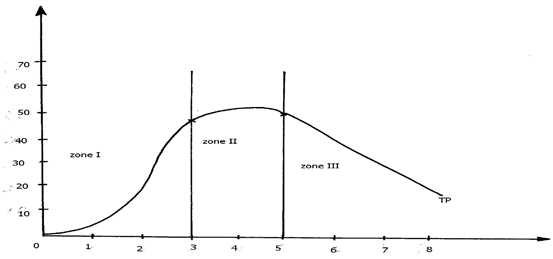 12. Below is a graphical representation of the law of diminishing returns.

(a) Explain what happens in each of the three zones marked I and III in relation to the output
of maize and the NPK fertilizer input
(b) Which of the three is a rational zone of production
13. Give four variable costs in maize production
14. A farmer has the following yield from a two hectare millet crop enterprise at Oluch irrigation schemes.
Study it and prepare his gross margin. is it profitable to grow millet? He spent the following in
his operations
Weed 800/=
Seeds 20kg/ha
Irrigation 600/=/ha
Ploughing 500/=/ha
Clearing the land 1200/=
Cost of seeds 300/= /10kg bag
Planting 400/= /ha
Harvesting 1200/= /ha
Yield 32bags
DAP fertilizer 2 bags at 10 000/= /50kg bags
CAN fertilizer 2 bags at 700/= /50kg bags
Gunny bags 40/= /bag
Transport to market 2000/=
14. A farmer has the following yield from a two hectare millet crop enterprise at Oluch irrigation schemes. Study it and prepare his gross margin. is it profitable to grow millet? He spent the following in his operations
Weed 800/=
Seeds 20kg/ha
Irrigation 600/=/ha
Ploughing 500/=/ha
Clearing the land 1200/=
Cost of seeds 300/= /10kg bag
Planting 400/= /ha
Harvesting 1200/= /ha
Yield 32bags
DAP fertilizer 2 bags at 10 000/= /50kg bags
CAN fertilizer 2 bags at 700/= /50kg bags
Gunny bags 40/= /bag
Transport to market 2000/= (20mks)
15. What is profit maximization in Agricultural Economics
16. a) A farmer is considering undertaking the production of either maize or beans. Study the
following information about the two crops and then answer the questions that follow:
Maize | |
Yield per hectare | 5500kg |
Price | Kshs.15 per kg |
Cost of cultivation/ ha | Kshs. 3000/= |
Amount of DAP fertilizer/ bag | Kshs.1500/= |
Amount of DAP fertilizer/ ha | 3 bags |
Cost of seed/ Kg | Kshs.100 |
Labour requirements / ha | 50 man days |
Cost of labour | Kshs.150 per man day |
Amount of CAN fertilizer | 3 bags |
Cost of CAN fertilizer/ bag | Kshs.1000 |
Beans | |
Yield per hectare | Kshs.5000 |
Price | Kshs.50 per kg |
Cost of cultivation/ ha | Kshs.3600 |
Labour requirements/ ha | 75 man- days |
Cost of labour | Kshs.200 per man day |
Cost of DAP fertilizer/ bag | Kshs.1500 |
Amount of DAP fertilizer/ ha | 2 bags |
Cost of seed/ kg | Kshs.80 |
Amount of seed/ ha | 20kg |
Amount of CAN fertilizer/ | 1 bag |
Cost of CAN fertilizer/ bag | Kshs.1000 |
Cost of sprays | Kshs.3000 |
i) Calculate the gross margin for each crop
ii) From your calculation which crop is profitable to grow
b) Discuss five factors considered when planning a farm
17. Using the data provided in the table below, make an interpretation and advice the farmer on which
crop to grow
Type of crop | Gross margin (Ksh) |
Cotton | 18,400 |
Ground nuts | 20,050 |
18. Outline three advantages of budgeting in farm business
19. A farmer has 1 Ha piece of land on which he grows maize. His farm record on maize
production for nine years is as shown in the table below:
Year | Fertilizer applied (bags) | Total output of maize (bags) |
1995 | 0 | 4 |
1996 | 2 | 10 |
1997 | 4 | 28 |
1998 | 6 | 42 |
1999 | 8 | 52 |
2000 | 10 | 60 |
2001 | 12 | 66 |
2002 | 14 | 66 |
2003 | 16 | 64 |
(a) i) Using an appropriate scale, with input on the X-axis draw a graph to show the relationship
between inputs and total output
(ii) From the graph you have drawn, how many bags of maize would the farmer produce if
he applied 9bags of fertilizer?
Calculate the farmers marginal products and average products for the years (i) From the data given, what rate of fertilizer application would the farmer choose if he
wanted to grow maize in 2004?
(ii) Give an explanation for your choice in (c) (i) above
(b) Assuming that the average price of fertilizer over the years recorded was shs. 1,200/= per bag
and the price of maize was ksh.1000/= per bag :
Calculate the gross income for the years 2002 and 2003
Calculate the net income for the year 1999. (Assume no other costs were incurred)
20. Name five types of costs incurred in a farming business
22. List any four sources of credit to farmers.
23. List three ways in which labour peaks can be overcome in the farm (1½ mks)
24. State four ways of improving farm labour productivity
25. A farmer had a plot of land measuring 5 hectares in which be intended to plant maize.
He was advised to apply 150 kg of P20 per hectare at planting and 200kg N per hectare during
top dressing. The fertilizer available in the market was Calcium Ammonium Nitrate containing
20% N and Di-ammonium phosphate 46% P205. Calculate.
(a) (i) The amount of Di—ammonium phosphate required
(ii) The amount of calcium ammonium nitrate required
(b) Baraka farm manager plans to grow Irish potatoes or maize for grains. Study the information
below and answer the questions that follow:
Irish potatoes
Cost of fertilizers/ha____________________________ Ksbs 10,000.
Labour requirements/ha ______________________ Kshs 50 man – days
Yield /ha ___________________________________ 10,000kg
Seed potato/ha ________________________________Kshs20, 000
Cost of labour ___________________________ Kshs 200 per man day
Cost of fungicides___________________________ Kshs 5000
Cost of ploughing____________________________ Kshs 4000
Selling price of potatoes per kg __________________ Kshs 30.
Maize
Yield per hectare ______________Kshs.7,500kg
Selling price of maize per kg _____________Kshs 20.
Cost of ploughing /ha ________________Kshs.4000
Seed maize/ha _____________________Kshs.3000
Labour requirement /ha _________________________ 200 man days.
Cost of fertilizers /ha ____________________Kshs 10,000
Cost of top dressing fertilizers __________________Kshs 4,800
Cost of labour _____________Kshs 150 per man – day
(i) What is gross margin?
(ii) Calculate the gross margin of each of the crops
(iii) From the calculation above which crop should the farm grow?
(d) Describe the environmental factors that may lead to poor yields in crop production
AGRICULTURAL ECONOMICS III (PRODUCTION ECONOMICS) ANSWERS
1. four ways of increasing labour efficiency on the farm
- Training them
- Giving incentives
- Supervision
- Good operator – worker relationship
- Farm mechanization
- Assigning tasks according to skills & specialization
- Proper remuneration : Attractive salaries
2. a) graph representing the total egg production per week.
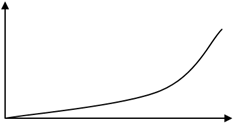
b) – Increasing returns production function.
3. (a) – Help to determine the value of the farm/ determine assets and liabilities.
– Provide history of the farm.
– Assist in planning and budgeting in various fields.
– Helps to detect losses or theft in the farm.
– Assists when sharing losses or profits (dividends)for communal owned farms/ partnership.
– Help to settle disputes in the farm among heirs.
– Help to support insurance claim e.g. against fire and theft.
– Provide labour information like terminal benefits, NSSF due, Sacco dues for all employees.
– Help to compare the performance of different enterprises within a farm or other farms.
– Help in the assessment of income tax to avoid over or under taxation.
– Records, helps to show whether the farm business is making profit or losses. This information
helps in obtaining credit. (10 x 1 = 10 mks)
(b) – Training worker e.g. in F.T.C’s, during field days, Agricultural shows, through
demonstrations and workshops.
- Measuring farm operations to supplement the labour force.
- Providing incentives to workers such as attractive wages, free protective wear, housing, medical facilities, proper feeding, rewarding good workers. Et.c
- Supervising and counseling workers.
- Creating good operator – worker relationships.
- Assigning specific tasks to the labor force.
(c) – Establishment of land ownership.
– Measurement of land size.
– Description of the land.
– Recording and mapping of the surveyed land.
– Solving objections if any.
– Submission of the maps and records to the district land office registration
4. Three types of agricultural services available to the farmer
- Credit
- Extension and training
- Agricultural research
- Banking
- Artificial insemination
– Veterinary
5. Four management guideline questions which assist a farm manager in making accurate
farm decisions
– For whom to produce?
6. – Training
- Farm mechanization
- Labor supervision
- Giving incentives and improving terms and conditions of service
Assign specific tasks
7. – Fertilizers – Seeds
- Pesticides -Casual labor
8. – Banking
- Extension and training
- Credit facility
- Agricultural research
- Marketing
- Farm input supplies
Tractor hire service
9. (a) Is the sum total of goods and services produced by a country within a period of one year (b) -Per capital income: Is the gross national income divided by the number of people living
in a country
10. -Diversification- Setting up several and different enterprises on the farm. If one fails the
farmer cannot incur total loss.
- Contracting- farmers can enter into contract with consumers. It guarantees a constant fixed market for goods/services
- Insurance- Taking an insurance cover to compensate them incase of loss
- Input rationing- Farmers can control the quantities of inputs used in various enterprises to reduce losses
- Flexibility in production methods- Ability to change from one enterprise to another in response to demand changes
- Adopting modern methods of production e.g. disease control, irrigation, mechanization e.t.c.
11. Application of fertilizer
Input 50kg bag fertilizer | Out put 90kg bag maize | Average product (AP) | Marginal product (MP) |
0 1 2 3 4 5 6 7 8 | 6 10 24 31 36 40 43 43 40 | – 10 12 10.33 9 8 7.18 6.14 5 | 0 4 14 7 5 4 3 0 -3 |
(ii) The best level of production in relation to the inputs and out put is level 3
(b) (i) Gross margins for the crops
(i) Maize
Value of maize/incomve | 5,500 x 15 = 82,500/= (1mk) |
Cost of labour | 50x 150 = 7,500/= (1mk) |
Cost of cultivation /ha | 1 x 3,000 = 3,000/= (1mk) |
Cost of seed | 25 x 100 = 2,500/= (1mk) |
Cost of DAP fertilizer | 3 x 1,500 = 4,500/= (1mk) |
Cost of C.AN fertilizer | 3 x 1000 = 3,000/= (1mk) |
Total variable costs | 20,500/= (1mk) |
GM for maize | 82,500 – 20,500 = 62,000 (1mk) |
(ii) Beans
Value of beans/income | 5,000 x 500 = 250,000/= (1mk) |
Cost of labour | 75 x 200 = 15,000/= (1mk) |
Cost of cultivation /ha | 1 x 3,600 = 3,600/= (1mk) |
Cost of seed | 20 x 80 = 1,600/= (1mk) |
Cost of DAP fertilizer | 2 x 1,500 = 3,000/= (1mk) |
Cost of C.AN fertilizer | 1 x 1000 = 1,000/= (1mk) |
Total variable costs | 27,200/= (1mk) |
GM for beans | 250,000 – 27,200 = 222,800 (1mk) |
(b) (ii) The crop which is profitable from the calculation is that : (1mk)
- It is more profitable to grow beans than maize
12. a) ZONE I
– For each additional unit of input applied the output of maize increased at an increasing
rate because the fertilizer resources are underutilized Ö1 (1×2=2 mks)
ZONE II
– For each additional unit of input applied the output of maize increased at a decreasing
rate because the resources are used to the maximumÖ1 (1×2=2 mks)
ZONE III
– For each additional unit of input applied the output of maize decreases because
the fertilizer/ resources are excessively appliedÖ1 (1×2=2 mks)
b) ZONE II
13. Give four variable costs in maize production
- Cost of fertilizer
- Cost of seeds
- Cost of pesticide
- Cost of weeding
- Cost of harvesting
- Cost of casual labour
- Cost of fuel
14.
ITEM | QUANTITY | NO. OF UNITS | COST PER UNIT | TOTAL VARIABLES COST |
Weeding Seeds Irrigation Ploughing Clearing land Planting Harvesting DAP fertilizer DAN fertilizer Gunning bags transport | – 20kg – – – – – 2bags 2bags 32 – | – 2 2ha 2ha – 2ha 2ha 2 2 32 – | – 300 600 500 – 400 1 200 10 000 700 40 – | 800 00 600 00 1200 00 1000 00 1200 00 800 00 2400 00 20 000 00 1400 00 1280 00 2000 00 |
Total variable cost | 32 680 00 | |||
income | 32bags | 1200 | 38 400 00 | |
Gross margin=total revenue-total variable cost
= 38400-32680 = 5720.00
15.
- Profit maximization is the profit in a production process where the highest net returns (Net revenue) on invested capital is realized/ when the difference between total revenue (TR) and total cost (TC) is the highest point in a production process/ where profit is highest
- Is where marginal revenue (MR) is equal to or almost equal to marginal costs
16. a) i) Gross margins for the crops
Value of maize/ income | 55000 X 15 = 82500 | 1 mark |
Cost of labour | 50 X 150 = 7500 | 1 mark |
Cost of cultivation/ ha | 1 X 3000 = 3000 | 1 mark |
Cost of seed | 25 X 100 = 2500 | 1 mark |
Cost of DAP fertilizer | 3 X 1500 = 4500 | 1 mark |
Cost of CAN fertilizer | 3 X 1000 = 3000 | 1 mark |
Total variable costs | 20500 | 1 mark |
GM for maize | 82500- 20500 = 62000 | 1 mark |
ii) Beans
Value of beans/ income | 5000 X 500 = 250000 | 1 mark |
Cost of labour | 75 X 200 = 15000 | 1 mark |
Cost of cultivation/ ha | 1 X 3600 = 3600 | 1 mark |
Cost of seed | 20 X 80 = 1600 | 1 mark |
Cost of DAP fertilizer | 2 X 1500 = 3000 | 1 mark |
Cost of CAN fertilizer | 1 X 1000 = 1000 | 1 mark |
Cost of sprays | 3000 | 1 mark |
Total variable costs | 27200 | 1 mark |
GM for beans | 250000 – 27200 = 222800 | 1 mark |
iii) It is more profitable to grow beans than maize 1 mark
b)
- Size of the farm
- Climatic conditions
- Fairness objectives and preferences
- Existing market conditions
- Available resources
- Expected returns
17. – The farmer should grow groundnuts;
– The crop has a higher gross margin than cotton;
18. – The farmer may be able to estimate the required production resource e.g labour capital e.t.c
– Assists farmer when e.g. labour capital etc
– Assists farmer in making management decisions;
– Helps to reduce uncertainties in the production process;
– Shows progress or lock of progress in farm business;
19. (a) (i) See the graph paper
(ii) 56 bags; (1×1=1mk)
(b) Table – ( 16x ½ =8mks)
Year | Fertilizer applied (bags) | Maize output (bgs) | Marginal product | Average product |
1995 1996 1997 1998 1999 2000 2001 202 2003 | 0 2 4 6 8 10 12 14 16 | 4 10 28 42 52 60 66 66 64 | – 6 18 14 10 8 6 0 -2 | – 5 7 7 6.5 6 5.5 4.7 4 |
(c) (i) 4 bags (1×1=1mk)
(ii) MP is maximum; AP is maximum; (2×1=2mks)
(d) Gross income = Total output x price per unit
in 2002 66 x 1000 = 66000/= (1×1=1mk
in 2003: 64 x 1000 = 64000/= (1×1=1mk)
(ii) Net income = Total income – Total cost
in 1999: Total income was 52 x 1000 = 52000/=
total cost was 8 x 1200 = 9,600/=
Hence 5200/= – 9600; (1mk)
= Shs. 42,400/= (1mk)
21.
- Flood costs (F.C)
- Variable costs (V.C)
- Total costs (T.C)
- Average costs (A.C)
- Marginal costs (M.C)
22.
- Co-operative societies
- Crop boards
- Commercial banks
- Agricultural finance corporation (A.F.C)
- Settlement fund trustees
- Hire purchase companies
- Insurance companies. (Any 4 )
23. three ways in which labour peaks can be overcome in the farm
- Overtime working for casual labourers
- Greater use of casual workers
- Mechanization
- Use of contractors who may be engaged to do some work at a fee
- Cropping system devised such that ripening of crops could be at different times
Work study to devise new techniques of doing work more quickly and efficient
24 . – training
-giving incentives/motivation
-farm mechanization
-labour
25. (a) 1000kg of NAP con 46kg P2O5S
150 x 100 – 150
50
300kg of DAP per hectar
1ha = 300kg of DAP
5ha x 300
1 = 1500g of DAP
1 bag = 50kg
1500 x 1 = 1500kg
50 = 30bags pf DAP
N/B Approximation = 3obags
CAN
100kg contain 20kg of price N
200x 100 = 200kg
30 = 1000kg
I ha = 1000kg
5ha = 1000 x 5 = 5000kg
1bag = 50kg
5000 x 1 = 5000kg
50
= 100bags of CAN
(b) (i) – cross margin is variable cost – total revenue
Gross margin of irish potatoes
Cost of fert = shs 10000 x 5 = 50000
Cost labour requirement = 50 x 200 x 5 = 50,000
Cost of seed potatoes 20,000 x 5 = 100000
Cost of fungicides 5000 x 5 = 25000
Cost of ploughing 400 x 5 = 50,000
Total variable cost shs.145,000
Total revenue = shs.50,000 x 50 = shs.1,500,00
Gross margin shs. 1,500,000 – shs.145,000 =shs.1,255,100
(i) Maize
Cost of fert. shs 10000 x 5 = shs.50000
Cost of fert. shs. 4800 x 5 = shs.24000
Cost of maize seed shs.3000 x 5 = shs.15000
Cost f labour shs.200 x 150x 5 = shs.150000
Cost of ploughing shs.4000 x 5 = shs.20000
Total cost = shs.259000
Revenue 750000 X 5 X 20= Shs.750000
Gross margin = 750000
– 259000
Shs.481000
(ii)He should grow potatoes
– pests
Diseases
Unreliable rainfall
Change in temperature
Strong wind
Light aspect
Infertile soils


