

535/12¼ hours | UGANDA NATIONAL EXAMINATION BOARD Uganda Certificate of Education PHYSICS Paper 1 Time: 2¼ hours |
SECTION A
(2004.A.1) A body moves with a uniform acceleration of P m/s-2. If its initial velocity is x m/s and it travels for t seconds to attain a final velocity of y m/s, find the value of p in terms of x, y, and t.
A. x + yt
 B. (y – x) / t
 C. (y + x) / t
D. y + xt
(2004.A.2) An electric lamp is marked 120 W, 240 V. What does 120 W mean?
- A. Total energy consumed by the lamp.
- B. Rate at which energy is consumed.
- C. Total current flowing through the lamp.
- D. Potential difference across the lamp.
(2004.A.3) Two forces of 5 N and 12 N act on a body at right angles. Find their resultant.
- A. 7 N
- B. 13 N
- C. 17 N
- D. 169 N
(2004.A.4) A moving coil galvanometer can be used to:
- A. Measure direct current.
- B. Convert alternating current into direct current.
- C. Convert direct current to alternating current.
- D. Measure the peak value of an alternating current.
(2004.A.5) A car of mass 1200 kg moving with a constant velocity of 60 m/s is retarded uniformly to rest in 12 seconds. Calculate the retarding force.
- A. (1200 × 12) N
- B. (1200 × 5) N
- C. (1200 × 10) N
- D. (1200 × 60) N
(2004.A.6)
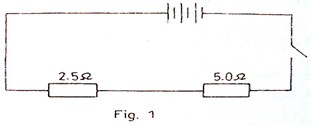
If each cell shown in fig.1 has an internal resistance of 0.5 Ω, find the effective resistance in the circuit.
- A. 1.25 Ω
- B. 7.50 Ω
- C. 8.00 Ω
- D. 9.00 Ω
(2004.A.7) A load of 500 N is placed at 2 m from a pivot of a seesaw. At what distance from the pivot should a weight of 250 N be placed to balance the seesaw?
- A. 0.5 m
- B. 1.0 m
- C. 2.0 m
- D. 4.0 m
(2004.A.8)
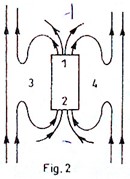
Figure two shows the superposition of the earth’s magnetic field and the field due to a magnet. Identify points marked 1, 2, 3, and 4.
| 1 | 2 | 3 | 4 | |
A. B. C. D. | South pole North pole Neutral point Neutral point | North pole South pole Neutral point Neutral point | Neutral point Neutral point North pole South pole | Neutral point Neutral point South pole North pole |
(2004.A.9) Which of the following is the correct order of energy changes or conversions in a generator?


A. Heat energy in cylinder → Kinetic energy in pistons → Electrical energy.


B. Chemical energy from fuel → Heat energy in cylinders → Kinetic energy in pistons

Rotational kinetic energy in a dynamo → Electrical energy.


C. Chemical energy → Rotational kinetic energy in the dynamo → Rotational kinetic energy in pistons → Electrical energy.


D. Electrical energy → Rotational kinetic energy in dynamo → Rotational kinetic energy in pistons → Sound energy.
(2004.A.10) A metal rod gains a positive charge when rubbed with fabric. The fabric acquires:
- A. No charge.
- B. A negative charge equal to that of the rod.
- C. A positive charge equal to that on the rod.
- D. A positive charge greater than that on the rod.
(2004.A.11) The transfer of heat by the actual movement of molecules in matter takes place:
- A. Only in liquids.
- B. Only in gases.
- C. In solids and liquids.
- D. In liquids and gases.
(2004.A.12) Which of the following can be detected by an ordinary antenna?
- A. Microwaves
- B. Infrared rays
- C. Ultraviolet rays
- D. Gamma rays
(2004.A.13) A girl whose mass is 50 kg runs up a staircase 25 m high in 4 s. Find the power she develops.
- A. 50 × 4 W
- B. 50 × 10 W
- C. 50 × 25 W
- D. 50 × 10 × 25 W
(2004.A.14) A pin is placed in front of a convex lens at a distance less than the focal length of the lens. What type of image is formed?
- A. Real, inverted, diminished.
- B. Virtual, erect, magnified.
- C. Real, erect, diminished.
- D. Virtual, inverted, magnified.
(2004.A.15) In a liquid, pressure is:
- A. Transmitted in a specific direction.
- B. Transmitted in all directions.
- C. Decreased with depth.
- D. Decreased with density.
(2004.A.16) A man standing in front of a tall wall makes a loud sound and hears the echo after one and a half seconds. How far is he from the wall if the velocity of sound in air is 330 m/s?
- A. 110 m
- B. 247.5 m
- C. 440 m
- D. 990 m
(2004.A.17) A set of apparatus suitable for measurement of the volume of an irregular object includes:
- A. Overflow can, measuring cylinder, irregular object, and a string.
- B. Measuring cylinder, irregular object, overflow cans, flask.
- C. Overflow can, irregular objects, string, retort stand, and burette.
- D. Burette, overflow can, irregular object, a string, measuring cylinder, and retort stand.
(2004.A.18) The number of vibrations a wave makes in 1 second is the:
- A. Frequency
- B. Wavelength
- C. Period
- D. Amplitude
(2004.A.19) Brownian motion experiment shows that molecules of gases are:
- A. Stationary
- B. In motion in one direction only
- C. In constant random motion
- D. More closely packed than molecules in liquid.
(2004.A.20) The following equations represent part of the radioactivity series.

23490Th → X-Radiation
Substance X and the radiation in the equation above are:
- A. 23491Pa and gamma
- B. 23090Th and beta
- C. 23090Th and gamma
- D. 23491Pa and beta
(2004.A.21) The specific heat capacity of a substance is:
- A. Heat required to raise it through 1°C.
- B. Heat required to raise the temperature of 1 kg mass of the substance through 1°C.
- C. Heat required to change 1 kg mass of the substance into liquid at the same temperature.
- D. Heat required raising its temperature the specific number of degrees.
(2004.A.22)
| Element | Neutrons | Protons | Electrons |
|---|---|---|---|
| P Q R S | 6 8 2 2 | 6 6 2 3 | 6 6 2 3 |
The table above shows the structure of four atoms P, Q, R, and S. Which ones are isotopes of the same element?
- A. P and Q
- B. Q and R
- C. P and S
- D. P and S
A ductile material is that which:
- A. Is fragile.
- B. Is not elastic.
- C. Can be molded into any shape.
- D. Easily breaks under compression.
(2004.A.23) Streams of electrons moving at high speed are called:
- A. X-rays
- B. Gamma rays
- C. Cathode rays
- D. Alpha particles
(2004.A.25)
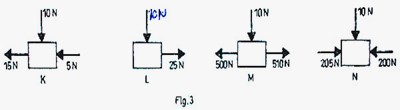
The above figure shows forces applied on each of the identical blocks of the same mass. The block which has the greatest net force is:
- A. K
- B. L
- C. M
- D. N
(2004.A.26) An object is placed 6 cm from a plane mirror. If the object is moved further by 2 cm, find the distance between the object and the image.
- A. 16 cm
- B. 12 cm
- C. 8 cm
- D. 6 cm
(2004.A.27) The purpose of treads on tyres is to make them:
- A. Attractive
- B. Stronger
- C. Reduce friction
- D. Grip the road surface
(2004.A.28) Which of the following are longitudinal waves?
- A. Water waves
- B. Light waves
- C. Sound waves
- D. Radio waves
(2004.A.29) A car of mass 1200 kg moving with a velocity of 60 m/s collides head-on with another car of mass 1000 kg at rest and they stick together. Calculate their velocity after collision.
- A. (1200 + 1000) / (1000 × 60) m/s
- B. (1200 + 1000) / (1200 × 60) m/s
- C. (1000 × 60) / (1200 + 60) m/s
- D. (1200 × 60) / (1200 + 1000) m/s
(2004.A.30) A radioactive sample of 16 g has a half-life of 6 days. How much of it will be left after 6 days?
- A. 1 g
- B. 4 g
- C. 32 g
- D. 48 g
(2004.A.31) A body of mass m kg and height h m from the ground has:
- A. Total gravitational potential energy = mgh
- B. The greatest gravitational potential energy when at height h
- C. The greatest potential energy when it just drops to the ground
- D. The least potential energy when at height ½ h to the ground
(2004.A.32) An atom contains 3 electrons, 3 protons, and 4 neutrons. Its nucleon number is:
- A. 3
- B. 4
- C. 6
- D. 7
(2004.A.33) A stone feels cold to bare feet in cold weather, but on a carpet in the same room feels comfortably warm. Why is this so?
- A. The stone is a worse conductor of heat than a carpet.
- B. The stone is a better conductor of heat than a carpet.
- C. The carpet is a better conductor of heat than a stone.
- D. The stone is a better reflector of heat than a carpet.
(2004.A.34) The process by which electrons are emitted from the surface of a metal by application of heat is known as:
- A. Photoelectric emission
- B. Electromagnetic emission
- C. Thermionic emission
- D. Heat emission
(2004.A.35) A man lifts a weight of 300 N through a height of 2 m in 6 s. Determine the power he develops.
- A. 25 W
- B. 100 W
- C. 600 W
- D. 900 W
(2004.A.36)
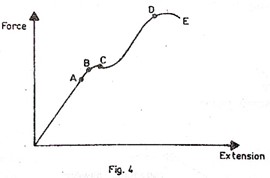
The above figure shows how the extension of a wire varies with the forces applied. Point B represents:
- A. Proportional limit
- B. Elastic limit
- C. Breaking stress
- D. Yield point
(2004.A.37)
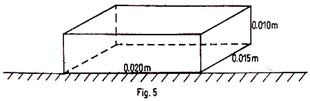
A box is placed on top of a table as shown above, with dimensions indicated. If its mass is 40 kg, find the pressure it exerts on the table.
- A. 40 / (0.020 × 0.015)
- B. 40 / (0.015 × 0.10)
- C. 40 × 10 / (0.020 × 0.015)
- D. 40 × 10 / (0.020 × 0.010)
(2004.A.38) Calculate the amount of heat required to change 100 g of water at 100°C to steam at 100°C. (Specific latent heat of steam = 2.26 × 10⁶ J/kg)
(2004.A.39) Which one of the following can be used to measure the diameter of a bicycle spoke accurately?
- A. Metre rule
- B. Vernier caliper
- C. Tape measure
- D. Micrometer screw gauge
(2004.A.40)
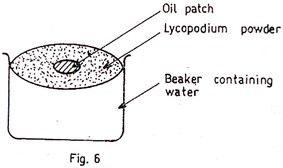
An oil drop of volume 10-3 cm3 forms a patch of water as shown in figure 6. The area of the patch is 0.785 cm2. If it is 1 molecule thick, what is the size of the molecule?
- A. 4.06 × 10⁻⁴ cm
- B. 7.85 × 10⁻⁴ cm
- C. 9.53 × 10⁻⁴ cm
- D. 1.27 × 10⁻³ cm
SECTION B (2004)
(2004.B.41)
(a) List two ways by which a magnet may lose its magnetic properties.
(b)
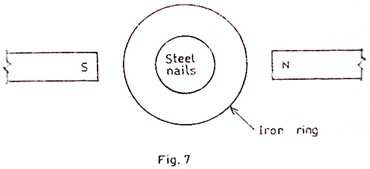
The above figure shows an iron ring between two opposite magnetic poles.
(i) Sketch the magnetic lines of force on the diagram.
(ii) Explain what happens to the steel nails.
(2004.B.42)
(a) State two differences between a.c and d.c generators.
(b)
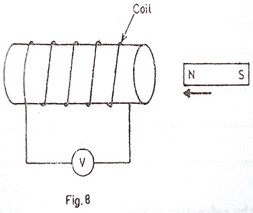
Briefly describe what happens when a magnet is moved into a coil as shown above.
(2004.B.43) (a) What is meant by:
(i) mass number?
(ii) atomic number?
(b) Name any two radiations emitted by radioactive substances.
(2004.B.44) (a) What is meant by the term reverberation?
(b) State two factors which affect the frequency of a vibrating string.
(c) A sound wave of frequency 440 Hz has a velocity of 330 m/s. Calculate its wavelength.
(2004.B.45)
(a) What is meant by refractive index?
(b)
(i) Define focal length of a converging lens.
(ii) With the help of a ray diagram, show how a converging lens can be used as a magnifying glass.
(2004.B.46) A 240 V, 600 W water heater is used to boil water for 5 minutes.
(a) By what means does heat spread through the water?
(b) Calculate:
(i) The current that flows in the heater.
(ii) The electrical energy converted into heat.
(2004.B.47) (a) (i) Define moment of a force.
(ii) State the principle of moments.
(b)
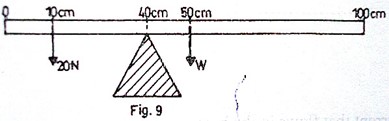
A uniform meter ruler is pivoted at the 40 cm mark as shown in fig. 9. The meter ruler is in equilibrium under its weight W and a 20 N force acting at the 10 cm mark. Calculate W.
(2004.B.48) (a) What is meant by specific latent heat of vaporization?
(b) State two factors which affect boiling points of water.
(c) Calculate the heat required to convert 0.8 kg of water at 100°C to steam. [Specific latent heat of vaporization of water = 2.26 × 10⁶ J/kg]
(2004.B.49)
(a)
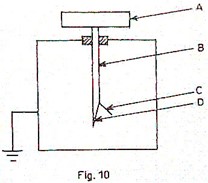
The above figure shows the main parts of an electroscope. Name them.
(b) State two uses of an electroscope.
(2004.B.50) State Archimedes’ principle.
(b) A solid weighs 25.00 g in air and 19.0 g when submerged in water. Find the density of the material of the solid.


