


1. A block of ice of mass 40 g at 0°C is placed in a calorimeter containing 400 g of water at 20°C. Ignoring the heat absorbed by the calorimeter, determine the final temperature of the mixture after all the ice has melted. (Specific latent heat capacity of fusion of ice = 340,000 J/kg, specific heat capacity of water = 4,200 J/kg).
 2. a) Fig 1 (a) shows the circuit of a simple telephone receiver. When the telephone is lifted, a steady current flows through the solenoids. When a person speaks into the microphone on the other side, a varying current flows. These two currents are shown in fig. 1(b).
i) State the reason why solenoids are wound in opposite directions around the soft-iron core pieces as shown.
ii) Explain how the speech current from the microphone is converted into sound in the receiver.
iii) State and explain the effect of replacing the soft iron core pieces with steel core pieces.
b) A step down transformer has 400 turns in the primary coil and 20 turns in the secondary coil. A 50 Ω resistor is connected to the secondary output. If the r.m.s (root-mean-square) value of the primary voltage is 240 V, determine the peak value of the current in the secondary circuit.
c) A hole of area 2.0 cm2 at the bottom of a tank 2.0 m deep is closed with a cork. Determine the force on the cork when the tank is filled with water. (Density of water is 1000 kg/m3 and acceleration due to gravity is 10 m/s2).
i) Describe how the electrons are produced in the tube.
ii) State and explain the function of the grid.
iii) State what would be observed on the screen if an a.c voltage is connected across the y-plates.
iv) State how the deflection system of a television differs from that of a CRO.
v) Give the reason why it is possible to have a wider screen in the television set than on the C.R.O.
b) In an excited hydrogen atom, an electron moves from an energy level of -1.36 x 10⁻¹⁹ J. Determine the wavelength of the radiation emitted. (Planck’s constant h = 6.63 x 10⁻³⁴ Js and speed of light c = 3.0 x 10⁸ m/s).
5 a) You are provided with a 12 V a.c source, four diodes and a resistor.
i) Draw a circuit diagram for a full wave rectifier and show the points at which the output is taken. AC source shown – symbols; arrangement of diode (one for each pair); correct position of R; correct position of output.
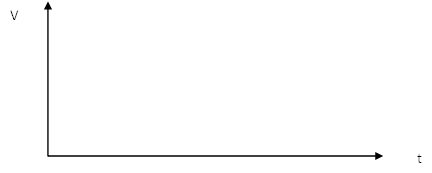 ii) Sketch the graph of the output when a capacitor is put in parallel with the resistor in the circuit in (i) above.
b) A certain transistor is connected in common-emitter mode. The base current IB is 0.50 mA. Determine the values of the:
(i) Emitter current IE.
(ii) Base-collector current gain β.
(iii) Current gain α.
SECTION II
6 a) i) State one of Newton’s laws of motion.
ii) A body resting on a horizontal surface is given an initial velocity V so that it slides on the surface for some distance before coming to a stop. Table I shows the distances d moved by the body for various values of μ.
| Velocity (m/s) μ | 0.20 | 0.40 | 0.60 | 0.80 | 1.00 | 1.20 |
|---|---|---|---|---|---|---|
| Distance, d (m) | 0.007 | 0.027 | 0.027 | 0.110 | 0.170 | 0.200 |
Given that v2 is 2μd where μ is a constant for the surface, plot an appropriate graph and use it to determine μ. Determine values of μ from the table.
b) A train of mass 200 tonnes starts from rest and accelerates uniformly at 0.5 m/s2. Determine its momentum after moving 100 m.
7 a) i) State the pressure law of an ideal gas.
ii) The pressure p of a fixed mass of a gas at constant temperature T = 300 K is varied continuously. The corresponding values of p and the volume V of the gas are shown in Table 2.
| Pressure, p (x 105 Pa) | 2.00 | 2.50 | 3.00 | 3.50 | 4.00 | 4.50 |
|---|---|---|---|---|---|---|
| Volume, V (m3) | 0.025 | 0.020 | 0.017 | 0.014 | 0.012 | 0.011 |
Given that PV = 2RT where R is a constant, plot an appropriate graph and use it to determine R.
| 1/V (m-3) | 40.0 | 50.0 | 58.8 | 71.4 | 83.3 | 90.0 |
|---|
b) A tin closed with an airtight lid contains air at a pressure of 1.0 x 10⁵ Pa and temperature of 12°C. The tin is heated in a water bath until the lid opens. If the temperature at which the lid opens is 88°C, determine the pressure attained by the gas. (Ignore expansion of the tin).
| 1/P x 105 (Pa-1) | 0.50 | 0.40 | 0.33 | 0.29 | 0.25 | 0.22 |
|---|


