



1 SHORTAGE OF AFRICAN LABOUR IN EARLY COLONIAL ZIMBABWE
Carefully study the following sources and answer all the parts of this question.
Source A
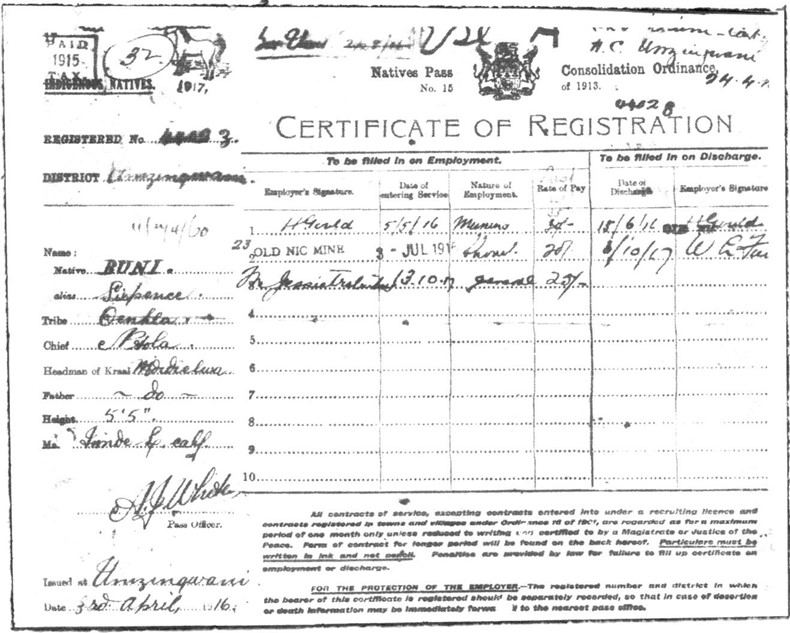
The above photograph shows the Certificate of Registration carried by every male African from the age of 16 years in colonial Zimbabwe.
Adapted from a book by Zimbabwean historians published in the 1990s.
Source B
Ten shillings a month was a ridiculously low wage for an African considering the price of food at that time. It was not surprising at all why Africans were unwilling to work for it. After working for thirty days an African would get ten shillings. He could only buy twenty four pounds of meat at five cents per pound. It was not enough for an adult male African for twelve days only.
2167/1 N2017
Adapted from a comment by the Native Commissioner for Hartley (Chegutu) in 1895.
Source C
Africans at first wanted to go on living in their traditional ways. Inspite of a certain amount of land alienation to the few thousand white settlers, there was still a great deal of land available for the half a million Africans. They were not used to the money economy and had little desire for the things money could buy.
Adapted from a book by a white historian, published in the 1960s.
(a) Study Source A
Identify the ways by which the Certificate of Registration was used to
control African labour. [4]
(b) Read Source B
Is this source reliable on the reasons why Africans were unwilling to work for the European settlers in the early colonial period in Zimbabwe?
Explain your answer
[5]
(c) Read Source C
Does the source sufficiently explain why there was a shortage of labour on settler farms and mines in early colonial Zimbabwe?
Explain your answer. [5]
(d) Read Source B and Source C
Do the two sources differ on the causes of labour shortages on European farms and mines in early colonial Zimbabwe?
Explain your answer. [5]
(e) Study Source A
What do you think were the reactions of the different groups of people in Colonial Zimbabwe to the introduction of the Certificate of Registration
for adult African males?
Explain your answer. [6]
2167/1 N2017
[Turn over
- (a) State any six items produced by the blacksmiths during the Early Iron Age
period in Southern Africa. [6]
- Describe six negative effects of the discovery of iron during the Early Iron
Age period in Southern Africa. [12]
- To what extent did the discovery of iron improve the social life of the
Early Iron Age people? [8]
- (a) Name any six government officials of the Mutapa State. [6]
- Describe six internal factors that led to the decline of the Mutapa State. [12]
- How far were the internal political factors responsible for the collapse
of the Mutapa empire? [8]
- (a) Identify the three Nguni Chiefdoms and their
respective paramount chiefs
at the beginning of the 19th Century. [6]
- Describe six results of Mfecane south of the Limpopo. [11]
- Did the people of Southern Africa benefit from Mfecane?
Explain your answer. [8]
- (a) State any six causes of the Mfecane. [6]
- Describe six features of the political system of the Zulu State under
Tshaka. [11]
- To what extent was Tshaka a cruel ruler? [8]
- (a) Name any three missionaries of the
London Missionary Society and anythree Catholic missionaries who worked in Zimbabwe between 1850 and
1900. [6]
- Describe six activities of the Catholic missionaries in Zimbabwe up to
1900. [11]
- To what extent was the failure of the Catholic missionaries caused by the influence of the African Traditional religion in this period? [8]
2167/1 N2017
- (a) List any six items which the Portuguese obtained from trade with the
Mutapa State. [6]
- Describe six methods used by the Portuguese to gain control of trade in the Mutapa State between 1650 and 1700. [11]
- To what extent did the rulers of the Mutapa State contribute to the success
of these methods? [8]
- (a) Identify any six problems experienced by the people of Southern Africa
as a result of European colonisation. [6]
- Outline six reasons why Great Britain was involved in the scramble for
territories in Southern Africa. [11]
- Did social factors contribute to Great Britain’s involvement in the scramble for territories in Southern Africa?
Explain your answer. [8]
- (a) State any three treaties signed between Lobengula and Europeans from
1887 to 1889 and their
respective signatories. [6]
- Describe six recruitment features of the Pioneer Column. [11]
- How far did the Pioneers contribute to the successful occupation of
Mashonaland? [8]
- (a) List any six British nationals who visited Zimbabwe between 1890 and
1896. [6]
- Outline six causes of the Shona uprising of 1896-97. [11]
- To what extent were the Shona grievances solved after the uprising? [8]
- (a) State any six different diseases which affected African miners in
colonial Zimbabwe. [6]
- Describe six working conditions of African mine workers in colonial
Zimbabwe before 1960? [11]
- To what extent were the African mine workers able to resist exploitation
during that period? [8]
2167/1 N2017
[Turn over
- (a) List any six problems faced by African workers on European farms in
colonial Zimbabwe. [6]
- Describe six problems faced by white colonial farmers in their attempt to destroy African agriculture before 1960. [12]
- Did the colonial government succeed in solving these problems?
Explain your answer. [8]
- (a) Name any six countries in Southern Africa from where migrant labourers were recruited for South African gold mines. [6]
- Outline six problems faced by the early gold mining companies in South
Africa before 1910. [11]
- How far were the gold mining companies able to solve these problems by
1910? [8]
- (a) Name the three countries that formed the Federation of Rhodesia and
Nyasaland and their respective leaders at that time. [6]
- Outline six provisions of the constitution of the Central African
Federation. [12]
- How far did the Federal Constitution disadvantage Africans?
Explain your answer. [8]
- (a) Identify any six African grievances against the Federation of Rhodesia
and Nyasaland. [6]
- Outline six measures taken by the Africans to oppose the Federation. [11]
- To what extent were these measures successful? [8]
- (a) State any three names of the armies created by the Smith regime to fight
against the guerrillas and any three female guerrillas in the armed struggle
in Zimbabwe. [5]
- Describe six roles played by women during the liberation struggle in
Zimbabwe. [12]
- To what extent did the role played by women contribute to the attainment
of Independence in Zimbabwe? [8]
2167/1 N2017
- (a) Identify any six branches of the Rhodesian Joint Operations Command used to attack the guerrillas during the armed struggle. [6]
- Outline six measures taken by the Rhodesian government to contain the activities of the armed struggle from 1975 to 1979. [11]
- How effective were these measures?
Explain your answer. [8]
- (a) Identify any six fundamental Human Rights enshrined in the constitution
of Zimbabwe. [6]
- Outline six principles governing the electoral system enshrined in the
constitution of Zimbabwe. [12]
- How far has the government adhered to these principles in conducting
elections since 2000? [8]
- (a) Name any six member states of the Southern African Development
Community (SADC). [6]
- Describe six roles played by SADC in maintaining peace within the
region. [11]
- To what extent has SADC been successful in maintaining peace within the
region? [8]
- (a) Name any three neighbouring countries of Zimbabwe and their respective
capital cities. [6]
- Describe six problems caused by the brain drain in Zimbabwe. [11]
- To what extent has the government been able to solve these problems? [8]
- (a) Name any six leaders of anti apartheid movements in South Africa after
1965. [6]
- Describe six efforts of the African National Congress (ANC) governments in improving the social lives of the people of South Africa since 1994. [11]
- To what extent have the people of South Africa benefited from these
efforts? [8]
2167/1 N2017
[Turn over
22 (a) Name the three political parties formed in Mozambique in the early 1960s
and their respective leaders. [6]
- Describe six economic problems experienced by the Mozambicans since
independence. [11]
- How far has the government of Mozambique been able to solve these
problems? [8]
MARKING SCHEME
ZIMBABWE SCHOOL EXAMINATIONS COUNCIL
General Certificate of Education Ordinary Level
MARKING SCHEME
HISTORY 2167/1
SOUTHERN AFRICA
NOVEMBER 2017
- SHORTAGE OF AFRICAN LABOUR IN EARLY COLONIAL ZIMBABWE
- Study Source A
Identify the ways by which the Certificate of Registration was used to control
African labour. [4]
|
|
Target: | comprehension with inference. |
Level 1: | Superficial answers taken directly from the source eg African workers could not leave their current employers unless the Registration Certificate was signed, or African wages were indicated on the Certificate of Registration, or workers who deserted were easily traced. [1 – 2] |
Level 2: | Inference level eg African workers had no freedom to choose employers, or African workers had no freedom of movement, or African workers had no freedom to bargain for better wages. |
[3 – 4] | |
|
- Read Source B
Is this source reliable on the reasons why Africans were unwilling to work for the European settlers in the early colonial period in Zimbabwe?
Explain your answer. [5]
Target: Evaluation of source for reliability
Level 1: Answers stating that it is reliable because the remuneration
was low or because the Native Commissioner said so. [1]
Level 2: | Status/bias level – Answers stating that it is reliable because it was a comment by the Native Commissioner who was a government official at that time, or the Native Commissioner commented objectively on the wages paid to Africans. [3 – 4] |
Level 3: | Motive level – Answers stating that the Native Commissioner said so to encourage the settler government or settlers to pay higher wages to African so as to get sufficient labour. [4 – 5] |
- Read Source C
Does the source sufficiently explain why there was a shortage of labour on settler farms and mines in early colonial Zimbabwe? Explain your answer. [5]
Level 1: | Answers taken directly from the source eg It sufficiently does because Africans wanted to continue living in their traditional ways or Africans were not used to the money economy. [1] |
Level 2: | Status/bias level – Answers stating that it sufficiently does because it was mentioned by a white colonial historian who researched, or who lived during the colonial era, or it does not sufficiently explain because the white historian was opposed to Africans having much land. [2 – 3] |
Level 3: | Motive level / It does sufficiently explain because the white |
historian wanted to encourage the government to appropriate more land from Africans to force them to work for the settlers. | |
[4] | |
Level 4: | Sufficiency / Insufficiency level. Answers which state that it does not sufficiently explain because the colonial historian cited the abundance of land, Africans not being used to the money economy, leaving out other factors like low wages and the ill-treatment by settler employers. [5] |
- Read Source B and Source C
Do the two sources differ on the causes of labour shortages on European farms and mines in early colonial Zimbabwe?
Explain your answer. [5]
Target: | Comparison of sources for differences or similarities |
Level 1: | Answers comparing on the basis of contents eg Source B attributes the shortage of African labour to the low remunerations while Source C cites the Africans still had plenty of land and were not used to the money economy. [1 – 2] |
Level 2: | Status/Bias level: Answers stating that they differ because Source B was a comment from a Native Commissioner who was a government official while Source C was a comment from a colonial historian who had researched and was opposed to Africans having much land. [3 – 4] |
Level 3: | Motive level : Answers stating that they differ in motives, Source B was advocating for the increase in wages paid to Africans while Source C was advocating for the appropriation of land from Africans. [5] |
- Study Source A
What do you think were the reactions of the different groups of people in
colonial Zimbabwe to the introduction of the Certificate of Registration
fuer adult African males? Explain your answer. [6]
Target: | Empathy |
Level 1: | Answers focusing on common group feelings and reasons e.g. the whites were happy that they could trace the employees who deserted or Africans were sad because their movements were restricted.” [1 – 2] |
Level 2: | Answers identifying two or more group feelings and reasons eg The white settlers were happy that the move would help to keep African labour on their farms and mines while Africans were resentful because it curtovited their freedom of choice of employers. [3 – 4] |
Level 3: | Complexity level – Answers identifying conflicting feelings and reasons within two or more groups or individuals e.g white settlers were happy that it would help keep African labour on their farms and mines but feared that the fact Africans still had a lot of land which could prevent them from taking up employment on settler farms and mines. Africans were resentful |
that it prevented them from leaving harsh employers but were relieved that they earned money for paying taxes. [5 – 6]
- (a) State any six items produced by the blacksmiths during the Early Iron Age
period in Southern Africa. [6]
- Axes – Hoes
- Arrow heads
- Spearheads
- Fishing hooks
- Knives
- Razor blades
- Muttocks
- Swords
- Describe six negative effects of the discovery of iron during the Early Iron
Age period in Southern Africa. [11]
- Competition for farming and hunting lands
- Mining promoted land degradation
- Rise of the haves and have-nots, social classes
- Exhaustion of agricultural and pastoral lands
- Wars led to deaths of many people
- Payment of tribute benefitted few individuals such as the aristocracy
- Increase in intergroup wars in a bid to control areas with resources
- Women and girls tended to be patronised
- Exhaustion of mineral resources
- Depletion of wild life in some areas where extensive hunting was practised
- Foreign trade endangered local industries due to the taste of foreign goods
- Rise of ambitious leaders led to rebellions and civil wars
- Capture and enslavement of some people as a result of local wars
- To what extent did the discovery of iron improve the social life of the
Early Iron Age people? [8]
(i) Positive impact
- Life expectancy rose
- Emergency of job specialisation such as the blacksmiths, hunters, fishers etc
- Rise of division of labour by sex
- Intermarriages brought about co-existence
- Religion united most people
- Hunting was enjoyed as a sport
(ii) Other factors
- Work parties (Nhimbe)
- Kuronzera system
- Lobola payment
Level 1: Irrelevant and one-sided (0 – 3)
Level 2: Balanced answer without judgement (4 – 6)
Level 3: Balanced answer with judgement (7 – 8)
3 (a) Name any six government officials of the Mutapa State. [6]
- Chancellor
- Court Chamberlain
- Head drummer
- Head doorkeeper
- Chief cook
- Chief priest
- Councillor
- Blacksmiths
- Queen mother
- King’s sister
- King’s nine principal wives
- King’s son in law (mboko-rume)
- Describe six internal factors that led to the decline of the Mutapa State.[11]
- Civil wars
- Rebellions by some provinces
- Rise of ambitious leaders
- Vastness of Mutapa empire
- Exhaustion of mineral resources
- Depletion of wild life
- Succession disputes
- Decline of trade
- Weaknesses of individual Mutapas
- Lack of a standing army
- Exhaustion of pastoral and agricultural lands leading to poor yields
/harvests
- famine and droughts
- outbreak of diseases which killed both people and livestock
- How far were the internal political factors responsible for the collapse
of the Mutapa empire? [8]
(i) Responsibility of internal political factors
- civil wars
- rebellious
- ambitious leaders
- succession disputes
- weaknesses of Mutapa rulers
- lack of a standing army
- loss of tribute
- vastness of the state
(ii) Other factors
- Depletion of economic resources
- Decline of trade
- population expansion
- droughts and famine
- diseases
- Portuguese interference
- Nguni incursions which finally destroyed the Mutapa empire
- prazo system
- Maravi invasions
- rise of the Rozvi State
Level 1: Irrelevant and one-sided answer (0 – 3)
Level 2: Balanced answer without judgement (4 – 6)
Level 3: Balanced answer with judgement (7 – 8)
4 (a) Identify the three Nguni Chiefdoms and their respective paramount chiefs at the beginning of the 19th Century. [6]
Chiefdoms Paramount chiefs
- Ngwane-Dlamini Sobhuza
- Ndwandwe Zwide
- Mthethwa Dingiswayo
- Describe six results of Mfecane south of the Limpopo. [12]
- death of many people as a result of never ending wars
- hunger, as means of livelihood were destroyed
- loss of livestock eg cattle and goats because of perennial raids
- circumcision was abandoned as it kept the boys away from active duty
- chiefdoms recruited youths of both sexes in regiments for hunting, raiding, fighting, ceremonial dances, household chores etc
- original kingdoms that started the wars ie the Ndwandwe, Mthethwa and Ngwane were completely destroyed
- new powerful, strong willed leaders such as Shaka, Mzilikazi, Soshangane, Zwangendaba and mantantisi emerged from the collapsed kingdoms
- some areas were left depopulated while others were inhabitated by the war weary groups; of the Tshwana, Pedi, Sotho and Venda
- other areas were depopulated leaving weak groups at the mercy of the Boer Trekkers
- Mfecane facilitated the process of ethnic assimilations and the spread of Nguni culture and language
- Zulu military tactics were also spread to distant areas of Southern Africa
- Mfecane facilitated cannibalism as people fed on human flesh
- external trade with the Portuguese at Delagoa Bay was disrupted
- powerful kingdoms like the Sotho and Zulu resisted the European scramble for Southern Africa
- Did the people of Southern Africa benefit from Umfecane?
Explain your answer. [8]
(i) Benefits
- new and powerful leaders emerged
- establishment of new and strong defensive kingdoms eg
Moshoshwe’s Basuto
- Zulu and other conquering chiefdoms benefited from the
loot taken from defeated chiefdoms
- powerful kingdoms resisted European colonisation
- spread of Nguni culture and military tactics
(ii) Non benefits
- loss of lives
- depopulation in some areas
- cannibalism
- hunger and starvation
- loss of livestock due to raids
- disruption of farming activities
- loss of trade
Level 1: Irrelevant and one-sided answer (0 – 3)
Level 2: Balanced answer without judgement (4 – 6)
Level 3: Balanced answer with judgement (7 – 8)
5 (a) State any six causes of the Mfecane. [6]
Causes of Mfecane
- population growth in Nguniland due to abundance of food
- shortage of land for growing crops
- control of trade with the Portuguese at Delagoa Bay
- Raids for slaves by the British, Boers and Portuguese in the interior of South Africa
- control of hunting areas for elephants
- periodic droughts leading to shortage of food
- banning of traditional ceremonies and creation of standing armies
(b) Describe six features of the political system of the Zulu State under
Tshaka. [11]
- the government was highly centralised
- the king had absolute power, being the commander in chief, of the army, the religious leader and distributor and the chief judge
- he consulted the traditional council of advisors and the military council before making important decisions
- kingship was hereditary
- Tshaka held the inxwala – first fruits ceremony as well as inkatha – the state was organised along military lines with military towns set up
throughout the state
- each military town was under a induna female member of the royal family
who was incharge of female regiments
- all soldiers were to marry at the age of forty or after military service – he practised total warfare killing all members of the royal family including
women and children
raids yielded booty such as cattle, grain, woman and boys of military age (c) To what extent was Tshaka a cruel ruler? [8]
(i) Tshaka as a cruel ruler
- he became autocratic to be able to implement unpopular decisions
- he forbade soldiers to marry until the age of forty
- he practised total warfare killing even innocent people
(ii) Tshaka was not cruel
- he wanted a strong and permanent army to defend the state
- his soldiers looted cattle, grain to feed the whole nation
- he practised total warfare to prevent rebellions by defeated chiefs
Level 1:
| Irrelevant or one-sided answer | (0 – 3) | |
Level 2: | Balanced answer without judgement | (4 – 6) | |
Level 3: | Balanced answer with judgement | (7 – 8) |
6 (a) Name any three missionaries of the London Missionary Society and any three
Catholic missionaries who worked in Zimbabwe between 1850 and 1900. [6]
(i) L.M.S Pioneer Missionaries
- John Smith Moffat
- Thomson
- Sykes
- Charles Helm
- David Carnegie
(ii) Catholic Pioneer Missionaries
- Father Bartholomew Kroot
- Father Prestage
- Andrew Hartman
- Father Croonebergh
(b) Describe six activities of the Catholic missionaries in Zimbabwe up to
1900. [11]
Activities of Pioneer Catholic Missionaries
- They built mission stations eg Empandeni near Bulawayo
- Catholics preached the Christian gospel
- They taught indigenous people to read and write Established clinics and treated the sick
- Practised legitimate trade with the indigenous people – Used Empandeni Mission as the “mother house” of extending
Catholicism into Mashonaland
- Repaired guns and wagons for chiefs
- Taught the indigenous people skills in hunting, farming and carpentry
- inoculated native cattle
- were used as interpreters
- Advised African rulers
- Condemned African practices e.g polygamy
(c) To what extent was the failure of the Catholic missionaries caused by the influence of the African Traditional religion in this period? [8]
(i) Influence of traditional religion
- Africans feared punishment from ‘gods’ for forsaking their religion
- they feared disasters like droughts
- Africans associated Christians with witchcraft
- missionaries were opposed by spirit mediums
- the Catholic vow of chastity was loathed by Africans
Other factors
- many missionaries were killed by tropical diseases such as malaria
- some priests like Father Crooneberghs concentrated on hunting, neglecting missionary work
- strict monitoring of work done by missionaries in Ndebele state
- missionary work retarded by poor road network and transport system
Level 1: Irrelevant and one-sided answer (0 – 3)
Level 2: Balanced answer without judgement (4 – 6)
Level 3: Balanced answer with judgement (7 – 8)
7 (a) List any six items which the Portuguese obtained from trade with the
Mutapa State. [6]
Items
- gold ivory
skins
- grain
- cattle
- slaves
- silver
(b) Describe six methods used by the Portuguese to gain control of trade in the Mutapa State between 1650 and 1700. [11]
Methods used
- 1560 Portuguese sent Father Silveira to the Mutapa State to preach and establish good relations with the Mutapa
- the Portuguese pressurized the Mutapa to expel rival Swahili and Arab
traders from state
- 1607 Portuguese signed a treaty with Mutapa Crutsi Rusere gained land, and trade concessions
- supplied guns to vassals of the Mutapa to weaken the king
- caused and intervened in succession disputes
- Portuguese prazeros raised Chikunda armies to control trade and trade routes
- raided African villages for slaves and cattle
- assassinated Mutapa kapararaidze who attempted to reduce Portuguese
influence
- installed puppet Mutapa Mavhura whom they forced to sign treaty granting
them
- Portuguese forced the Mutapa to pay tribute to them
- a Portuguese National Canado was made Captain of the Gates in the
Mutapa state to control trade with the Mutapa
- the Mutapa state was turned into a vassal state of Portugal
- the Portuguese established feiras in the Mutapa state
- introduced the credit system
(c) To what extent did the rulers of the Mutapa State contribute to the success of these methods? [8]
(i) Contribution of Mutapa rulers
- sought protection from Portuguese to fight enemies
- sought guns from Portuguese
- puppet Mutapas signed treaties with Portuguese granting
them land and freedom to hung, preach and trade in the state
- the Mutapas were forced to expel Arab and Swahili from state
- succession disputes and civil wars
(ii) Other factors
- the Portuguese possessed guns
- the vastness of the Mutapa state
Level 1: Irrelevant and one-sided answer (0 – 3)
Level 2: Balanced answer without judgement (4 – 6)
Level 3: Balanced answer with judgement (7 – 8)
8 (a) Identify any six problems experienced by the people of Southern Africa as a result of European colonisation. [6]
- loss of independence
- taxation
- forced labour
- wars
- loss of land
- loss of mineral wealth
- discrimination
- ill treatment
- loss of lives
(b) Outline six reasons why Great Britain was involved in the scramble for
territories in Southern Africa. [11]
Reasons
- industrial revolution leading to search for raw materials and markets by
British
- need for new investment areas
- hope for a second Rand north of the Limpopo River
- Rhodes’ Cape to Cairo dream
- Rhodes’ desire to keep missionary road to the north open
- Britain was influenced by missionaries traders and hunters’ reports
- the British wanted to end the slave trade
- Britain believed that colonies were a source of prestige
- pressure from the British electorate
- British were attracted by fertile lands, pastures, cattle and game animals in Zimbabwe
possession of stream ships and superior weapons
(c) Did social factors contribute to Great Britain’s involvement in the
scramble for territories in Southern Africa?
Explain your answer. [8]
(i) Social reasons
- need to spread Western civilisation
- the need to spread Christianity
- British believed in superiority of their race – with a duty to govern
inferior races of Africa
- Britain was involved in campaign against slave trade and slavery
(ii) Other factors
- to encircle Boers and force them to join a British dominated
federation
- Rhodes’ Cape to Cairo dream
- search for raw materials and markets
- search for the second Rand
- strategic reasons
Level 1: Irrelevant and one-sided answer (0 – 3)
Level 2: Balanced answer without judgement (4 – 6)
Level 3: Balanced answer with judgement (7 – 8)
9 (a) State any three treaties signed between Lobengula and Europeans from
1887 to 1889 and their respective signatories. [6]
(i) Treaties Signatories
Grobler treaty Piet Grobler
Moffat treaty J.S Moffat
Rudd Concession Charles Rudd
Rockfort Maguire
F. Thompson
(b) Describe six recruitment features of the Pioneer Column. [11]
Recruitment features of the pioneers
- advert placed in South African newspapers
- Frank Johnson responsible for recruitment of corps
- 200 young men, aged 25 years with South African experience recruited
consisted of different tradesmen carpenters, builders, doctors, miners, engineers, technicians and professional printers
- each promised 3000 acres of land and 15 gold claims upon reaching Mashonaland
- paid 75 shillings and 6 pence per day
- BSA Police were ex members of the Bechuanaland Border Post Police
- BSAP under Colonel Pennefather
- Khama provided auxillaries
- leader of the Pioneers was F.C Selous
(c) How far did the Pioneers contribute to the successful occupation of
Mashonaland? [8]
(i) Pioneer contribution
- cleared the road for communication and reinforcement
- established forts
- signed the Mutasa treaty to block Portuguese penetration
- pegged farms
- fought in the Anglo-Ndebele war
(ii) Other factors
- disunity amongst Africans
- Rhodes’ finances
- Khama’s help
- superior weapons of the whites
Level 1:
| Irrelevant and one-sided answer | (0 – 3) | |
Level 2: | Balanced answer without judgement | (4 – 6) | |
Level 3: | Balanced answer with judgement | (7 – 8) |
10 (a) List any six British nationals who visited Zimbabwe between 1890 and
1896. [6]
(a) British Nationals
- Goold Adams
- Leander Star Jameson
- Pennefather
- F.C Selous
Captain Lendy – Major Forbes
- Allan Wilson
- Colquhoun
- Fair bairn
- Usher
- Captain Raat
- Cecil John Rhodes
(b) Causes of the uprising [12]
- permanent settlement of whites in Mashonaland not accepted
- loss of land, livestock eg cattle, sheep
- forced labour
- loss of independence – authority of Shona chiefs undermined
- stopping of the Shona – Portuguese trade
- abuse of Shona women by white men
- ill treatment of Shona workers
- natural disasters – rinderpest, locusts and drought
- role of spirit mediums – Kaguvi Nehanda
- unreasonable fines
- discrimination
- fear of punishment by the Ndebele
(c) To what extent were the Shona grievances solved after the uprising? [8]
(i) Successes
- some Shona were appointed chiefs
- international condemnation of the BSAC
- police brutality reduced
- some Shona people were able to purchase land in African purchase areas
(ii) Failures
Execution of Shona spirit mediums. BSAC took over the ruling of the country
- Land grabbing continued
- cattle raiding persisted
- taxes increased
- puppet chiefs were installed
Level 1: Irrelevant or one-sided answer (0 – 3)
Level 2: Balanced answer without judgement (4 – 6)
Level 3: Balanced answer with judgement (7 – 8)
11 (a) State any six different diseases which affected African miners in
colonial Zimbabwe. [6]
Diseases
- T.B
- Whooping cough
- Diarrhoea
- pneumonia
- scabies
- STI – flue
(b) Describe six working conditions of African mine workers in colonial
Zimbabwe before 1960? [11]
Working conditions
- low wages
- long working hours
- contracted for 12 months periods
- paid only when they had completed a ticket
- subjected to beatings
- prone to accidents
- attacked by diseases
- lack of protective clothing
- exposed to dangerous machines
- no medical aid facilities
- no pension schemes
- control of all mine workers’ wages to prevent them from moving from one mine to another
- strikes forbidden
- trade unions outlawed
(c) To what extent were the African mine workers able to resist exploitation during that period? [8]
(i) African resistance
- troublesome white employers killed in arranged accidents
- absenteeism
- faked illnesses
- desertions
- broke machines
- some went on strikes
(ii) Failures
- strikers heavily punished
- wages remained low
- deserters punished
- long working hours persisted
Level 1: Irrelevant and one-sided answer (0 – 3)
Level 2: Balanced answer without judgement (4 – 6)
Level 3: Balanced answer with judgement (7 – 8)
12 (a) List any six problems faced by African workers on European farms in
colonial Zimbabwe. [6]
Problems faced by African workers
- low wages
- long working hours
- beatings
- diseases
- abuse of African women
- lack of protective clothing
(b) Describe six problems faced by white colonial farmers in their attempt to destroy African agriculture before 1960. [11]
Problems faced by whites
- Africans refused to move off the land
- some Africans bought land in the African purchase areas
- some Africans refused to construct contour ridges and storm drains
- Africans refused to pay the high dipping fees
- slaughtered their cattle to avoid paying dipping fees for many cattle
- refused to work as farm labourers
- refused to pay rent
- defaulted in paying taxes
- avoided destocking by loaning cattle
- stole and slaughtered European cattle
- refused to sell their cattle to the whites
(c) Did the colonial government succeed in solving these problems?
Explain your answer. [8]
(i) Successes
- grabbed land by force
- some Africans destocked
- some Africans became squatters on white owned farms
- forced labour imposed
(ii) Failures
- many Africans refused to destock
- rent collection was difficult
- some African resisted evictions
Level 1: | Irrelevant or one-sided answer | (0 – 3) | |
Level 2: | Balanced answer without judgement | (4 – 6) | |
Level 3: | Balanced answer with judgement | (7 – 8) |
13 (a) Name any six countries in Southern Africa from where migrant labourers were recruited for South African gold mines. [6]
Southern African countries
- Namibia
- Zimbabwe
- Botswana – Lesotho
- Swaziland
- Malawi
- Zambia
(b) Outline six problems faced by the early gold mining companies in South
Africa before 1910. [11]
Problems of early gold companies
- experienced flooding of mines
- poor transport system
- lack of suitable mining equipment
- surface gold deposits were exhausted
- poor quality of ore – low profit margins
- labour shortages
- banks did not offer them loans
- theft of their gold by employees
- experienced food shortages
- no buyers for shares
- closure of some of the mines
- influx of poor white who became vagrants
- social ills e.g prostitution
(c) How far were the gold mining companies able to solve these problems
by 1910? |
| [8] | |
| |||
(i) | Solutions | ||
– food imports | |||
– built railways and harbours to ease transport woes | |||
– shipped mining equipment from overseas | |||
(ii) | Failures | ||
– labour shortages continued | |||
– theft continued | |||
– social ills escalated | |||
– freight tariffs charged | |||
– higher wages for workers | |||
| Level 1: Irrelevant or one-sided answer | (0 – 3) | |
Level 2: Balanced answer without judgement | (4 – 6) | ||
Level 3: Balanced answer with judgement | (7 – 8) | ||
14 (a) Name the three countries that formed the Federation of Rhodesia and
Nyasaland and their respective leaders at that time. [6]
Countries | Leaders | |
Southern Rhodesia | – Godfrey Huggins | |
– Garfield Todd | ||
Northern Rhodesia | – Sir Roy Welensky | |
– Harry Nkumbula | ||
– Kenneth Kaunda | ||
Nyasaland | – Wellington Chirwa | |
– Charles Matinga | ||
– Kumbikano | ||
– Sir Robert Armitage |
(b) Outline six provisions of the constitution of the Central African
Federation. [11]
Provisions of the Federal Constitution
- A federal parliament of 36 MPs, later increased to 60, 18 came from Zimbabwe, 11 from Zambia and 7 from Malawi
- only 6 were Africans from 36 Mps
- three white MPs looked after African affairs
- an African Affairs board composed of three whites and three African MPs to examine legislation
- five arms of government namely the federal government, three territorial governments and British government represented by the Colonial office
- Governor General was head of state
- a federal Prime Minister led the Federal government
- Federal government was in charge of finance, external affairs, trade communication and defence and received revenue from the three territories
- territorial governments controlled local government, African education, land, agriculture and health
- 60% of income tax revenue would go to Zimbabwe and only 17% each to Zambia and Malawi
- federal capital was to be Salisbury
(c) How far did the Federal Constitution disadvantage Africans? [8]
(i) Disadvantages on Africans
- whites interests would override black interests
- African Affairs Board was powerless
- whites controlled vital arms of government in Federal Government
- there was racial discrimination and exploitation of Africans
- capital projects benefitted whites at the expense of Africans
(ii) Advantages on Africans
- Africans were represented by 6 Africans in the Federal parliament
- there was a multi-racial university for Africans
- African Affairs Board represented African interests
Level 1:
| Irrelevant and one-sided answer | (0 – 3) | |
Level 2: | Balanced answer without judgement | (4 – 6) | |
Level 3: | Balanced answer with judgement | (7 – 8) |
15 (a) Identify any six African grievances against the Federation of Rhodesia
and Nyasaland. [6]
- unequal partnership between whites and Africans
- exploitative on Africans in mines, farms and industries
- high prices of commodities
- Africans not allowed to form trade unions
- high taxation
- loss of land
- displacement of Africans to pave way for the Kariba Dam’s construction – racial discrimination and injustices
- Africans saw federation as a mechanism designed to delay independence
(b) Outline six measures taken by the Africans to oppose the Federation. [11]
Measures by Africans to oppose Federation
- signing of petitions against the federation
- spoke against federation
- wrote pamphlets against the federation
- industrial strike e.g Copperbelt Strike in 1956
- formation of trade unions which denounced the Federation
- conducting campaigns against federation
- conducting demonstrations against the federation
- boycotted against high prices
- formation of political parties opposed to the federation in three territories
- organised mass meetings or rallies
- rioting and making violent campaigns
- calling for complete independence
- sought international support
- attended conferences which discussed about the dissolution of the federation
(c) To what extent were these measures successful? [8]
(i) Successes of the measures
- federation was subsequently dissolved in 1963
- British government supported the federation’s dissolution
- the two Northern territories finally succeeded from the federation and became independent
- Monckton commission supported federation
- some political parties were revived and new ones formed
(ii) Failures of the measures
- banning of political parties against the federation initially
- some nationalist leaders were arrested and imprisoned
- some Africans took a moderate approach and co-operated with whites
- whites’ propaganda for sometime convinced some Africans to accept some reforms as good for them
- longer time was taken to dislodge the whites from positions of entrenched power
Level 1: Irrelevant or one-sided answer (0 – 3)
Level 2: Balanced answer without judgement (4 – 6)
Level 3: Balanced answer with judgement (7 – 8)
16 (a) State any three names of the armies created by the Smith regime to fight against the guerrillas and any three female guerrillas in the armed struggle
in Zimbabwe. [6]
(i) – Rhodesian Airforce
- Special Branch
- Selous Scouts
- Rhodesian Front Forces
(iii) Female Guerillas
- Teurai Ropa Nhongo
- Vivian Mwashita
- Oppah Muchinguri
- Margaret Dongo – Fay Chung
(b) Describe six roles played by women during the liberation struggle in
Zimbabwe. [11]
Role of women
- fought alongside male guerillas
- worked as nurses, teachers and engineers in the course of the struggle
- prepared food
- used clandestine methods
- transported war materials
- passed on information to the masses
- spied for guerrillas
- sang revolutionary songs
- attended ‘pungwe’ meetings
(c) To what extent did the role played by women contribute to the attainment of Independence in Zimbabwe? [8]
(i) Contribution of women
- fought in war
- treated the sick and injured guerrillas
- cooked for guerrillas
- transported war materials
- disseminated propaganda for support
- taught cadres and repaired war materials
(ii) Other factors
- man also fought in the struggle
- boys were used as Mujibhas
- boys spied on enemies
- external support
Level 1:
| One-sided answer | (0 – 3) | |
Level 2: | Balanced answer without judgement | (4 – 6) | |
Level 3: | Balanced answer with judgement | (7 – 8) |
17 (a) Identify any six branches of the Rhodesian Joint Operations Command used to attack the guerrillas during the armed struggle. [6]
Branches of Rhodesian Joint Operations Command
- Central Intelligence Organisation
- Special Branch
- District Commissioner
- Police
- Selous Scouts/Grey Scouts / Guard Forces
- Criminal Investigation Department
- Pfumo Revanhu and Ziso Revanhu
(b) Outline six measures taken by the Rhodesian government to contain the activities of the armed struggle from 1975 to 1979. [11]
Rhodesian Government measures
- refused to accept the idea of majority rule
- created on internal settlement in 1978 with some nationalists which resulted in the creation of Zimbabwe – Rhodesia
- attacked civilians accusing them of supporting guerrillas
- exaggerating the number of guerrillas killed in war and downplaying Rhodesian soldier numbers
- Rhodesian soldiers dressed like guerrillas killed civilians
- displaying of mutilated bodies of guerrillas and civilians, and military parades to instil fear
- arresting and imprisonment of some suspected of guerrillas
- created many armies like grey and selous scouts
- creation of protected villages
- imposition curfews
- passing legislation that suppressed the armed struggles
- raiding refugee camps in neighbouring countries and training camps
- used media propaganda through radio, newspapers, magazines and fliers to discreet guerrillas
- poisoning clothes and water sources used by the guerillas
(c) How effective were these measures? [8]
(i) Effectiveness
- some civilians were afraid and ended up collaborating with the
Rhodesian forces as sell outs
- some nationalists joined forces with Smith to create a shortlived
internal settlement
- some peasants found it difficult to support guerrillas from protected
villages
- some civilians were killed, and some refugees were killed in their camps
- some people were imprisoned
(ii) Ineffectiveness
- armed struggle continued unabated
- peasants continued to support guerrillas even from protected
villages
- counter propaganda was used by Zanu and Zapu
- signatories of the internal settlement were labelled sell outs
- more casualties, war was costly for Smith
Level 1:
| Irrelevant or one-sided answer | (0 – 3) | |
Level 2: | Balanced answer without judgement | (4 – 6) | |
Level 3: | Balanced answer with judgement | (7 – 8) |
18 (a) Identify any six fundamental Human Rights enshrined in the constitution of Zimbabwe. [6]
Fundamental Human Rights
- right to life, food and water to a family – right to personal liberty
- right to human dignity
- right to personal security
- right to education, healthcare
- right to privacy
- right to fair and safe labour practises
- right to a fair hearing
- right to agricultural land
(b) Outline six principles governing the electoral system enshrined in the
constitution of Zimbabwe. [11]
Principles of the Electoral system
- elections must be held regularly according to the constitution
- free and fair elections
- use of the secret ballot
Based on universal adult sufferage
- free from violence and other electoral malpractices
- eligible citizens should be registered as voters
- ensure that all eligible voters have an opportunity to cast a vote and facilitate voting by people with disabilities or special needs
- all political parties and candidates contesting in elections should be provided with fair and equal access to electronic and print media
- timely resolutions to be made to electoral disputes
(c) How far has the government adhered to these principles in conducting
elections since 2000? [8]
(i) Adherence to the principles by governments since 2000
- regular elections have been carried out
- secret ballot system has been used
- eligible citizens have been registered
- people with disabilities have been given an opportunity to cast a
vote
- use of translucent ballot boxes
- announcement of results after the close of polls
(ii) Failures to adhere to the principles
- elections have not always been free and fair
- violence and other malpractices have been witnessed
- not all eligible voters have been registered and given an opportunity
to cast a vote
- no equal access given to some political parties and candidates to electronic and print media
- some electoral disputes have taken long to be resolved
Level 1: Irrelevant or one-sided answer (0 – 3)
Level 2: Balanced answer without judgement (4 – 6)
Level 3: Balanced answer with judgement (7 – 8)
19 (a) Name any six member states of the Southern African Development
Community (SADC). [6]
Member states
- Zimbabwe
- South Africa
- Zambia
- Botswana
- Angola
- Namibia
- Malawi
- Lesotho
- Swaziland
- Democratic Republic of Congo
(b) Describe six roles played by SADC in maintaining peace within the
region. [12]
Roles of SADC
- appointed mediators to resolve political crises eg Joaquim Chissano appointed mediator in Madagascar
- actively attempted to resolve political crises in Angola, Lesotho, DRC
- military units based in SADC countries
- has adopted various treaties, and protocols to bring peace
- governments that have taken power through coups have been barred from attending SADC summits
- suspension of Madagascar from SADC after a coup in the country – training courses for peacekeepers from the SADC region
- SADC regional peace keeping training centre has prepared and participated in peace keeping exercises in Zimbabwe, Botswana, and South Africa
(c) To what extent has SADC been successful in maintaining peace within the region? [8]
(i) Successes
- peace has been maintained within the region
- treaties, protocols have been adopted
- peace keeping forces still maintaining peace within the region
(ii) Failures
- fighting still prevalent within the region
- coups still taking place within the region
- inadequate funding
Level 1:
| Irrelevant or one-sided answer | (0 – 3) | |
Level 2: | Balanced answer without judgement | (4 – 6) | |
Level 3: | Balanced answer with judgement | (7 – 8) |
20 (a) Name any three neighbouring countries of Zimbabwe and their respective
capital cities. [6]
Countries Capital cities
South Arica Pretoria
Botswana Gaborone
Zambia Lusaka
Mozambique Maputo
(b) Describe six problems caused by the Brain drain in Zimbabwe. [11]
Problems caused by the brain drain
- shortage of qualified workers eg nurses, teachers and doctors
- creation of a weak investment environment
- emergence of child headed families
- increase in prostitution
- school dropouts due to pregnancy or early marriages
- marriage breakdowns
- destruction of family values
- abandonment of the elderly
(c) To what extent has the government been able to solve these problems? [8]
Successes
- training of more teachers, nurses
- a few investors have been attracted to the country
Failures
- marriages still breaking down
- divorces still rampant
- prostitution prevalent
Level 1: Irrelevant or one-sided answer (0 – 3)
Level 2: Balanced answer without judgement (4 – 6)
Level 3: Balanced answer with judgement (7 – 8)
21 (a) Name any six leaders of anti apartheid movements in South Africa after
1965. [6]
Leaders
- Steve Biko
- Allan Boesak
- Desmond Tutu
- Cyril Ramaphosa
- Mangosuthu Buthelezi
- Nelson Mandela
(b) Describe six efforts of the African National Congress (ANC) governments in improving the social lives of the people of South Africa since 1994. [11]
Efforts by the ANC government
- more schools constructed
- schools supplied with resources
- social grants given to poor households
- more resources put in HIV/AIDS programmes
- more South Africans able to access Anti-Retrovital drugs
- consultative meeting (imbizos)
- attempt to lower the crime rates
- rural electrification
(c) To what extent have the people of South Africa benefited from these efforts?
[8]
(i) Benefits
- more Africans educated
- many people could access ARVs
- some people got employed
- gained accommodation
- availability of land
- empowerment
(ii) Non benefits
- some Africans did not receive education
- not all people could be employed
- some areas did not access water and electricity
- not all people were empowered
22 (a) Name the three political parties formed in Mozambique in the early
1960s and their respective leaders. [5]
Political party Leader
UDENAMO Unya Simango
MANU Lazaro Nkavande
FRELIMO Edwardo Mandlane
(b) Describe six economic problems experienced by the Mozambicans since
independence. [11]
Economic problems
- brain drain of skilled manpower
- disappearance of tractors, machinery and heavy vehicles
- inadequate international funding
- low agricultural output
- disruption of commercial activities by Renamo
- low income
- shortage of foreign currency
- industries were under foreign ownership
- dependence on South Africa for food and work
- high unemployment rate
- floods, droughts, water logging in Southern Mozambique
- black market rampant
(c) How far has the government of Mozambique been able to solve these
problems? [8]
(i) Successes
- economic sabotage solved through peace with Renamo
- Kabora Bassa now under Mozambique ownership
- Joined Commonwealth – leading to external funding
- Liberalisation of the economy
- Importation of skilled personnel
(ii) Failures | |||
– | lack of skilled manpower | ||
– | low agricultural productivity | ||
– | poor communication network | ||
– | low income still rampant | ||
– | corruption still rife within the country | ||
Level 1:
| One-sided answer | (0 – 3) | |
Level 2: | Balanced answer without judgement | (4 – 6) | |
Level 3: | Balanced answer with judgement | (7 – 8) | |


