

Introduction
- The breeding of animals is under human control, and breeders decide which individuals shall produce the next generation.
- The breeder makes a choice based on desired traits.
- Animal breeding is based on the fact that certain qualities are genetic; hence valuable qualities are passed from parents to offspring.
- These qualities can be maintained or improved in the next generation through selective breeding.
The Performance of an Animal Is Influenced by Two Major Factors:
- Genetic potential
- The environment, which includes:
- Feeding
- Health
- Care
- Ecological conditions
- The genetic potential of an animal is inherited from its parents.
- In selection and breeding, animals with superior characteristics are selected and allowed to mate.
- They transmit these superior characteristics to their offspring.
- When this process is repeated over a long period, it results in livestock improvement.
Reproduction and Reproductive Systems
- Reproduction is the process by which offspring are produced.
- All farm animals multiply by sexual reproduction.
- It begins with fertilization, the fusion of male and female gametes to form a zygote.
- Fertilization takes place internally in the female’s body.
- The embryo (zygote) develops inside the mother, fed and protected until the end of gestation.
- In poultry, eggs are fertilized internally but laid externally, with chick development occurring during incubation.
- Both males and females have specialized reproductive organs.
- Some organs secrete fluids necessary for gamete movement and survival.
Reproduction in Cattle
- The male reproductive organs produce spermatozoa (male gametes).
- Sperm are introduced into the female reproductive system, where they fuse with the ovum to form a zygote.
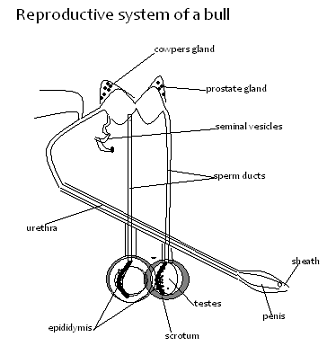
- The Testis:
- Two testes hang loosely between the hind legs.
- Enclosed by loose skin called the scrotum, which regulates temperature for optimum sperm production.
- Produce spermatozoa stored in a coiled tube called the epididymis.
- Epididymis: Storage of spermatozoa.
- Sperm Ducts:
- Convey sperm from the testis and urine through the penis.
- Sphincter muscles contract to allow each to pass separately.
- Seminal Vesicles: Produce fluid called semen.
- Semen carries sperm out of the penis in fluid form.
- Prostate Gland: Produces fluid that neutralizes the acidic effects of urine in the urethra, preventing sperm death.
- Accessory Glands: Include seminal vesicles, Cowper’s gland, and prostate gland.
- Urethra: Conveys urine and semen.
- Penis:
- Surrounded by a sheath, an extension of skin.
- Introduces sperm into the cow’s vagina through the vulva during mating.
- Functions as a copulatory organ and for urination.

Ovaries and Fallopian Tubes (Oviduct)
- Two ovaries located in the abdomen, left and right.
- Produce ova (eggs) and hormones controlling the sexual cycle.
- Oestrogen produced by the Graafian follicle induces oestrus (heat), causing the cow to show signs of heat.
- Every 21 days, the ovary releases a mature ovum and the cow comes into heat.
- The ovum travels through the fallopian tubes to the uterus.
- This release and movement of the ovum is called ovulation.
- If mating occurs at this time, fertilization takes place.
- The fertilized egg implants onto the endometrium (uterine wall) and develops into a fetus.
Fallopian Tubes:
- Site of fertilization.
- Passage for the egg from ovary to uterus.
The Uterus
- Embryo develops here.
- The cervix: Closes the uterus.
The Vagina and Vulva:
- Vulva is the external opening of the female reproductive system.
- Allows mating so sperm are deposited into the vagina.
- The fetus and urine are expelled through the vulva.
Pregnancy
- Period between fertilization of ova and expulsion of the fetus through the vulva.
- Also called the gestation period.
- In cattle, gestation lasts 270-285 days.
- Ends with the birth of a calf.
- The reproductive tract rests, repairs, and returns to normal after birth.
- During pregnancy, the hormone progesterone is produced by the placenta to maintain the fetus in the uterus.
Parturition (Giving Birth)
- Parturition is the act of giving birth.
- The fetus is expelled through the birth canal.
Signs an Animal Is About to Give Birth:
- Distended udder producing thick milky fluid called colostrum.
- Swollen vulva producing thick mucus.
- Loose and slackened pelvic girdle.
- Visible pin bones.
- General restlessness.
- Parturition usually occurs within 2-3 hours after these signs.
- The correct presentation is front feet first, with the head outstretched between the feet.
- Any other presentation is called mal-presentation or breech presentation and requires assistance.
Reproduction in Poultry
- The cock has no penis but a small opening near the vent through which sperm are emitted.
- The cock’s testes are located within the body.
- The hen has an elongated oviduct for egg formation.
- Fertilization occurs internally.
- During mating, the cloaca of the hen and vent of the cock fit together, allowing semen to enter the cloaca and then the oviduct.
The Reproductive System of a Hen
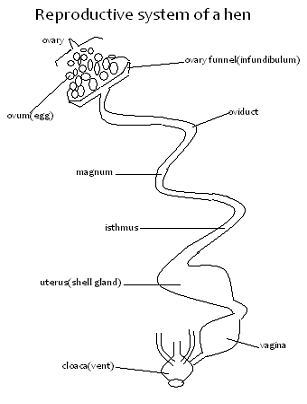
Ovary
- Hen has two ovaries but only one is functional.
- Ova are formed in the ovary.
- There are 3500-4000 ova inside the ovary held by follicles.
- Mature ovum is released via rupture of a follicle.
- The ovum moves into the oviduct, received by the funnel.
Funnel (Infundibulum)
- Fertilization occurs here.
- Chalazae are added to the yolk.
- Egg stays here for about 15 minutes.
- The funnel is approximately 11.6 cm long.
Magnum
- Thick albumen (egg white) is added.
- Egg stays here for about 3 hours; the magnum is 33 cm long.
Isthmus
- Approximately 10.6 cm long.
- Shell membranes are added.
- Determines the shape of the egg.
- Water, mineral salts, and vitamins are added.
- Egg stays here for about 15 minutes.
Uterus (Shell Gland)
- Calcium is deposited to form the shell around the egg.
- Pigments are added.
- Albumin addition is completed.
- Egg stays here for 18-22 hours.
Vagina
- Short, about 6.9 cm long.
- Temporary storage of the egg before laying.
Cloaca
- Egg moves out through the cloaca and vent.
- The cloaca extends to prevent the egg from breaking during laying.
Note:
- Egg formation does not depend on fertilization.
- Egg formation takes 24-26 hours.
- Egg components are obtained from the hen’s body reserves.
Selection of a Breeding Stock
- Selection is a tool for livestock improvement.
- A breeding stock is a group of males and females acting as parents of future generations.
- Selection involves allowing certain animals to be parents while culling others.
- Culling removes animals that do not perform to the desired level.
- Retained animals have desirable characteristics that make them produce more.
- Selected animals form the breeding stock.
- The breeding stock should pass good qualities to offspring for better performance and livestock improvement.
- Repeated selection over generations increases the chances of desirable qualities forming in animals.
- Genetically, this is termed gene frequency (occurrence of genes carrying desirable traits).
- Selection increases desirable genes and decreases undesirable ones.
- Characteristics selected should be mainly influenced by genetics, not environment.
- Selection improves highly heritable traits.
- Heritability is the likelihood a trait is transmitted to offspring.
- Traits like milk yield are lowly heritable, meaning environment affects them more.
The Degree to Which Selection Affects a Character Depends on the Following Factors:
- The heritability of the character.
- The intensity of selection.
- The interval between generations and the type of selection practiced.
Factors to Consider When Selecting a Breeding Stock
- Age
- Level of performance
- Physical fitness
- Health
- Body conformation
- Temperament or behaviour
- Quality of products
- Mothering ability
- Adaptability
- Prolificacy
Age
- Select young animals.
- Those that have not parturated more than three times are preferred.
- They have a longer productive life.
- Old animals are poor breeders and low producers.
- Production and breeding efficiency decline with age.
Level of Performance
- Animals with the highest production level are selected.
- Performance is best indicated by records.
Good Performance Is Indicated By:
- High milk, wool, and egg production.
- Good mothering ability.
- High prepotency, the ability of a parent to pass good qualities to offspring.
- Animals with poor performance should be culled.
- Good records should be kept and used for selection.
Physical Fitness
Animals selected should be free from physical defects such as:
- Mono-eyed condition
- Limping
- Irregular number of teats
- Scrotal hernia
- Defective or weak backline
Health
- Sick animals do not breed well and are expensive to keep.
- Disease-resistant animals pass resistance to offspring.
Body Conformation
- Animals should have proper body conformation for breeding.
- A dairy cow should be wedge-shaped with a large udder, thin legs, and a long neck.
Temperament or Behaviour
- Animals with bad behaviour should be culled, such as:
- Cannibalism, egg eating, aggressiveness, kicking.
Quality of Products
- Select animals that produce high-quality products.
Mothering Ability
- Animals should have good mothering ability.
- They should have a natural instinct to care for their young.
- This enables them to rear young up to weaning.
Adaptability
- Animals should be well adapted to the prevailing climatic conditions.
Prolificacy
- Animals should be highly prolific.
- This means the ability to give birth to many offspring at a time (larger litter).
- This is especially important when selecting pigs and rabbits.
Selection in Cattle and Sheep
Selection in Cattle
Consider the Following:
- Level of performance including:
- Milk yield and butter content
- Length of lactation period
- Calving intervals
- Age of the animal
- Fertility
- Physical fitness
- Health
- Body conformation
- Suitability for milk or beef enterprise
Selection in Sheep
Consider the Following:
- Level of performance including:
- Mothering ability
- Growth rate
- Wool quality
- Carcass quality
- Twinning rate
- Age
- Suitability for wool or mutton enterprise
- Flocking instinct
- Health
- Physical fitness
- Inheritable defects
- Fertility
Selection in Goats
Consider the Following:
- Fertility
- Mothering ability
- Growth rate
- Twinning rate
- Carcass quality/dressing percentage
- Suitability for milk or meat enterprise
- Health
- Age
Selection in Pigs
Consider the Following:
- Carcass quality/dressing percentage
- Suitability for bacon or pork enterprise
- Growth rate
- Health
- Mothering ability
- Prolificacy
- Number of teats
- Temperament
- Body formation
- Age
- Heredity defects
Selection in Camels
- Health
- Age
- Temperament
- Foraging ability
- Fertility
- Level of performance for milk, meat, fur, and transport
Method of Selection
These Include:
- Mass Selection: Animals with superior characteristics are selected from a herd and allowed to mate among themselves.
- Progeny Testing: Assessing an animal’s breeding value based on offspring performance.
- Contemporary Comparison: Comparing performance between heifers of the same age and sexual maturity.
Breeding
- Process of mating selected males and females to produce offspring with desired characteristics.
Reasons for Breeding
- To expand the inherited potential of the animal.
- To improve production.
- To overcome production problems caused by the environment.
- To satisfy consumer preferences.
- For economic reasons.
Terms Used in Breeding
Inheritance
- Genetic transmission of characteristics from parents to offspring.
- Inheritance is carried by sex cells (gametes) and controlled by genes in chromosomes.
- Genes are tiny units carrying specific traits such as color, body shape, and milk production.
- Chromosomes carry genes and exist in pairs (paternal and maternal) in the nucleus of body cells.
- The number of chromosomes is constant.
Dominant and Recessive Characteristics
- A dominant gene suppresses the other and produces a dominant trait.
- A recessive gene is suppressed and produces a recessive trait.
Hybrid and Hybrid Vigour
- A hybrid is an animal produced by crossing two different breeds.
- Hybrid vigour (heterosis) is increased vigor and performance from crossing two superior breeds.
Epistasis
- Masking of one gene’s effect by another non-allelic gene located at a different locus.
Breeding Systems
Inbreeding
- Mating of related animals.
- Reasons:
- To increase genetic uniformity in a herd.
- Used to fix desired characteristics in new breeds.
- To increase phenotypic uniformity.
- To obtain proven sires.
Limitations
- Loss of hybrid vigour.
- Decline in fertility.
- High rate of prenatal mortality.
Systems of Inbreeding
- Close Breeding: Mating between very closely related animals, e.g., siblings or parent-sibling.
- Line Breeding: Mating of distantly related animals with a common ancestor, e.g., cousins.
Outbreeding
- Mating of unrelated animals.
Reasons:
- To introduce new genes into an existing herd.
- To exploit heterosis from crossing two breeds.
- To develop new breeds or grade animals.
Limitations
- Lack of uniformity in offspring.
- Desirable traits may be lost due to variation.
Systems of Outbreeding
- Cross-breeding: Mating animals from two different pure breeds.
- Out-crossing: Mating unrelated animals from the same breed.
- Upgrading/Grading Up: Mating a local female with a pure breed sire to produce a high-grade animal.
The resultant animal is called a high grade.
Mating in Livestock
Mating in Cattle
- Heat signs occur every 21 days.
- Heat period lasts 18-30 hours, averaging 24 hours.
- Cow should be served 12-18 hours after first heat signs.
Heat Signs
- Restlessness.
- Mounting others and standing still when mounted.
- Rise in body temperature.
- Drop in milk production in lactating cows.
- Swollen, reddish vulva.
- Clear or slimy mucus discharge from vulva.
- Frequent bellowing or mooing.
Mating in Pigs
- Heat signs occur every 21 days.
- Heat lasts about 72 hours.
- Sows or gilts should be served 18-36 hours into the heat period.
Signs of Heat
- Restlessness.
- Frequent urination.
- Swelling and reddening of vulva.
- Clear or slimy vulva discharge.
- Frequent mounting on others.
- Responds well to the ‘riding test’.
Mating in Rabbits
- Does are ready for mating at 6-7 months of age.
- Heat signs occur every 14 days.
- The doe should be taken to the buck for mating, not vice versa.
Signs of Heat
- Restlessness.
- Frequent urination.
- Swollen vulva.
- The doe lies on her side.
- Rubs herself against walls or solid objects.
- Attempts to contact other rabbits by peeping.
Methods of Service in Livestock
Natural Mating
Advantages
- More accurate.
- Less laborious.
- Useful when heat signs are difficult to detect.
Disadvantages
- Inbreeding is not easily controlled.
- Transmission of breeding diseases.
- Extra feed required for the male.
- Large males can injure small females.
- Wastage of semen.
- Transporting bulls to remote areas is cumbersome and expensive.
Artificial Insemination
- Introduction of semen into the female reproductive tract by artificial means.
Advantages
- Economical use of semen.
- Controls transmission of breeding diseases.
- Sires unable to serve due to injury or weight can still produce semen.
- Prevents injury to small cows by large bulls.
- Reduces expenses of keeping a male animal.
- Affordable for small-scale farmers.
- Semen can be stored for long periods.
- Helps control inbreeding.
- Eliminates the need to keep dangerous bulls on the farm.
- Facilitates research work.
Disadvantages
- Harmful traits can spread quickly from one bull to many offspring.
- Requires skilled labor.
- Low conception chance if semen dies during storage.
- Laborious process.
Embryo Transplant
- Implantation of an embryo from a high-quality female (donor) into the uterus of a low-grade female (recipient).
Advantages
- Faster multiplication of animals with superior traits.
- Easier to transport embryos than whole animals.
- Embryos can be stored awaiting recipient availability.
- Stimulates milk production in recipient females not ready to produce milk.
- Allows use of low-grade animals for rearing high-quality offspring.
- Offspring of superior females spread quickly in an area.
Disadvantages
- Expensive.
- Requires skilled personnel.
- Needs special equipment for fertilization and embryo storage.
Signs of Parturition in Livestock
- Parturition is the act of giving birth in female animals.
Parturition in Cattle
- Gestation period is 270-285 days, averaging 280 days.
Signs of Parturition
- Restlessness.
- Enlarged or swollen vulva.
- Clear mucus discharge from vulva.
- Slackening of pelvic muscles.
- Full and distended udder.
- Thick milky fluid from teats.
- Appearance and bursting of water bag just before calving.
Parturition in Pigs
- Gestation period is about 4 months (3 months, 3 weeks, and 3 days).
Signs of Parturition
- Restlessness.
- Reddening and swelling of vulva.
- Full udder with milky fluid; sow prepares a nest by collecting bedding.
Parturition in Rabbits
- Gestation period is 28-32 days.
Signs of Parturition
- Preparing a nest by plucking hair from belly.
- Loss of appetite.
- Restlessness.
- Udder distension.


