

Introduction
- Animals are fed for the purpose of production and body maintenance.
- The edible material given to animals is called food.
- Food is digested, absorbed, and utilized in the body.
- Nutrients are organic and inorganic substances contained in food materials.
Components of Food
- Water
- Protein
- Carbohydrates
- Fats and oils
- Vitamins
- Mineral salts
Water
Sources
- Free water (through drinking)
- Bound water (contained in feeds)
- Metabolic water (obtained from oxidation of food)
Functions
- Regulates body temperature.
- Acts as a transport agent in the body.
- Serves as a universal solvent in the body.
- Gives shape to the cells (turgidity).
- Acts as a lubricant.
- Constituent of body fluids.
Factors Determining the Requirements of Water by Livestock
- Production level.
- Amount of dry matter eaten.
- Temperature of the surrounding area.
- Type of animal.
- Type of food eaten.
Protein
Sources
- Groundnut cakes
- Cotton seed cakes
- Fish meal
- Meat meal
Functions
- Growth of new tissues.
- Repair of worn-out tissues (body building).
- Synthesis of antibodies.
- Synthesis of hormones and enzymes.
- Production of energy during starvation.
Digestion of Proteins
In Non-Ruminants
Protein digestion takes place in the stomach.
- Food is mechanically broken down through chewing into small particles.
- Proteins are acted on by enzymes to break down into amino acids, which are then absorbed into the bloodstream.
In Ruminants
Protein digestion initially takes place in the rumen.
- Food is acted on by microorganisms to form microbial protein.
- Later, enzymatic action occurs in the “true stomach” or abomasum, where proteins are broken down into amino acids and absorbed into the bloodstream.
Carbohydrates
Sources
- Cereals
- Tubers
- Commercially mixed feeds
Functions
- Supply energy and heat to the body.
- Excess carbohydrates are stored as fat for insulation.
Digestion of Carbohydrates
- In non-ruminants:
- Carbohydrate feeds are broken down by chewing into small particles.
- Enzymatic action further breaks down carbohydrates into glucose, fructose, and galactose, which are absorbed into the bloodstream.
- In ruminants:
- Mechanical breakdown of carbohydrate feeds is followed by microbial fermentation, which breaks down cellulose into volatile fatty acids.
- These acids are absorbed through the rumen walls.
- Some carbohydrates are further broken down enzymatically in the “true stomach” or abomasum.
Fats and Oils
Sources
- Cotton seeds
- Soya beans
- Groundnuts
Functions
- Supply energy and heat to the body.
- Excess is stored as fat in adipose tissues.
- Source of metabolic water in the body.
- Required for the development of the neural system.
- Acts as an insulator in the body.
Digestion of Lipids in Ruminants
- Fats are hydrolyzed in the rumen into fatty acids and glycerol.
- Some are fermented into propionic acid.
- The shorter chains pass to the true stomach where enzymatic digestion occurs.
Vitamins
Sources
- Green materials
- Dried grass
- Fish liver oil
Functions
- Protect the body against diseases.
- Regulate the functions of all parts of the body.
- Act as co-enzymes in the body.
Examples:
- Vitamin A
- Vitamin B2
- Vitamin C
- Vitamin E
- Vitamin K
Minerals
Sources
- Salt licks
- Bone meal
- Legumes
- Cereals
Functions
- Form part of tissues such as bones and teeth.
- Work together with enzymes.
- Act as acid-base buffers.
- Act as electrolytes in the body.
- Regulate osmotic balance in the body.
Examples:
- Calcium
- Phosphorus
- Magnesium
- Iron
- Iodine
- Sodium
- Chlorine
- Calcium and phosphorus:
- Needed for teeth and bone formation.
- Lack of these minerals leads to rickets and osteomalacia.
- Lack of iron leads to anaemia.
Classification of Animal Feeds
This is based on nutrient composition:
- Roughages
- Concentrates
- Feed additives
Roughages
Roughages are feeds with low available nutrients per unit weight and high fiber content.
Examples:
- Dry roughages
- Succulent roughages
- Residues from agricultural by-products and conserved materials
Characteristics
- Low level of available nutrients.
- High level of calcium, especially in legumes.
- Good source of vitamin A.
- High fiber content.
Concentrates
Concentrates are feeds with high available nutrients per unit weight.
Examples:
- Maize germ and bran
- Malt extract
- Milk products
- Soya beans
- Oil seed cakes
- Meat meal
- Bone meal
- Blood meal
Characteristics
- Low fiber content.
- Consistently high feed content.
- High digestibility.
- High nutrient content.
Feed Additives
These are substances added to feed to increase:
- Palatability
- Medication
- Or hormones to make animals produce more.
There are two types:
- Nutritive additives, such as mineral licks (maclick).
- Non-nutritive additives, such as:
- Medicants (coccidiostats)
- Stilboestrol (used in beef animals)
- Oxytocin (to increase milk let down)
Functions
- Stimulate growth and production.
- Improve feed efficiency.
- Prevent disease-causing organisms.
Compounded Feeds
- These are feeds prepared and mixed using machines.
- They can be round, pelleted, pencils, cubes, or mash.
Poultry feeds can be categorized as:
- Chick mash having 20% D.C.P., given to chicks.
- Growers mash having 16% D.C.P., given to growers.
- Layers mash having 12-15% D.C.P., given to layers.
Meaning of Terms Used to Express Feed Values
- Nutritive ratio (NR):
- Proportion of protein to carbohydrates and fats.
- In young animals: 1:3:6
- In old animals: 1:8
- Crude protein (C.P): Total amount of protein contained in a feed.
- Digestible Crude Protein (D.C.P): Portion of crude protein that an animal can digest.
- Crude Fibre (C.F.):
- Total amount of fiber contained in a feed.
- Primarily lignin and cellulose.
- Digestible Fibre (D.F.): Portion of total fiber that an animal can digest.
- Dry Matter (D.M.): Material left in a feed after water has been removed.
- Starch equivalent (S.E.): Amount of pure starch with the same energy as 100 kg of that feed.
- Total Digestible Nutrients (T.D.N.): Sum of all digestible organic nutrients such as fats, proteins, carbohydrates, and fiber.
Computation of Livestock Rations
- Ration:
- Amount of food that provides essential nutrients to an animal in a 24-hour period.
- Enables the animal to meet maintenance and production requirements.
- Balanced ration: Contains all essential nutrients in required amounts and correct proportions.
- Maintenance ration:
- Portion of feed required to maintain vital body processes without weight loss or gain.
- Production ration:
- Feed required over and above maintenance to enable the animal to produce.
- Examples include milk, eggs, wool, growth, work performance, reproduction, and fattening.
Steps in Ration Formulation
- Determine the animal’s feed requirement based on body weight.
- List all available feeds with their nutrient composition and prices.
- Calculate the amount of each ingredient required to meet the animal’s needs.
Methods Used in Ration Formulation
- Trial and error method
- Pearson’s square method
- Graphical method
- Linear programming (use of computers)
Example
Mix a pig’s ration with 22% protein using soya bean meal (40% DCP) and maize meal (8% DCP).

Soya bean meal (14 * 100) = 43.75 kg
Maize meal (18 * 100) = 56.25 kg
Digestion and Digestive Systems
- Digestion is the process through which food is broken down into small particles in the alimentary canal, ready for absorption into the bloodstream.
Digestion of Food in Livestock Takes Place in Three Stages:
- Mechanical breakdown and chewing
- Microbial breakdown by bacteria and protozoa in the rumen of ruminants
- Chemical breakdown by enzymes
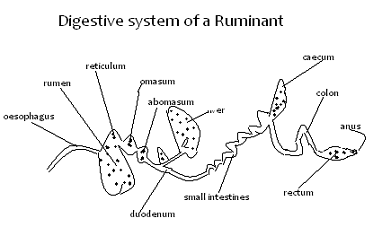
Rumen
- Breakdown of food by microorganisms and storage of food.
- Synthesis of vitamin B-complex.
- Synthesis of amino acids from ammonia gas.
- Proteins are broken down to peptides and amino acids.
- Carbohydrates are broken down to volatile fatty acids.
Reticulum
- Separates large food particles from small particles.
- Retains foreign materials such as stones, hardwood, and sand.
Omasum
- Breaks up food by grinding.
- Reduces water content from the feedstuff.
Abomasum
- Enzymatic digestion takes place here.
- Contains some microbes that digest cellulose.
- Breaks up food by grinding.
- Also found in non-ruminants.
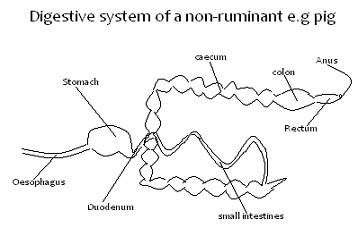
Comparison Between Digestion in Ruminants and Non-Ruminants
| Ruminants | Non-ruminants | ||||
|---|---|---|---|---|---|
| 1. | Chew the cud. | 1. | Do not chew the cud. | ||
| 2. | Have four stomach chambers – polygastric. | 2. | Have one stomach chamber – monogastric. | ||
| 3. | Regurgitate food. | 3. | Cannot regurgitate food once swallowed. | ||
| 4. | Can digest cellulose; have microorganisms in the rumen. | 4. | Cannot digest cellulose; have no microorganisms that digest cellulose. | ||
| 5. | Have no ptyalin in saliva. | 5. | Have ptyalin in saliva; digest starch but not cellulose unless microorganisms are present. | ||
| 6. | Most digestion and absorption take place in the rumen. | 6. | Most digestion and absorption take place in the small intestines. | ||
| 7. | Have alkaline saliva due to presence of ammonia. | 7. | Saliva is neutral pH. | ||
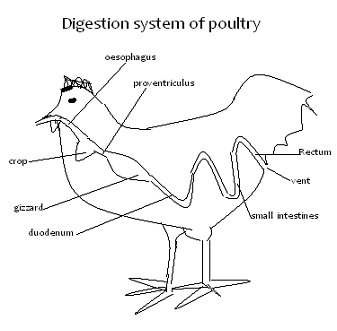
Functions of the Parts of Poultry
- Crop:
- Storage of food.
- Softening of food by secretions from small glands in the walls.
- Proventriculus: Enzymes start the breakdown of food.
- Gizzard: Crushes and grinds coarse food (contains small grit and gravel).
Comparison Between Digestion in Ruminants and Non-Ruminants
Similarities Between Digestion in Ruminants and Non-Ruminants
- Digestion in young ruminants is similar to that in non-ruminants as they do not have a developed rumen-reticulum complex.
- Final protein digestion takes place in the small intestines in both.
- Water absorption takes place in the colon in both ruminants and non-ruminants.


