


CHAPTER SEVEN
HOOKE’S LAW.
Hooke’s law states that “the extension of a spring is proportional to the applied force, provided that the force is not large enough to deform the spring permanently.” Mathematically expressed as Force α extension.
Spring constant
Since Force α extension, then Force / Extension = constant (k).
The constant of proportionality (k) is called the spring constant.
F / e = k or Force (N) = k e.
The spring constant is a measure of the stiffness of a spring. The greater the constant, the stiffer the spring.
The spring constant varies with the following:
- Material – identical springs made of different materials will have different constants, e.g., steel and copper.
- Diameter – the stiffness decreases with the increase in diameter.
- Thickness of the wire – a spring made of a thicker wire is stiffer than one made of thin wire of the same material.
- Length of spring – a short spring is stiffer than a longer one.
- Number of turns per unit length – a spring with a higher number of turns per unit length is less stiff than one with fewer turns per unit length.
Example
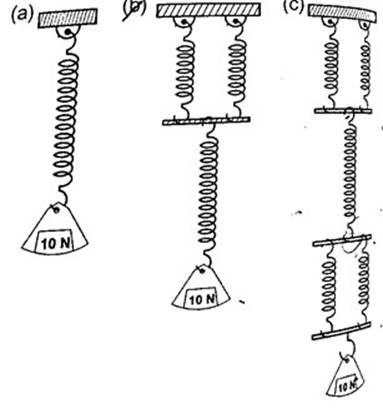
- If the springs shown below are similar and the constant of proportionality (k) is 100 Nm-1, determine total extension in each arrangement.
Solution
- k = 100 Nm-1, extension = force / k = 10 / 100 = 0.1 m = 10 cm.
- Extension of the lower spring = 10 cm, extension of the two parallel springs = 5 cm. Total extension = 10 + 5 = 15 cm.
- Extension of the two lower springs = 5 cm. Middle spring extends by 10 cm. Upper two springs extend by 5 cm. Total extension = 5 + 10 + 5 = 20 cm.
The spring balance
It is made up of a spring mounted in a metal or plastic casing. The spring is fitted with a pointer which moves along a calibrated scale divided into ten equal parts.

Examples
1. A load of 4 N causes a certain copper wire to extend by 1.0 mm. Find the load that will cause a 3.2 mm extension on the same wire. (Assume Hooke’s law is obeyed).
Solution
- Since F α e, then F1 / F2 = e1 / e2. Therefore, F2 = (4 × 3.2) / 1.0 = 12.8 N.
2. A body of 200 g was hung from the lower end of a spring which obeys Hooke’s law.
Given that the spring extended by 100 mm, what is the spring constant for this spring?
Solution
- F = k e. F = 200 × 10-3 kg × 10 N/kg = 2 N.
Extension = 100 × 10-3 m = 0.1 m.
Spring constant (k) = 2 / 0.1 = 20 N/m.
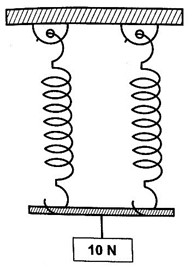
3. Two identical springs, whose spring constant is 6.0 N/cm, are used to support a load of 60 N as shown below. Determine the extension of each spring.
Solution
Since the springs are parallel, their combined spring constant equals 2k.
Therefore, extension = Force / (2k) = 60 / (2 × 6) = 5 cm. Each spring will extend by 5 cm.


1 Comment