

BIOLOGY PAPER 231 / 1 K.C.S.E 2001
QUESTIONS
- Other than having many features in common, state the other characteristics of a species.
- Why are green plants referred to as primary producers in an ecosystem?
- A person whose blood group is AB requires a blood transfusion. Name the blood groups of the donors.
- Name the parts of the flower that are responsible for the production of gametes.
- State two functions of muscles found in the alimentary canal of mammals.
- Adult elephants flap their ears twice as much as their calves in order to cool their bodies when it is hot. Explain.
- Name the organelle in which protein synthesis takes place.
(a) The type of circulatory system found in members of the class Insecta is
(b) Name the blood vessel that transports blood from:
(i) Small intestines to the liver
(ii) Lungs to the heart
- Name three types of chromosomal mutations.
- Name three sites where gaseous exchange takes place in terrestrial plants.
SECTION B
-

The diagram below represents a mammalian nephron.
(a) Name the
(i) Structure labeled P
(ii) Portion of the nephron between point X and Y
(b) Name the process that takes place at point Q.
(c) Name one substance present at point R but absent at point S in a healthy mammal.
(d) The appearance of the substance you have mentioned in (c) above is a symptom of a certain disease caused by a hormone deficiency. Name the
(i) Disease
(ii) Hormone
(e) State the structural modifications of nephrons found in desert mammals.
-
The graph below shows the effect of substance concentration on the rate of enzyme reaction.
-
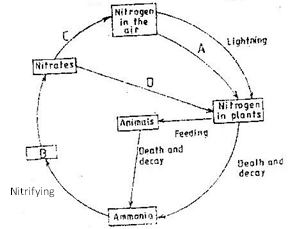
The diagram below represents the nitrogen cycle.
(a) State the process labeled
A
D
(b) Name the compound represented by B.
(c) Name the group of organisms labeled C.
(d) (i) Name the group of plants which promote process A.
(ii) State the part of the plant where process A takes place.
(e) How would excess pesticides in the soil interfere with process A?
Tallness in pea plants is due to a dominant gene.
Two tall pea plants were crossed and their F1 generation were in the ratio of 3 tall: 1 short. Using letter T to represent the gene for tallness and t for shortness give the:
(i) Genotype of the parents.
(ii) Gametes of the parents.
(iii) Genotype ratio of the F1 generation.
(b) What is meant by the term testcross in genetic studies?
-
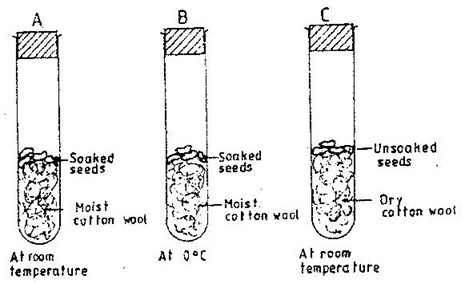
The diagram below represents a setup to investigate the conditions necessary for seed germination.
The setup was left for 7 days.
(a) What conditions were being investigated in the experiment?
(b) State three reasons for soaking seeds in setups A and B.
(c) What were the expected results after seven days?
SECTION C
An experiment was carried out to investigate the nutritional value of two dry powder animal feeds X and Y over a period of six months. Twenty 5-month-old castrated goats were used. The goats were divided into two equal groups A and B.
The animals in group A were fed on feed X throughout the experiment while those of group B were fed on feed Y.
The feeds were supplemented with dry hay and water. The average body weight of each group of goats and the weight of the dry powder feeds were determined and recorded each month. The faeces produced by each group was dried and weighed and the average dry faecal output per month was also recorded. The results are as shown below.
GROUP A GROUP B Months since commencement of the experiment Average total weight of goats (kg) Average weight of total feed (kg) Average monthly dry faecal output (kg) Average total weight of goats (kg) Average weight of total feed (kg) Average monthly dry faecal output (kg) 0 20.4 26.7 10.5 20.5 35.4 16.5 1 22.5 27.5 10.7 19.5 34.3 17.7 2 24.5 25.8 10.3 19.0 35.2 17.2 3 26.3 18.5 8.8 18.5 36.1 17.5 4 28.0 16.6 7.2 17.1 36.0 16.9 5 29.4 16.3 6.0 16.3 35.8 16.8 6 29.5 16.1 5.6 15.6 35.5 16.6 (i) What is the relationship between the amount of feed and the faecal output?
Output
(ii) Work out the average increase in weight for the animals in group A during:
The last two months.
(iii) Account for the average increase in weight in goats in group A during the first four months.
The last two months.
(iv) Which of the two feeds is more nutritious?
Give reason for your answer.
(b) State four uses of digested food in the bodies of animals.
(c) State four uses of water in the bodies of animals.
17. (a) State the functions of the following parts of the mammalian ear:
(i) Tympanic membrane
(ii) Eustachian tube
(iii) Ear ossicles
- Describe how semicircular canals perform their functions.
18. (a) Describe the process of fertilization in a flowering plant.
(b) State the changes that take place in a flower after fertilization.


