

6. Gaseous exchange in (a) plants (b) animals Questions
1. a) Name the site of gaseous exchange during breathing in mammals.
b) State three characteristics of the site named in (a) above.
2. Why would carboxyhaemoglobin lead to death?
3. State two causes of coronary thrombosis
4. What adaptation do red blood cells have for transportation of carbon (IV) oxide?
5. (a) What is Respiration Quotient (RQ)?
(b) (i) Calculate the RQ of the food substance shown by the equation below.
2C51H98O6 +
145 O2 102CO2 + 98H2O + Energy
(ii) Name the food substance being oxidized in b (i) above.
6. Outline three ways in which the gills of Tilapia fish are modified to perform their function.
7. Identify the surfaces of gaseous exchange in the following:-
(i) Paramecium;
(ii) Roots;
(iii) Frog;
8. (a) Name two gaseous exchange
(b) Explain how oxygen gets into the haemolymph of an insect
10. (a) Outline two physiological changes that occur in the body to lower the level of Carbon (IV)
Oxide after vigorous physical exercise
(b) Name the site of respiration in a cell
11. What is the importance of counter current flow in the exchange of gases in a fish
12. State four ways in which red blood cells (RBC) are adapted to the their function
13. (a) (i) Where in a cell does glycolysis take place?
(ii) Name the product of the above process
(b) Briefly explain Kreb’s cycle in a plant cell during anaerobic respiration
14. Describe the changes that occur to the rib cage and the diaphragm during inspiration
15. a) What is translocation b) Name two forces that maintain transpiration stream
16. Most carbon (IV) oxide is transported form tissues to the lungs within the red blood cells and
not in the blood plasma. Give two advantages of this mode of transport
17. Give a reason why halophytes have pneumatophores
18. Give two characteristics of respiratory surfaces in animals
19. Give a reason for each of the following on mammalian Red blood cells
(a) Absence of the nucleus
(b) Biconcave shape
20. State two ways in which bodies of people living in high altitude areas respond to low oxygen
concentration.
21. Explain what would happen to a mammalian Red blood cell 30 minutes alter being placed in
distilled water.
22. (a) State two ways in which the surface area of the fish filaments is increased for efficient gaseous
exchange.
(b) What is the importance of counter flow system in the filaments of a fish.
23. The apparatus below illustrates breathing in mammal.
Describe what happens if the rubber plug is pulled in the direction shown by the arrow.
24. Describe the path taken by oxygen gas from atmosphere to the tissues of an insect.
25. Why should respiratory surfaces be: (i) Moist (ii) Thin
26. The set up below represents an experiment to investigate the process of photosynthesis.
The set up placed in sunlight for six hours.
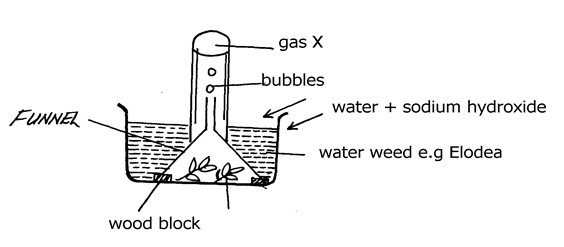
(a) Why was sodium hydrogen carbonate added to water in this experiment?
(b) Explain why the number of bubbles reduced by evening
(c) Explain why the water was used in this experiment
(d) Explain why the water was used in this experiment
27. (a) State two adaptations of red blood cell to its functions
(b) Name two ways in which carbon (IV) Oxide is transported in mammalian blood
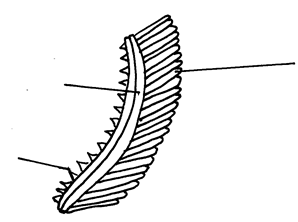 28. The diagram below represents an organ from a bony fish. Study the diagram and answer the
questions that follow:
(a) State the functions of each of the following:
(b) How is the structure labeled C adapted to its function?
29. State how the tracheal system in insects is adapted for gaseous exchange.
30. Differentiate between active immunity and passive immunity
31. Name three sites where gaseous exchange takes place in terrestrial plants.
32. An athlete training to take part in an international competition moved to a high attitude area where
he was to train for twelve days before the competition. He took his pulses per minute daily and
tabulated them as shown below:-
a) Other than pulse rate, name one other process which was affected by change of altitude
b) Account for the change in pulse rate from:- i) Day 1 to day 7
ii) Day 8 to day 12
c) Explain the advantage this athlete has over the one who trains in a lower altitude area
d) The equation below represents a reaction which takes place during rapid muscular movements
in humans.
Glucose Lactic acid + 150KJ
i) State two effects of this reaction to an individual
ii) How is lactic acid finally eliminated from the muscle tissues of the human after the muscle
33. a) State any two structures used for gaseous exchange in plants.
b) Name any two sites where gaseous exchange takes place in a leaf of a terrestrial plant.
c) State any two types of leaves and their respective functions.
d) Briefly describe how stoma opens.
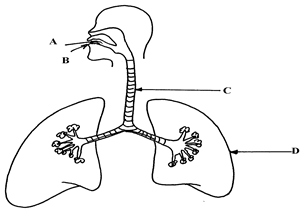 34. The diagram below represents a section of the human respiratory system:
(a) One can inhale through path A, or B. Giving reasons, state the more appropriate path.
(b) How is the part labbelled C adapted for its function?
(c) Explain the effect of regular tobacco smoking to the functioning on the organ labelled D
35. (a) How is the structure of mammalian gaseous exchange system adapted to its functions
(b) Describe the mechanism of opening and closing of the stomata using the photosynthetic
theory
36. (a) Describe the mechanism of inhalation in man.
(b) Using photosynthetic theory explain the mechanism of opening of stomata.
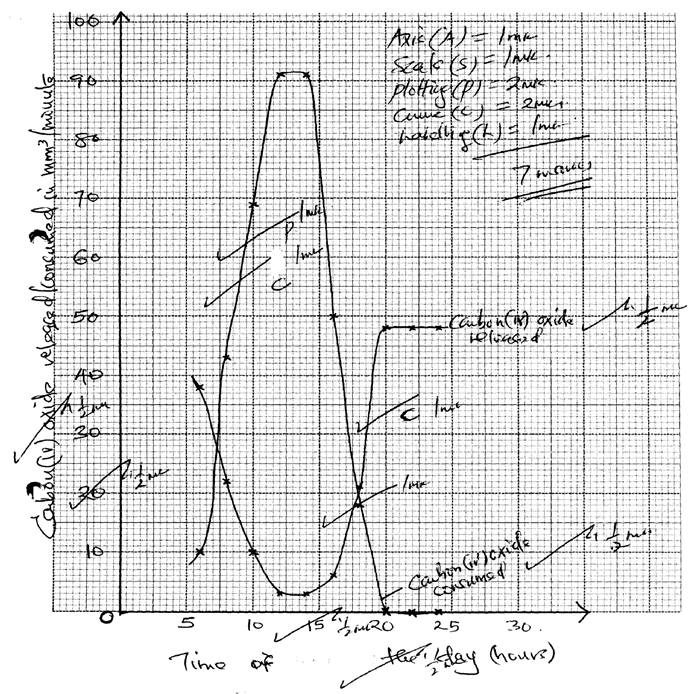
37. In an experiment to investigate a certain processes in a given plant species, the rate of carbon (IV)
oxide consumed and released were measured over a period of time of the day. The results of the
investigation are shown in the table below:
Time of the day (hours) | 6 | 8 | 10 | 12 | 14 | 16 | 18 | 20 | 22 | 24 |
Carbon (IV) oxide consumed in mm3/min | 10 | 43 | 69 | 91 | 91 | 50 | 18 | 0 | 0 | 0 |
Carbon (IV) oxide released in mm3/min | 38 | 22 | 10 | 3 | 3 | 6 | 31 | 48 | 48 | 48 |
b) Name the biochemical processes represented by;
(i) Carbon (IV) oxide consumption
(ii) carbon (IV)oxide release
(c) Account for the shape of the curve for carbon (IV) oxide consumption between
(i) 6-16 hours
(ii) 20-24 hours
(d) Account for carbon (IV) oxide released between 12-16 hours
(e) (i) What is compensation point?
(ii) From the graph state the time of the day when the plant attains compensation point
(f) Explain how high temperature above optimum affects the rate of carbon (IV) oxide
consumption in the plant.
6. Gaseous exchange in (a) plants (b) animals Answers
1. a) Alveoli
b) Thin walled/ epithelium highly vascularised, has large surfaces area; moist;
2. It does not easily dissociate; thereby reducing the capacity of haemoglobin to transport *KKE*
oxygen;
3. Smoking; Diet with lots of fats and carbohydrates/cholesterol fat; (2mks) *KKE*
4. – Carbonic anhydrase; facilitates formation of /ionization of carbonic acid;
– It has haemoglobin which readily combines with bicarbonate.
5. (a) The ratio of the amount/volume of Carbon (IV) Oxide produced to that of oxygen consumed
during respiration;
(b) (i) RQ = Vol. of CO2 produced
Vol. of oxygen consumed
= 102
145;
= 0.703;
(ii) Fats;
6. Gill filaments are thin/one cell thick to facilitate faster/rapid diffusion of respiratory
gases; the surfaces of the gill filaments are moist to facilitate dissolution of respiratory gases The gill filaments are numerous to prove a large surface area for gaseous exchange; the gills have numerous rakers that filter food/solid particles that may damage the gill filaments; The gill has a gill bar which is long and curved to provide a large surface area for attachment of gill filaments; the gill is highly vascularised to ensure efficient transport of respiratory gases;
7. (i) Cell membrane;
(ii) Lenticels;
(iii) Skin, lungs and mouth cavity;
8. a) (Moist) skin/ buccal cavity; lungs; mark the first two
b) – (oxygen) dissolves in the water film; in the tracheoles; and diffuses in to the haemolymph (along the concentration gradient)
9. a) Increased rate of breathing; increased rate of heart beat;
b) Mitochondrion;
10. – Importance of counter current flow in fish : – It maintains a steep concentration gradient
across the respiratory surface; thus ensuring there is a maximum exchange of O2 from water
to the blood;
11. Four adaptations of red blood cells
- -lack of nucleus to create large surface are for dense packing of haemoglobin required for oxygen transportation;
- Have biconcave shape to provide large surface are for oxygen transportation;
- have thin membrane to facilitate rapid diffusion of respiratory gases;
- have numerous /many haemoglobin densely packed to increase the rate of oxygen transportation;
- are pleumorphic /can change shape easily thus can squeeze through narrow capillaries;
12. a) i) Cytoplasm
ii) Pyruvic acid
b) Pyruvic acid is broken down; into ethanol and CO2
13. – Ribcage moves upwards and outwards;
– Diaphragm muscles contracts; hence;
– Diaphragm flattens;
14. a) Process of movement of food substances from site of manufacture to other storage
organs
b) – Capillarity
– Root pressure
– Transpiration pull
15. -PH of blood, plasma is not altered homeostasis maintained;
-Within RBC there is an enzyme (carbonic anhydrate) which helps in fast loading /
dissociation / combination and offloading/dissociation of CO2; (award 1st two2mks)
16. Have lenticels: for gaseous exchange: *
17. – Moist;
– Thin epithelium; Mark 1st two
– Highly vascularised:
– Large surface area;
18. (a) Create more room/space for packing of more haemoglobin:
(b) To provide a large surface area for diffusion of a lot of respiratory gases:
19. -Increase in Red blood cell count/Total number of red blood cells;
– Increase in haemoglobin content of RBC
20. Distilled water is hypotonic to RBC (OWTTE); hence water is absorbed by osmosis; the RBC
bursts haemolysis (due to absence of cell wall)
21. (a) Numerous/ many;
(b) Long:
(b) Blood in the gill filaments flow in the opposite direction to water over the gill filaments:
to create a deep diffusion gradient; for rapid ?faster diffusion of respiratory gases:(2marks)
22. When the rubber plug is pulled there is an increase in volume and decrease in pressure in the
syringe; Therefore due to this the atmospheric pressure exceeds the pressure in the syringe case
causing air to flow in the balloon; leading to the increase in size of the balloon;
23. – Air containing oxygen from the atmosphere gets to trachea; through spiracles; on to the tracheoles from where it diffuses; to the tissue;
24. (i) Moist to dissolve respiratory gases prior to diffusion;
(ii) Thin to reduce the distance through which diffusion has to take place/to facilitate
rapid diffusion;
25. (a) Adds carbon dioxide to the water
(b) At evening the light intensity has reduced hence reduction in the rate of hotosynthesis.
(c) Water plants are able to extract dissolved carbon(IV)oxide in water (1×1=1mk)
26. (a) – Red blood cells are biconcave in shape increase surface area to pack more haemoglobin
– They are numerous for efficient transport of oxygen
– Red blood cells lack nucleus, creating large surface area to more haemoglobin
(b) – In form of hydrogen carbonate by plasma, carboamino haemoglobin or carbonic acid in plasma
27. a) A – Ciil rackers act as a screen preventing entry of food and other particles that
might damage the delicate gill lamella;
B – Gill bar for attachment of gill rakers and gill filament
C – Gill filaments – the surface on which gaseous exchange take place
b) Filaments are supplied wit a dense network of blood capillaries for the efficient transport
of gases;
28. .- Ventilated through spiracles on either side of the insects body;
– Trachea branches too numerous tracheoles increasing the surface area for gaseous exchange;
– Tracheoles are moist to allow gases to diffuse in solution form;
– Tracheoles membrane is very thin to provide a short distance for diffusion
– Trachea has circular rings of chitin to prevent collapsing. This keeps the air passages always open;
– Spiracles have valves to enhance movement of gases into the trachea, and also to prevent drying of the trachea;
29. – Active immunity is immunity that is produced when an animal’s body reacts to an antigen
by producing antibodies;
– Passive immunity is immunity that is produced when antibodies are transferred from
one individual to another;
30. – Lenticels;
– Cuticles
– Mesophyll cells/ spongy mesophyll/ palisade mesophyll/ stomata/ substomatal chambers;
31. a) Ventilation
b) i) lower concentration of oxygen in high altitude areas; raises the demand of oxygen by
body cells
ii) Number of red blood cells has increased; hence enough oxygen is reaching all body
cells adequately
c) Has a higher capacity of transporting enough oxygen to body cells; due to higher number of
red blood cells; in the body (has lower oxygen demand)
d) i) Muscle crumps; Muscle fatigue
ii) It is completely oxidized by oxygen to form water, carbon IV oxide and energy;
32. a) Red Blood Cells
- Lacks nucleus to provide greater space for packing more haemoglobin; oxyhaemoglobin;
- Thinner membrane for faster diffusion of gases through a shorter distance
- Biconacave to increase the surface area for maximum transport of gases
- Shorter life cycle for increasing more efficiency in gass transport;
- Numerous to increase the surface area for maximum transport of gases;
White blood cells – Have a lobbed nucleus to carry out engulfing and digestion process of
pathogens more effectively
Platelets – Has thromboplastic enzyme which catalyses the activation of prothrombin to thrombin during blood clotting process;
FibrinogenIt is highly sensitive to thrombin whose presence changes it into insoluble fibrin;
Plasma – Has water with a high specific heat capacity which enables it to maintain the
temperature of the body within a narrow range
- Water also dissolves and act as a medium of transport of dissolved substances;
33. (a) Stomata; cuticle; lenticels; any two
(b) Spongy mesophyll layer; Palisade mesophyll; sub-stomatal air spaces/chambers;
(c) Foliage leaf – photosynthesis;
scale leaf v – protection;
floral leaf – attraction of agent of pollination/photosynthesis;
cotyledon leaf – storage of food / photosynthesis
(d) Guard cells photosynthesize food, accumulate monosaccharide and become osmotically
active; they absorb water from neighbouring epidermal cells and stoma opens as they
expand/swell;
34. (a) Path A (Nose) has mucous lining which trap foreign particles in air; has sensitive
cells to smell in nose limit inhalation of poisonous gases; air is warmed in the nose before
reading the lungs; hair in the nose filter solid particles in the air;
(b) Has a lumen/tubular for air passage; has mucous membrane to trap foreign particles and filter
dust; Has cartilage to prevent collapsing / to keep it open; Has elastic muscles to allow
compression and flexibility;
(c) Soot/smoke particles block the passage (bronchi/alveoli) of the gases; may cause cancer
/stimulate the epithelium membrane/lining to secrete a lot of mucus which may block the
passage;
35. (a) Adaptations of the air ways (trachea and bronchi)
– The walls of the trachea and bronchi are lined by rings of cartilage; which prevent them from
collapsing and keep them open for air passage;
– The inner passage of air ways is lined with mucous membrane; which contain ciliated cells;
whose movements to and from the pharynx cause a sweeping action that collects mucus
containing dust towards the pharynx hence preventing their entry into the air ways;
– The mucous membrane contains mucus secreting cells; which produce mucus that trap dust
and pathogenic particles which would find their ways into the air ways;
– The mucous membrane has a rich supply of blood; which helps to keep the incoming air
warm and moist for easy diffusion into the lungs;
– The epiglottis and other structures on top of the trachea prevent food, drinks and other soil
particles from gong into the trachea during swallowing;
Adaptations of the lungs
– It has numerous alveoli; that provide a large surface area for efficient gaseous exchange;
– Epithelial lining between alveoli wall and the blood capillaries is thin; to provide a shorter diffusion distance for easy gaseous exchange;
– The lung is spongy and has numerous air sacs; that accommodate large volume of gases (oxygen);
– It is highly supplied with blood capillaries that transports oxygen and carbon (IV) oxide to and from the body tissues respectfully;
– Its epithelial lining is covered by a thin layer of moisture; to dissolve oxygen for easy diffusion into the blood stream;
– The lung is connected to tree – like system of tubes (the trachea, bronchi and bronchioles); that supply oxygen and removes carbon (IV) oxide from the lung;
– The whole lung is covered with the pleural membrane which is gas-tight thus changes in pressure within the lungs can occur without external interference; N/B- Mark as a whole)
- Opening
-In the guard cells there are chloroplasts; which carry out photosynthesis in the presence of light; (in the day)
-During photosynthesis glucose is produced in the guard cells; this increases osmotic pressure compared to the neighbouring epidermal cells; water then moves into the guard cells by osmosis; and increases their turgidity;
-The inner walls of guard cells are thicker than the outer walls; so outer walls stretch more than the inner walls causing guard cells to bulge outwards causing the stomata to open;
Closing
-During the night when there is no light; no photosynthesis takes place in the guard cells; Glucose in the guard cells is converted into starch; this lowers the osmotic pressure of the guard cells than the neighbouring cells;
-Water is then drawn away from the guard cells by osmosis; into the neighbouring cells, making them to be flaccid;
– Thinner outer wall shrink and the curvature of the thicker inner wall reduces; then the stomata closes;
36. a) External intercostals muscles contract; internal intercostals muscle relax; Rib cage
move outwards; and upwards; Diaphragm muscles contract; diaphragm flatten; Volume
in thoracic cavity increases; pressure reduces;
Atmospheric air enters the lungs; lungs inflate;
b) Guard cells have chloroplast; which photosynthesis in the presence of light, to form sugar;
the osmotic pressure of guard cell increases; water move from neighboring cells into guard
cells; by osmosis. Guard cells become turgid; inner walls of guard cells being thicker than
outer walls. Causes the outer wall to stretch more resulting in guard cells budging outwards,
 stoma opens
37. (a)
b) i) Photosynthesis;
ii) Respiration
c) i) Rapid increase in amount of carbon (iv) Oxide consumed; As time increase amount of
light increases’, thus increasing rate of photosynthesis
ii) No carbon (iv) Oxide consumed, No light hence no photosynthesis
d) Low amount of carbon (iv) oxide released, carbon (iv) Oxide consumed for
photosynthesis; respiration rate very low
e) i) Point when rate of photosynthesis equals rate of respiration
ii) At 18 hrs
f) It denatures enzymes/ stops photosynthesis; hence consumption of carbon (iv) Oxide


1 Comment