


5. Water and hydrogen Questions
1. (a) Hydrogen can reduce coppers Oxide but not alluminium oxide. Explain
(b) When water reacts with potassium metal the hydrogen produced ignites explosively
on the surface of water.
(i) What causes this ignition?
(ii) Write an equation to show how this ignition occurs
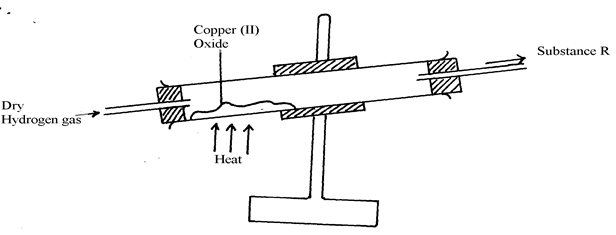 2. In an experiment, dry hydrogen gas was passed over hot copper (II) oxide in a combustion
tube as shown in the diagram below:-
(a) Complete the diagram to show how the other product, substance R could be collected
in the laboratory.
(b) Describe how copper could be obtained from the mixture containing copper (II) oxide
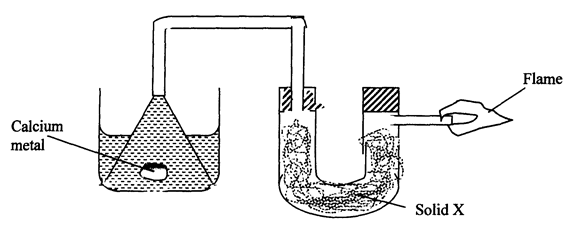 3. The setup below was used to investigate the reaction between metals and water.
(a) Identify solid X and state its purpose
Solid X ………………..………………………………………………………………………..
Purpose ………………………………………………………………………………………..
(b) Write a chemical equation for the reaction that produces the flame.
4. Gas P was passed over heated magnesium ribbon and hydrogen gas was collected as shown
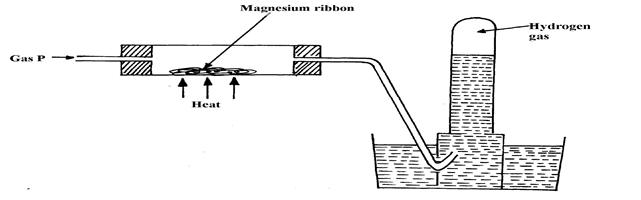 in the diagram below:


(i) Name gas P …………………………………………………………………………………………………
(ii) Write an equation of the reaction that takes place in the combustion tube
(iii) State one precaution necessary at the end of this experiment
5. When hydrogen is burnt and the product cooled, the following results are obtained as shown
in the diagram below:
(a) Write the equation for the formation of liquid Y
(b) Give a chemical test for liquid Y
6. Jane set-up the experiment as shown below to collect a gas. The wet sand was heated before
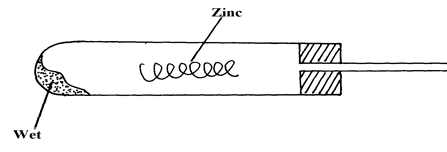 heating Zinc granules

(a) Complete the diagram for the laboratory preparation of the gas
(b) Why was it necessary to heat wet sand before heating Zinc granules?
 7.
7.

(a) Between N and M which part should be heated first? Explain
(b) Write a chemical equation for the reaction occurring in the combustion tube.
8. The set-up below was used to investigate electrolysis of a certain molten compound;-
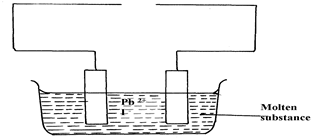
(a) Complete the circuit by drawing the cell in the gap left in the diagram
(b) Write half-cell equation to show what happens at the cathode
(c) Using an arrow show the direction of electron flow in the diagram above
9. Hydrogen can be prepared by reacting zinc with dilute hydrochloric acid.
a) Write an equation for the reaction.
b) Name an appropriate drying agent for hydrogen gas.
c) Explain why copper metal cannot be used to prepare hydrogen gas.
d) Hydrogen burns in oxygen to form an oxide.
(i) Write an equation for the reaction.
(ii) State two precautions that must be taken before the combustion begins and at the end of
the combustion.
e) Give two uses of hydrogen gas.
f) When zinc is heated to redness in a current of steam, hydrogen gas is obtained. Write an
equation for the reaction.
g) Element Q reacts with dilute acids but not with cold water. Element R does not react with
dilute acids. Elements S displaces element P from its oxide. P reacts with cold water. Arrange
the four elements in order of their reactivity, starting with the most reactive.
h) Explain how hydrogen is used in the manufacture of margarine.
10. a) The set-up below is used to investigate the properties of hydrogen.

i) On the diagram, indicate what should be done for the reaction to occur
ii) Hydrogen gas is allowed to pass through the tube for some time before it is lit. Explain
iii) Write an equation for the reaction that occurs in the combustion tube
iv) When the reaction is complete, hydrogen gas is passed through the apparatus until they
cool down . Explain
v) What property of hydrogen is being investigated?
vi) What observation confirms the property stated in (v) above?
vii) Why is zinc oxide not used to investigate this property of hydrogen gas?
11. The set up below was used to collect gas K, produced by the reaction between water and
calcium metal.

(a) Name gas K ……………………………………………………………..
(b) At the end of the experiment, the solution in the beaker was found to be a weak base. Explain
why the solution is a weak base
5. Water and hydrogen Answers
1. (a) Aluminium is above hydrogen in the reactivity series of elements
(b) (i) The reaction is too exothermic that alot of heat is produced causing ignition of
hydrogen in presence of oxygen
(ii) K(s) + H2O(g) KOH(aq) + H2(g)
H2(g) + O2(g) H2O(g)
2.
3. a) Calcium chloride
Drying agent
b) 2H2(g) + O2(g) __________ 2H2O(g)
 4. (i) Steam
(ii) Mg(s) + H2O(g) MgO(s) + H2(g)
(iii) Gas P is passed through the combustion tube before heating is commenced
5. a) 2H2(g) + O2(g) 2H2O(l)
√1
b) – Turns anhydrous white paper √½ copper (II) sulphate into blue. √½ Or
– Turns anhydrous blue √½ cobalt (II) chloride into pink. √½
6. a)


b)reverse steam√1
7. (a) N
(b) 4H2O(g) + 3Fe(s) Fe3O4(s) + 4H2(g) (Not balanced 0mk)
 8. (a)
(b) Pb2+ (l) + 2e– Pb(s)
 (c)
(c)
9. (a) Zn(s) + 2HCl(aq) ZnCl2(aq) + H2(g) 1
(b) Concentrated sulphuric (IV) acid or anhydrous calcium chloride. 1
(c) Copper cannot displace hydrogen from its solution. 1
(d) (i) 2H2(g) + O2(g) 2H2O(l) 1
(ii) Before: Pass hydrogen / through the tube before lighting 1 to drive off air.
End: There should be a continuous flow of hydrogen after / putting off the flame
to avoid an explosion. 1
(e) – Filling balloons 1
– Manufacture of margarine.
– Manufacture of ammonia.
– Conversion of coal to synthetic petrol.
(f) Zn (s) + H2O(g) ZnO(s) + H2(g) 1
(g) S,½ P, ½ Q, ½ R, ½
(h) It adds to unsaturated oils and hardens them. 1
10. a) i) Heating of copper (ii) Oxide to be shown on the diagram
ii) To drive out air because mixture of air and hydrogen is explosive when lit
iii) CuO(g) + H2(g) __________ Cu(g) + H2O(g)
(penalize ½ mark for wrong S.S)
iv) To prevent re-oxidation of hot copper by the atmospheric oxygen
v) Reducing agent
vi) Black copper (ii) Oxide turns to brown showing that copper (ii) Oxide has
been reduced to copper
vii) Zinc is more reactive than hydrogen and therefore cannot be reduced by hydrogen
 11. (a) Hydrogen gas
(b) – Calcium react with water forming calcium hydroxide solution
 – Calcium hydroxide solution dissociates to produce calcium ion (Ca2+ions) and hydroxide
(OH–) ions responsible for basic properties.


