


FIRST TERM E-LEARNING NOTE
SUBJECT: PHYSICS CLASS: SS3
SCHEME OF WORK
WEEK TOPIC
- Electromagnetic Spectrum: Propagation, Detection and Uses
- Gravitational Field: Law, Gravitational Potential, Escape Velocity, Potential Energy in Gravitational Field.
- Electric Field: Coulombs Law, Electric Field Intensity, Electric Potential, Capacitor and Capacitance.
- Electric Cells: Primary and Secondary Defects of Simple Cells. Cells in Series and Parallel.Electrolysis: Electrolytes, Electrodes, Ions, Faraday’s laws.
- Electrical Measurement of Resistance: Resistivity, Conductivity, Conversion of galvanometer to ammeter and Voltmeter, Methods of Measuring Resistance.
- Magnetism: Magnets and Magnetic Materials, Magnetization, Demagnetization, Magnetic Flux, Earth Magnetic Field.
- Electromagnetic Field: Magnetic Field around Current Carrying Conductors- Straight Conductor, Circular Conductor, Solenoid, Applications of Electromagnets-Electric Bell, Telephone Ear Piece.
- Electromagnetic Field: Force on Current Carrying Conductor in a Magnetic Field, Fleming’s Left Hand Rule, Application– DC. Motor, Moving Coil Galvanometers.
- Electromagnetic Induction(i):Induced Current, Laws of Electromagnetic Induction, Flemings Right Hand Rule,Induction Coil.
- Electromagnetic Induction(ii):Application in A.C and D.C. Generator, Transformer, and Power Transmission.
REFERENCE TEXTBOOKS
- New School Physics by Prof. M.W Anyakoha
- New System Physics by Dr. Chow.et.al
- WAEC Past Questions Pack
- UTME Past Question Pack
- Masters Physics Practical Manual
WEEK ONE
ELECTROMAGNETIC WAVES
CONTENT
- Definition and Concept
- Types of Radiation
- Detectors
- Uses
DEFINITION AND CONCEPT
Electromagnetic waves are produced by electromagnetic vibrations. Electromagnetic waves have electrical origin and the ability to travel in vacuum. So, electromagnetic waves are regarded as a combination of traveling electric and magnetic forces which vary in value and are directed at right angles to each other and to the direction of travel. In other words, they are transverse waves.
TYPES OF RADIATION
The electromagnetic waves consist of the following:
- Radio waves with wavelength 10-3m to 1000m.
- Infra-red waves with average wavelengths of 10-6m.
- Visible spectrum, known as light waves, with wavelengths of 7 x 10⁻⁷ m for red rays.
- Ultraviolet rays with wavelength of 10-8m
- X- rays with wavelength of 10-10 m.
- Gamma –rays with wavelength of 10-11m.
Radio waves: Radio waves have the longest wavelengths. Radio waves are emitted from transmitters and carry radio signals to radio sets. The shortest radio waves are called microwaves. Microwaves are used in radar and in heating hence they are used in cooking.
Infra-red waves Infra-red waves are found just beyond the red end of the visible spectrum. They are present in the radiation from the sun or from the filament of an electric lamp. Many manufacturing industries used infra-red lamps to dry paints on painted items. They are also used for the treatment of muscular problems.
VISIBLE SPECTRUM OR LIGHT WAVES
The visible spectrum is made up of red, orange, yellow, green, blue, indigo and violet rays. These are all colours of the rainbow. When these rays combine, they form a white light. In the visible spectrum, red rays have the longest wavelengths while the violet rays have the shortest wavelengths. The main source of light is the sun.
ULTRA VIOLET RAYS
Ultra violet rays are located just beyond the violet end of the visible spectrum. Ultraviolet rays can be produced by quarts, mercury filaments, or the sun. Ultraviolet rays can cause certain materials to fluoresce (i,e glow).
X-RAYS
X-rays are produced when fast moving electrons strike a metal target, which reduces their velocity.X- rays are used in hospitals to destroy malignment growth in the body and to produce X–ray photographs which can locate broken bones, Much of X-ray in the body is harmful and can lead to sterility and adverse change in the blood. X-rays are used in industries to locate cracks in metal castings and flows in pipes.
X-rays ionize gases and have a penetrating effect such that they pass through substances opaque to white light are diffracted by crystals and unaffected by either electric or magnetic fields.
GAMMA – RAYS
Gamma – rays are emitted by radioactive substances such as cobalt. 60, uranium and polonium. Like x- rays, gamma rays ionize gases and darken photographic plates. Because of their shorter wavelengths gamma rays have a greater penetrating power.
EVALUATION
1. Give three similarities of electromagnetic waves. Mention two distinguishing properties of infra-red and ultraviolet rays.
2. Mention and describe two important uses of x-rays.
DETECTORS
The detectors of the various radiations in the electromagnetic spectrum are
i. Gamma rays – Geiger-Muller tube
ii. X- rays – Photographic films
iii. Ultraviolet rays- Photographic films, fluorescent substances
iv. Visible rays – Eye, photographic film, photo electric cell
v. Infra-red rays – Skin, thermometer, photo transistor, photographic film.
vi. Radio waves – Radio set, Television set, Aerials
EVALUATION
- How can you detect the following radiations? (i) x- rays, (ii) Visible rays, (iii) Infra-red rays.
- Electromagnetic waves are regarded as transverse waves, why?
USES
- A knowledge of infra-red rays is used in developing infer red telescopes, infra-red signaling lamps which are useful to soldiers fighting in darkness.
- With the aid of photographic film which are sensitive to infra red, it is possible to take clear photographs through mist and haze.
- X-rays are useful in hospitals (e.g to inspect broken bones), industry (to inspect metal castings), and in science to study crystal structure of matters.
- Gamma rays are used to kill cancer cells in patient’s body as well as bacteria in foods and hospitals equipment.
- A knowledge of ultraviolet rays is used in developing ultraviolet lamps, the lamps are useful in conducting experiments on photo-electric effect.
- Radio waves are very important for effective communication especially when radio set, television set, walkie-talkie are involved.
EVALUATION
- What is the relationship between the direction of a radio wave and the direction of its electric and magnetic fields?
- A radio station transmits at a frequency of 1200KHZ. What is the wavelength of the radio wave?(c = 3.0 x 10⁸ ms-1).
READING ASSIGNMENT
New School Physics for Senior Secondary School(M. WAnyakohaPages 364- 369)
GENERAL EVALUATION
- When a mass is hung on a spring, the spring stretches 6cm. Determine its period of vibration, if its pulled down and released [Π = 3.142 , g = 10m/s2]
- A simple pendulum has a period of 17.0s. When the length is shortened by 1.5cm its period is 8.5s. Calculate the original length.
WEEKEND ASSIGNMENT
1. Arrange the following electromagnetic waves in their increasing order of wavelength, Infra-red rays, visible rays, radio waves and x-rays.(a) Radio waves, infra- red ray, visible rays, x-rays (b) x-rays, visible rays, infra –red rays, radio waves (c) Visible rays, x –rays, radio waves, infra-red rays. (d) Infra-red rays, Radio waves, X- rays, Visible rays.
2. Which of the following radiation is of nuclear origin?(a) X- rays (b) Visible –rays (c ) Radio waves (d) Gamma rays.
3. Which of the following radiations is found useful by soldiers fighting in darkness.(a) Gamma-rays (b) x- rays ( c) infra- red rays (d ) ultra violet rays.
4. The velocity of light in vacuum is
(a) 3. 0 x 106 m/s (b) 3.0 x 10⁷ m/s (c) 3.0 x 10⁸ m/s (d) 3.0 x 10⁹ m/s
5. Which of the following has the shortest wavelength?
(a ) Radio waves (b) x –rays ( c) Infra –red rays (d) microwaves.
THEORY
1. (a) What rays make up the radio waves?
(b) Arrange these radiations in their increasing order of wavelength.Ultraviolet rays,Radio waves Visible spectrum, Infra-red wavesX- rays Gamma –rays
2. (a) What is a radar?
(b) What type of electromagnetic radiation does it use?
(c) How does it function?
WEEK TWO
GRAVITATIONAL FIELD
CONTENT
- Introduction
- Law of Universal Gravitation
- Gravitational Potential
- Escape Velocity
- Potential Energy in Gravitational Field.
INTRODUCTION
Gravitational field is a region or space around a mass in which the gravitational force of the mass can be felt. Gravitation is the force of attraction exerted by a body on all other bodies in the universe. Gravitational force exists between a body and all other bodies around it. Gravitational force act between all masses and hold together planets, stars and galaxies. Each mass has a gravitational field around it.
LAW OF UNIVERSAL GRAVITATION
Newton’s law of universal of gravitation states that “every particle in the universe attracts every other particles with a force that is proportional to the products of their masses and inversely proportional to the square of the distance between them

K
r
The law can be expressed mathematically as:
F ά m1m2 ………………… 1
F ά 1
r2 .…………………2
F ά m1m2
r2
F = G m1m2
r2
m1 and m2 are the masses of the two particles r is the distance between them and G is the universal gravitational constant. The numerical value of G = 6.67 x 10⁻¹¹ Nm2 kg -2.
EVALUATION


- State Newton’s law of universal gravitation.
- Two small objects of masses 100Kgand 90Kg respectively are separated by a distance of 1.2m. Determine the force of attraction between the two objects. (G = 6.67 x 10⁻¹¹ Nm2Kg-2 )
GRAVITATIONAL FIELD INTENSITY
Gravitational field intensity at a point is the force per unit mass of an object placed at that point.
g = F
mThe unit is N/Kg . It is a vector quantity and it is regarded as acceleration due to gravity.
RELATIONSHIP BETWEEN g AND G
If the force of attraction (F) between two particles of matter separated by a distance r is given by:
F = Gm1m2…………………..(1)
r2
But g = F ……………….. ( 2 )
m2
g = Gm1m2 x 1
r2 m2
g =Gm1 ………………. (3)
r2
Note that m1 is the mass of the body exerting the force on the other (e.g the Earth).
EVALUATION
- If the mass of the earth is 5.78 x 10 24Kg and gravitational constant is 6.67 x 10⁻¹¹ Nm2kg2. Calculate the gravitational field intensity due to earth. Radius of earth is 6400km
- The gravitational field intensity at a location X in space is two-fifth of its value on the earth surface. If the weight of an object at x is 4.8N, what is the weight on earth?
GRAVITATIONAL POTENTIAL
The gravitational potential at a point is the work done in taking a unit mass from infinity to that point. The unit is Jkg-1.
The gravitational potential, V, is given by V = – Gm
r
m is the mass producing the gravitational field and r is the distance of the point to the mass. The gravitational potential decreases as r increases and becomes zero when r is infinitely large. The negative sign indicates that the potential at infinity (zero) is higher than the potential close to the mass.
EVALUATION
- Calculate the gravitational potential at a point on the earth surface. Mass of earth is 6.0×1024kg, radius of earth = 6400km and G = 6.67 x 10 -11Nm2kg-2
- Calculate the gravitational potential at a point on the earth surface [ radius of the earth = 6.4X10⁴m mass of the earth = 6.0 X 10 24Kg, G= 6.67X 10 -11 Nm2Kg-2]
ESCAPE VELOCITY
This is the minimum velocity required for an object ( e.g. satellite, rocket) to just escape or leave the gravitational influence or field of an astronomical body (e.g the earth) permanently.
If M = mass of the earth, m = mass of the satellite, then the gravitational force of the Earth on the satellite is:
F =GMm
r2
The work done in carrying a mass m from a point at a distance r from the centre of the earth, to a distance that is so great is
W= GMm Xr
r2
= GMm
r
This work must equal the Kinetic energy of the body of mass m at this point, having a velocity, Ve.
Remember Kinetic Energy K.E = ½mVe2
:. 1/2mVe2 = GMm
r.
Therefore:Ve =………………… (1)
If the mass was launched from the earth surface where r = R, and m1 = M,
so that g = GM
R2.
This implies that:gR = GMand 2gR = 2GM
R R
i.eVe =………………. (2)
EVALUATION
- Calculate the escape velocity of a satellite from the earth’s gravitational field.(g = 9.8m/s2, R = 6.4 x 10 6m).
ENERGY IN GRAVITATIONAL FIELD
A satellite moving in an orbit round the earth has both kinetic and potential energy.
The centripetal force = mv2 = GMm
r2r2
KE = ½ mv2= GMm
2r
PE of mass in orbit = – GMm
r
the total energy in orbit = PE + KE
= – GMm + GMm= GMm
r 2r2r
The following conclusions can be drawn from the equation.
i. The magnitude of the total energy is equal to that of the k.e of the satellite.
ii.The kinetic energy of a satellite in an orbit increases as the radius o the orbit decreases.
iii.The kinetic energy of a satellite in an orbit increases as the speed of the satellite increases.
iv. The potential energy of the satellite in orbit is twice its kinetic energy and of opposite sign.
EVALUATION
Derive an expression for the total energy in a gravitational field. What conclusions can you draw from the equation?
READING ASSIGNMENT
New School Physics for Senior Secondary Schools (M.W Anyakoha Pages 370-377).
GENERAL EVALUATION
- An object is projected with a velocity of 50m/s from the ground level at an angle of φ to the vertical. If the total time of flight is 5s, calculate the value of φ.
- A ball is projected horizontally from a height of 30m above the ground with a speed of 20m/s. calculate the horizontal distance travelled by the ball when it hits the ground g = 10m/s2]
WEEKEND ASSIGNMENT
1. What is the gravitational potential due to a molecule of mass m at a distance r from it.?
(a) Gm (b) Gm (c) Gm2 (d) m2
r2 r r Gr2
- Calculate the escape velocity for a rocket fired from the earth’s surface at a point where the acceleration due to gravity is 10m/s2 and the radius of the earth is 6.0 x 10⁶m
(a) 7.8 x 10³m/s (b) 1.1 x 10⁴m/s (c ) 3.5 x 10⁷m/s (d) 6.0 x 10⁷m/s
3. If g = 9.8m/s2. G = 6.7 x 10⁻¹¹Nm2kg-2, calculate the mass of the earth if the radius is 64000km. (a)6.14 x 10²³kg (b) 5.99 x 1024kg (c ) 3.98 x 1026kg (d ) 4.02 x 1025kg
4. Two objects of mass 80kg and 50kg are separated by a distance of 0.2m. calculate the gravitational attraction between them if G = 6.67 x 10⁻¹¹ Nm2kg-2.
(a) 6.67 x 10⁻⁶ (b) 6.67x 10⁶N (c) 5.92 x 10⁻⁶N (d) 5.92 x 10⁶N.
5. Which of the following statements is/are correct about gravitational potential?
V = -Gm
r
I. The negative sign indicates that work done is against the gravitational field.
II. The potential at infinity is zero
III. The potential at infinity is less than that at the surface of the earth.
IV. Gravitational potential is a vector quantity
(a)I and II only (b) III and IV Only (c) III only (d) I,II and III only (e) II and IV only.
THEORY
1. The average radius of Jupiter’s orbit round the sun of mass 2 x 1030Kg is 7.8 x 10¹¹m. If the mass of Jupiter is 1.9 x 10 27, find the gravitational force the sun exerts on Jupiter , G = 6.67 x 10⁻¹¹Nm2kg-2
2. If the mass of a portion is 1.67 x 10⁻²⁷kg and the mass of an electron is 9.11 x 10⁻³¹kg, calculate the force of gravitation between:
i. a proton and an electronii. two electronsiii. two protons.
Take G= 6.67 x 10⁻¹¹ Nm2kg-2, distance between the protons = 4.0m., distance between the electrons = 2 x 10⁻²m, distance between the proton and the electron = 5.4 x 10⁻¹¹m
WEEK THREE
Electric Field
CONTENT

- Electric Field
- Coulomb’s Law
- Electric Field Intensity
- Electric Potential
- Capacitors and Capacitance.
ELECTRIC FIELD
An electric field is a region of space which surrounds a system of electric charges. Electrical forces will act on any electric charge which is placed within the region. Electric field is a vector quantity. The direction of the field can be determined using a test charge (a small positive charge).
Fundamental Law of Electrostatics
The fundamental law of electrostatic states that: “Like charge repels, unlike charges attract.
Negative charge Positive charge
Attraction between two unlike charges
EVALUATION
With the aid of a sketch diagramexplain the following
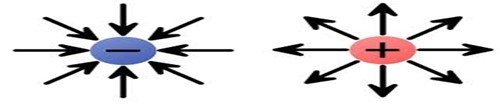

- Like charges repel
- Unlike charges attract.
Electric Force between Two Charges: Coulomb’s Law
It has been pointed out that like charges repel each other while unlikecharges attract each other. Charles Coulomb formulates the law that governs electrostatics forces between electric charges. This law is known as Coulomb’s law.
COULOMB’S LAW states that in a given medium, the force of attraction or repulsion between two charges is directly proportional to the product of the two charges and inversely proportional to the square of the distance between the two charges.
r q1 q2 For charges of magnitude q1, q2, separated by distance r as shown above, Coulomb’s law can be stated mathematically as :
Fαq1q2
Fα 1
r2
:. Fα q1q2
r2
F = Kq1q2
r2
K = 14πEo
Eo is permittivity of free (vacuum) in S. I unit.
Eo = 8.85 x 10⁻¹² Farad/meter.
:. F = q1q24πEor2
RELATIVE PERMITIVITY (εr)
The relative permittivity of a medium is the ratio of the permittivity of a medium to that of air.
Εr = εm
εo
εm = permittivity of medium εo = permittivity of air/ vaccum
EVALUATION
- State Coulomb’s law
- Find the force of attraction between two charges of magnitude 6UC and 20UC respectively. If the distance between them is 0.5m (taek ¼ πEo = 9.0 x 10⁹ Bm2C-2).
- Three charges +15C – 25C and -20C are distributed as shown in the diagram below. Find the resultant force acting on 15C charge.
ELECTRIC FIELD INTENSITY OR STRENGTH (E)
The electric field intensity, E, at any point in an electric field is the force experienced by a unit positive test charge at that point . It is a vector quantity whose S. I unit is (N/C), mathematically.
E =F
q
E= Electric field intensity (NC-1), F = Force, q = charge.
q1 q2
rFrom the diagram above, F between q and q is given as
F =Qq
4πeor2
But E = F = Qq x 1
q 4πEor2 q
:. E = Q
4πEor2 EVALUATION
- Calculate the electric field intensity in vacuum at a distance of 5cm from a charge of 5,0x 10⁴c(1/4πEo = 9.0 x 10⁹ NM2C-2).
- Two similar but opposite point charges –q and +q each of magnitude 6UC are separated by a distance of 12cm in vacuum as shown below:
12cmP
Calculate the magnitude and direction of the resultant electric field intensity at p.
ELECTRIC POTENTIAL
The electric potential (V) at a point is the work done in bring a unit positive charge from infinity tothat point against the electrical forces of the field. It is measured in volts. It is scalar quantity.
Mathematically, V = w
q
V= electric potential (volts)
W = work done in joules, q = charge in coulombs
The electric potential at a point due to a charge Q at a distance r from the charge Q at a distance r from the charge is given as:
V =Q .
4πEor
If the work done is against the field, the potential is positive. If the work done is by the field, the potential is negative. The potential an infinity is zero. Also the potential of the earth is zero. The earth is used to test the potential of the body. This is done by connecting a wire form the body to the earth (the body is said to be earthed). If electron flow from the body to the earth, the body is at a negative potential. If electron flows from the earth to the body, the body is at positive potential. Positive points are at higher potential while negative points are at lower potential.
POTENTIAL DIFFERENCE
The potential difference between any two points in an electric field is the work done is taking a unit positive charge from one point to another in the field.
If a charge Q is moved from a point at a potential V1 to another at a potential V2, the potential difference (V1 – V2) is the work done by the field.
Work done on the charge, W = Q (V1 – V2)
Q
A B
r
If Q moves from A to B, then the work done,
W = Force x distance
W = F.r
But E = F
q
Eq = F
: . W = Eq.r
But W = q(Va – Vb)
Q (Va – Vb) = Eq rVa – Vb = E r
E =Va – Vb
r
: . E = p.d.
distance
i.e, E = V
r
V = E r
: . V = Q
4πEorELECTRON VOLT (eV)
The electron volt is the quantity of energy gained by an electron in accelerating through a potential difference of one volt.
Electronic charge = 1.6 x 10⁻¹⁹C
I e V = 1.6 x 10-19 x 1 = 1.6 x 10⁻¹⁹J
The energy acquired by a charged particle accelerated by an electronic field in a vacuum depends only on its charge and the p.d. through which it falls. When the electron is in motion, its kinetic energy will be ½ mv2. If the electron moves in a circle of radius r, the force towards the centre inmv2r (centripetal force), and it is provided by the electrical force of attraction
Force of Attraction = e2 .
4πEor2
: . ½ mv2= e2
4πEor2
EVALUATION
- Calculate the electric potential due to a positive charge of -12C at a point distance 10cm away
(1/4π εo= 9.0 x 10⁹m).
- A point, A, is at a potential of 120v. Determine the work done in moving an electric charge 25C from A to B.
- Calculate the velocity of an electron as it strikes the anode of a thermionic tube if the p.d. between anode and cathode is 150v.Mass of electron is 9.1 x 10⁻³¹kg while its charge is -1.6 x 10⁻¹⁹C.
WORKED EXAMPLE
1. Calculate the energy in eV and in Joule of an α particle (helium nucleus) accelerated through a p.d. of 4 x 10⁶V.
SOLUTION
The charge on an α particle is 2e.
Ke = work done
= charge x p.d.
= 2 x 4 x106
= 8 x 10⁶eV = 8 MeV
IeV= 1.6 x 10⁻¹⁹J.
K.e. gained = 8 x 106 x 1.6 x 10-19
= 1.48 x 10⁻¹²J
2. An electron gun releases an electron. The p.d. between the gun and the collector plate is 100V. What is the velocity of the electron just before it touches the collector plate? (e = -1.6 x 10⁻¹⁹C, Me = 9.1 x 10⁻³¹ kg).
SOLUTION
Electrical energy = QV
= 100 x 1.6 x 10-19
= 1.6 x 10⁻¹⁹J.
½ (9.1 x 10⁻³¹) v2 = 1.6 x 10⁻¹⁹
V2 = 3.2 x 10⁻¹⁶
9.1 x 10⁻³¹
V2= 0.35 x 10¹⁴
: . V = 6 x 10⁶ ms-1
GENERAL EVALUATION
- Three identical cells each of emf 1.5V and internal resistance 1.0Ω are connected in parallel across an external load of resistance 2.67Ω. Calculate the current in the load.
- A radio is operated by eight cells each of emf 2.0V connected in series. If two of the cells are wrongly connected, the net emf of the radio is?
CAPACITORS
Every conductor may possess one or more of the following properties:
- It could be mainly a resistor, which means that if a current is passed through it, heat energy is mainly produced
- It could be a capacitor which means that when a current passes through it electrical energy or charges are stored.
- Finally, it could be an inductor which stores mainly magnetic energy when a current is passed through it.A Capacitor is essentially a device for storing electrical energy or charges. In general, capacitors can be in the form of two conductors which are insulated electrically from the surroundings. However, most common types of capacitors are in the form of two parallel plate conductors which are separated by a very small distance, d. the two plates of the capacitor can be made to carry equal and opposite charges by connecting the capacitor across the terminals of a battery such that the p.d across the plate is V.
parallel plate capacitor
circuit representation of a capacitor.
This is called “charging”. For a charged capacitor the electric charge on one plate is +q while on the other plate it is -q
EVALUATION
- Explain the term capacitor
- Explain the process of charging and discharging a capacitor
CAPACITANCE
Experiment shows that the magnitude of the charge q on any of the plate is directly proportional to the potential difference, V across the capacitor,
that is q α v
q = cv………………………….. 1
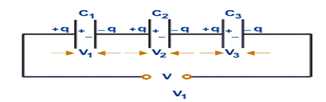
Where c is a constant of proportionality known as the capacitance the farad (F) is capacitance unit.
(F). Practical units are micro (
F ) and pico ( pF ) farad
CAPACITANCE IN SERIES AND IN PARALLEL
If two or more capacitors, c1, c2 — are connected in series , it can be shown that the equivalent or net capacitance, c of the combination is given by
1/c = 1/c1 + 1/c2 + —– 2
If they are connected in parallel the net capacitance C in this is given by
C = c1 + c2 + c3 ——- 3
NOTE
The opposite is the case if these were resistance.
SIMPLE PROBLEMS
E.g. A capacitor contain a charge of 4 .0 x 10– 4 coulomb when a potential difference of 400 v is applied across it. Calculate the capacitance of the capacitor
The capacitance C = q/v
= 4.0 x 10-4= 10 – 6 F= 1. 0
F
400
EVALUATION
- What do you understand by the term capacitance?
- How is it related to potential difference and charge?
ENERGY STORED IN CAPACITOR
A charged is a store of electrical energy. When a charge , q , is moved through a p.d , the work done is given by
W = average p.d x charge
= ½ v q
But v = q /c
W = ½ q/c x q = ½ q2/c
W = ½q2/C
0r if instead we use q=cv
W =1/2 cv2
Therefore the work done is either
W = ½ CV2 = 1/2 q2/c
This work is stored in the capacitor as electrical potential energy.
EVALUATION
1.The net charge on capacitor which is charged to a p.d of 200 is 1.0 x 10⁻⁴ coulomb. What is the capacitance of capacitor and the energy stored in the capacitor?
2. Derive an expression for the energy lost on sharing charges.
PARALLEL PLATE CAPACITOR
For a parallel plate capacitor with plates each of area (A), separated by distance (d) the capacitance (C), of the capacitor is given by
C = εoA/d
Where εo is the permittivity of the dielectric material between the plates of the capacitor.
It therefore means the capacitance of a parallel plate capacitor is dependent ov several factors namely:
- The separation or distance (d) between the plates.
- The permittivity of the medium εo
- The area of the plates (A).
GENERAL EVALUATION
- A string of length 4cm is extended by 0.02cm when a load of 0.4Kg is suspended at its end. What will be the length of the string when a load of 15N is applied?
- A spring of force constant 500N/m is compressed such that its length is shortened by 5cm. the energy stored in the spring is.
READING ASSIGNMENT
New School Physics for Senior Secondary Schools (M.W AnyakohaPages 377 – 379).
WEEKEND ASSIGNMENT
1. Calculate the force acting on an electron carrying a charge of 1.6 x 10⁻¹⁹C in an electric field of intensity 5.0 x 10⁸ N/C is (A). 3.2 x 10⁻²⁹N (B).8.0 x 10-11 (C). 3.1 x 1027N D. 4.6 x 10⁻⁶N
2. Find the electric field intensity in a vacuum at a distance of 10cm from a point charge of 15uc if 1/ 4πε0= 9.0 x 10⁹(A). 1.35 x 10⁷NC-1(B). 1.4 x 10¹⁰NC-1(C). 1.3 x 10¹¹NC-1 (D).1.5×1010NC-1
3. Which of the following statements is/are true about an isolated positively charged sphere? I. It contains excess positive charges.II.It has an electric field associated with it. III. It carries electric current. Iv. It has excess negative charges.A. I and II only B. I, II and III only C.II and IV only D.III and IV E. I and III only
4. Two capacitor of capacitance 3uF and 6uF are connected in series. Calculate the equivalent capacitance (a) 9uF (b) 6uF (c) 2uF (d) ½ uF.
5. A capacitor stores 10-4c of charge when the p.d between the plates is 1kv. What is the capacitance? (a) 10-4uF (b) 0.1 uF (c) 4uF (d) 100uF.
THEORY
1.If three charges are distributed as shown in the diagram below.
+10C 3m
– 20C2m
+16C
Find the resultant force on the +10C charge (take 1 = 9.0 x 10⁹s.I. units)
4πEo
2.Two charges of +5uc and -10NC are separated by a distance of 8cm in a vacuum as shown below.
+5uc B -10uc
3cm 5cmCalculate the magnitude and direction of the resultant electric field intensity due to point B.
1/ 4πEo = 9.0 x 10⁹ s.I unit.
WEEK FOUR
ELECTRIC CELLS AND ELECTROLYSIS
DEFINITION OF SIMPLE TERMS
ELECTRIC CIRCUIT
Electric current is simply electric charge in motion. In conductors such as cables or wire, the current consist of swam of moving electron. Electric cells are chemical devices, which are capable of causing an electric current to flow. This produces electric force, which pushes the current along. If there is a complete circuit of conductors by which current can leave from one end to terminal of the cell and travel round to the other terminal, a current will flow. This current will be the at any point round the circuit and of the line is broken, the current is stopped or switched off. The electrons flow from the negative terminal or cathode of the cell to the procedure terminal or anode
TYPES OF ELECTRIC CELLS
Electric cells are divided into two namely: the primary cells and the secondary cells
PRIMARY CELLS
These are those cells in which current is produced as a result of an irreversible chemical charge.
SECONDARY CELLS
These cells are those which can be recharged when they run down by passing current backwards through them.
There are three component in a cell .Two of them are electrodes in the primary cell, the two electrodes are of different metals (graphite is often used). The third item is the container bearing the electrolyte. Examples of electrolyte are strips of aluminum, Carbons (graphite) copper, iron lead and zinc.
THE SIMPLE PRIMARY CELL (VOLTAIC CELL)
A simple cell can be made by placing two different electrodes (metals) in an electrolyte. Two wire are then used to connect these metals to a voltmeter, an instrument which measure the potential different between any two point in an electric circuit. If a deflection is noticed it means that the cell creates a voltage. If the deflection is done to the right it mean that the electrode, or anode, which is connected to the positive terminal of the voltmeter is the positive electrode, or anode, while the one is connected to the negative terminal is the negative electrode or cathode. If the deflection is however done to the left, a reconnection should be done.
The two major deflects of a simple cell are polarization and local action
POLARIZATION
The cell is characterized by the release of “hydrogen bubbles.” The bubbles collect at the positive electrode and insulate it. This shows down and eventually stops the working of the cell. This defect is called polarization.
This defect can be corrected either by occasionally brushing the plates, which is highly in convenient, or by using a depolarize e.g. manganese oxide. This oxides hydrogen to form and so removes the hydrogen bubble.
LOCAL ACTION
This occurs when pure zinc is not in use. The impurities in the zinc results in the gradual wearing away of the zinc plates. This can be prevented by cleaning the zinc with H2SO4 and then rubbed with mercury. The mercury amalgamates the zinc by covering the impurities thereby preventing it from coming into contact with electrolyte.
EVALUATION
1. What is a cell?
2. Explain the defects of a named cell.
LECLANCHE CELL
Leclanche cells are of two types : the wet and the dried types. The wet leclanche cell consists of a zinc rod at the cathode in solution of ammonium chloride contained in a glass vessel. The anode is a carbon rod contained in a porous pot and is surrounded by manganese chloride as a depolarize
An e.m.f. is set up by the zinc, the carbon and the electrolyte, which drives a current from zinc to carbon through the cell. This carbon is at a higher potential than the zinc. When an external circuit is connected to the cell, current flows from carbon to zinc out side. The e.m.f is set up because zinc reacts with the ammonium chloride to form zinc chloride, ammonia and hydrogen, and electrons are released. These electrons flow from the zinc plate to the carbon plate out side the cell.
Hydrogen reacts with the manganese dioxide and oxidizes it to form water. The e.m.f of a leclanche cell is 1.5 voIts, defect includeWhen the cell has worked for sometime, the rate of hydrogen production becomes greater than rate at which it is oxidized by the manganese dioxide, hence the formation of polarization. Therefore the cell must be allowed to rest from time. These primary cells are restricted to intermittent current supply because they do not give continuous service.They are too heavy to carry about without spilling the liquid. For the dry leclanche cell, the defect of heaviness is overcome.
The ammonium chloride electrolyte is a jelly-like material and not aligned solution. The positive electrode is a carbon rod surrounded by a packed mixture of manganese dioxide and powered carbon, inside a zinc container, which is the negative electrode.
The dry cell can be carried about easily E.g. torch batteries, and transistor radio batteries. Due to local action, they deteriorate after sometime.
THE DANIEL CELL
This is also a primary cell invented to counter the problem of polarization. The zinc rod is the negative electrode while the positive electrode is the container. The electrolyte is dilute tetrasulphate (vi) acid contained in a porous pot around the zinc rod, and the depolarize is copper tetraoxosulphate (vi) in the surrounding copper container. The diaphoreses is mush more efficient than the leclanche cell. The e.m.f. is of a constant value of l..08V.
Secondary cells are of two main type: lead acid accumulator, and the alkaline or Nife accumulation.
THE LEAD-ACID ACCUMULATOR
This is the most common one. It consists of lead oxide as the positive electrode, lead as the negative electrode and tetra oxosulphate (vi) acid as the electrolyte. During the discharge, when the cell is given out current both plates gradually charge to lead tetraoxosulphate (vi) while the acid gradually becomes more dilute and the density decreases. When fully charged the relative density and e.m.f. of the cell are 1.25 and 2.2v respectively. But when discharged, they are reduced to 1.5 and less than 2.0v respectively. The rod density of the cell should not be allowed to drop 1.15 before it is recharged.
MAINTENANCE OF LEAD ACID ACCUMULATORS
1 The liquid level must be maintained by using distilled H2O
2. The cell should be charge if relative density of acid falls below 1.15. it is fully charged when relativedensity of acid is 1.25. It is tested with a special hydrometer.
3.If the cell is not in use for a long time, it should be discharge from time to time or the acid remove and thecell dried.
4. The battery should be kept clean so that current does not leak away across the casing between the terminals.
THE ALKALINE OR NIFE ACCUMULATORS
The name is gotten from the chemical symbol nickel (Ni) and iron (Fe). The positive electrode is made of nickel hydrogen while the negative plate is either of iron or calcium. The electrolyte is potassium hydroxide dissolve in water. This cellslast longer and lead acid cells keep their charge longer and they require less maintenance. They are used for emergencies in factories and hospitals. They are expensive and bulky with a small e.m.f value, about 1.25v.
EVALUATION
- What is the advantage of dry leclanche. Cell over wet leclanchecell.?
- How can polarization and local action beprevented.
Summary
Cell
Positive Terminal
Negative Terminal
Electrolyte
Depolariser
Simple
Copperplate
Zinc rod
Dilute sulfuric acid
_
Daniell
Copper container
Zinc rod
Dilute sulfuric acid
Copper sulphate solution
Leclanché (wet)
Carbon rod
Zinc rod
Ammonium chloride solution
Manganese dioxide
Leclanché (dry)
Carbon rod
Zinc container
Ammonium chloride paste
Manganese dioxide
Lead-acid accumulator
Lead oxide
Lead
Dilute sulfuric acid
_
READING ASSIGNMENT
New School Physics for Senior Secondary Schools (M.WAnyakohaPages 397 – 402).
GENERAL EVALUATION
- A block of mass 2.0Kg resting on a smooth horizontal plane is acted upon simultaneously by two forces, 10N due north and 10N due east. The magnitude of the acceleration produced by the forces on the block is.
- Two forces 3N and 4N act on a body due north and due east respectively. Calculate the equilibrant.
ELECTROLYSIS
Is the process whereby a liquid conducts electricity by the movement of positive and negative ions within the liquid while undergoing chemical changes.
ELECTROLYTES
Are liquid, which allow the electricity through them. Such electricity is salt solutions, alkalis and dilute acids (acidulated water).
NON-ELECTROLYTES
Are liquids, which do not allow electricity to pass through them. Such liquids include distilled water, alcohol, liquid paraffin and sugar solution.
NOTE
Metals and hydrogen are deposited at the cathode, while non-metals and oxygen are deposited on the anode. The anode may dissolve in solution.
Electrolysis does not manufacture electric charges and it is the “splitting’ of compounds by electricity. E.g water decomposes into oxygen and hydrogen by electric current. Electrolysis begins when the electric circuit is completed and ends abruptly when the electric circuit is broken.
EVALUATON
- Explain the term electrolysis?
- What is an electrolyte
FARADAY’S LAWS OF ELECTROLYSIS
FARADAY’S FIRST LAW OF ELECTROLYSIS
States that the mass of a substance liberated during the process of electrolysis is proportional to the quantity of electricity passed through the electrolyte
FARADAY’S SECOND LAW OF ELECTROLYSIS
States that the relative masses of substances liberated by the same quantity of electricity are proportional t their chemical equivalents.
SIMPLE CALCULATIONS
If M is the mass of substance deposited when a current q flows for time t, then the quantity of electricity of electricity which flows is flows is It, and
m = Z It.
Where, Z = electrochemical equivalent (e.c.e) the substance.
…. Z = mIt
I = current in t = time in see m = mass of subs in grammes.
EVALUATION
1. What is meant by the statement “ the electrochemical equivalent of copper is 0.000 33 g /coulomb.
2. A current of 3A maintained for 50 minutes deposits 3.048g of zinc at the cathode. Determine the electrochemical equivalent of zinc.
APPLICATIONS OF ELECTROLYSIS
In industry, electrolysis is used in electroplating of metals, purification of metals and electrolytic production of metals from compounds.
ELECTROPLATING
This process is used in coating cutlery and other articles with copper, silver, chromium, nickel or gold. The article to be plated is used as the cathode and the coating metal is used as the anode. The electrolyte is a solution of a salt of a salt of the plating metal. For example, in the silver –plating of a spoon is made the cathode, pure silver is the anode, and silver nitrate solution is the electrolyte (see figure below). Two anodes would be placed, one on each side of the spoon so that back and front would be plated at once.
The silver nitrate dissociates in solution into silver ion and nitrate ions.
AgNo Ag++ NO-3When electricity is passed through the solution, the Ag ions move towards the cathode where they are discharged and the spoon becomes coated with metallic silver. The NO remains in solution combining with silver from the anodes to form more silver nitrate, thus, staying at its original concentration.
THE PURIFICATION OF METALS
In the electrolysis of copper sulphate using copper electrodes, copper is deposited at the cathode while at the same time the copper from the anode goes into solution.
In purification of copper metal, the impure copper is made the anode while the pure copper is made the cathode. When current is passed, copper ions are dissolved from the anode and deposited at the cathode leaving the impurities behind. The pure copper is used in manufacture of electric cables because of its low resistance.
THE ELECTROLYTIC PREPARATION OF METALS FROM COMPOUNDS
Metals such as aluminum, sodium and potassium are prepared from their molten chlorides or hydroxide by the process of electrolysis.
EVALUATION
1. Mention at least two uses of electrolysis
2. Explain how electrolysis can be used to calibrate an ammeter?
READING ASSIGNMENT
New School Physics for Senior Secondary Schools (M.WAnyakohaPages 385- 395).
GENERAL EVALUATION
- A wheel and axle of radii 80cm and 20cm respectively is used to raise a load of weight 800N by the application of 250N. Calculate the efficiency of the machine.
- A machine of efficiency 80% is used to lift a box. if the effort applied by the machine is twice the weight of the box, calculate the velocity ratio of the machine
WEEKEND ASSIGNMENT
- Which of a-d below is correct?(i)Ordinary torch battery is an example of primary cell.(ii) Accumulations have very high interne resistance.(a)(i) only (b) (ii) only (c)(iii) only (d) (i) and (ii) only
- Which of the following statement is not true? (a) The chemical action in a primary cell is irreversible (b) Lead-acid accumulation can be recharged (c) Lead-acid accumulator has large internal resistance (d) A secondary cell can be recharged
- The defect in simple cell which result in a back e.m.fand increase in internal resistance is known as (a)local action (b) reduction (c)polarization (d) oxidation
- Which of the following instrument is most accurate for comparing e.m.f of two cell? (a) Wheatstone bridge (b) galvanometer (c) potentiometer (d)meter bridge
- Which of the following devices coverts mechanical energy to electric current? (a) Battery (b) Photocell (c) Thermopile (d) Dynamo
THEORY
- In electrolysis of copper tetraxosulphate (vi) using copper electrodes, 1.53g of copper wire deposited in 30 minutes. Determine the average current used.(Z=3.29 x 10⁻⁴)
WEEK FIVE
ELECTRIC MEASUREMENT
CONTENT





 F ) and pico ( pF ) farad

 F
F



- Resistivity and Conductivity.
- Conversion of Galvanometer to Ammeter and Voltmeter.
- Measuring Resistance.
RESISTIVITY AND CONDUCTIVITY
The resistance of a wire maintained at a constant temperature is related to its length L and its cross-sectional area (A) by the expression
R = p l ……………. 1
A
Where p is a constant of proportionality known as resistivity of the material. Therefore,
p = Rl
A
A = Π r2 = Π d2 where r = radius of conductor d = diameter of conductor
4
RESISTIVITY
This is the resistance of unit length of material of unit cross sectional area.
When R is measured in ohms, A in m and l inm, the unit of p is its ohm-metre (Ωm).The resistance is the ability of a material to oppose the flow of current through it. The greater the resistivity of a wire the poorer it is as an electrical conductor. That is why conductivity is used to specify the current –carrying ability of a material. The greater the conductivity the more easily can current flow through the material. Hence, materials with high conductivity will have low resistively.Conductivity бis the reciprocal of the resistivity p.
Б = 1 …………………… 2
P
ELECTRICAL CONDUCTIVITY
This is a measure of the extent to which a material will allow current to flow easily through it when a p.d is applied at a specified temperature. It is the reciprocal of the resistivity.
EVALUATION
1.The resistance of a wire of length 100cm and diameter 0.3mm is found to be 3.0 ohms. Calculate (a) the resistivity, (b) the conductivity of the material of the wire.
2. What length of the wire will produce a resistance of 5Ω?
INTERNAL RESISTANCE OF A CELL
In the absence of an external conductor, a chemical cell develops a potential difference E, which is called the electromotive force (emf) . The electrolyte inside the cell offers a certain amount of resistance when its terminals are connected and currents flows. This is known as the internal resistance (r). The p.d required to drive a current through a cell is Ir( lostpd) while that required to drive a current through an external conductor is IR ( terminal pd)
I = E ……………………. 3
R + rE = I (R + r) = IR + Ir = V + v
Where V = terminal pd r = internal resistance of the cell
R = external resistance v = lost pd
GALVANOMETER CONVERSION
CONVERSION OF GALVANOMETER TO AMMETER (SHUNT)
An ammeter is used for measuring currents. A galvanometer is used for detecting and measuring very small currents. We can convert galvanometer into ammeter by connecting a suitable resistor in parallel with the galvanometer. This is known as shunt. A shunt is a low resistance wire and is used to divert a large part of the current being measured but to allow only a small current to pass through the galvanometer.
EVALUATON

- A galvanometer or resistance 50hms gives a full scale deflection when a current of 50mA flows through it. How will you convert it to an ammeter capable of measuring 2A?
- What is a shunt?
CONVERSION OF GALVANOMETER TO VOLTMETER:
A galvanometer used for measuring very small current can be converted to voltmeter by connecting a high resistance or multiplier in series with the galvanometer.
Measurement of resistance by Ammeter and Voltmeter Method: The resistance of a wire can also be measured using ohm’s law, as we now show with the following activity( Ohms law)
MEASUREMENT OF RESISTANCE
The methods of measuring resistance are:
- Voltmeter – ammeter method
- Wheatstone –bridge
- Meter-bridge
- Potentiometer
WHEATSTONE BRIDGE
Wheatstone bridge is an instrument used in getting accurate resistance. It consist of four resistors R1, R2, R3,R4 connected side by side together to form a close circuit. Varying the resistance, a stage is reached when no current flows through the galvanometer at the centre indicating zero.
I1R1= I2R3
At the same time, the pd between A and C is
I1R2 = I2R4
Diagram of wheatstone bridge
Dividing through the equations
R1 = R2
R3 Rx
POTENTIOMMETER
The potentiometer is a device used to measure potential difference. It consists of a uniform wire AB of length 100cm stretched on a wooden hard board by the side of a meter rule.
Diagram of potentiometer
E2 = L2
E1L1
ADVANTAGE OF POTENTIOMETER OVER VOLTMETER
- It does not draw current from the circuit at a balance point in error due to internal resistance.
- It has no zero scale error.
- It gives an accurate reading for the pd than the voltmeter.
GENERAL EVALUATION
- It takes 4min to boil a quantity of water using electrical heating coil. How long will it take to boil the same quantity of water using the same coil, if the current is doubled?
- How much heat is required to convert 50g of water at 1000C to steam at the same temperature [specific latent heat of vaporization = 2260J/g]?
READING ASSIGNMENT
New School Physics for Senior Secondary Schools (M.W Anyakoha Pages 412 – 415)
WEEKEND ASSIGNMENT
- The internal resistance of each of the cells E1 and E2 shown in the figure below is2 Ω. Calculate the total current in the result (A) 0.80a (B) 0.50a (C) 0.40a (d) 0.004a
- A cell of e.m.f 1.5V and internal resistance 2.5pohms is connected in series with an ammeter of resistance 0.5 ohms and a resistor of resistance 0.7ohms. Calculate the current in the circuit. (a) 0.15A (b) 0,20 A (c) 0.60 A (d) 3.00A (e) 6.67A
- A cell of internal resistance 2 ohms supplies a current of a 6-hm resistor. The efficiency of the cell is (a) 12.0% (b) 25.0% ( c) 33.3% ( d) 75.0%
- When a resistance r is a across a cell, the voltage across the terminals of the cell is reduced to two-thirds of its nominal value. The internal resistance of the cell is (a) 1/3R (b) ½R (c)2/3R (d) R
- Which of the following does not determine the electrical resistance of a wire? (a) Length (b) Color (c) Cross-sectional area (d) Temperature
THEORY
- A battery of three cells in series, each of e.m.f. 2 V and internal resistance 0.5 Ω is connected to a 2 Ω resistpr in sries with a parallel combination of two 3Ω resistors. Draw the circuit diagram and calculate
- the effective external resistance
- the current in the circuit
- the lost volts in the battery
- the current in one of the 3 Ω
- Calculate the length of a constantin wire of diameter 0.6 mm and resistivity 1.1 x 10⁻⁶Ωm required to construct a standard resistor of resistance 35Ω
WEEK SIX
MAGNETISM
CONTENT


- Magnets and its Properties.
- Magnetization and Demagnetization.
- Temporary and Permanent Magnets.
- Magnetic Flux.
- Earth Magnetic Field.
MAGNET AND ITS PROPERTIES
A magnet is any material that is capable of attracting other pieces of the same material as well as pieces of iron.Lodestone is an iron ore which has the property of attracting pieces of iron’s substance is said to be ferromagnetic if it is attracted by a magnet. Examples are iron,cobalt,Nickel,and certain alloys. Substances which cannot be attracted by a magnet are called non magnetic material e.g brass, wood, copper, and glass.
PROPERTIES OF MAGNETS
1.The ends of a magnet where the attracting power is greatest are called the poles.
2. A bar magnet suspended freely in a vertical plane called magnetic meridian comes to rest with its axis in the North-South direction. The part which points northwards is called the north seeking pole or North pole while the opposite pole is called the south pole
3.Like poles of magnet repel each other while unlike poles attract each other.
4. The polarity of a magnet can be tested by bringing both poles in turn nearer to the known pole of a suspended magnet. Repulsion indicates similar polarity. Attraction could be due to two unlike poles or a pole and a piece of unmagnetized material.Hence, repulsion is the only sure test for polarity.
MAGNETIZATION AND DEMAGNETIZATION
Magnetization is a process whereby a material is made to becomemagnetic. This can be achieved through any of the following methods.
ELECTRICAL METHOD
A cylindrical coil wound with several turns of insulated copper wire is connected in series with a six or twelve volt electric battery and switch.A coil of this type is called a solenoid.A steel bar is placed inside the coil and the current is switched on forsometime. On removing and testing the steel, it will be found to have been magnetized. It is unnecessary to leave the current for long as length of time makes no difference but causes over heating. The induce polarity depends on the direction of flow of the current. Clockwise flow at an end indicates South Pole while an anti-clockwise flow indicates North Pole.
SINGLE TOUCH METHOD
A steel bar is stroke from end to end several times in the same direction with a known pole of a magnet. Between successive strokes the pole is lifted high above the bar otherwise the magnetism already induced will be weakened. The disadvantage of this method is that it produces magnets in which one pole is nearer the end of the bar than the other.
DIVIDED TOUCH METHOD
Here the steel bar is stroke from the centre outward with unlike poles of two magnets simultaneously. The polarity produced at the end of the bar where the stroking finishes is of opposite kind to that of the stroking pole.
HAMMERING IN THE EARTH FIELD
Magnets can be made by hammering red hot steel bar and allow it to cool as it lies in North- South direction.
INDUCED MAGNETISM
When a piece of unmagnetized steel is placed either near or in contact with a pole of a magnet and then removed, it will be magnetized. This is called Induced Magnetism. The induced pole is of opposite sign to that of inducing pole.
DEMAGNETIZATION
This is a process whereby a magnet is made to lose its magnetism. Demagnetization can be achieved by:



- ELECTRICAL METHOD
The magnet is placed in a solenoid through which an alternating current is flowing. The solenoid is placed with its axis pointing in the East Westdirection. After a few seconds, the magnet is slowly withdrawn out of the solenoid to a long distance away. This is the most efficient way of demagnetizing a magnet.
- MECHANICAL METHOD
Another method of demagnetizing magnets is to hammer it hard when it is pointing in the East West direction.
- HEATING METHOD
When magnet is strongly heated, it loses its magnetism.
EVALUATION
- With the aid of a diagram, explain the following methods of magnetization: electrical, single and divided touch.
- What is the demerit of using the method of divided touch?.
TEMPORARY AND PERMANENT MAGNET
Soft iron is pure iron while steel is an alloy of iron and carbon. Steel is a much harder and stronger material than soft iron. Steel and iron have different magnetic properties.
Iron is easily magnetized than steel but it readily loses its magnetism. Steel produces a stronger magnet, which is the reason why steel is used for making permanent magnet such as compass needle. In temporary magnets, where the magnetism is required for a short time, iron is used,e.g electromagnets.
EVALUATION
- Differentiate between steel and iron with respect to magnetism.
- What are magnets and how can you differentiate between a magnetic and non magnetic material?
MAGNETIC FIELDS
Magnetic field is the space surrounding the magnets in which magnetic force is exerted. It is a vector quantity and it is represented by magnetic lines. The direction of the magnetic flux at any point is the direction of the force on a north pole placed at that point.
In the neighbourhood of two magnets placed closed together, there exist a field in which the direction of the magnetic flux changes rapidly in a confined space. The magnetic flux can be obtained by using iron fillings.
Magnetic meridian at any place is a vertical plane containing the magnetic axis of a freely suspended magnet at rest under the action of the earth field.The geographical meridian at a place is a plane containing the place and the earth axis of rotation.
The angle between the magnetic and geographical meridian is called the Magnetic Declination.The angle of dip or inclination is the angle between the direction of the earth magnetic flux and the horizontal.
EVALUATION
With the aid of a suitable diagram, explain the following.Magnetic Flux, Angle of Inclination andAngle of Declination.
READING ASSIGNMENT
New School Physics for Senior Secondary Schools (M.W. ANYAKOHA Pages 425—430).
GENERAL EVALUATION
- A gas occupies a certain volume at 270C.At what temperature would the volume be three time the original volume assuming constant pressure.
- A gas with initial volume 2X 10⁶ m3 is allowed to expand six times its original volume at constant pressure of 2X 10⁵ N/m2, what is the work done?
WEEKEND ASSIGNMENT
- An iron ore which attracts pieces of iron to itself is called —(A) iron (B) steel (C) lodestone (D) cobalt
- The following are magnetic substances except —(A) cobalt (B) Nickel (C) iron (D) brass
- The end of a solenoid where current flow is clockwise represents—(A) north pole (B) neutral pole (C) south pole (D) magnetic equator
- A magnetic substance can be demagnetized by —(A) dropping on the floor. (B) hammering while red hot. (C) divided touch. (D) single touch.
- The following are alloys for making powerful magnets except —(A) alcomax (B) alnico (C) mumeta(D) ticonal
THEORY
- Explain the term magnetic fields
- State and explain three properties of a magnet.
WEEK SEVEN
ELECTROMAGNETIC FIELD
CONTENT
- Patterns of Magnetic Field around Current Carrying Conductors
- Magnetic Field around a Straight Conductor Carrying Current
- Magnetic Field around a Circular Conductor Carrying Current
- Magnetic Field around a Solenoid.
- Force between two Parallel Current Carrying Conductors.
PATTERNS OF MAGNETIC FIELD AROUND CURRENT CARRYING CONDUCTORS
A straight conductor carrying current can be shown that it has magnet filed around it. Allow a thick isolated copper wire to pass vertically through a hole in a card board sheet. As shown below, sprinkle some iron fillings uniformly on the cardboard around the vertical wire connect the ends of the wire to a battery, switch on the current and place some compass needles around the wire. Note the direction to which the compass needle point. Switch on the current and note the swing of the needles and how they point.
It will be observed that when current is switched on and the card board is gently tapped, the fillings arrange themselves in a series of concentric circles about the wire as centre. Also as soon as the current is switch on, the needles will swing around and form a circle with the wire as centre. The direction of the iron fillings depends on the direction of flow of the current.
MAGNETIC FIELD AROUND A STRAIGHT CONDUCTOR CARRYING CURRENT
round+a+current+carrying+conductor.png”>
The direction and pattern of the magnetic field around a straight conductor carrying current can be determined using the the following rules.


- Maxwell’s Cork Screw Rule:which states that when a right handed cork screw is turned, the direction of motion of the cork represents the direction of current while the direction of rotation of the cork represents the direction of the magnetic field.
- Right Hand Grip Rule (or Clenched Fist Rule):Grip the wire with your right hand so that your thumb points in the direction of flow of the current, your fingers will then point in the direction of the magnetic field around the wire.


MAGNETIC FIELD AROUND A CIRCULAR CONDUCTOR CARRYING CURRENT

MAGNETIC FIELD AROUND A SOLENOID

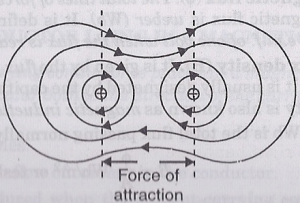
FORCE BETWEEN TWO PARALLEL CURRENT CARRYING CONDUCTORS.
When two current carrying wires are placed parallel to each other, their magnetic fields interact.
When current flows in the same direction, the conductors will repel each other, and when current flows in the same direction in the conductors, they attract.

READING ASSIGNMENT
New School Physics for Senior Secondary Schools (M.WAnyakohaPages 425 -428)
GENERAL EVALUATION
- A uniform meter rule AB is balanced on a knife edge which is 55cm from B. If a mass of 10g is hung at P, which is 10cm from A. Calculate the mass of the meter rule
- Masses m1 and m2are hung at the 20cm and 60cm mark respectively of a uniform meter rule freely suspended at its centre of gravity. If the meter rule balances horizontally, determine the ratio of m1 to m2.
WEEKEND ASSIGNMENT
1. Alloys for making powerful permanent magnets are these except — (a) alcomax (b) alnico (c) mumetal(d) ticonal
2. A magnetic substance can be demagnetized by (a) dropping on the floor (b) hammering while hot (c) divided touch (d) single touch
3. Which of the following pairs of metals will be picked up by an electromagnet? (a)Aluminium and Copper (b) Brass and Copper (c) Iron and Steel (d)Aluminium and Brass
4. Which question can be asked to determine if a material is magnetic or non-magnetic? (a) Is it a metal or a non-metal? (b) Is it a conductor or an insulator? (c) Is it a solid or a gas (d)Does it affect the direction of a compass needle?
5. One of the following rules can be used to determine the direction of the magnetic field around a straight current carrying conductor. (a) Fundamental law of magnetism(b) Clenched fist rule (c) Fleming’s right hand rule (d) Fleming’s left hand rule
THEORY
- State Maxwell’s cork screw rule.
- Draw the diagram showing the magnetic field around a solenoid.
WEEK EIGHT
ELECTROMAGNETIC FIELD
CONTENT
- Force on a Current Carrying Conductor in a Magnetic Field
- Fleming Left Hand Rule
- Application – D.C Motors, Moving coil galvanometer
- Force on a Moving Charge in a Magnetic Field
FORCE ON A CURRENT CARRYING CONDUCTOR IN A MAGNETIC FIELD
A conductor carrying an electric current, when placed in the magnetic field experiences a mechanical force. This can be demonstrated by using a set up a shown below. Two metal rails fixed on each side of a powerful horse-shoe magnet. A copper rod is placed across the rays. When the current is passed through this copper rod, it is observed that the copper rod rolls along the rays, toward the right. If by adjusting the rheostat, more current is made to flow through the rod. One will notice that the rod moves faster, thus the force on the rod increases when the current increases.
If the direction of flow of current is reversed by reversing the connections at the battery terminals, the rod will be observed to move towards the left, opposite to the previous direction of motion.
If one turns the magnet such that the magnetic field is parallel to the length of the rod as shown below, it will be observed that the current carrying rod remains stationary no matter the amount of current that passes through. There is therefore no force on the rod.
The direction of the force on a current carrying conductor placed perpendicular to the magnetic field is given by Fleming’s left-hand rule which is stated as follows:
If the thumb, forefinger and middle finger are held mutually at right angles to one another with the fore-finger pointing in the direction of magnetic field, and the second finger in the direction of Current, then the thumb will point in the direction of Motion (or force producing the motion).
EVALUATION
Explain the effects of force on a current carrying conductor in a magnetic field?
APPLICATIONS OF ELECTROMAGNETIC FIELD

- ELECTRIC MOTOR
The electric motor is a device for converting electrical energy into mechanical energy. It consists of the following
(i) a rectangular coil of insulated wire, known as armature,
(ii)a powerful magnetic field in which the armature turns is provided by two curve pole pieces of a powerful magnet.
(iii) acommutator consisting of a split copper ring, two halves of which are insulated from each other.
(iv) two carbon brushes which are made to press lightly against either side of the split-ring commutator
- MOVING COIL GALVANOMETER
This galvanometer is one of the most sensitive and accurate methods for detecting or measuring extremely small currents or potential differences.
Structure:
It consists essentially of:
- a light rectangular vertical coil ABCD pivoted in jeweled bearings such that it can move in a vertical plane
- two curved pole piece of a horse shoe magnet and a soft iron core or cylinder inserted between the pole pieces.
- two spiral non-magnetic control springs of phosphor bronze, each of which is attached to the jeweled bearing or spindle. Current enters or leaves the rectangular coil through these spiral springs. The springs also provide the control couple.
STUDENT PROJECT
Draw the structures of the electric motor and the moving coil galvanometer. Explain the working principle of both.
FORCE ON A MOVING CHARGE IN A MAGNETIC FIELD
The force on a charge q moving with a velocity v ( less than the velocity of light) in a magnetic field of strength B is given by:
F = qvB
READING ASSIGNMENT
New School Physics for Senior Secondary Schools (M.WAnyakoha Pages 425 -428)
GENERAL EVALAUTION
- A body of mass 4.0Kg moving with a speed of 2.5m/s collides with a stationary body of mass 0.2Kg. if the bodies stick together after collision, calculate the magnitude of the velocity with which they move.
- A body of mass 4.0Kg is accelerated from rest by a steady force of 9N. What is its speed when it has travelled a distance of 8m?
WEEKEND ASSIGNMENT
- In a D.C motor, the split-ring commutator ensures that (a) the direction of the current in the coil is reversed after every half turn (b) the flow of current in the coil is constant (c) the wires carrying the current to the coil do not get tangled (d) the magnitude of the current is progressively increased.
- The force on a charge moving in a magnetic field is ……….. to the speed of the charge (a). inversely proportional (b) opposite (c) directly proportional to the (d) parallel
- What is the force on an electron of charge -1.6 X 10⁻¹⁹C, mass 9.1 X 10⁻³¹Kg and speed2.0 X 107ms-1which enters perpendicularly into a magnetic field of strength 0.010T (a) 3.2 X 10 -14N(b) 3.2 X 10 -12N (c) 5.2 X 10 -24N (d) 3.5 X 10 -12N
- Calculate the radius of the circular path travelled by the electron in (4) above. (a) 3.2 X 10 -14m (b) 1.2 X 10 -4m (c) 1.14 X 10 -2m (d) 4.12 X 10 -14m
- When the direction of current in a conductor is parallel to the magnetic field, the force of the conductor is …… (a) maximum (b) perpendicular (c) zero (d) opposite the field.
THEORY
- State Fleming’s left hand rule.
- Explain how the direction of current in a conductor placed in a magnetic field affects the force on the conductor.
WEEK NINE
ELECTROMAGNETIC INDUCTION(I)
CONTENT
- Induced Current
- Laws of Electromagnetic Induction
- Induction Coil
- A/C and DC Generator
- Transformer and Power Transmission
INDUCED CURRENT
Electromagnetic induction: is the production of electric current or voltage in a conductor whenever there is a relative motion between the conductor and a magnetic field or a magnet. The current so induced is called induced current.
The induced e.m.f. or current depends on:
- the speed of motion of the magnet. The faster the speed of motion, the larger the induced current
- the number of turns of the coil
- the presence of a soft-iron core inside the coil
The direction of the induced current reverses when the direction of motion of the magnet or coil is reversed.


The coil A and C are wound on a steel ring R. When the switch S is close, a deflection will be obtained on the galvanometer G, and when S is open G will show a deflection in the opposite direction.
Current will flow in the galvanometer whenever there is relative motion between the coil and the magnet. There is such a relative motion when the magnet moves towards the coil or away from the coil and when the magnet is stationary but the coil is moved. Such a current is called induced current and the phenomenon is called electromagnetic induction.
EVALUATION
- Explain the term electromagnetic induction.
- Describe how induced current are produced.
LAW OF ELECTROMAGNETIC INDUCTION
There are two laws of electromagnetic induction
1. Faraday’s law
2. Lenz’s law
FARADAY’S LAW OF ELECTROMAGNETIC INDUCTION
States that whenever there is a change in the magnetic lines of force (e.m.f) is induced, the strength of which is proportional to the rateof change of the flux linked with the circuit.
The magnetic flux or field lines linking a coil depends on
- the magnetic field strength
- the number of turns of the coil
- the area of each turn
To obtain a large induced e.m.f move at a high speed across a strong magnetic field. Faraday’s law gives the magnitude of the induced e.m.f.
LENZ’S LAW OF ELECTROMAGNETIC INDUCTION STATES
That the induced e.m.f is in such a direction as two oppose the motion or change producing it.”
Lenz law gives the direction of the induced e.m.f or induced currents.
EVALUATION
- State Faraday’s law of electromagnetic induction
- State Lenz law
- What are the benefits of these law to modern day engineering/
INDUCTION COIL
This is an electrical device that is capable of producing a very high intermittent e.m.f .by electromagnetic induction from a low voltage d.c.
Source e.g battery
It consist of
- A primary coil, made up of a few turns f thick copper wire, wound on a laminated soft iron core. The lamination of the core is to reduce loss of energy due to eddy currents.
- Secondary coil overlapping the primary coil. It is made up of a large number of turns of insulated thin copper wire. The ends of this coil are connected to an adjustable spark gap created by two adjustable brass rods.
- In front of the soft iron core of the primary coil is a make-and-break-device consisting of soft iron armature carried on a light brass spring to which is attached a platinum contact with adjustable screw. The primary circuit is completed from this contact through a key and the battery which provide the current.The induction coil is commonly used in motorcar ignition system and in the operation of x-ray tubes.
EVALUATION
- Draw a labeled diagram of the induction coil
- Describe the principle of operation of the induction coil.
GENERAL EVALUATION
- A string of length 4cm is extended by 0.02cm when a load of 0.4Kg is suspended at its end. What will be the length of the string when a load of 15N is applied?
- A spring of force constant 500N/m is compressed such that its length is shortened by 5cm. the energy stored in the spring is.
WEEKEND ASSIGNMENT
- The current produced by a simple dynamo is not steady because (a) a back e,m,f opposes the induced voltage (b) eddy currents oppose the motion which induces them, and absorbs energy from the current ( c) the magnetic field produced by the magnet is not sufficiently uniform (d) the induced current opposes the motion which causes it, in accordance with Len’s law.
- Induced current depend on the — (a) number of turns in the coil (b) strength of the magnet (c) speed with which the magnet is plunged into the coil
- Lenz law of electromagnetic induction is essentially a statement 0f the law of the (a)inverse square law of gravitation (b) inverse square law of magnetism (c) inverse square law of electrostatics (d) law of conservation of energy
- Which of the following operation will not lead to an increase in the induced e.m.f in a coil of wire rotating between the poles of a magnet? Increasing the — (a) area (b) strength of the magnet (c) gap between the poles of the current(d) number of turns in the coil (e) speed of rotation in the coil
- Which of the following statements about a generator is not correct?(a) It can produce direct current (b) It requires an external supply of energy to rotate the coil(c) It requires an external supply of current to the coil (d) It can produce alternating current
THEORY
- Describe the principle of operation of the induction coil.
- Describe how induced current are produced.
WEEK TEN
ELECTROMAGNETIC INDUCTION(II)
CONTENT
- Moving a Conductor within a Magnetic Field
- A/C and DC Generator
- Transformer
- Power Transmission
MOVING A CONDUCTOR WITHIN A MAGNETIC FIELD
Induced current can also be produced by moving a conductor in a magnetic field. The direction of such current can always be obtained by applying the Fleming’s Right hand rule which states that “If the thumb, forefinger and middle finger are held mutually at right angles to one another with the fore-finger pointing in the direction of magnetic field, the thumb pointing in the direction of Motion (of the conductor), then the second finger will point in the direction of the induced Current.”

A.C AND D.C GENERATOR
A machine that converts mechanical energy into electrical energy or electrical energy into mechanical energy is called a dynamo. When it changes mechanical energy into electrical energy it is called a generator, but when it changes electrical energy into mechanical energy, it is called a motor.
There are two classes of generators, the alternating current (A.C) generator and the direct current (D.C) generator.
The A.C. generator consists of:
- an armature – a rectangular coil consisting of a large number of turns of insulated wire wound on a laminated soft iron core.
- a magnetic field created by the curved poles of a horse-shoe magnet or an electromagnet.
- two copper slip rings to which the ends of the rectangular coil are connected and which rotate with the armature.
- two stationary carbon brushes which are made to pressed lightly against the slip rings

EVALUATION
- Draw a labeled diagram of A.C generator
- Describe the principle of operation of A.C generator.
DIRECT CURRENT (D.C) GENERATOR
An A.C generator can be made to produce a D.C by replacing the two slip rings with a single split ring or commutator. A split ring commutator is a split ring that has been split into two segments which are insulated from each other. The ends of the coil are connected one to each split ring or commutator segment.
The commutator is a current reverser. When the armature coil is rotated, the commutator automatically switches each end of the coil from one brush to the other each time the coil completes one-half of a revolution. As the current reverses in the coil after each half revolution, the connection between the coil and the brushes are reversed through the action of the commutator.
A DIRECT CURRENT (D.C) GENERATOR

TRANSFORMER
A transformer is an electrical device for changing the size of an a.c. voltage. It acts to increase or decrease the em.f of an alternating current. It consists of two separate sets of coil, the primary coil and the secondary coil. The primary coil is the input winding of turns of wire and the secondary coil is the output winding. The coils are wound round a soft-iron core. The soft-iron core acts to increase and concentrate the magnetic flux within the core. It is also laminated, i.e. it consists of sheets of soft-iron insulated from each other instead of a solid block of iron. This lamination reduces loss of energy in the form of heat due to eddy currents introduced in the core.

STEP DOWN TRANSFORMER
When an alternating e.m.f. or A.C voltage (EP) is applied at the terminals of the primary coil (p), an alternating magnetic flux is produced in the iron core which links or threads the secondary coil (s). An alternating e.m.f (Es) of the same frequency as that Ep is induced in the secondary coil by mutual inductance.
Mutual inductance is the flow of induced current or voltage in a coil due to an alternating or varying current in a neighboring coil.
The total flux linking the two coils is proportional to their number of turns. The induced e.m.f in the secondary coil (Ep) depends on the e.m.f. in the primary coil and on the ratio of the number of turns in each
:. ES= Ns
EpNp
In an ideal transformer with a 100% efficiency, the power developed in the secondary coil is equal to the power developed in the primary coil.
:. Es= Ip
Ep Is
Hence,Es = Ns= Ip
EpNpIs
To use a transformer to increase an applied voltage, i.e to make Es greater than Ep, Ns must be greater than Np. Such a transformer which increases or steps up the applied or primary voltage is called a step-up transformer. In a step-up, the primary current is greater than the secondary current but the primary voltage is less than the secondary voltage.
ENERGY LOSSES IN PRACTICAL TRANSFORMER
There are energy losses in practical transformers due to:
- Eddy currents
- Hysteresis loss
- Heat loss
- Leakage of magnetic flux
Eddy Current reduces efficiency because they consume power and this causes energy lost in the form of heat. Such loss can be reduced by laminating the core.
Hysteresis loss is wasted energy due to reversing the magnetization of the core. It is reduced by the use of special alloys in the core of the primary coil.
Heat loss is the primary and secondary coils have resistance, some energy is lost in the form of heat (I2R) in the coils. This can be reduced by using thick wires or low resistance coils.
Some energy is lost due to leakage of magnetic flux. This arises because not all the lines of induction due to current in the primary coil pass entirely through the iron core. This loss is reduced by efficient core design.
Examples
1. Find the turns ration in a transformer which delivers a voltage of 120V in the secondary coil from a primary voltage of 60v.
Turns ration =Ns= 120= 2
Np60
2. Atransformer has 500 turns in the primary coil and 300 turns in the secondary coil. If the primary coil is connected to a 220v mains, what voltage will be obtained from the secondary coil? What type of transformer is this?
Es = Ns
EpNp
Es =300
220 500
Es = 220 x 300
500
Es = 132 V
It is a step-down transformer because secondary voltage is less than primary voltage (132 < 220)
3. A transformer supplies 15v from a 220v mains. If the transformer takes 0.7A from the mains when used to light three lamps connected in parallel and each rated 15v, 40w calculate:
i. the efficiency of the transformer
ii.the cost of using it for 24hrs at 30k per kwh.
Primary or input power = IpVp
= 0.7 x 220 = 154w
Secondary (output power) =IsVs = (Is x 15 )W
p = ISV
p = Is
V
Is = 40= 2.67A.
15
Total current taken by the 3 lamps in parallel = 3 x 2.67 =8A
:. Output power = 8 x 15 = 120 W
Efficiency = Output Power X 100
Input Power
= 120x 100 = 78%
Power consumed = 0.7 x 220Kw
1000
Total power consumed in 24 hrs
= 0.7 x 220 x 24kwh
1000
Cost at 30k per Kwh
= 0.7 x 220 X 24 X 30
1000 100
= N1
EVALUATION
- Draw a labeled diagram to explain the working of a transformer which can produce 24v from a 240v supply.
- Give two reasons which explain why the efficiency of the transformer cannot be 100%.
POWER TRANSMISSION
Power generated at power stations are distributed over large distances to consumers through metal cables. Power can be transmitted either at low current and high voltage or at high current and low voltage. Because the metal cables through which the power is transmitted have a certain amount of electrical resistance, transmitting power at high current will lead to loss of energy in the form of heat. To avoid this, power is transmitted at high voltage and low current. This is known as high tension transmission.
Low currents leads to low energy loss. It also requires thinner cables, cost of cable materials is considerably reduced if power is transmitted with low current and high voltages.
Step down transformers are used to reduce the high transmitted voltages to lower voltages required in home and factories.
READING ASSIGNMENT
New School Physics for Senior Secondary Schools (M.W. ANYAKOHA Pages 447 – 457).
GENERAL EVALUATION
- A block of mass 2.0Kg resting on a smooth horizontal plane is acted upon simultaneously by two forces, 10N due north and 10N due east. The magnitude of the acceleration produced by the forces on the block is.
- Two forces 3N and 4N act on a body due north and due east respectively. Calculate the equilibrant.
WEEKEND ASSIGNMENT
- Which of the following is not a part of an a.c generator? (a)carbon brushes (b)slip rings (c) communicator (d) field magnets
- To convert an alternating current dynamo into a direct current dynamo the(a) number of turns in the coil is increased (b) strength of the field magnet is increased (c) slip rings are replaced with split ring commutator (d) coils is wound on a soft iron armature
- The current in the primary coil of a transformer is 2.5A, if the coil has 50turns and the secondary 250 turns calculate the current in the secondary coil. (a)0.2A (b) 0.5A (c)2.5A (d)5.0A
- A voltage of 240V is connected to the primary coil of a transformer. Calculate the ratio of the primary turns to the secondary turns if the voltage available at the secondary coil is 15V (a) 0.06 (b) 0.90 (c) 1.16 (d) 16.00
- An inductor of inductance 10H carries a current of 0.2A. Calculate the energy stored in the inductor. (a)0.11J (b) 0.20J (c) 1.10J (d) 2.00J
THEORY
- State three ways by which energy is lost in a transformer and how it can be minimized.
- State the laws of electromagnetic induction.
- Distinguish between a step-up and a step down transformer.
- State three methods by which by which high e.m.f can be obtained from a generator.


1 Comment