


FIRST TERM E-LEARNING NOTE
SUBJECT: BASIC TECHNOLOGY CLASS: JSS 2
SCHEME OF WORK
WEEK TOPIC
- First Aids and Materials
- Rescue Operations
- Uses of Materials (Wood and Metals)
- Uses of Materials (Ceramics, Plastics and Rubber)
- Geometrical Construction; Lines
- . Angles
8. Triangles
9. Circle
10. Construction of Tangent to a Circle.
11. Revision
12. Examination
REFERENCE MATERIALS
- MELROSE, Basic Science and Technology, Book 2
- NERDC, Basic Technology for JSS, Book 2
WEEK ONE
TOPIC: FIRST AIDS
CONTENT
- Definition of First Aid.
- Aims and Objectives of First Aid.
- Materials in the First Aid Box.
- Application of Simple First Aid.
- Uses of Materials in the First Aid Box.
DEFINITION OF FIRST AID
First aid can be defined as the simple medical treatment that is given as soon as possible to someone who is injured or who suddenly becomes ill and injured.
First aid is the immediate treatment given to an injured person before being taken to the hospital or before the arrival of a doctor.
First aid kit is a small box or bag with the equipment that someone needs in order to give first aid. During metal work or woodwork activities in the workshop, everybody should be at alert to give first aid because a little carelessness can lead to an accident. Sometimes, the hazards and accidents could be very dangerous and life-threatening. In order to salvage the life involved, there is need to provide first aid fast and to have first aid skills.
AIMS AND OBJECTIVES OF FIRST AID
- To save life.
- To prevent injury from getting worse.
- To reduce pains as much as possible.
EVALUATION
- Explain the term “First Aid”.
- Mention three aims and objectives of first aid.
ACCIDENTS
Some of the domestic and workplace accidents include:
Suffocation: Suffocation poses a great danger to people. This is the reason for proper ventilation of the workshop.
Cut: Cut results whenever the skin is opened, torn or punctured by such sharp objects as knives, broken bottles and glasses, scissors or any rough edge.
Bruises: A bruise occurs when the body is given a blow with sufficient force. The blow may be applied directly or from a fall in which the body strikes against a fixed surface. There is bleeding under the skin without breaking it.
Fire Accidents: Fire accident from inflammable liquids and electrical appliances are very disastrous.
Electric Shocks: Caused either by naked electric wire or careless handling of electric appliances.
CONTENTS OF THE FIRST AID BOX
The First aid box is a container, where materials used to give simple medical treatment before the arrival of a doctor are kept. The box could be made of wood or metal, but it is usually painted white and with an “addition” sign written in red. The box comes in different sizes depending on the amount of the items.
The first aid box must be clearly marked with its name or with a large red cross, so that everybody can easily recognize it. Contents in the first aid box include:
- A roll of cotton wool
- Safety pins
- Vaseline
- Razor blade
- A clinical thermometer
- Different sizes of bandages
- 1 bottle of antiseptic cream
- Embrocating
- Scissors
- A bottle of antiseptic fluid such as Dettol or Savlon, for washing cuts and bruises etc.
EVALUATION
- Mention three types of accidents that require first aid treatment.
- List five items that can be found in a first aid box.
Applications of Simple First Aid
The cases of accidents where first aid treatment is used include:
- Simple cuts which cause bleeding: The bleeding is drained with cotton wool and iodine. Penicillin ointment is put on before it is covered with plaster.
- Snakebites or scorpions’ stings: These can be treated by tying a rope above the bite point. A razor blade is used to make one or two marks on the bite points so that the poison can flow out
- Respiratory problem: The victim is made to lie down face up. The belly of the victim is pressed gently to release water through his mouth and nose. If the patient still does not breathe, try a mouth to mouth resuscitation by putting your mouth on his mouth and blowing air into his lungs forcefully.
- High fever: It can be treated by removing the clothes of the patient. A wet towel is then used on his body to cool down the temperature.
- Dog bite: Clean with Savlon, apply iodine or TBC. Dress the wound with bandage. Then go to hospital for anti-rabies.
- Broken arms: Clean and dress wound if any. Splint (bandage with ruler or stick). Go to the hospital.
- Hot object and hot palm oil: Clean gently with Savlon and then apply gentian violent (G.V. Paint) or dermacin cream, give antibiotics.
- Electric shock: Firstly, switch off the source of power supply. The victim is then made to lie down to rest for a while, give milk if necessary.
- Febrile convulsion: This happens when body temperature is too high. Tepid sponge (mop
with ordinary water). Protect the tongue with spoon covered with bandage in the mouth. Do not give any drug. - Epilepsy: Remove all dangerous objects from his surroundings. Lay him on one side until he is conscious (awake).
EVALUATION
1. Describe how you will apply first aid to a victim of
- high fever (b) electric shock (c) a scorpion bite.
2. Mention five (5) cases of accidents where first aid is needed.
FIRST AID MATERIALS AND THEIR USES
S/N | MATERIALS | USES |
1 | Aspirin or paracetamol | They are used for pain relief. |
2 | Plaster | It is used to cover a small wound. |
3 | Cotton wool | It is used to drain blood and apply chemicals like hydrogen peroxide on wound. |
4 | Gauze bandage | It is used with a cotton wool to cover a wound. |
5 | Cofta tabs or cough mixture | These are drugs for treating cough. |
6 | Antacid tabs or Mist mag | These are drugs for stopping stomach pains. |
7 | Nerve/ bone (Embrocation) | These are drugs used to relief pains in the nerves, joints and bone. |
8 | Robb or Mentholatum | These are ointments used to rob the body against cold and bone pain. |
9 | Penicillin ointment | It is also used to rub the surface of fresh wound or injury. |
10 | Thermometer | It is used for measuring temperature. |
11 | Iodine lotion | It is used for treating wounds. |
12 | Dettol or Hydrogen peroxide | It is used for treating wounds |
13 | Spirit | It is used to clean the surface of wounds. |
14 | Injection powder | It is used for treating wounds. |
EVALUATION
- Mention eight (8) materials found in a first aid box and state their uses.
- State the uses of the following: (a) penicillin ointment (b) cotton wool
READING ASSIGNMENT
Read “Rescue Operations”
- MELROSE, Basic Science and Technology, Book 2 page 56-58
- Rescue Operations www.xpinoscholars.com.ng
WEEKEND ASSIGNMENT
- ____ is a simple initial treatment given to a patient before the arrival of the doctor. (a) First aid (b) Infection (c) Immunization (d) Injection
- The following are materials in the first aid box except ____ (a) hanger (b) aspirin (c) spirit (d) thermometer
- Which of the following is the sign on the first aid box? (a) + (b) X (c) – (d) ÷
- _____ is applied on a fresh wound (a) Spirit (b) Hydrogen Peroxide (c) Injection powder (d) Mist Mag
- Mouth to mouth resuscitation is used for ___ problem (a) snake bite (b) respiratory (c) high fever (d) bleeding
THEORY
- State five materials in the first aid box and their uses.
- Discuss how to give first aid treatment to (a) bleeding from cut (b) respiratory problem.
WEEK TWO
TOPIC: RESCUE OPERATIONS
CONTENT
- Meaning of Rescue Operations
- Objectives of Rescue Operations
- Types of Rescue Operations
- Rescue Operation Situations
- Materials used in Rescue Operations
MEANING OF RESCUE OPERATION
Rescue operations are responsive operations organized to save people or a person from dangerous situation or prevention of injury during an accident. Rescue operations are carried out by trained firemen, police, military, first aid or ambulance attendants.
OBJECTIVES OF RESCUE OPERATIONS
- To save lives.
- To prevent injury during an accident or dangerous situation.
TYPES OF RESCUE OPERATIONS
- Air-Sea Rescue (ASR): This is the coordinated search and rescue of emergency water landings as well as people who have survived shipwreck or boat mishap.
- Combat search and rescue (CSAR): This is the search and rescue operations that are carried out during war that are within or near combat zone.
- Mine rescue; is the specialized job of rescuing miners and others who are trapped or injured in underground mines after mine accidents.
- Cave rescue: is the operation involved in rescuing people trapped, lost or injured in wilderness or cave.
- Surface-water rescue: is the rescue of a person who is afloat on the surface of a body of water.
- Vehicle extrication: is the process of removing vehicle from around a person who has been involved in a motor accident.
- Confined space rescue: It involves the rescue and recovery of victims trapped in a confined space like tanks, sewers and underground vaults.
- Urban search and rescue: It involves the location, extrication and initial medical stabilization of victims trapped in collapsed buildings or trenches.
EVALUATION
- What are rescue operations?
- What is vehicle extrication?
RESCUE OPERATION SITUATIONS
- Fire outbreak
- shipwreck or boat mishap
- plane crash
- Mine accidents
- Bomb blast
- Road accident
- Collapsed buildings
- Drowning
- Natural disaster e.g earthquakes, landslides etc
TOOLS AND EQUIPMENT USED IN RESCUE OPERATIONS
- Helicopters
- Search and rescue dogs
- Mounted search and rescue horses
- The “jaws of life”
- Hydraulic cutting and spreading tools used to extricate individuals from wrecked vehicles
- heavy rescue vehicles
- Ladder
- Air bags
- Ambulance
- High lift jack etc
- Fire extinguisher
- Stretchers
EVALUATION
- Mention five (5) situations that required rescue operations
- State ten (10) tools used in rescue operations
GENERAL EVALUATION
- Describe ASR.
- Mention four persons trained to help in rescue operations.
READING ASSIGNMENT
Read “Uses of wood and metals ”
- MELROSE, Basic Science and Technology, Book 2 page 59-62
- NERDC, Basic Technology for JSS, Book 2, pages 16 – 22
WEEKEND ASSIGNMENT
- What rescue operation is right for someone trapped in a vault? (a) cave rescue (b) confined space rescue (c) surface-water rescue (d) ASR
- What do we call the rescue of people trapped in a collapsed building? (a) CSAR (b) mine rescue (c) urban search and rescue (d) confined space rescue
- ______ is used to extricate individuals from wrecked vehicles (a) Helicopters (b) Rescue dogs (c) Ambulance (d) Hydraulic cutting and spreading tools
- Which of the following does not require rescue operations (a) collapsed building (b) fire outbreak (c) phone calls(d) natural disasters
- ——– is the coordinated search and rescue of emergency water landings as well as people who have survived shipwreck or boat mishap (a) ASR (b) CSAR (c) Cave rescue (d) RRS
THEORY
- (a) What are rescue operations?
(b) Explain “Vehicle extrication”
- State the function of the following in rescue operations:
(a) rescue dogs (b) ambulance
WEEK THREE
TOPIC: USES OF MATERIALS
CONTENT
- Uses of Wood
- Uses of Metal
USES OF WOOD
Wood is used today in the following industries and processes:
- HOUSING: Wood is used for home furniture such as doors, window and roofing.
- INDUSTRIAL BUILDING: Many industries are constructed using wood.
- JOINERY: Wood is used for making staircase in our buildings today.
- PACKAGING: Packaging technologist cannot do without wood for making crates, pallet, and packaging electronics equipment.
- FURNITURES: Chairs, bed, ward robes, table, book cases etc
- TRANSPORT: Railway, train wagons, lorry-body.
- BRIDGES AND POLES: Most farm bridges and bridges across the roads in villages are made with wood. Some electric poles and railway sleepers are made of wood.
- PULP AND PAPER: Exercise book, textbooks, magazines etc are made from pulp and paper derived from wood.
- MEDICINE: People who have their arms and legs amputated (cut off), such are usually replaced by artificial limbs made from wood.
- CLOTHING: Most heels and some soles shoes are made from wood. The rayon stocking.
- TOOL MAKING: Handles for hammer, pick axes, felling axes, screw drivers and many other tools are made from wood.
EVALUATION
- Mention five industries using wood and state the processes they are used for.
- State the processes they are used for in (1) above.
USES OF WOOD
S/N | SOFTWOOD | USES |
1 | Cedar | In the building industry for roofing and garages, doors and partitions. |
2 | Pine | Railway sleepers, heavy gate posts, decorative panel stairways. Pattern making joinery. |
3 | Spruce | Aircraft industry, ship masts, interior joinery, ladders, packing cases. |
S/N | HARDWOOD | USES |
1 | Afromosia | Ship building, good quality furniture. |
2 | Agba | Joinery and furniture. |
3 | Balsa | Model making, life rafts life belts. Insulation (noise or heat). |
4 | Beech | Furniture mallets, kitchen utensils e.g. bread boards, rolling pins. |
5 | Ekki | Pier piles, dock, gates, bridge building. |
6 | Iroko | Joinery |
7 | Mahogamy | Cabinet making, ship building, panelled, carving, wood turnery. veneers |
8 | Oak | Furniture making , boat building , veneer, plywood |
9 | Obeche | Interior joinery, furniture, model making. |
10 | Teak | Ship building , furniture, laboratory benches, veneers |
EVALUATION
- Describe the purposes for which the following woods are used :(a) mahogany (b) oak (c) balsa.
- Mention three soft wood and their uses.
USES OF FERROUS METALS
| MELTING POINT | COMPOSITION | PROPERTIES | USES |
Cast iron | 1240 | Mixture of carbon and iron carbon content is between 1.5-5% | Vary with carbon content. Brittle with hard skin | Suitable for moving parts of machinery because of the ability of one piece to slide on another due to carbon content. |
Wrought Iron | 2000 | 99% iron with small amount of impunities | Malleable and ductile. Elastic can be shaped easily when red hot (forged) | Engine blocks haulage gear, vices, crane, hooks and chains |
High carbon steel (Tool steel, cast steel) | Varies | 99% iron with small amounts of impunities. The carbon content is between 0.1-0.5% | Malleable and ductile. Elastic. Not very hard. Can be shaped easily when red hot(forged) | Haulage gear, crane hooks and chains, anchor chains, general constructional work, nuts, bolts, screws, non-cutting |
Low carbon steel (mild steel) | Varies | Mixture of carbon and steel | Forges and machines well | All kinds of cutting tools. Steel sheets |
USES OF NON-FERROUS METALS
ALUMINUM | It is used for making aircraft, electrical cables, and aluminium, foil, engine parts tubes boxes, kitchen and cooking utensils. |
ZINC | It is used for making roofing sheets containers, galvanizing and protective, cooling on sheet, sheet and base for many alloys (e.g. brass). |
TIN | It is used as base for many alloys e.g. bronze, protective coating on copper wire and tin plate sheets. |
COPPER | It is used in making many copper alloys, soldering bits, decorative purposes, wire, electrical point, boiler tubes, rivets, boxes, bowland pipes. |
LEAD | It is used for making battery elements, water piping base for many alloys and sheeting for roofing. |
EVALUATION
- Mention three uses each of the following non-ferrous metals. (a) zinc (b)aluminium.
- State three ferrous metals and their uses
USES OF ALLOYS OF NON-FERROUS METALS
- DURALUMIN: It is made of 95% aluminium, 4%copper and 1% manganese. It is used to build aircraft bodies, door and window frames, vehicle parts etc.
- BRASS: It is made of 35%zinc 65% copper. We use brass to make decorative items, ammunition, plumbing fittings, electrical appliances, etc.
- BRONZE: It is made of 10% tin and 90% copper. It is used in carving, statues, plaques, ornaments, ship propellers, gears and some machine parts.
GENERAL EVALUATION
- Differentiate between hard and soft wood
- Mention 5 uses of wood
READING ASSIGNMENT
Read “USES OF MATERIALS II”
- MELROSE, Basic Science and Technology, Book 2 page 63-66
- NERDC Basic Technology for JSS Book 2. Page 23-27.
WEEKEND ASSIGNMENT
- The following are hard wood except (a) Balsa (b) Beech (c) Spruce (d) Iroko.
- The type of hard wood used in making veneer and plywood is called (a) Iroko (b) Oak (c) Teak (d) mahogany.
- The type of metal that is suitable for moving parts of machinery is (a) cast Iron (b) wrought iron (c) aluminium (d) low carbon steel.
- The temperature at which wrought iron turns liquid is (a)12400C (b) 2000oC (c)1500oC (d) It varies.
- Aluminium is used for making cooking utensils because a) it is malleable (b) it is a good conductor of heat (c) It is light (d) it is a good conductor of electricity.
THEORY
- Mention five (5) industries that use wood and their processes.
- In tabular form state the melting point, composition and uses of the following metal
(a) Cast iron (b) High carbon steel
WEEK FOUR
TOPIC: USES OF MATERIALS II
CONTENT
- Uses of Ceramic
- Uses of Glass
- Uses of Rubber
CERAMIC
All solid objects made from clay, mud or cement are called ceramics. Ceramics are concerned with clay and clay products, glass and glass products, cements and plasters.
USES OF CERAMICS
- Ceramics can withstand very high temperature; they are used in making furnaces.
- Ceramics can carry heavy loads. Thus bricks and cement blocks are used to build houses. The walls carrying the roof of the building.
- Ceramics do not corrode and they are resistant to chemical attack. It can be used to store chemicals and water.
- They can be easily moulded and decorated, so can be used for sculpture.
- They are good insulator of electricity, so can be used as insulation of high-tension voltages. The insulators between the lines are also ceramic.
- They last longer e.g. Benin head.
EVALUATION
- Explain why ceramics are used in making furnaces
- Name three common ceramics and state their properties.
USES OF GLASS
- Glass is used for making bottles.
- It is used for making tumblers and mugs.
- It is used for making flower vases.
- It is used for making bulbs.
- Glass is also used to make eyeglasses, magnifying glasses and binoculars.
- It is also used in mirrors, windscreens of vehicles, television screens and computer screens.
RUBBER
Raw rubber (Latex) is normally too tough and too hard. It is softened by adding certain chemicals and mixed through until it is in a state in which it can be formed.
There are two types of rubber: natural rubber and synthetic rubber.
NATURAL RUBBERS
Are produced from the latex of rubber trees. Natural rubber deteriorates with age and when it is exposed to sunlight. The process of improving the properties of rubber is called VULCANIZING. This is done by adding sulphur to it together with carbon particles and heating it. Vulcanized rubber is much harder and much heat resistant than ordinary rubber.
SYNTHETIC RUBBER
These are manufactured from chemicals.They are forms of plastics. Examples include butyl rubber and neoprene. They have better quality than natural rubbers. They are resistant to sunlight and temperature changes. They do not age, like natural rubbers and they are resistant to chemicals. Rubber products include: hoses, pipes, belts, tyres, tubes, footwear, rainwear and mounting.
USES OF RUBBER
- It can be used as an elastic material e.g. for making catapult.
- Rubber is water proof, so it is used in making sandals and gloves.
- Rubber has insulating property i.e. it is an insulator. Thus it is used in covering electrical wires that supply electricity to the iron or kettle.
- Rubber can be used as shock absorber, thus it is used in making bumper of cars, tyres and tubes of cars.
EVALUATION
READING ASSIGNMENT
Read about GEOMETRIC CONSTRUCTION-LINES
- MELROSE, Basic Science and Technology, Book 2 page 67-69
- NERDC Basic Technology for JSS book 2 page28-32.
WEEKEND ASSIGNMENT
- All solid objects made from clay, mud or cement are called ____(a) plastics (b) rubber (c) semiconductors (d) ceramics
- The art of using clay to make various objects is called ____ (a) plastics (b) rubber (c) semiconductors (d) pottery
- Which of the following is not a rubber product? (a) tyres(b) pipes (c) foot wear (d) sculpture
- One of the differences between plastic and rubber is that RUBBER is more _____ (a) cheaper (b) available (c) elastic (d) tougher
- Properties of rubber can be improved through the process called (a)extrusion (b)vulcanization (c) injection moulding (d)compression moulding.
THEORY
WEEK FIVE
TOPIC: GEOMETRICAL CONSTRUCTION: LINES
CONTENT
- Definition of Lines
- Types of Lines
- Dividing a Given Line into Equal Parts
LINES: A line is a long narrow mark made on a surface. A line may be straight, crooked or curved.
Properties of lines
- A line has position and length.
- A line does not have width or thickness.
- A straight line is the shortest distance between two points.
- A line that has more than one curve is called a crooked line.
- Two or more lines always having equal distance apart are parallel lines.
- A line following a circular path is a curve.
EVALUATION
- Define a line
- State three properties of line.
TYPES OF LINES
Thick continuous line: This is a thick and solid line used to show visible outlines of an object.
They are also used as border lines (15mm from paper margin).

Thin continuous line: This is a thin and solid line used for dimension lines, lines, projection lines, leader lines, hatching or section lines etc.

Short dashes: The dashes are about 3mm long and spaced about 1mm
from each other.
These are approximate values and will depend on how large the drawing might be. They are used to represent/show hidden details.

Thin continuous chain line: These are thin lines made of long and short dashes. The long dashes can be about 19-38mm long while the short dashes may be about 1.5mm long. The length will vary with the size of the drawing and the length of centre line needed. They are used for centre lines

Thick continuous chain with arrow head: They are thick lines made of either long and short dashes or equal sized dashes. Arrow heads are drawn on their ends to show the direction in which the section was taken. They are used for cutting and viewing planes.



Thick irregular solid lines: These are thick solid lines drawn freehand. They are either short break or long break lines used to show the part of an object that has been removed. The long break lines are drawn as thin solid lines with Z symbol inserted in several places along its length.



 or
or

 Continuous irregular wavy lines: They are thin lines drawn freehand and are used to indicate the limit of partial views.
Phantom lines: These are thin dashes lines drawn with one long dash followed by two short dashes. They are used to show alternate positions of moving parts. The original position is drawn with visible (thin continuous) lines while its rotated or new position is shown with phantom lines.

TYPES OF LINES
Thick continuous line: – this is used for all visible outlines. It should be the most prominent on drawing.
- Thin continuous line: – This is used for constructing projections, extensions, hatching and leader lines.
- Short dashes: This is used to show hidden details.
- Thick continuous wavy or irregular line): – it is used for irregular boundary or short break lines.
- Thin ruled line and zigzags: – This is used for long break lines.
- Arrow head – it is used for dimension.
- Thin long chain line: – It is used for centre lines.
- Thick long chain line: – It is used for cutting viewing lines.
- Thin continuous wavy line:- It is used for limits of partial views.
.
EVALUATION
- Mention five types of lines and state their uses.
- When do we use thin continuous lines?
Division of a straight line into equal parts
A line can be divided into a number of equal parts. For example, a given line can be divided into halves, fourths, eights etc.
Procedure 1
- Draw the given line AB.
- Draw AC any convenient acute angle and set off from A.
- Divide the line into the number of the required parts using a pair of divider or a scale rule and a pencil.
- Now join the points on the inclined to the line to be divided from the extreme with parallel lines.
Procedure 2
- Draw the given line, AB.
- Draw a line AC to meet it at any convenient angle.
- Join CB.
- Divide AC into the required number of parts using your ruler. Label the points 1,2,3,4…
- From the points 1, 2, 3…. Draw lines parallel to CB to meet AB. These parallel lines intersect AB at the required points; this divides AB into equal segments.
ACTIVITY
Divide a straight line 70mm long into 5 equal parts.
GENERAL EVALUATION
- How can horizontal and vertical line be drawn?
- List the information required in title block.
READING ASSIGNMENT
Read about ANGLES
- MELROSE, Basic Science and Technology, Book 2 page 56-58
- NERDC Basic Technology for JSS book 2 page 32-39.
WEEKEND ASSIGNMENT
- Identify this line. ___________________________________ (a) thin continuous line (b) ruled zigzag line (c) arrow head line. (d) short dashes.
- The type of line used in showing visible outline is (a) thin continuous line (b) thick continuous line (c) thin ruled zigzag line (d)thick continuous wavy line.
- The shortest distance between two points is _______ (a) curve (b) straight line (c) crooked line (d) parallel line
- Which of the following is not a property of a line? (a)It has position and length (b)It has width and thickness (c)It has virtually no thickness (d) It may be a straight line or curved line.
- The line that is used in showing hidden details is __________ (a) thin continuous (b) thick continuous (c) arrow hand (d) short dashes
THEORY
- (a) Define a line.
- Draw a line AB of 60mm and divide the line into 8 equal parts.
- Draw line AB equals to 10cm and divide into proportions 3:5:4.
WEEK SIX AND SEVEN
TOPIC: ANGLES
CONTENT
DEFINITION OF ANGLES
TYPES OF ANGLES
BISECTION AND CONSTRUCTION OF ANGLES.
ANGLES
An angle is formed when two straight lines intersect or meet at a point.

The sum of angle at the centre of a complete circle is 3600.
TYPES OF ANGLES
- Acute angles: – These are angles that are less than 900.
- Right angle: – This is an angle that is equal to 900.
- Obtuse angles: – These are angles that are greater than 900 but less than 1800.
- Reflex angles: – These are angles that are greater than 1800 but less than 3600.
- Complementary angles: – These are angles that sum up to 900.
- Supplementary angles: – These are angles that sum up to 1800.
EVALUATION
- Define an angle.
- Mention five types of angle and describe them.
CONSTRUCTION OF ANGLES
The following are several ways of constructing or drawing angles:
- Using a setsquare
- Using a combination of setsquares
- Using a protractor
- Using a pair of compasses
HOW TO CONSTRUCT ANGLES USING SETSQUARE
Standard angles are angles 300,450, 600 and 900. These angles can be drawn by simply using a setsquare. The method is simply choosing the appropriate setsquare that has the angle that is to be drawn. Thus 300-600 setsquare is used to draw 300, 600 and 900. Similarly, the 45-45 setsquare is used to draw 450 and 900.
EVALUATION
With the aid of a set square construct the following angle: i)900 ii) 600 iii)450
COMBINATION OF SETSQUARES
Setsquares can be combined to construct the following angles:
- To construct 750, combine 450 and 600 setsquares
1800– (600 + 450)= 750
- To construct 1350, combine 450 and 900
450+ 900 = 1350
- To construct 1050, combine 600 and 450
450+ 600 = 1350
EVALUATION
- Combine the sets-square to construct angles750 and 1350.
- Construct angle 60o
HOW TO DRAW AN ANGLE USING A PROTRACTOR
Procedure
- Place the protractor on the line from which the angle is to be formed. The baseline marked O at one end and, 180 marked at the other end.
- Set the centre of the protractor to start from where the vertex of the angle will be.
- Mark the required degree of the angles to be drawn.
- Use a straight line to join the marked point at the angle to the point vertex of the angle
EVALUATION
- Measure the following angles using your protractor
a) 880 b)1700 c)2750 d) 3000 e)150
- Construct angle 30o
How to construct Angles Using a Pair of Compasses
600
Procedure
- Draw a straight line and mark the centre O.
- From O, using a convenient radius at point A draw an arc (almost a quadrant).
- With same radius draw another arc to intersect the first arc at C.
- Draw a line from O through the point of intersection.
The angle formed is 600
900
Procedure
- Draw a straight line and mark the centre O.
- From O draw a semicircle to touch the straight line at A and B.
- From A, with longer radius, draw an arc at the centre up.
- From B, with longer radius, draw an arc at the centre up to intersect at C.
- Draw a line from O through C.
The angle COA and COB is 900
BISECTION OF ANGLES
To bisect a given angle
- Draw a given angle ABC.
- With centre B and any convenient radius draw an arc to cut AB to D and BC at E.
- With centre A1 and any small radius an arc.
- With centre E and the same radius draw an arc to intersect the previous one at F.
- Join BD, BD bisects angle ABC, i.e. angle ABD= DBC.
- Use a protractor to check angles ABF and CBF.




 The following angles can be constructed by bisection:
- 300 can be constructed by bisecting 600
- 150 can be constructed by bisecting 300
- 12.50 can be constructed by bisecting 150
- 450 can be constructed by bisecting 900
- 22.50 can be constructed by bisecting 450
READING ASSIGNMENT
‘Read about TRIANGLES’
- MELROSE, Basic Science and Technology, Book 2 page 77-79
- NERDC-BASIC TECHNOLOGY, BOOK 2, page 46- 51
WEEKEND ASSIGNMENT
- The angle that FC makes when constructed perpendicular with line AB is _______ (a) 1800 (b) 2700 (c) 900 (d) 1200
- The line FC is called __________ (a) vertical (b) perpendicular (c) Horizontal (d) incline
- Which of the following drawing materials cannot be used to construct a straight line? (a) Compass (b) protractor (c) Ruler (d) pencils
- Angles that sum up to 1800 is called __________ (a) supplementary (b) complementary (c) Reflex (d) obtuse
- The line for all visible outlines is called ____________ (a) Thin continuous line (b) Thick continuous line (c) short dashes (d) Zig – Zag lines.
THEORY
- With the aid of a protractor measure the following angles
(a)150 (b)700 (c)1500 (d)2200 (e)3000.
- With the aid of compasses and a ruler construct angle 600 and 300
WEEK EIGHT
TOPIC: TRIANGLES
CONTENT
Triangles
Types of triangles
Construction of triangles
TRIANGLE
A triangle is a plane figure bounded by three straight lines and having three angles. The sum of angles in a triangle is 1800
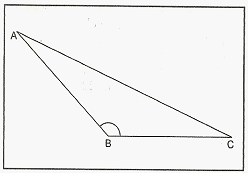
TYPES OF TRIANGLES
- Scalene triangle: – This is a triangle that has none of its sides or angles equal.
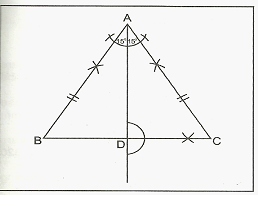
- Isosceles triangle: – This is a triangle that has two sides and two angles equal.
- Equilateral triangle: – This is a triangle that has all the three sides and angles equal.
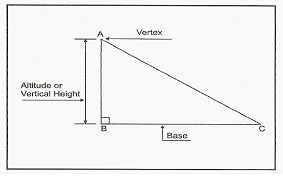
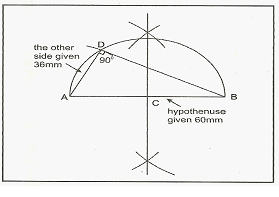
- Right-angled triangle: – This is a triangle that one of its angles equal to 900 and the longest line facing the 900 is called THE HYPOTENUSE
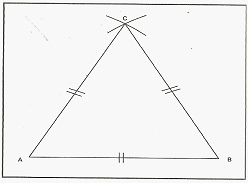
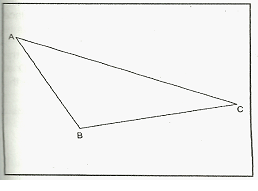
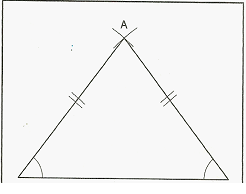
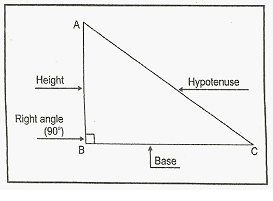
EVALUATION
- What is a triangle?
- List the types of triangles and describe them.
TO CONSTRUCT A TRIANGLE GIVEN THE THREE SIDES
Procedure
- Draw the horizontal line and mark off the base of the triangle AB.
- With center A and a radius equal to the length of a side of the triangle, strike an arc
- With center B and a radius equal to the other side strike another arc to cut the previous one at C.
- Join CA and CB to obtain the triangle ABC.
EVALUATION
Construct triangle ABC such that AB is 8cm BC 7cm and AC is 6cm
TO CONSTRUCT A TRIANGLE GIVEN TWO SIDES AND THE INCLUDED ANGLE
- Draw a horizontal line and mark off one of the given sides AB
- At A, construct the given included angle BAC with the aid of a protractor
- With center A and radius equal to the other given side of the triangle cut AC at D.
- Join DB to complete the required triangle ABD
EVALUATION
Construct triangle ABC such that line AB is 5cm,
TO CONSTRUCT AN EQUILATERAL TRIANGLE USING COMPASSES
- Draw a horizontal line and mark off base AB equal to the given side.
- With centers A and B and a radius equal to the given side, strike arcs to intersect at C.
- Join CA and CB to obtain the required equilateral triangle.
EVALUATION
- Construct an equilateral triangle whose sides are 6cm long.
- Construct triangle ABC such that line AB is 5cm,
0 and line BC is 7cm
READING ASSIGNMENT
Read about “CIRCLES”
- MELROSE, Basic Science and Technology, Book 2 page 73-76
- NERDC, BASIC TECHNOLOGY, BOOK 2, page 40- 46
WEEKEND ASSIGNMENT
- Which of the following triangles has all its sides equal? (a) Equilateral (b) Scalene (c) Isosceles (d) Right-angled
- Which of the following triangles has none of its side equal? (a) Equilateral (b) Scalene (c) Isosceles (d) Right-angled
- Which of the following triangles has all two sides equal? (a) Equilateral (b) Scalene (c) Isosceles (d) Right-angled
- What is the center rule formula used to construct a polygon as well as dividing a circle into equal parts? (a) 360 – N (b) 360 x N (c) 360/ N (d) 360 + N
- The perpendicular distance from the vertex to the base of triangles is called ______(a) vetoed (b) Aptitude (c) Altitude (d) Interior
THEORY
- Construct a rectangle of length 7cm and breadth 5cm with the aid of compass and ruler.
- Construct a square with diagonal 5cm.
WEEK NINE
TOPIC: CIRCLE
CONTENT
DEFINITION OF CIRCLE
PARTS OF A CIRCLE
A circle is a plane figure bounded by a curved line called the circumference. All the points on the circumference of a circle are equidistant from a point called the centre.






PARTS OF A CIRCLE
- Diameter
The diameter is a straight line drawn through the centre of a circle and meeting the circumference at both ends.
- Radius
The radius is a straight line drawn from the centre of a circle to any point on the circumference of the circle. The length of the radius is always used to draw the circle.
- Segment
The segment is an area of the circle bounded by an arc and a straight line called the chord.
- Chord
The chord is a straight line which joins any two given points on the circumference of a circle.
- Sector
The sector is part of the circle bounded by two radii and an arc.
- Quadrant
The quadrant is the part of the circle bounded by two radii which are at right angles to each other, bounded by an arc. The quadrant, as the name, is ¼ of the circle.
- Tangent
The tangent is usually formed outside the circle. When a straight line touched is formed. However, that line must be right angle to a radius
.
EVALUATION
- Draw a circle 30mm and show the different parts.
- Explain each part of a circle
HOW TO DRAW A CIRCLE GIVEN THE RADIUS
Procedure
- Draw the centre lines horizontally, and the other vertically, to intersect each other at E at 900.
- The point of intersection is the centre. With the compass at centre E, pick the given radius into the compasses.
- The point of intersection E, is the centre of the circle. Place the pinpoint of the compasses on the centre and swing the pencil round such that the pencil makes 3600 to give the circle.
HOW TO CONSTRUCT A CIRCLE THROUGH A THREE POINTS WHICH ARE NOT ON A STRAIGHT LINE
Procedure
- Join the given points ABC with straight lines AB and BC.
- Draw the perpendicular bisector of the two lines AB and BC to intersect at point D.
- The point of intersection D is the centre of the circle. With point D as centre, set the pencil point of the compasses to any of the three given point A, B or C
HOW TO DRAW A SERIES OF CIRCLES TOUCHING ONE ANOTHER ON THE TWO CONVERGING LINES
Procedure
- Copy the given converging lines AB and AC.
- Bisect the angle between the converging lines BA and CA.
- Draw a line from A to pass through D.
- AE is the bisector, and the centre of the circles is located on the bisector.
- Draw the largest circle by placing the point of the compasses somewhere on the bisector and adjust the pencil point, until the required radius is obtained.
- Draw a tangent FG to the circle at point of intersection between the circumference of the circle and the bisector .
- Bisect the angle IJA
- Draw a line through point K to intersect main bisector AE at L.
- Note that point L is the centre for smaller circle.
- With centre L draw the smaller circle to touch the bigger circle tangentially.
HOW TO FIND CENTRE OF A CIRCLE
Procedure
- Draw the given circle.
- Draw any two chords AB and AC.
- Bisect lines AB and AC. The bisecting lines will intersect at O.
- O is the centre of the circle.
EVALUATION
- Draw a circle of diameter 80 mm and determine its centre.
- Draw three circles of diameter 40mm touching each other
READING ASSIGNMENT
Read construction of tangents to a circle
- MELROSE, Basic Science and Technology, book 2 page 73-76
- NERDC, Basic technology for JSS book 2, page 44-45.
WEEKEND ASSIGNMENT
- The part of the circle that is bounded by an arc or cord is (a) segment (b) sector (c) diameter (d) tangent.
- A straight line drawn through the centre, meeting the circumference at both ends is called (a) sector (b)radius (c) diameter (d) tangent
- A plane figure bounded by a curved line called circumference is called——-(a) triangle (b) circle (c) quadrilaterals (d) curved line
- Any straight line drawn across the circle, meeting the circumference at both ends is called (a) chord (b) tangent (c) radius (d) diameter
- Which of the following can be used to draw a circle? (a) protractor (b) French curve (c) compass (d) template
THEORY
- Draw a circle of radius 35mm and divide it into 12 equal sizes.
- Draw a circle and with shaded portion show (i) quadrant (ii) sector (iii) segment inside the circle.
WEEK TEN
TOPIC: CONSTRUCTION OF TANGENT TO A CIRCLE
CONTENT
- Construction Of Tangent To A Given Circle.
HOW TO CONSTRUCT A TANGENT TO A CIRCLE AT A GIVEN POINT ON THE CIRCUMFERENCE
Procedure
- Draw the given circle with centre O
- Indicate the given point P.
- Draw a line from centre O to pass through point P to extend outside the circle.
- With centre P and radius OP, draw an arc to cut the extended line at A.
- Bisect line OA.
- Join the bisecting points with a line BC
- BC is the required tangent



HOW TO CONSTRUCT A TANGENT TO A CIRCLE FROM A GIVEN POINT OUTSIDE THE CIRCLE
Procedure
- Draw the given circle with centre O.
- Indicate the point P to centre O
- Join point P to the centre O.
- Construct a semicircle on OP to cut the circle at A.
- A is point of tangency on the circle.
- Draw a line to join P to A to give the required.
HOW TO CONSTRUCT A CIRCLE OF A GIVEN RADIUS TO TOUCH A GIVEN STRAIGHT LINE AND CIRCLE
Procedure
- Draw the given straight line AB, and a circle O
- Draw a line parallel to line AB at a distance equal to the radius of the required circle.
- Take this length (radius of required circle R2 + radius of given circle R1.
- With O as centre, draw an arc to cut the parallel line at C.
- With centre C and radius CD, draw required circles.



HOW TO CONSTRUCT A CIRCLE TO TOUCH THREE GIVEN LINES
Procedures
- Draw the three given lines.
- Bisect the two angles.
- The Bisecting lines should be extended to intersect at O.
- O is the centre of the required circle.
- Draw a line perpendicular to any side from centre O to give A.
- With centre O and radius OA draw the required circle.
HOW TO CONSTRUCT A CIRCLE OR AN ARC OF A GIVEN RADIUS TO TOUCH TWO GIVEN CONVERGING LINES
Procedure
- Draw the given lines AB and AC
- Draw lines parallel to AB and AC at a distance equal to the radius R of the circle.
- Extend the lines to intersect at O.
- Draw a line perpendicular to AB or AC from O.
- With centre O, and radius OD draw the arc to touch the two converging lines.
EVALUATION
- Draw a tangent to a circle of radius 40mm from a point ‘P ’80mm outside the circle.
- With the aid of compasses and a ruler construct angle 600 and 300
READING ASSIGNMENT
Read more on construction of tangents.
- MELROSE, Basic Science and Technology, book 2 page 73-76
- NERDC, Basic technology for JSS book 2, page 44-45.
WEEKEND ASSIGNMENT
- The angle that FC makes when constructed perpendicular with line AB is _______ (a) 1800
(b)
2700 (c) 900 (d) 1200 - The line FC is called __________ (a) vertical (b) perpendicular (c) Horizontal (d) incline
- Which of the following drawing materials cannot be used to construct a straight line? (a) Compass (b) protractor (c) Ruler (d) pencils
- Angles that sum up to 1800 is called __________ (a) supplementary (b) complementary (c) Reflex (d) obtuse
- The line for all visible outlines is called ____________ (a) Thin continuous line (b) Thick continuous line (c) short dashes (d) Zig – Zag lines.
THEORY
 Draw a tangent to a circle of radius 30mm from a point ‘P ’70mm outside the circle.
- With the aid of compasses and a ruler construct angle 600 and 300.



