


11. Growth and development in (a) plants (b) animals Questions
1. a) Name the hormone which controls moulting in insects.
b) State the importance of moultng in insects.
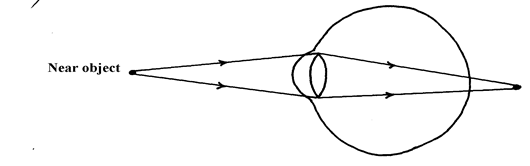 2. The illustration below represents an eye defect
a) Name the eye defect .
b) Name the lenses that can be used to correct the defect.
3. (a) State two functions of the kidney
(b) Name two substances that are not found in urine of a healthy person
(c) Name two diseases that affect the kidney
4. The diagram below represents a growth pattern of arthropods.

(a) Name the type of growth pattern represented on the graph.
(b)Identify the process represented by X.
(c) Which hormone is responsible for process at X in 15 (b) above?
5. Distinguish between natural and acquired immunity.
 6. The cells shown below were obtained from different parts of a young root tip:
Give the name of the zone from which each cell was obtained A, B and C
7. Differentiate between continuous and discontinuous variations
 8. An experiment was set-up as shown in the diagram below:-
(a) Suggest the possible aim of this experiment
(b) Account for the observation at the end of the experiment
9. State the location of each of the following plant meristematic tissues:-
(i) Vascular cambium
(ii) Intercalary meristem
10. Define the following terms: a) Growth
b) Development
11. State two advantages of metamorphosis in the life insects
12. State one disadvantage of exoskeleton in insects.
13. Distinguish between primary growth and secondary growth in a flowering plant
14. What is the role of the following to a germinating seed: (i) Oxygen
(ii) Cotyledons
15. Give three applications of plant growth hormones in agriculture
16. State two functions of calcium in the human body
17. State the biological importance of ecdysis in arthropods
18. The diagram below represents a stage during the process of germination.
(a) (i) Name the type of germination illustrated in the diagram
(ii) Give a reason for your answer in (a) (i) above.
(b) Give two functions of the part labelled X
19. In an experiment young potted seedlings were placed in a dark box with unilateral light source
as shown below:
(a) What was the aim of the experiment?
(b) State the observations made on the seedlings after 3 days
20. The graph below represents the growth of animals in a certain phylum.
(a) Name the type of growth pattern shown on the graph.
(b) Identify the process represents by x.
(c) Name the hormone responsible for the process in B above.
21. (a) State the role of the vascular cambium in plant growth and development.
(b) Explain why monocotyledons plants do not undergo secondary thickening.
22. Explain how placenta is adapted to its functions
23. State the role of the following during germination:
(a) oxygen
(b) enzyme
24. Name the type of responses exhibited by:-
(a) (i) Marine crabs burrowing into the sand to avoid dilution of their body fluids
(ii) Chlamy domonas plant moving towards a region of high light intensity
(b) (i)What type of neuron is drawn above?
(ii) Using an arrow, show the direction of the nerve impulse
(iii) Name the part labelled X
(iv) State the function of part labelled Y . (c) Give two differences between reflex action and conditioned reflex action
25. The experiment set – up below was designed to investigate an aspect of germination.

a) Why was potassium hydroxide pellets used in this experiment?
b) What was the role of moist cotton wool in this experiment?
c) i) By means of an arrow, indicate on the diagram the direction in which red dye would move
during the experiment.
ii) Give reason for your answer in c(i) above.
d) Other than the factor investigated above, state any other one factor necessary for germination
process.
26. The following data represents the development in dry mass of germinating seedlings within 18
weeks:
Time in weeks | 0 | 1 | 2 | 4 | 6 | 10 | 13 | 15 | 16 | 18 |
Dry mass in grammes | 0.1 | 2 | 3.2 | 10 | 18 | 32 | 44 | 45 | 44 | 38 |
(a) Using suitable scales plot a graph of dry mass against time
(b) Write reference to the graph, explain the changes in dry mass between:-
(i) Week 0 to 2
(ii) Week 5 to 13
(iii) Week 16 – 18
(c) (i) What is the significance of time zero?
(ii) What difference would be expected from the above results if the experiment started with
the seeds? Give a reason for your answer
(d) (i) Describe how you carry out the experiment to obtain dry mass in the respective weeks
(ii) State one advantage of using dry mass instead of fresh weight in estimating growth of an
organism
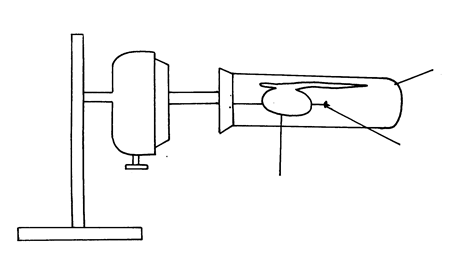 27. The diagram below represents a set-up that was used to investigate the effect of rotation on the
growth of a bean radicle. The set-up allowed the seedling to rotate slowly and continuously for
seven days
(a) Name the piece of apparatus illustrated
(b) (i) State the observation made on the shape of the radicle after seven days
(ii) Explain the observation in (b) (i) above
(c) Suggest a suitable control for this experiment
(d) Give any four importance of tropism in plants
28. An experiment was carried out to determine the growth rates of variety of bamboo and a variety of maize in two adjacent plots. The average height and average dry weight of plants from the two
populations were determined over a period of twenty weeks. The data is as shown below:-
a) On the same axes, plot a graph to show the changes in average weight of the bamboo and maize
plants over time
(b) (i) Which of the two plants had a higher productivity by the end of the experiment?
(ii) Give a reason for your answer in (b)(i) above
(c) Explain the following:
(i) Between weeks 14 and 18 the average height of maize plants remained constant while the
average dry weight increased
(ii) Dry weight was used instead of fresh weight in this experiment
(iii) Describe how the average height and average dry weight of plants were determined in
this experiment;
(d) Why was it appropriate in this experiment to use both weight and height?
(e) Give a reason why secondary thickening does not occur in bamboo and maize plants
29. (a) What is meant by the term fertilization ?
(b) (i) Name the type of cell division that produces gametes
(ii) Where does the type of cell division mentioned above occur in mammals?
(c) What happens to the wall of the uterus;
(i) before the release of an egg ?
(ii) if no fertilization occurs?
(b) How is the placenta adapted to its functions?
30. The relationship between seed fresh mass in the lupin lupinus and percentage seed germination,
percentage seedling survival and seedling fresh mass is shown in the table;
Seed fresh Mass mg-1 | Percentage germination | Percentage of seedlings surviving 2 leaf stage | Mean seedling fresh mass 5 weeks after germination/mg |
Below 16 17-25 26-35 36-45 Above 45 | 41.9 90.2 95.6 97.5 100.0 | 84.6 96.8 98.8 100.0 100.0 | 24.3 44.2 60.7 86.4 106.4 |
a) How was percentage germination in column two of the table calculated?
b) Why was seed fresh mass preferred to seed dry mass to take measurements of the seed weight
in the experiment
c) i) Explain why the measurements of mean seedling fresh mass (5) weeks after germinated
may not have been an accurate measurement of growth that had occurred
ii) How could more meaningful and accurate measurement been obtained in c(i) above?
d) With reference to the figures in the taste indicate the relationship between seed fresh mass
and percentage seed germination, percentage seedling survival and seedling fresh mass
e) Suggest an explanation why seedling produced from large seeds grow more rapidly than the
seedling produced from small seeds
31. The diagram below illustrate enzyme controlled reaction
a) State the relationship between rate of reaction and enzyme concentration
b) Account for the rate of reactions between i) Q and R
ii) R and S
iii) U and V
c) Name one other factor that affects enzyme action, not illustrated above
32. Carefully study the figure below and answer the questions that follow:-
The seedling with straight radicle and plumule was attached to a machine horizontally as shown
above. The machine rotates making one revolution in 15minutes.
(a) Draw how the seedling would look like after one week
(b) Explain your drawing in (a) above
(c) Name the machine used in the experiment above
(d) What would happen if the seedling was put horizontally outside the machine
(e) Name the stimuli investigated and type(s) of response expected in the experiment
33. (a) Give the form in which each of the following substances ate transport in mammalian blood:
(i) Carbon (IV) oxide
(ii) Oxygen
(b) Give two functions of pleural membrane
(c) Explain why formation of carboxyhaemoglobin in the blood of a mammal results in death
(d) Other than stomata, name two other gaseous exchange surfaces in plants
34. In an experiment the radicle of a seedling was marked equidistant using Indian ink as shown
in the diagram below:
(a) What was the aim of the experiment?
(b) On the diagram below mark on the radicle to show the appearance of the marks after 3days
(c ) State three characteristics of cells found just behind the root cap of a radicle
(d) Give two factors inside a seed that causes seed dormancy
11. Growth and development in (a) plants (b) animals Answers
1. a) Moulting hormone/ ecdysone
b) It allows growth to take place; since growth can not take place in the presences of the
2. a) Long sightedness/ hypermetropia ;
b) Convex/ converging lenses;
3. (a) – Excretion;
– Osmo-regulation;
(b) – Glucose
– Amino acids;
(c) – Nephritis;
– kidney stones /Gall stones;
– Hepatitis A and B; (mark first 2 pts (2mks)
4. (a) Intermittent growth curve;
(b) Moulting;
(c) Ecdysone;
5. Natural immunity is inherited /transmitted from parent to offspring; Acquired immunity
is developed after suffering from a disease or through vaccination;
6. A – Cell elongation/expansion ;
B – Cell division/multiplication ;
C – Cell différentiation/maturation ;
7. Continuous variation shows gradation in characteristic with intermediate; discontinuous shows distinct characteristics between organisms with no intermediate groupings;
8. a) to investigate the effect of the force of gravity on the growth of a seedling
(shoot and root);
b) Force of gravity cause accumulation of auxins on the lower side of the seedling
– Higher concentration of auxin will promote growth in the shoot but inhibit growth in the
Roots;
– There will be more/ faster growth on the upper side of the root than on the lower side hence
the downward bending;
-There will be more/ faster growth on the lower side of the shoot than on the upper part hence
the upward curvature;
9. i) Between xylem and phloem;
10. Growth – Increase in size of an organism or its parts due to synthesis of protoplasm
Development – Differentiation and formation of various tissues to perform specialized
functions;
11. – Reduce competition between the young ones (larvae)
– Avoid predation of the young ones as they are different
– The pupa stage can withstand harsh environment by being inactive;
12. Disadvantages of exoskeleton;
– Limits growth
– heavy to the insect;
13. Primary growth results form the activity of primary/embryonic tissues/apical meristems and
lead to increase in height, while secondary growth result from activities of secondary meristems; /cambium and leads to increase of girth/diameter /circumference;
14. i) — Oxidizes food to release energy needed for germination;
ii) — Stores food for the seed;
– Stores enzymes;
15. .- Selective weeding
– Ripening of fruits
– Parthenocorpy
Reject Prunning of coffee and tea
16. – -Contraction of muscles
– Formation of bones
17. allow growth to the place;
(ii) Grain/cotyledon remains underground below the soil level: (I mark)
18. (a)(i) Hypogeal;
(b) Photosynthesis; OWTTE
-Gaseous exchange; accept. Transpiration.
19. (a) Effect of unilateral/unidirectional light on shoots:
(b) Seedling/shoots growth towards light’ growth curvature towards light;
20. (a) Intermittent growth;
(b) Moulting /ecdysis;
(c) Ecdysone rej. Moulting hormones;
21. (a) Divide giving rise to more vascular tissues – phloem and xylem; hence leading to secondary
growth/thickening of the stem;
(b) They lack vascular cambium;
22. – It has chondrionic villis to increase surface area for excahgne of materials
– Has thin epithelium for rapid exchange of exchanged substances
– Has counter current flow of foetal and maternal blood to enhance speed diffusion gradient.
– Highly vascularised (dense network of capillaries) for faster transport of exchanged material
23. (a) For oxidation of stored food;
(b) Breakdown and oxidation of food
24. (a) (i) osmotaxi/cremotaxis
(ii) phototaxis
(i)Sensory neuron
(ii) Direction of nerve impulse
(iii) Schwarn cell
(iv) insulate the axon/Speed up transmission of impulses
(c)
Reflex action | Conditioned reflex action |
Single stimulus to bring about response. Simplest form of behaviouir and is independent of experience Sensory and mother component are the same at all times | Repeatal stimulus to bring about response Involves modifications of behaviour and dependent experience . Primary sensory component is repeat by a sensory component bat the motor. Component remains unchanged. |
25.
(a) To absorb carbon (IV) oxide;
(b) to provide moisture to germinating seeds
(c) (i) (Left – right direction );
(ii) Oxygen in the tube is taken up by the seeds for germination; the Carbon (IV Oxide
Produced during respiration and the one in the tube reacts with potassium hydroxide
pellets; lowering the pressure inside the set-up; the higher pressure from outside the tube
forces the dye in the direction shown;
26. (i) Lag phases; Dry mass increases slowly; became in plant has not developed
leaves; for photosynthesis hence is depending on stored food;
(ii) Expontial phase; Rapid growth /increase in dry mass, leaves developed; photosynthesis taking place leading to accumulation of food and rapid cell division / plant adapted to the environment
(iii) Death phase/ senescence; Negative growth/decrease in dry mass as some tissues die after reaching maximum maturity; Fall in photosynthesis activity; toxic wastes poison tissues;
(c) (i) When dry mass was first recorded/at germination
(ii) Dry mass would decrease first because food is oxidized to produces energy; water and
carbon dioxide/utilized in respiration;
(d) (i) Harvest every week about five seedlings; dry in oven to a constant dry mass; Calculate the average mass for one seedling and record the results.
(ii) Advantage; Dry mass is not affected by environmental conditions while fresh weight is
dependent on the amount of water in the plant which fluctuate with environmental factors
affecting transpiration rate.
27. a)klinostat/clinostat;
b)i)the radicle remains /grow horizontally;
ii)rotation of klinostal causes uniform distribution of auxins/ indoleacetic acid; hence
uniform growth/clongations (no curvature formed); c)the experiment repeated but with stationary klinostat;
d)-(tropism)enable plants to get water-hydrotropism;
-chemotropism aids plants in fertilization and nutrients absorption;
-thigmotropism enable weak plants to obtain support
-phototropism enable plants to obtain light for photosynthesis;
-geotropism enables the roots grow down the soil towards the centre of the earth thus
providing support to the plant
28. a)graph
-axes have to be labelled- ½ mk@-1mk No axes marking stops there.
-scale-should be appropriate and workable- ½ mk @-1mk
-plotting correctly-1mk@*RCH*∗wrong scale stop marking.
-curve-smooth and not extrapolated beyond 3 small squares- ½ mk@-1mk
-identity- ½ mk each-*RCH*
Note/ -axes reversed-award only for identity
-no origin-award only for one scale/vertical one.









b) i)bamboo;
ii)(bamboo)have higher average weigh
c) i)average height of maize plant between weeks 14 and 18 constant (at 2.1m); maximum
height attained; average weight increased; because there was slight increased in the girth;
ii) dry weight represents the actual dry matter/fresh weight includes weight of water;
iii)-average height was determined by measuring the length; of the plants at various intervals;
-average dry weight was determined by heating the plants to exclude all the water; and then
taking their dry weights;
d) both height and weight are used to show rates of growth;
e) lacks cambium(tissue)hence no secondary thickening;
29. a) Fusion of an egg cell nucleus with sperm cell nucleus; to form a zygote
b) i) Meiosis
ii) In the testis/ testes/ ovary/ ovary
c) i) There is increased blood supply causing thickening of the uterine walls;
ii) Capillaries break up/ endometrium is lost with some blood/ menstruation occurs
d)
- Large number/ numerous blood vessels to increase surface area for exchange of materials
- Thin membrane for faster diffusion across it
- Has villi to increase surface area for diffusion
- Special cells to produce hormones
- Membrane selectively allows materials across it
30. a) Number of seeds that germinate X 100 = % seed germination
Number of seeds planted
b) Seeds dry mass would have resulted in death of embryo thus no germination
c)i) Mean seedling fresh mass include the mass of water that has not resulted from growth
ii) At regular intervals of time; uproot seedlings (say five each) dry to constant weight,
and record
d) Directly proportional / Increase in seed mass results in increase in % seed germination,
survival and seedling fresh mass
e) Embryo well developed/ Embryo very mature;
– Large food reserves for growth and development
30. a) Directly proportional/ increase in enzyme concentration results in increase in
reaction rate
b) i) Increase in substrate concentration results in increase in reaction rate
Increase in concentration results in more active sites occupied by substrate
molecules, resulting in higher turn over
ii)A rate of reaction constant/ does not change
Active sites fully occupied
iii) Sharp decrease in reaction rate
Enzymes denatured
c) PH/ Enzyme inhibitors/ Enzyme co- factors
31. a)

b) the rotation of the machines/ klinostat ensured equal distribution of Auxins in the
seedling (upper & inner) side;
c) Klinostat;
d) radicle grow dominants; plumule grow upwards;
e)
STIMULI | RESPONSE (name) |
light | Phototropism; |
gravity | Geotropism; |
32. (a) (i) Carbam inohaemoglohin:
(weak) Carbonic acid: (2marks)
(ii) Oxyhaemoglobin; (I mark)
(b) Secretes pleural fluid:
– Makes lungs air tight:(OWTTE) (2marks)
(c ) Carboxyhaemoglobin doesn’t dissociate readily (OWTTE):
Hence its formation reduces the capacity of haemoglobin to carry oxygen to time lungs
hence resulting in death: (2marks)
(d) Cuticle: lenticels: (Both to be correct to score I mark) (I mark)
33. (a) Region of rapid growth / cell elongation in a radicle: root
(b)
(c ) Dense cy1oplasms
Lack cell vacuoles
Thin cell walls
(d) -Presence of germination inhibitors / abscicic acid:
– Low concentration of hormones / Enzymes/ gibberclic acid:
– Impermeable seed coats to water and oxygen:
– Embryo not fully developed:


