


THERMOSPHERE
The thermosphere extends from about 80 km to between 500 and 1,000 km. Temperatures increase as it approaches nearer to the sun. The heating effects of the Earth no longer exist at these higher altitudes.
The thermosphere is considered part of Earth’s atmosphere (the upper atmosphere), but air density is so low that most of this layer is what is normally thought of as outer space. In fact, this is where the space shuttles flew and where the International Space Station orbits Earth.
This is also the layer where the auroras occur. Charged particles from space collide with atoms and molecules in the thermosphere, exciting them into higher states of energy. The atoms shed this excess energy by emitting photons of light, which we see as the colorful Aurora Borealis and Aurora Australis.
EXOSPHERE
The exosphere, the highest layer, is extremely thin and is where the atmosphere merges into outer space. It is composed of very widely dispersed particles of hydrogen and helium.
The upper part of the exosphere is called the Magnetosphere. The motion of ions in this region is strongly constrained by the presence of the Earth’s magnetic field. This is the region where satellites orbit the Earth.
Note:
- (i) The troposphere, stratosphere, and mesosphere collectively form the homosphere. These layers have the same chemical composition: 78% nitrogen, 21% oxygen, 1% argon, and other gases which sum to about 0.05%. The thermosphere is excluded due to differences in chemical composition.
- (ii) The upper atmosphere above 90 km is called the heterosphere. The atmosphere is no longer a mixture of gases but separates into layers, with heavier ones forming the bottom layer.
VARIATION OF TEMPERATURE WITH HEIGHT
The temperature above the Earth’s surface varies as shown in the graph below.

The residence time,  is the mean lifetime of a gas molecule in the atmosphere.
THE IONOSPHERE AND TRANSMISSION OF RADIO WAVES
The ionosphere is the region containing high concentrations of charged particles: ions and electrons.
The ionosphere is created by atoms absorbing UV radiation, gamma rays, and X-rays.
The ionosphere extends from the lower thermosphere, 55 km to 550 km above the Earth’s surface.
Ionosphere layers:
Due to differences in composition of the air in the ionosphere, it is divided into layers:
- (i) The lower layer, called D layer: This layer exists only in the daytime at an altitude of 55 to 90 km above the Earth’s surface. Ionization in this region is relatively weak.
- (ii) The next layer, E layer: This layer is between 90 and 145 km above the Earth’s surface. It has a maximum density at noon but is only weakly ionized at night.
- (iii) The top layer, the F layer: At night, it exists as a single layer in a region of about 145 to 400 km above the Earth’s surface. During the day it splits into two layers, F1 and F2.
The Ionosphere and Communication
The ionosphere plays an important role in communication. Radio waves can be reflected off the ionosphere allowing radio communications over long distances. However, this process is more successful during the night-time.
Why Transmission is Better at Night?
During the day: The ionosphere extends into the lower atmosphere (D layer). In this layer, there is a high concentration of particles, so recombination of electrons and ions due to collision is more likely to occur. This leads to the radio waves being absorbed rather than reflected. Hence, distant communications are poor during the day.
During the night: The D layer disappears due to a decrease in ionization of molecules, but recombination of electrons and ions still occurs at a slower rate. The radio waves are then reflected by E and F layers in which recombination of electrons and ions is rare; hence there is less absorption of the radio waves.
EXAMPLES: SET C
Example 01: Necta 1985 P1
(a) (i) Distinguish between P and S waves, stating clearly the difference between their speeds in a medium.
(ii) Draw a schematic diagram showing how one station on the Earth’s surface can receive P or S waves from a distant source and state which waves can be refracted by the Earth’s outer core.
(b) (i) Give a summary of the origin and composition of the ionosphere.
(ii) What is the net electric charge in the ionosphere?
(iii) Show graphically how electron density changes with altitude in the ionosphere.
Answers
(a) (i) P waves are longitudinal compression waves which can pass through solids, gases, and liquids, whereas S waves are transverse shearing waves which cannot pass through a fluid (gas or liquid).
The speed of P waves in a medium is approximately twice that of the S waves; hence P waves are faster than S waves.
(ii) Refer to the diagram for the seismic wave paths.
(b) (i) The ionosphere is the upper part of the atmosphere. It is formed due to the ionization of gaseous atoms as they absorb ultraviolet radiation from the sun, gamma rays, and X-rays.
(ii) The net electric charge in the ionosphere is zero.
(iii) Variations of electron density in the ionosphere: Electron density increases from D to F layer.
Example 02: Necta 1988/1993 P1
(a) What are the factors that influence the velocities of P and S waves?
(b) Explain briefly the characteristic property of seismic waves which is used to locate discontinuities in the Earth’s crust.
Answer
(a) The velocities of both P and S waves are influenced by:
- Density of the rock material (media),
- Moduli of elasticity.
(b) Speed is the characteristic property of seismic waves that is used to locate discontinuities.
Between the crust and mantle, there is an abrupt change of density, which shows an abrupt change in speed of both P and S waves; a Mohorovicic discontinuity exists here. Both P and S waves travel across this discontinuity.
Between the mantle and the core, there is the Gutenberg discontinuity; only P waves travel this discontinuity.
Example 03: Necta 1989 P1
(a) State three sources of heat energy in the interior of the Earth.
(b) (i) How does temperature vary with depth of the Earth?
(ii) What are the factors that influence the flow of heat from the interior of the Earth?
Answers
(a) Refer notes.
(b) (i) The temperature increases with increasing depth.
(ii) The rate of heat flow (conduction) is given by:

The heat flow from the interior of the Earth depends on:
- Thermal conductivity of the rock,
- Temperature gradient of the rock.
Example 04: Necta 1989 P2
(a) What do you understand by the terms?
- (i) Solar wind,
- (ii) Magnetopause,
- (iii) Magnetosphere.
(b) What are the various factors that contribute to the Earth’s magnetic field?
(c) (i) With the aid of a suitable diagram, illustrate the components of the Earth’s magnetic field at a given point P in the Earth’s atmosphere.
(ii) An electron whose kinetic energy is 10 eV is circulating at right angles to the Earth’s magnetic field whose uniform induction is 1.0 x 10⁻² Wb/m2. Calculate the radius of the orbit and its frequency in that orbit.
Answers
(a) (i) Solar wind is a continuous stream of fast-moving charged particles in the atmosphere which are produced from flares (eruptions) from the sun.
(ii) Magnetopause is the upper boundary of the magnetosphere.
(iii) Magnetosphere is the uppermost part of the exosphere consisting mainly of charged ions. These particles move under the influence of the Earth’s magnetic field.
(b) Short term variations: Disturbances in the magnetosphere due to solar emissions; these charged ions travel and in the ionosphere they form ring currents which give rise to a magnetic field.
Long term variations: The molten inner core of the Earth is partly ionized. The movement of this ionized core causes a magnetic field which contributes to the Earth’s magnetic field.
(c) (i) Refer notes.
(ii) Refer electromagnetism.
Example 05: Necta 1990 P1
(a) Define the term “isoseismal line”.
(b) Write short notes on each of the following regions of the atmosphere:
(i) Troposphere, (ii) Stratosphere, (iii) Exosphere.
Answer:
Refer notes.
Example 06: Necta 1990 P2
(a) Explain clearly how P and S waves were used to ascertain that the outer core of the Earth is in liquid form.
(b) Giving reasons, discuss the temperature variation in atmosphere (above the Earth’s surface).
Answers
(a) P waves are longitudinal elastic waves capable of passing through solids and liquids, and S waves are transverse elastic waves capable of traveling through solids only.
As both waves are projected towards the surface from the interior core, only the P waves are recorded. This shows that the outer core is in liquid form.
(b) From the ground level, the atmospheric temperature decreases steadily as altitude increases up to the troposphere. Thereafter, the temperature increases with altitude up to the stratosphere. The ozone of the stratosphere absorbs the incoming sun radiation; hence the temperature increases. In the mesosphere, there is no ozone; thus, there is a decrease (cooling) with increasing altitude. The heating effect of the Earth ceases in the thermosphere, so the closer to the sun, the higher the temperature.
Example 07: Necta 1991 P2
(a) List four physical changes that took place at a location just before onset of an earthquake at that particular location.
(b) Give brief accounts of the processes that give rise to:
(i) The Earth’s magnetic field,
(ii) Volcanic eruptions.
Answers
(a) Density of rocks, stresses, faults, and waves.
(b) (i) Explain generation of the Earth’s field in the atmosphere and the outer core.
(ii) The seismic or earthquake waves result from a fracture or sudden deformation of the Earth’s crust. Vast stresses occur locally in the rocks being concentrated where the rocks are sliding over one another. In regions where pressure is reduced, pockets of molten rock called magma are formed. Once the rock has melted, the pressure may force it into cracks and fissures in the surrounding solid rock. This may emerge above the surface as a lava flow or volcano.
Example 08: Necta 1992 P1
(a) What do you understand by the term ionosphere?
(b) Explain how short wave long distance transmission and reception of radio waves is more effective at night than it is during the daytime.
Answer
(b) In the daytime, the base of the ionosphere (D-layer) is at lower heights where the high concentration of particles allows for ionization and recombination of ions by collision. Because of this, radio waves are absorbed rather than reflected, so distance communication is poor.
During the nighttime, the D layer disappears, the base of the ionosphere is higher; thus, the recombination of ions is rare and so less absorption of waves occurs. Obliquely transmitted waves therefore can be reflected for distant reception.
Example 09: Necta 1993 P2
(a) What is the origin of the Earth’s magnetic field?
(b) The diagram below shows the structure of the Earth. Name the parts indicated by the letters A to F.

Answer
(b) A represents Mohorovicic discontinuity.
B represents Gutenberg discontinuity.
C represents core.
D represents mantle.
E represents epicenter.
F is not clear to interpret.
Example 10: Necta 1994 P1
(a) Define the terms: angle of inclination (dip) and angle of declination (variation) as used in specifying the Earth’s magnetic field at any point.
(b) The Earth’s total resultant flux density BR in a certain country is found to be 5.0 x 10⁻⁵ T and the horizontal component BH is 2.0 x 10⁻⁵ T. Calculate:
- (i) The vertical component, Bv, and
- (ii) The angle of inclination in that country.
Solution
(b) (i) The vertical component is given by:

(ii) Angle of inclination is given by:

Example 11: Necta 1994 P1
(a) (i) Name the lowest layer of the atmosphere and the lowest layer of the ionosphere.
(ii) State the importance of each of these layers.
(b) What is the ozone layer?
Answers
(a) (i) The lowest layer of the atmosphere is the troposphere and the lowest layer of the ionosphere is called the D layer.
(ii) The troposphere supports life.
The D layer is important for communication purposes as it reflects radio waves.
(b) The ozone layer is within the stratosphere. In the ozone layer, molecular oxygen (O2) is dissociated into atomic oxygen (O), which is then reformed into ozone (O3).
The ozone so formed absorbs ultraviolet radiation, thus protecting plants and shielding people from skin cancer and eye cataracts.
Example 12: Necta 1994 P2
(a) Illustrate the components of the Earth’s magnetic field at a given point P in the Earth’s atmosphere by a suitable diagram.
(b) Using a tangent galvanometer, explain how you could determine the Earth’s magnetic field.
Answers
Example 13: Necta 1995 P1
(a) (i) Which region of the solid Earth includes the Earth’s centre?
(ii) On which region of the solid Earth do the continents rest directly?
(iii) Which region of the ionosphere has the highest electron density?
(b) Briefly explain how earthquakes can be detected.
Answers
(a) (i) Inner core, (ii) Crust, (iii) F region.
(b) Detection of earthquakes is done by recording or measuring the seismic waves generated by the earthquakes. These waves are recorded by an instrument called a seismograph.
Example 14: Necta 1995 P2
(a) Draw a well-labeled diagram which shows the interior structure of the Earth. Indicate also which parts of the interior are in solid form and which are in liquid form.
(b) Name and distinguish the type of waves that are produced by an earthquake.
(c) Briefly describe the three ways in which signals from ground-based transmitters can reach the receiver.
Answers
(a) There are four types of seismic waves:
- Body waves – divided into P and S waves.
- Surface waves – divided into Love and Rayleigh waves.
(b) A telecommunication problem.
Ground wave, sky wave, and space waves.
Example 15: Necta 1998 P1
(a) State any three magnetic components of the Earth’s magnetic field.
(b) The horizontal and vertical components of the Earth’s magnetic field at a certain location are 2.73 x 10⁻⁵ T and 2.1 x 10⁻⁵ T respectively. Determine the Earth’s magnetic field at the location and its angle of inclination θ.
Solution
(a) Components of the Earth’s magnetic field are:
- Vertical component (which points vertically downward).
- Horizontal component which comprises:
- Eastly component (towards geographic north pole).
- Northly component (towards magnetic north pole).
(b) 
Example 16: Necta 1998 P1 B
(a) What is the origin of the Earth’s magnetic field?
(b) The following diagram shows the main layers forming the interior of the Earth. Name the layers indicated by letters A to G.

Answers
(a) Refer notes.
(b) A = Earth’s surface, B = Crust, C = Moho discontinuity, D = Gutenberg discontinuity, E = outer core, F = Mantle, and G = inner core.
Example 17: Necta 1998 P2 B
(a) Explain the following terms: Earthquake, Earthquake focus, Epicenter, and body waves.
(b) List three sources of earthquakes.
(c) (i) Define ionosphere.
(ii) Mention the ionosphere layers that exist during the daytime.
(iii) Give the reason for better reception of radio waves for high-frequency signals at night than during daytime.
(d) Explain briefly three different types of radio waves traveling from a transmitting station to a receiving antenna.
Answers
(a) Refer notes.
(b) Refer notes.
(c) (i) During the daytime, all the layers D, E, F1, and F2 layers exist.
(ii) Refer Necta 1992 (b).
(d) Ground (surface wave), Space wave, Sky waves (refer telecommunication notes).
Example 18: Necta 2000 P1
(a) With reference to an earthquake on a certain point of the Earth, explain the terms ‘focus’ and ‘epicenter’.
(b) What is the importance of the following layers of the atmosphere?
(i) The lowest layer
(ii) The ionosphere
(c) (i) Describe two ways by which seismic waves may be produced.
(ii) Describe briefly the meaning and application of “seismic prospecting”.
Answers
(a) Refer notes.
(b) (i) Importance of troposphere: it supports life on Earth.
(ii) Ionosphere enhances communication over long distances.
(c) (i) Describe any two causes of earthquake.
(ii) Seismic prospecting is an artificial production of seismic waves purposely for searching underground fuels, oils, or gases.
Example 19: Necta 2001 P1
(a) (i) Define the term “angle of declination” as used in the specification of the Earth’s magnetic field at a point.
(ii) The horizontal component of the Earth’s magnetic field at a location was found to be 26.0  while the angle of inclination was
  . Find the magnitude of the field and the vertical component of the field at the location.
(b) (i) Define an earthquake.
(ii) Distinguish between P and S waves. What factors influence their velocities?
Answers
(a) (i) Refer notes.
(ii) 
(b) The velocities of P and S waves are influenced by:
- Density,
 of the media,
 - Shear modulus, of the media, and
- Bulk modulus, B of the media.
 of the media,
 of the media, and
Example 20: Necta 2002 P1
(a) (i) What is the importance of ionosphere to mankind?
(ii) Explain why transmission of radio waves is better at night than at daytime.
(b) (i) What is an earthquake?
(ii) Explain briefly any four (4) causes of earthquake.
Example 21: Necta 2003 P2
(a) Explain the following:
(i) Earthquake (ii) Earthquake focus (iii) The epicenter.
(b) List three sources of earthquake.
(c) (i) Define the ionosphere.
(ii) State the ionosphere layer that exists during daytime.
(iii) Give the reason for better wave reception for high-frequency signals at night than during daytime.
Answers
(a) Refer notes.
(b) Refer notes.
(c) (i) During the daytime, all the layers D, E, F1, and F2 layers exist.
(ii) Refer Necta 1992 (b).
(d) Ground (surface wave), Space wave, Sky waves (refer telecommunication notes).
Example 22: Necta 2004 P1
(a) (i) Explain the terms epicenter and focus as applied to earthquake.
(ii) State any four (4) indications that may predict the occurrence of an earthquake.
(iii) State and explain two variations of the Earth magnetic field.
(iv) State one necessary precaution to be taken by people living in a region with a high risk of occurrence of earthquakes.
(b) Explain the following:
(i) Solar wind (ii) Magnetopause (iii) Ionosphere.
Example 23: Necta 2005 P1
(a) Define the following terms:
(i) Epicentral distance (ii) Body wave (iii) Seismograph.
(b) (i) Explain the meaning of reflection seismology and state its application.
(ii) Show how the magnetic field within the atmosphere is generated.
(c) (i) Name the lowest layers of the atmosphere and the ionosphere.
(ii) State their importance.
Answers
(a) (i) Lowest layer of atmosphere is troposphere and that of the ionosphere is the D layer.
Example 24: Necta 2006 P1
(a) (i) State two (2) ways by which seismic waves may be produced.
(ii) What is seismic prospecting?
(b) (i) Discuss briefly the importance of the lowest layer of the atmosphere and the ionosphere.
(ii) Sketch the temperature against altitude curve for the atmosphere indicating the important atmospheric layers.
(iii) The average velocity of P waves through the Earth’s solid core is 8 km/s. If the average density of the Earth’s rock is 5.5 x 10³ kg/m3, find the average bulk modulus of the Earth’s rock.
Answer
(a) (i) Causes of an earthquake.
(b) (ii) Using the formula:

Example 25: Necta 2007 P1
(a) (i) What are the differences between P and S waves?
(ii) Explain how the two types of waves (P and S) can be used in studying the internal structure of the Earth.
(b) Write short notes on the following terms in relation to the changes in the Earth’s magnetic field: long term (secular) changes, short-period (regular) changes, and short-term (irregular) changes.
(c) (i) What is geomagnetic micro pulsation?
(ii) Give a summary of location, constitution, and practical uses of the stratosphere, ionosphere, and mesosphere.
Answers
(c) (i) Geomagnetic micro pulsations are small rapid changes in the Earth’s magnetic field. They have periods between 0.2 seconds and 10 minutes and intensities less than 0.01% of the minimum field.
Example 26: Necta 2008 P1
(a) Define the following terms:
(i) Earthquake (ii) Atmosphere.
(b) Distinguish between body waves and surface waves that are produced by an earthquake.
(c) (i) Define the terms epicenter and focus as applied to earthquake.
(ii) Draw a well-labeled diagram which shows the interior structure of the Earth.
Example 27: Necta 2009 P1
(a) (i) What is meant by the shadow zone?
(ii) Why does the shadow zone occur?
(b) (i) Name the lowest layer of the atmosphere and the lowest layer of the ionosphere.
(ii) State the importance of each of these layers in (b)(i) above.
(iii) Explain briefly the reason for better reception of radio waves for high-frequency signals at night times than during day times.
(c) State the sources of heat energy in the interior of the Earth.
Example 28: Necta 2010 P1
(a) (i) Explain the terms: earthquake, earthquake focus, and epicenter.
(ii) Describe clearly how P and S waves are used to ascertain that the outer core of the Earth is in liquid form.
(b) (i) Define the ionosphere and give one basic use of it.
(ii) Why is the ionosphere an obstacle to radio astronomy?
Example 29: Necta 2011 P1
(a) (i) Define the following terms: Geophysics, Atmosphere, and Epicenter.
(ii) Write down brief notes on the location, composition, and importance of the following:
Troposphere, Stratosphere, Mesosphere, and Thermosphere.
(b) (i) Draw a sketch diagram showing the working part of a Seismometer.
(ii) Explain how temperature varies with both altitude and depth of the Earth.
(iii) Write down two factors that govern heat flow from the interior of the Earth.
Example 30: Necta 2012 P1
(a) (i) Name three layers of the atmosphere.
(ii) Describe any two major zones of the Earth.
(b) (i) What are the factors that influence the velocities of P and S waves?
(ii) The P and S waves from an earthquake with a focus near the Earth’s surface travel through the Earth at nearly a constant speed of 8 km/s and 6 km/s respectively. If there is no reflection and refraction of waves, how long is the delay between the arrivals of successive waves at a seismic monitoring station at 90° in latitude from the epicenter of the earthquake?
Solution
(a) (ii) Any two of core, mantle, crust, hydrosphere, atmosphere.
(b) (i) The density of rock, moduli of elasticity of rock material.
(ii) Illustration (R = Earth radius).
 |
Distance travelled by the waves (distance between focus and seismic station) is:

Time taken by P waves to arrive at the station is:

Time taken by the waves to arrive at the station is:

The time interval between the arrival of the two waves is t = t2 – t1 = 25.1 – 18.9 = 6.2 minutes.
Example 31: Necta 2012 P1
(a) (i) What do you understand by the word environmental physics?
(ii) Briefly explain three effects of seismic waves.
(b) (i) Mention three types of environmental pollution.
(ii) Explain the following climatic factors which influence plant growth: Temperature, Relative humidity, and wind.
Example 32: Necta 2013 P1
(a) (i) The main interior of the Earth core is believed to be in molten form. What seismic evidence supports this belief?
(ii) Explain why the small ozone layer on the top of the stratosphere is crucial for human survival.
(b) Electrical properties of the atmosphere are significantly exhibited in the ionosphere.
(i) What is the layer composed of and what do you think is the origin of such constituents?
(ii) Mention two uses of the ionosphere.
(c) Briefly explain why long distance radio broadcasts make use of short wave.
Answers
(a) (i) When P and S seismic waves are sent from one side of Earth to the other, only P waves can be detected on the other side. The fact that S waves do not travel through the core provides evidence for the existence of a liquid core.
(ii) Ozone absorbs harmful radiation from the sun. The ozone protects plants and shields people from skin cancer and eye cataracts.
(b) (i) The layer is composed of free electrons and positive ions. The ionosphere is created by atoms absorbing UV radiation, gamma rays, and X-rays.
(ii) Uses of the ionosphere:
- Ionosphere supports radio communication over long distances.
- Particles in the ionosphere absorb UV radiation, gamma rays, and X-rays, thus protecting people from harmful effects of these radiations.
(c) Refer telecommunication notes.
Example 33: Necta 2013 P1
(a) Briefly explain the following types of environmental pollution:
(i) Thermal pollution
(ii) Water pollution
(b) Describe the soil temperature with regard to agriculture, physics which causes lower crop growth at a particular area.
Answers
(b) High soil temperature causes the crop roots to rot; this leads to insufficient water supply to plant leaves and hence lowers the growth of the crop.
Lower soil temperature inactivates soil organisms. Decomposition of organic matter is lowered and hence the supply of nutrients to crop which in turn leads to lower crop growth.
TRY YOURSELF
(a) (i) What are auroras?
(ii) Define the homosphere.
(b) (i) What are the factors which contribute toward volcanic eruptions?
(ii) What are the effects of volcanic eruptions?
(iii) What are lahars?
Lahars are rapidly flowing mixtures of rock debris and water that originate on the slopes of a volcano. They are also referred to as volcanic mudflows or debris flows. Volcanic eruptions may directly trigger one or more lahars by quickly melting snow on a volcano or ejecting water from a crater lake. They form in a variety of ways including through intense rainfall on loose volcanic rock deposits and as a consequence of debris avalanches.
ENVIRONMENTAL POLLUTION
Pollution is the addition of unwanted materials or pollutants into the environment.
Pollutant is any substance that does not belong in the natural system and disrupts the natural balance.
Types of Environmental Pollution
- (a) Air pollution (atmospheric pollution)
- (b) Water pollution (hydrosphere pollution)
- (c) Land (soil) pollution
- (d) Noise pollution
- (e) Thermal pollution
ATMOSPHERIC (AIR) POLLUTION
Air pollution is a form of environmental pollution caused by the release of gaseous materials and dust particles in the atmosphere. The main pollutants found in the air we breathe include particulate matter, lead, ground-level ozone, heavy metals, sulphur dioxide, benzene, carbon monoxide, and nitrogen dioxide.
Causes of Air Pollution
Man-made causes:
- Clearing (deforestation) and burning of vegetation. This releases carbon dioxide into the atmosphere and dust particles which may be carried by wind on bare land.
- Burning of fuels: This releases greenhouse gases in the atmosphere. Fuels are burnt in cars, power stations, and industries.
- Construction activities, like road and building construction, can add dust particles in the atmosphere.
- Automobile exhausts. Cars, trains, etc., burn fuels as they move; this releases pollutant gases into the atmosphere.
- Smoke from industries also pollutes the atmosphere.
- Agricultural activities. The use of pesticides/insecticides pollutes the air.
- Mining activities.
Natural causes:
- Volcanic eruptions – release smoke and dust particles into the atmosphere.
- Wind storms – carry land particles into the air.
- Temperature inversion – the increase in temperature in the stratosphere causes high altitude particles to sink to the troposphere.
WATER POLLUTION
Water pollution is the degradation of water quality in a manner that disrupts or prevents its intended or original use.
Surface water or groundwater may be polluted.
Causes of Water Pollution
- Disposal of untreated sewage (industrial or hospital, etc.) into water bodies.
- Wind may introduce dust particles into water from the land.
- Agricultural activities near water bodies. Chemicals used during farming may be carried to the water bodies by rainwater.
- Oil spills. Leakage of oil in underwater oil pipes, leakage from boats, ships, etc., pollutes the water.
- Fishing by using chemicals (dynamite fishing).
- Volcanic activities along water bodies.
- Quarrying along the coast.
LAND (SOIL) POLLUTION
Soil pollution is defined as the build-up in soils of persistent toxic compounds, chemicals, salts, radioactive materials, or disease-causing agents which have adverse effects on plant growth and animal health.
A soil pollutant is any factor which deteriorates the quality, texture, and mineral content of the soil or which disturbs the biological balance of the organisms in the soil.
Causes of Soil Pollution
- Chemicals from industries.
- Acid rain – this increases soil acidity.
- Farming activities which make use of insecticides/pesticides.
- Mining activities – increase rock sediment into the soil.
NOISE POLLUTION
Noise pollution is any disorganized loud sound.
Causes of Noise Pollution
- Noise from factories and workshops.
- Thunderstorm explosions or bombs.
- Low-level flying aircraft.
- Radio at large volumes.
- Slamming of doors.
THERMAL POLLUTION
Thermal pollution is a form of environmental pollution caused by the release of waste heat into water or air.
Causes of Thermal Pollution
- Hot gases released by industries and motor vehicles warm the environment.
- Hot waste liquid from industries pumped into a river, lake, or other waterway.
Effects of Thermal Pollution
- Heat introduced into water can make the water so hot that no living thing can survive in it.
- Hot gases introduced into the atmosphere lead to greenhouse effects.
Solutions to Thermal Pollution
- One is a cooling pond into which heated wastewater is released before it enters a natural waterway. The cooling pond permits evaporation of some water, carrying heat into the air and thus releasing cooler water into the waterway.
- The cooling tower method – either wet or dry – which also transfers heat to the air. In both types, heated water is introduced into a tower through which air is blown, and some heat is passed to the air.
PARTICULATE MATTER IN THE ATMOSPHERE (AEROSOLS)
Particulate matter (aerosol) is the general term used for a mixture of fine solid particles and liquid droplets found in the air.
Haze Aerosol
Haze aerosol is frequently encountered in optical studies and includes any airborne particles that affect visibility.
Classification of Particulate
Particulate matter is classified in accordance with its formation mechanisms:
- Primary particles
- Secondary particles
Primary particles are directly emitted into the atmosphere from their sources, while secondary particles are formed after chemical transformation of their gaseous precursors. Chemical reactions transform primary pollutants (emitted by the sources) to secondary pollutants that are formed within the atmosphere. Ozone, sulfate aerosols, nitrates are examples of secondary pollutants.
Particulate matters in the atmosphere are categorized as:
- Minerals, 72–91%, e.g., soil particles, hematite, mica, and talc;
- Combustion products, 1–10%, e.g., coal and oil soot, fly ash, burned paper;
- Biological materials 2–10%, e.g., pollen, spores, starch, plant tissues, and diatoms;
- Miscellaneous matter, trace – 8%, e.g., salt, rubber, iron/steel, paint pigment, and humus.
Dust
Refers to a relatively coarse range of solid particles (diameter, d >1 μm), produced by disintegration of minerals or from re-suspension by wind when sun blasting of soil particles may often cause comminuting.
Smokes and Fumes
Are fine particles formed from the gas phase by condensation. In the case of fume, the particles are generally from 0.01 – 1 μm diameter, and are often observed as agglomerates of smaller particles. Suspended particulate matter < 15 μm diameter is usually defined as smoke.
Mists and Fogs
Are liquid droplets: Mists (d > 40 μm) and fogs (d = 5 – 40 μm).
Advantages of Particulate Matter in the Atmosphere
Aerosols act as nuclei where water vapour collects during the formation of water droplets through condensation.
Disadvantages of Particulate Matter in the Atmosphere
- Cause global warming.
- Can block the atmosphere (impair visibility).
- Once deposited on leaves, they block stomata and hence no photosynthesis for plants.
- Changing the timing and location of traditional rainfall patterns.
- Can lead to development of heart and lung diseases.
TRANSPORT MECHANISMS OF ATMOSPHERIC POLLUTANT
The transport of pollutants by the wind.
The three transport processes that influence the regional dispersion are:
- (a) Wind speed (shear)
- (b) Directional veer (change in direction of wind)
- (c) Eddy motion (eddy diffusion)
Wind shear: The vertical gradient of wind speed (i.e., wind shear) is responsible for lagging of low elevation pollutants behind those in the upper layers.

Directional veer: The directional veer with height causes lateral displacement of a vertically uniform puff.
The eddy motion is the vertical transport of pollutants from regions of high concentration to low concentration. Eddy motions are due to random vertical and horizontal fluctuations caused by thermal and mechanical turbulence.
Both the transport speed and direction for an air parcel vary from day to day.
Stratosphere – Troposphere Interchange
Temperature inversion at the tropopause causes an interchange of particulate matters between the stratosphere–troposphere boundary.
EFFECTS OF POLLUTION ON VISIBILITY
Atmospheric pollution results in a reduction in visual range in the atmosphere. The reduction in visual range is caused by an increase in airborne particles that affect light scattering and attenuation involving both primary and secondary aerosols, and may be experienced in rural as well as urban areas.
EFFECTS OF ATMOSPHERIC POLLUTION ON THE GLOBAL ALBEDO AND CLIMATE
Increases in particulate matter in the atmosphere may:
- (a) Affect cloud droplet formation and precipitation,
- (b) Reduce the amount of solar radiation that reaches the ground,
- (c) Reduce the cooling of the surface layer of the Earth at night and influence the global albedo.
However, controversy still remains as to whether the presence of particulate material exerts a net warming or cooling effect to enhance or offset the global warming predicted from increases in CO2 and chlorofluoromethanes in the atmosphere. In addition, considerable changes in global and surface albedo have been caused by deforestation, salinization, and desertification.
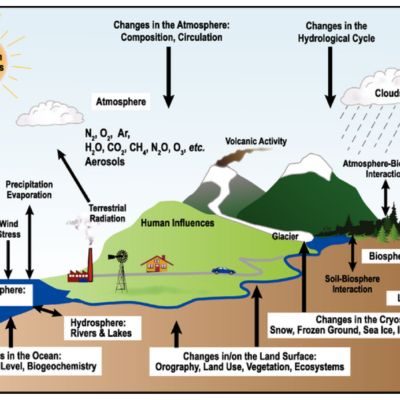
GLOBAL WARMING
Global warming is the increase of the average temperatures near or on the surface of the Earth as a result of the greenhouse effect.
Greenhouse Effect
Greenhouse effect is the process in which the emission of radiation by the atmosphere warms the Earth’s surface.
Greenhouse gases include carbon dioxide, methane, chlorofluorocarbons, and dinitrogen oxide.
When heat from the sun reaches the Earth’s surface in the form of sunlight, some of it is absorbed by the Earth. The rest is radiated back to the atmosphere at a longer wavelength than the incoming sunlight. Some of these longer wavelengths are absorbed by the greenhouse gases in the atmosphere before they are lost out of space. The greenhouse gases reflect the heat back to the Earth and warm the environment.
Sources of Greenhouse Gases in the Atmosphere
- (a) Carbon dioxide is added in the atmosphere by:
- (i) Clearing and burning of vegetation.
- (ii) Burning of fossil fuels.
- (b) Methane is added in the atmosphere by:
- (i) Agricultural activities;
- (ii) The mining of coal and oil.
- (c) Dinitrogen oxide is added in the atmosphere by:
- (i) Combustion of fossil fuels in vehicles and power stations.
- (ii) Use of nitrogenous fertilizer.
- (iii) The burning of vegetation and animal waste.
- (d) Sources of chlorofluorocarbon include fridges, air conditioners, and aerosols.
Effects of Global Warming
- Increase in the temperature of the oceans,
- Rise in sea levels,
- Change in world’s climatic patterns,
- Acidification of the oceans,
- Extreme weather events like floods, droughts, heat waves, hurricanes, and tornadoes,
- Higher or lower agriculture yields,
- Melting of Arctic ice and snow caps. This causes landslides, flash floods, and glacial lake overflow,
- Extinction of some animals and plant species,
- Increase in the range of disease vectors (organisms that transmit disease).
Solutions to Global Warming
- Use of cleaner alternative sources of energy such as solar and wind,
- Put in place energy conservation measures to reduce the use of fossil fuel,
- Planting trees that would absorb carbon dioxide.
NUCLEAR WASTE AND METHODS OF DISPOSAL
Nuclear wastes are the chemical products (solid, liquid, and/or gases) of nuclear reactions in the nuclear reactor.
Categories of Radioactive Waste
For the purpose of disposal, radioactive waste is divided into the following categories:
- (a) High-level waste (HLW): spent fuel (SF) not destined for reprocessing; vitrified fission product solutions from reprocessing of spent fuel.
- (b) Alpha-toxic waste (STW): waste with a content of alpha-emitters exceeding a value of 20,000 Becquerels per gram of conditioned waste.
- (c) Low- and intermediate-level (L/ILW): all other radioactive waste.
Nuclear Waste Disposal
- (a) Deep geological repository: for spent fuel and vitrified fission product solutions from reprocessing. The products are buried deep into the Earth.
- (b) Recycling of the nuclear waste.

2 Comments