


THERMAL EXPANSION
EXPANSION OF METAL WHEN HEATED
Expansion is the increase in dimension of a solid when heated.
Contraction is the decrease in dimension when a solid is cooled.
Thermal expansion is the change in size of matter when the temperature of matter changes.
DEMONSTRATION
- The ball and ring experiment

RESULT
A metal ball just slips through a metal ring before heating. This shows that the diameter of the metal ball is slightly smaller than that of the metal ring. After heating, the metal ball does not slip through the metal ring. This shows that the diameter of the metal ball increases when heated (the diameter of the ball is slightly larger than that of the metal ring).
NOTE:
Due to the kinetic theory of energy, all matter is made of small particles that are in a state of random motion. Hence, when a solid metal is heated, it tends to expand due to that random motion of such particles.
DISADVANTAGES
- When the solid expands or contracts, large forces are created to resist either expansion or contraction respectively. That is why railway lines are laid in such a way that a gap is left at the junction of two rail bars.

Note: The slits through which the nuts pass are rectangular in shape so that when the rail bar expands or contracts, the slight movement is free; otherwise, the rail bars are likely to cause accidents.
2. In steel bridges and roofs where both sides are fixed, the bridge or roof would elongate and hence buckle during expansion and crack during contraction.

NOTE:
To avoid these situations, one side of the bridge or roof is fixed while the other side rests on rollers so that movement of bridges or roofs is allowed during expansion and contraction.
3. Glassware breaks easily by expansion, e.g., a bottle containing cold liquids cracks if placed near strong heat.
THE COEFFICIENT OF LINEAR EXPANSION OR LINEAR EXPANSIVITY OF SOLID SUBSTANCE
Consider the original length L0 of the solid substance placed at initial temperature θ0 (at room temperature). When the solid substance is subjected to heat energy, the new length of the solid substance is L1 at final temperature θ1.

Where ΔL represents the amount of increase in length after the expansion.
Note: The amount of increase in length, ΔL depends on the following factors:
- The amount of increase in length of the solid substance depends on the original length, i.e., ΔL ∝ L0 (i)
- The amount of increase in length depends on the temperature rise, i.e., ΔL ∝ Δθ (ii)
- The amount of increase in length depends very much on the nature of the substance.
Using expressions (i) and (ii) above:
L ∝ L0
ΔL = ∝ L0 Δθ
Where ∝ = linear expansivity of the solid substance = coefficient of linear expansion.

The linear expansivity is the fractional increase in length per degree temperature rise.
The SI units are (°C-1) and (K-1).
Note: Some linear expansivity values of solid metal substances are:
| SOLID SUBSTANCE | LINEAR EXPANSIVITY (°C-1) |
|---|---|
| Aluminum | 0.000026 |
| Brass | 0.000019 |
| Copper | 0.000017 |
| Iron | 0.000012 |
| Concrete | 0.000011 |
| Glass | 0.0000085 |
| Invar | 0.000001 |
NB: The higher the linear expansivity of the substance, the larger the amount of expansion; the lower the linear expansivity, the smaller the amount of expansion.
EXAMPLE 1
- Copper rod has a length of 40 cm on a day when the temperature of the room is 22.3°C. What will its length become on a day when the temperature of the room is 30°C?
Take the linear expansivity of copper as 0.000017.
Solution
L0 = 40 cm
θ0 = 22.3°C
θ1 = 30°C
L1 = ?

L1 – 40 = 0.000017 × 308
L1 = 0.000017 × 308 + 40
L1 = 0.005236 + 40
L1 = 40.005236 cm
EXAMPLE 2
- A block of concrete 5.0 m expands to 5.00412 m when heated from 25°C to 100°C. Find the linear expansivity of the concrete.
Solution

= 0.000170
EXAMPLE 3
- A brick 30 cm × 18 cm × 10 cm is at 20°C. If it is heated to a temperature of 50°C, what will be its new dimensions? (The coefficient of linear expansion of concrete is 1.2 × 10⁻⁵ K-1).
Solution:
CASE I
New length L1
L1 = L0 [1 + ∝ (θ1 – θ0)]
= 30 [1 + 0.000012 (50 – 20)]
= 30 [1 + 0.000012 × 30]
= 30 [1 + 0.00036]
= 30 × 1.00036
L1 = 30.0108 cm
CASE II
New width, w1
w1 = w0 [1 + ∝ (θ1 – θ0)]
= 18 [1 + 0.000017 × 30]
= 18 [1 + 0.00036]
= 18 × 1.00036
w1 = 18.00648 cm
CASE III
New height, h1
h1 = h0 [1 + ∝ (θ1 – θ0)]
= 10 [1 + 0.000012 × 30]
= 10 (1 + 0.00036)
= 10 × 1.00036
h1 = 10.0036 cm
EXAMPLE 4
An iron plate at 20°C has a hole of radius 8.92 mm in the centre. An iron rivet with a radius of 8.95 mm at 20°C is to be inserted into the hole. To what temperature must the plate be heated for the rivet to fit into the hole? (Linear expansivity of iron is 1.24 × 10⁻⁵ K-1).
Solution

2.568 × 101 = 25.68
θ1 = 20 + 25.68
θ1 = 45.68°C
EXAMPLE 5
A brass plate has a hole whose radius is too small for an iron rivet to fit into. Explain two different ways the rivet can be made to fit in the hole.
Answer
- By expanding the brass plate to a certain diameter that could make the iron rivet fit into it.
- By contracting the iron rivet to a certain diameter which could fit into the brass plate.
Modification
- The brass plate will be heated; the radius of the hole will increase and the iron rivet can be fitted easily. When the brass plate cools, the contraction of the hole will secure the rivet.
- An iron rivet is kept in a cool place for it to contract (decrease in diameter) such that the diameter of the iron rivet is slightly smaller than the diameter of the hole.
EXAMPLE 6
Aluminium and an ordinary glass jar fit so tightly that it cannot be unscrewed. Should the jar and the lid be immersed in hot water or cold water to loosen the lid?
Answer: Hot water
Explanation
The aluminium expands more than the glass when heated through the same temperature change, so aluminium and glass expand by different amounts.
THE COEFFICIENT OF AREAL AND CUBICAL VOLUMETRIC EXPANSION
When a cubic solid is heated, all its dimensions change; its surface area and volume change too.
AREAL COEFFICIENT OF EXPANSION OR SUPERFICIAL EXPANSIVITY
It is the amount by which a unit surface area of a solid expands for a unit temperature increase.

A0 = L0 × L0 = L02
When the surface area is subjected to heat energy, the dimensions change:

A1 = (L0 + ΔL)(L0 + ΔL)
= L02 + 2L0ΔL + (ΔL)2
But ΔL = L0 ∝ Δθ
Therefore,
A1 = L02 + 2L02 ∝ Δθ + L02 ∝2 (Δθ)2
Since ∝ is very small, (∝)2 ≈ 0, so
A1 = L02 + 2L02 ∝ Δθ
i.e., A1 = A0 + 2A0 ∝ Δθ
Let β = areal expansivity, then
A1 = A0 + A0 β Δθ
EXAMPLES
- A steel plate has an area of 0.4 m2 at a temperature of 30°C. By how much should its temperature be raised so that its area may increase by 0.5%? Take the linear expansivity of steel to be 0.00002°C-1.

VOLUMETRIC / CUBIC EXPANSIVITY
Consider a cube:
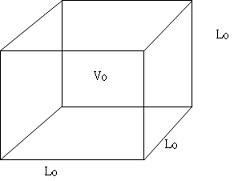
V0 = L0 × L0 × L0 = L03 (i)
When a cube is heated to temperature θ1:

V1 = (L0 + ΔL)³
= L0³ + 3L0² ΔL + 3L0 (ΔL)² + (ΔL)³
But ΔL = L0 ∝ Δθ
Therefore,
V1 = L0³ + 3L0³ ∝ Δθ + 3L0³ (∝ Δθ)² + L0³ (∝ Δθ)³
Since ∝ is very small, (∝)² and (∝)³ are negligible, so
V1 = V0 + 3V0 ∝ Δθ
Let γ = volumetric expansivity, then
V1 = V0 + V0 γ Δθ
EXAMPLES
- A solid cube has dimensions 20 cm at 20°C. To what temperature must the cube be heated for its volume to become 800.0 cm3? (Take linear expansivity of solid cube to be 1.1 × 10⁻⁵ K-1).

Data:
V0 = L03 = 20 × 20 × 20 = 8000.0 cm3
θ0 = 20°C
V1 = 8000.0 cm3
θ1 = ?
APPLICATIONS OF THERMAL EXPANSION IN SOLIDS
Some solids expand more than others due to the fact that different solids have different linear expansivities.
BIMETALLIC STRIP

A bimetallic strip consists of two dissimilar metal strips, e.g., brass and iron, welded together. At room temperature, the compound bar is straight. When it is heated to a higher temperature than room temperature, brass expands more than iron, causing the strip to bend towards the side of iron.
When the bimetallic strip is cooled, brass contracts more and the strip bends towards the side of brass.
The uses of Bimetallic strip
- Used in electric circuits of pressing devices which are completed by a metal strip. The maximum temperature is adjusted by a knob. When the temperature is maximum, the bimetallic strip bends sufficiently to break the circuit at the contact and the break point. The current is then switched off and the heating process stops. The temperature then falls until the bimetallic strip straightens and remakes the circuit. The current then flows again and the heating process occurs again.
- Used in manufacturing thermostats. It is found in hot water storage tanks and refrigerators.
- Used in traffic light circuits.
- Used as bimetallic thermometers to record temperature in inaccessible structures such as engines of vehicles and marine ships.
EXPANSION IN LIQUIDS
Liquids expand when heated. Different liquids have different thermal expansions.
Demonstration
Consider the glass bulbs A, B, and C filled to a short distance above the bulb with various liquids as shown below to make a fair comparison.

The liquids in the stems will rise by different amounts when heated in the same environment. Since liquids have no fixed shape, they take the shape of the vessels. Therefore, they don’t have linear or areal expansivities; they have only volume expansivity. When the liquids are heated, their volume increases.
THE COEFFICIENT OF VOLUME EXPANSION OF LIQUIDS
The coefficient of volume expansion is the fractional increase in volume per temperature rise. It is sometimes called apparent volume expansivity.

NB: Absolute volume expansivity of a liquid is the sum of the apparent volume expansivity and the volume expansivity of the containing vessel, i.e., Vab = γap + material.
Example:
The volume of liquid at 20°C and 70°C are 4 × 10⁻⁵ m3 and 4.1 × 10⁻⁵ m3 respectively. Calculate the apparent volume expansivity of the liquid.

THE DENSITY OF LIQUID WITH TEMPERATURE
- When the liquid is heated, its volume increases while its density decreases and its mass remains constant.
- When volume V increases, density decreases. Hence, the more volume of the liquid, the lower the density of the liquid and vice versa.

The unusual expansion of water
When water is heated from 0°C to 4°C, it contracts instead of expanding. This unusual behavior is called anomalous expansion of water. Below 0°C and above 4°C, water behaves like any other liquid.
THE VARIATION OF VOLUME OF WATER WITH TEMPERATURE

Volume of water is minimum at 4°C.
THE VARIATION OF DENSITY OF WATER WITH TEMPERATURE

Note: The density of water is maximum at 4°C.
BIOLOGICAL IMPORTANCE OF ANOMALOUS EXPANSION OF WATER
The anomalous expansion of water has an important role in the preservation of aquatic life during very cold weather.
As the temperature of a pond or lake falls, the water contracts, becomes denser, and sinks. A circulation is thus set up until all the water reaches its maximum density. If further cooling occurs, any water below 4°C will stay at the top due to its lighter density. As a result, ice forms on top of the water. After this, the lower layers of water at 4°C can lose heat only by conduction. Shallow water is liable to freeze solid. In deeper water, there will be water beneath the ice in which fish and other creatures can live and survive.

THERMAL EXPANSION IN GASES
Gas takes the shape of the container. When the gas is heated, the volume of the gas increases. Gases are sensitive to pressure changes as well.

When the flask containing air is heated, the gas (air) expands; bubbles come out of the tube through the water.
The bubbles are the escaping gases.
THE PRESSURE OF A GAS IN A CONTAINER
When the gas is heated, the molecules acquire thermal energy which increases their kinetic energy. The molecules collide with themselves and the walls, exerting force per unit area, which is the pressure of the gas.
EXPANSION OF AIR AT CONSTANT PRESSURE
When air is heated, the volume varies proportional to the temperature rise.
THE GRAPH OF VOLUME OF AIR AGAINST TEMPERATURE

Note: Air expands uniformly with temperature at constant pressure.
ABSOLUTE SCALE OF TEMPERATURE
In the graph above, when the line is extended to the left, it cuts the temperature axis at -273°C.
Theoretically, this means that the volume of air becomes zero when the temperature is -273°C.
Practically, air will have liquefied before it reaches this temperature.
Suppose the two axes of volume and temperature intersect at this temperature -273°C. Then a new scale of temperature is set at -273°C.

The temperature -273°C or 0 K is called absolute zero. This was proposed by Lord Kelvin, thus the scale is known as Kelvin’s scale. Consider θ to be the temperature on Celsius scale and T to be the temperature on Kelvin scale, then
0 – (-273) = 273 – 0
0 + 273 = 273 – 0
273 = 273
Example
The temperature of the gas is 65°C. What is the value of this temperature in absolute value?
Solution
T = θ + 273
= 65 + 273
= 338 K
Note: From the graph above, the volume of the gas is directly proportional to the absolute temperature, i.e., V ∝ T.
- This relation was proposed by a French scientist called Jacques Charles and hence called Charles’ Law.
Charles’ law states that “The volume of a fixed mass of a gas at constant pressure is directly proportional to the absolute temperature.”
i.e.

Example 1
The volume of a fixed mass of gas is 290 cm3 at 20°C. At what temperature will its volume be 340 cm3 if its pressure is kept constant?
Solution

T2 = 343.5 K
T2 = 70.5°C
BOYLE’S LAW
Boyle’s law states that “The volume of a fixed mass of gas at constant temperature is inversely proportional to the pressure.”

K = VP
V1 P1 = V2 P2 = … = Vn Pn
Example
The volume of a given mass of gas is 550 cm3 when the pressure is 79 cm of mercury. What will be its volume when the pressure is 76 cm of mercury? If the temperature remains constant.
Solution
V1 = 550 cm3
P1 = 79 cm Hg
P2 = 76 cm Hg
V2 = ?
Using Boyle’s law:
V1 P1 = V2 P2
550 × 79 = V2 × 76
V2 = 571.7 cm3
PRESSURE LAW
The pressure law states that the pressure of a fixed mass of gas at constant volume is directly proportional to absolute temperature.
i.e. P ∝ T
P = KT

Example
The pressure of a fixed mass of gas at 20°C is 78 mm of mercury. Find the pressure of the gas at 0°C if volume is constant.
Solution
T1 = 20°C = 293 K
T2 = 0°C = 273 K
P1 = 78 mm Hg
P2 = ?
From pressure law:

P2 = 72.7 mm Hg
GENERAL GAS EQUATION
The combination of the three gas laws, Charles’s, Boyle’s, and pressure law, gives the general gas equation.
Charles’s law: V ∝ T (i)
Pressure law: P ∝ T (ii)
Therefore, V P ∝ T
Which is the same as:

CASES
- At constant temperature: T1 = T2, hence V1 P1 = V2 P2 (Boyle’s law).
- At constant pressure: P1 = P2, hence V ∝ T (Charles’s law).
- At constant volume: V1 = V2, hence P ∝ T (Pressure law).
Note: At S.T.P, temperature is 0°C or 273 K.
Question 1
At a temperature of 30°C and a pressure of 740 mmHg, the volume of a gas is 30 cm3. Calculate the volume of the gas at S.T.P.
Data:
T1 = 30°C (+273) = 303 K
P1 = 740 mmHg
V1 = 30 cm3
Question 2
A sample of oxygen gas has a volume of 0.11 m3 at a temperature of 12°C and a pressure of 8.1 × 10⁴ Pascal, while a sample of nitrogen gas has a volume of 0.18 m3 at a temperature of 22°C and pressure 1.03 × 10⁵ Pa. Which gas will have a larger volume at S.T.P?
Solution
Oxygen: V1 = 0.11 m3
Nitrogen: V2 = 0.18 m3
T1 = 12°C
T2 = 22°C
P1 = 8.1 × 10⁴ Pa
P2 = 1.03 × 10⁵ Pa

Therefore, the larger volume is 1.2 × 10⁴ m3.



2 Comments