

THE TRANSFER OF THERMAL ENERGY
Heat is a form of energy that flows as a result of a temperature difference. Consider objects A and B.

Let θ1 be the temperature of object A and θ2 be the temperature of object B such that θA is greater than θB, i.e., θA > θB. Then the heat energy flows from object A toward object B.
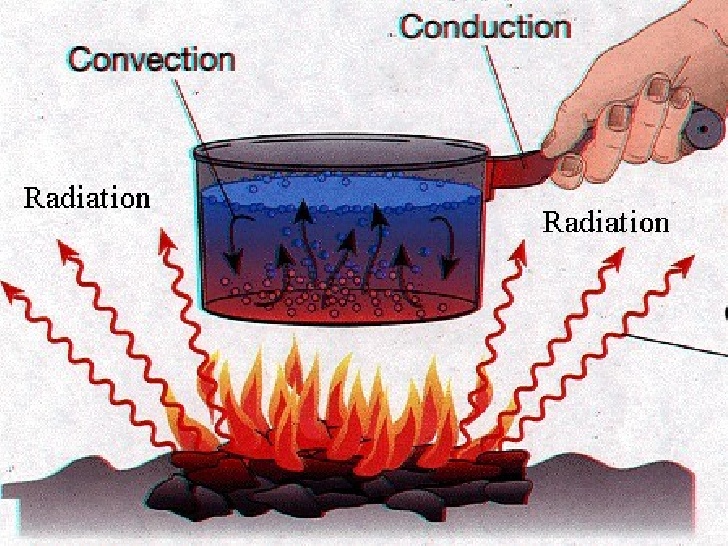
There are three ways in which heat energy can be transferred: conduction, convection, and radiation.
- BY CONDUCTION
Conduction is the transfer of heat through matter (solids) from a region of high temperature to a region of low temperature. It is the movement of energy from one atom to another without the movement of the matter itself. The atoms are bonded to neighboring atoms; when heat is supplied to a part of solid matter, the atoms vibrate, and the vibration is passed on to the neighboring atoms through the bonds. This process spreads the heat throughout the solid matter.

THE CONDUCTORS AND INSULATORS OF HEAT
All materials that allow heat to flow through them easily are called good conductors of heat, such as most metals (copper, silver, iron, aluminium, brass, lead, etc.), but the rate of conduction differs among them.
When metal is heated, the electrons that move around the lattice structure carry thermal energy from a region of high temperature to a region of low temperature.
Insulators are materials that do not conduct heat well, e.g., glass, plastic, clothes, rubber, and wood.
THE SIMPLE EXPERIMENT TO INVESTIGATE THE CONDUCTION OF HEAT BY METAL
SIMPLE EXPERIMENT
A simple experiment to show that water is a poor conductor of heat.
Apparatus:
- Test tube
- Water
- Ice
- Wire gauze
- A pair of tongs
- Source of heat
Procedure:
- Fill the test tube about two-thirds with water.
- Holding the test tube with a pair of tongs, heat it slightly over a Bunsen burner as shown below.
Observation:
The water near the open end of the test tube boils, but the ice at the bottom of the test tube does not melt. This shows that water does not conduct heat well (hence water is a poor conductor of heat).
THE FACTORS AFFECTING THE RATE OF CONDUCTION OF HEAT
- The rate of conduction of heat is inversely proportional to the length of the material. The longer the material, the lower the rate of heat conduction. The longer the material, the more time it takes to conduct heat, and vice versa.
- The rate of conduction of heat is directly proportional to the cross-sectional area of the material perpendicular to the heat flow. The larger the cross-sectional area, the faster the rate of conduction of heat.
- The rate of conduction is directly proportional to the difference in temperature between the two ends of the material. The higher the temperature difference, the higher the rate of conduction of heat, and vice versa.
- The rate of conduction depends on the thermal conductivity of the material (nature). Thermal conductivity is the measure of the rate at which a material conducts heat. The higher the thermal conductivity of the material, the higher the rate of conduction of heat, and vice versa.
HOW TO MINIMIZE THE LOSS OF HEAT BY CONDUCTION
- In a system where heat needs to be conserved, heat losses by conduction can be minimized by thermal insulation. Thermal insulation involves the use of poor or bad conductors of heat – thermal insulation is used in boilers and hot water pipes.
- In a house, insulating against heat loss is achieved by using double-glazed windows, carpets, curtains, etc.
APPLICATION OF CONDUCTION OF HEAT
- Cooking materials are made of metal to efficiently transfer heat to the food being prepared. The vessels have wooden or plastic handles that stay cool.
- In electronic devices, e.g., computers, some components are likely to be damaged by high temperature. To protect such components, heat sinks are attached to the device. The heat sink is a material with high thermal conductivity, e.g., copper, that can conduct heat away.
- Aluminium is used in making motor engines, pistons, and cylinders because of its low density and high thermal conductivity.
- Bad conductors are used for insulation purposes. The clothes we wear are insulators and hence poor conductors of heat, which insulate us against loss of heat by conduction. For example, in hot regions, people wear light clothes and vice versa.
- The bottoms of cooking pots need periodic cleaning to remove layers of dirt which reduce the flow of heat.
- Fiberglass is used under roofs of buildings to prevent heat loss in cold areas.
- Sawdust, which is a poor conductor of heat, is used for insulating hot water pipes.
BY CONVECTION
This is the transfer of heat in fluids by currents. When the fluid at the bottom is heated, it expands; as it expands, the volume increases. The density decreases as the volume increases. Therefore, the warmer fluid becomes less dense and rises to the top. The cooler fluid at the top becomes denser and sinks. This sets up a convection current.

NB: Convection involves mass movement of the fluid.
HOW TO MINIMIZE HEAT LOSS BY CONVECTION
- The losses of heat can be minimized by removing any fluid medium within which convection currents move. This principle is used in making vacuum flasks.
- The losses of heat can be minimized by filling hair cavities with insulating materials.
APPLICATIONS OF CONVECTION OF HEAT
- Land breeze and sea breeze
These are a result of expansion of air caused by unequal heating and cooling of adjacent sea and land surfaces.
- During the daytime, the land is warmer than the sea; thus, the air over the land surface becomes less dense and rises. The space left is occupied by cooler air from above the sea surface.

- During the night, the sea is hotter than the land; thus, the air over the sea becomes less dense and rises.

- Domestic hot water supply system
Hot water moves from the boiler to where it is used under convection currents. Inside the boiler, water is heated making it less dense; water rises and flows into the hot water reservoir where it is stored until needed for use in the main water supply.
- Air conditioning systems rely on convection currents to heat or cool a room. When it is hot, cool air is blown into the room from the air conditioner. This sinks to the bottom of the room, taking the place of the less dense warmer air (warmer air rises and is led out to be cooled and recirculated).
When it is cold, the heater is turned on, heating the surrounding air. The heated air rises up and cold air moves down to take the place of the rising warm air. This forms convection currents which continue to circulate until the air in the room is at the desired temperature.
RADIATION OF HEAT
Radiation is the transfer of heat between two bodies by means of electromagnetic waves that arise due to the temperature of a body in the form of infrared radiation. The transfer of heat by radiation does not require a material medium. It takes place in vacuums. All bodies at a temperature above absolute zero (0°C) emit some radiant energy. The heat from the sun reaches the earth through radiation. The region between the sun and the earth’s atmosphere is a vacuum. The heat energy from the sun cannot reach the earth by conduction or convection; it reaches by radiation.
NB: Radiation heat travels at the speed of light and hence can be reflected, absorbed, or transmitted.
ABSORBERS, EMITTERS, AND REFLECTORS OF RADIANT HEAT
Dark or black surfaces are good absorbers and emitters of radiant heat. A surface that absorbs all radiant heat energy is called a black body. A polished or shiny surface, on the other hand, is a good reflector of radiant energy but a poor emitter.
EXPERIMENT TO INVESTIGATE THE ABSORPTION AND EMISSION OF RADIANT HEAT
Apparatus:
- Two containers (shiny and black surfaces)
- Two thermometers A and B
- Water
- Heat source
Procedure:
- Fill the containers with water to about two-thirds full.
- Place the containers close to the heat source.
- Insert thermometers A and B into water contained in the shiny and black surfaces respectively.

Observations:
Thermometer B records a higher temperature than thermometer A because the black surface absorbs heat faster than the shiny surface.
When the heat source is removed, thermometer B records a lower temperature than thermometer A because a good absorber of heat is a good emitter of heat. This means that black surfaces absorb and emit radiant heat energy better than shiny surfaces.
HOW TO MINIMIZE HEAT LOSSES BY RADIATION
- The mechanism of a thermos flask to hold hot or cold liquid for a long time is designed to minimize losses of heat by radiation, conduction, and convection. It consists of double-walled glass containers with a vacuum between the walls. The inner wall is coated with silver. It has a stopper made of cork or other insulating materials and insulated materials to keep the inner glass container away from touching the outer container.

Both conduction and convection are minimized by the vacuum between the glass walls, insulated stoppers, and the separators. The silvered walls effectively reflect heat, thus preventing heat loss by radiation.



7 Comments