


MEASUREMENTS OF THERMAL ENERGY
Thermal energy refers to type of energy that relates to the heat or caused by heat. When one boil a utensil of water, thermal energy is applied at the bottom of the utensil then transferred to the water inside the utensil causing the water molecule to move faster and get hot.
Measurement of thermal energy involves indirect measurement of molecule kinetic energy which in total makes the heat content of an object.
We have already seen that heat is a form of energy transferred between bodies due to difference in temperature between them.
The heat required to raise the temperature of 1Kg of water through one degree is approximately 4.2 Joule.
The energy is possessed by the body due to its temperature is called internal thermal energy or heat content.
The heat content of a substance of an object due to random motion of the particles make up an object.
THE HEAT CONTENT OF A SUBSTANCE
The following are the factors which affect the amount of heat supplied to or taken away from a body.
- The mass
The amount of heat is directly proportional the mass of a body.
Q∝M
Q=kM
- Temperature different
The amount of heat is directly proportional to the temperature change.
Q∝θ
- Thermal property
The amount of heat depends on the thermal property of the body.
Note: when a quantity of heat is supplied to different bodies of equal masses, it will not cause the same temperature rise, this shows that each body has its own thermal property i.e. heat capacity.
HEAT CAPACITY
Is the amount of heat required or needed by a body to raise its temperature by one 1K.
The SI Unit of heat capacity is J/ K.
The amount of heat required to raise the temperature of a unity mass by 1K , is called Specific Heat Capacity (a unit mass =1Kg)
HEAT EQUATION
Using the factors affecting the amount of heat supplied to or taken away from a body is discussed above, Q∝MΔθ
Q∝Mθ
Q=kMθ
But, k is a constant known as specific heat capacity, C
Q∝Mθ
Q=kMθ
But, k is a constant known as specific heat capacity, C
Therefore;
Q=CMθ
Q=CMθ
Q=MCθ → Heat formula / equation
Whereby:
Q → Quantity of heat applied or lost
M → Mass of a substance
C → Specific heat capacity of a substance
θ → Temperature change (θ2-θ1).
The SI unit of specific heat capacity


∴The SI unit is J/KgK.
Specific Heat Capacities of a new Substances
Substance | J/kgK | J/gK |
Water | 4200 | 4.2 |
Alcohol | 2500 | 2.5 |
Ice | 2100 | 2.1 |
Steel | 460 | 0.46 |
Mercury | 130 | 0.13 |
Copper | 390 | 0.39 |
Brass | 320 | 0.32 |
Example
1. Water of mass 3kg is heated from 260C to 960C. Find the amount of heat supplied to water. Given that the specific capacity of water is 4200 J/kgºC
DATA GIVEN
M =3 Kg
Δθ = 960C – 260C
= 700C
C = 4200
Q=McΔθ
Q=3×4200×70
Q=882000J
M =3 Kg
Δθ = 960C – 260C
= 700C
C = 4200
Q=McΔθ
Q=3×4200×70
Q=882000J
∴ The amount of heat supplied is 882000J or 882KJ
2. How much heat is required to raise the temperature of sample of mercury from 200C to 300C. Take the specific heat capacity of mercury as 1395 J/KgK.

∴ The heat required is 348750 J
EXPERIMENT:I
Determination of the specific heat capacity of a solid substance by mixture method
Requirements
Determination of the specific heat capacity of a solid substance by mixture method
Requirements
- Calorimeter (made of copper and Aluminum)
- An insulating cover
- Thermometer
- Stirrer (same nature as the calorimeter)
- Solid substance
- Beam balance
- Heat source and beaker
Procedure
- Measure and record the mass of the calorimeter and the stirrers (Mc).
- Put water into the calorimeter and then put it in its jacket and cover.
- Record the temperature of the water (θi).
- Boil water in a beaker.
- Tie a solid substance of known mass (Ms) with a thin thread and place it in hot water in the beaker for a certain length of time .
- Remove the solid quickly and wipe it with a dry cloth and place it in a calorimeter.
- Replace the cover and stir gently until the temperature is steady.
- Read and record thus steady temperature (θf).

Heat loss by the solid substance = heat gained by water + heat gained by calorimeter
LET; Qs = heat loss by the solid
∴ Qs = Qw + Qc
Where; Qw = heat gained by water
Qc = heat gained by calorimeter
Where; Qw = heat gained by water
Qc = heat gained by calorimeter
Given that
Qs = MsCsΔθs
∴ Qs = MsCs (θs – θf)
Qw = MwCwΔθw
Where; Qw = heat gained by water
Where; Qw = heat gained by water
Mw = mass of water
Δθw = change in temperature of calorimeter
Δθw = change in temperature of calorimeter
∴ Qw = MwCw(θf – θi)
Qc = McCcΔθc
Where; Qc = heat gained by calorimeter
Mc = mass of calorimeter
Δθc = change in temperature of calorimeter
Where; Qc = heat gained by calorimeter
Mc = mass of calorimeter
Δθc = change in temperature of calorimeter
∴ Qc = McCc (θf – θi)
∴MsCs (θs – θf) = MwCw (θf – θi) + McCc (θf – θi)

Note: The solid should be transferred quickly in order to minimize heat losses to the environment.
EXPERIMENT: II
Determination of specific heat capacity liquid by mixture
Like in the experiment above, but instead of water we have another liquid. The specific heat capacity can be calculated as follows.
Heat loss by substance = heat gained by liquid + heat gained by liquid calorimeter
Given That;
Qs = MsCsΔθs
∴ Qs = MsCs (θs – θf)
QL = MLCLΔθL
∴ QL= MLCL(θf – θi)
Qc = McCcΔθc
∴ Qc = McCc (θf – θi)
Therefore;

CHANGE OF STATES
When heat is applied to a substance, a change of state may take place. The reverse change of state takes place on cooling.
The change of state from solid to liquid takes place at a constant temperature known as melting point.
Boiling and evaporation are terms used to describe the change from liquid to vapour (gas)
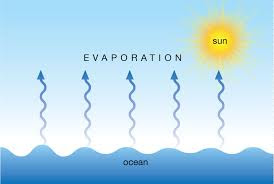
Evaporation
This is a slow process which occurs at all temperature and takes place only at the surface of the liquid.

Boiling Point
This is the temperature at which all of a liquid changes into gas.This takes place when the bubbles of vapour. The temperature at which boiling takes place is called as Boiling point.
This is the temperature at which all of a liquid changes into gas.This takes place when the bubbles of vapour. The temperature at which boiling takes place is called as Boiling point.
Freezing point
This is the temperature at which a liquid changes into a solid without change in temperature. The freezing point of a substance is the same as its melting point.
LATENT HEAT
Consider a block of ice which is cooled by a freezing mixture to -100C and then heated steady: at first the ice which has a specific heat capacity of 2100J/kg0C rises in temperature to 00C , it then changes into water (liquid) at the temperature 00C. Since the temperature is not changing and the state is changing the heat needed to change a solid ice to a liquid water is called LATENT HEAT
When the water formed from ice is heated further its temperature rises until it reaches about 100 0C. Here it begins to change into vapour or gas at constant temperature 1000C the heat needed is again latent heat (hidden).

NOTE:
1. Latent heat of a substance
1. Latent heat of a substance
This is the quantity of heat needed by a given mass of a substance to change the state without change in Temperature.
2. Specific latent heat of a substance
2. Specific latent heat of a substance
This is the quantity of heat needed to change a state of a unit mass without change in temperature, it is denoted by L.
L=Q/M
Q=ML
L=Q/M
Q=ML
Its SI Unit is J/Kg
3. Specific latent heat of fusion
This is the quantity of heat needed to change the state of a unit mass of solid to liquid without change in temperature.

4. Specific latent heat of vaporization.
This is the quantity of heat needed to change the state of count mass of liquid to vapour without change in temperature.
Specific latent heat of solidification.
This is the quantity of heat needed to change the state of a unit mass of liquid to solid without change in temperature. Q=MLV

5. Specific latent heat of liquidifications
This is the quantity of heat needed to change the state of a unit mass from to liquid without temperature change.

GRAPHICAL REPRESENTATION OF CHANGE OF STATE

Example
- 8g of ice at 0oCis heated so that it forms water at 10oC. Calculate the total quantity of heat required to do so given that the Specific Heat Capacity of water 4200 J/KgK. The specific latent heat of fusion of ice is 334000J/KgK.


2. The Specific Latent Heat of vaporization of liquid is 2260000J/kg, Specific Latent Heat of fusion of ice is 334000J/kg, the Specific Heat Capacity of ice is 2100J/kgK, Specific Heat Capacity of water 4200J/kgK, calculate the heat required to convert 2kg if ice at -120C to steam at 1000C.

QT = Q1 + Q2 + Q3 + Q4
QT = MCθ + MLf + MCθ + MLv
QT = (2×2100 × 12) + (2×33400) + (2×4200×100) + (2×2260000)
QT = 50400 + 66800+ 840000+ 4520000
QT = 5477200J
Therefore; the heat required to convert 2kg of ice to steam is 5477200J
3. A refrigerator can convert 400g of water at 200C to ice at -100C in 3hrs. Find the average rate of heat extraction from water in J/sec given that the Specific Heat Capacity is 4200J/kgK. The Specific Heat Capacity of fusion of ice is 336000J/kg. The Specific Heat Capacity of ice is 2100J/kgK.
QT = 5477200J
Therefore; the heat required to convert 2kg of ice to steam is 5477200J
3. A refrigerator can convert 400g of water at 200C to ice at -100C in 3hrs. Find the average rate of heat extraction from water in J/sec given that the Specific Heat Capacity is 4200J/kgK. The Specific Heat Capacity of fusion of ice is 336000J/kg. The Specific Heat Capacity of ice is 2100J/kgK.


power =16.3 watt
∴ The average rate of heat extract
ion is 16.3 watt



7 Comments