ENVIRONMENTAL CHEMISTRY
ENVIRONMENT CONSERVATION
Is the protection of natural resources for future use.
SIGNIFICANCES OF ENVIRONMENTAL CONSERVATION
- To avoid soil erosion.
- To ensure sufficient water.
- To ensure adequate supply of resources.
- Reduce ozone layer depletion.
PROTECTION AND UTILIZATION OF NATURAL RESOURCES
a) Protection of mineral(s) against overexploitation.
Overexploitation: is the overuse of natural resources.
This causes scarcity of natural resources and environmental destruction.
Protection:
- Use of scrap metal instead of extracting minerals from the ground (recycling).
- Establishing other economic activities instead of mining industries.
- Reducing population pressure through establishment of family planning and birth control. This reduces dependency on mining industries for exploiting use.
Note: Utilization is the use of natural resources.
ENVIRONMENTAL DESTRUCTION
Environmental destruction means destroying the environment which makes it unfriendly to human survival.
Environmental destruction occurs due to the following reasons:
- Agricultural chemicals.
- Dumping of solid and liquid waste on the land and into large water masses, rivers, wells, and oceans.
- Emission of gaseous effluents from industries into the air.
AGRICULTURAL CHEMICALS
- Use of pesticides and fertilizers.
- This causes a loss in biodiversity and soil destruction.
- Pesticides cause water pollution and facilitate growth of seaweeds causing oxygen deficiency for marine organisms.
- Pollination decline: pesticides kill organisms which are agents of pollination.
EFFECTS OF ORGANIC FERTILIZERS
- Soil acidification.
- Energy consumption.
- Climate change.
Suggestions
- Use of organic biodegradable materials.
- Use of manure.
- Avoid monoculture practices.
ii) DUMPING OF SOLID AND LIQUID INDUSTRIAL WASTE ON THE LAND AND INTO LARGE WATER BODIES
Dumping of solid and liquid industrial wastes on land and into large water bodies causes deterioration of water quality and land in general.
Petroleum products and heavy metals from industries may lead to environmental destruction.
- Destruction of environment from petroleum products is mainly due to accidental spills from ships, tanker trucks, pipelines, and leakage from underground storage tanks.
- Heavy metals such as mercury are often deposited with sediment at the bottoms of streams. They may become incorporated into plants.
iii) EMISSION OF GASEOUS EFFLUENTS FROM INDUSTRIES INTO THE AIR
- Working in thermal plants and different plants used to manufacture fertilizers or pesticides, as well as production of building materials, can encourage the production of toxic materials which are released into the air in the form of smoke.
- Poisonous gases, e.g., sulphur dioxide, may be emitted also in the form of smoke. These cause air pollution, leading to harmful diseases in humans.
ENVIRONMENTAL MANAGEMENT INTERVENTIONS
Environmental management and interventions should be done through the following:
- Waste management.
- Chemical treatment of urban sewage.
- Chemical treatment of urban supplies of edible/portable water.
POLLUTION
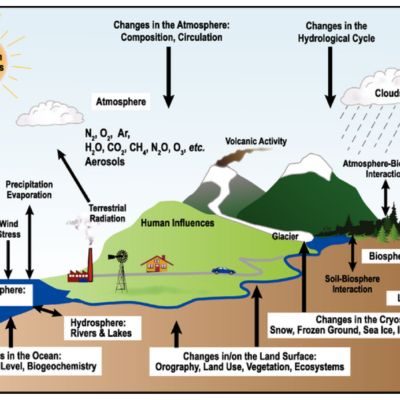
Environmental pollution is the contamination of air, water, and land from man-made wastes. Pollution leads to depletion of the ozone layer, global warming, and climate change.
1. WATER POLLUTION (AQUATIC POLLUTION)
Water pollution is the contamination of water by foreign matter that deteriorates the quality of water. It occurs in lakes, oceans, and rivers.
It involves the release of toxic substances, pathogens, substances that require much oxygen to decompose, easily soluble substances, and radioactive substances.
i) Sources of water pollution
The major forms and sources of water pollution are:
- a) Oil (Petroleum Product) discharged
These include manufacture of plastics, lubricants, solvents, and synthetic fabrics; fractional distillation of crude oil to produce vehicle fuel, paraffin wax, refinery gases for domestic cooking, and bitumen for road surfacing. Pollution is mainly due to accidental spills from ships, tanker trucks, pipelines, and leakage from underground storage tanks. - b) Synthetic chemical pesticides
Pesticides such as herbicides and fungicides used in agriculture and public health programs to control pests are important sources of water pollution. They enter water sources through runoff and atmospheric transport and deposition. Pesticides accumulate in plants and animals; when they die, they spread to water sources, increasing water toxicity. - c) Heavy metals
Heavy metals such as mercury are dangerous pollutants. They are often deposited with sediment at the bottom of streams. When deposited on surfaces, they become incorporated in plants, food crops, and animals. If they dissolve and water is withdrawn for agriculture or human use, poisoning can result.
i) Management of water
Water management refers to practices of planning, developing, distributing, and optimally utilizing water resources under defined water policies and regulations. These include:
- Management of water treatment for drinking water, industrial water, sewage, or wastewater.
- Management of water resources.
- Management of irrigation.
Treatment of water may be divided into two:
- Purification for domestic use.
- Treatment for specialized industrial applications.
2. AIR POLLUTION
Air pollution includes all contaminants found in the atmosphere. These dangerous substances can be either gases or particles.
Sources of air pollution are natural and human-based.
CAUSES OF AIR POLLUTION
The biggest causes are the operation of fossil fuel burning power plants and automobiles that combust fuel.
TYPES OF AIR POLLUTION
- Smog – This is the first type of air pollution. When smoke present in the atmosphere combines with fog present in the air, a mixture called smog or photochemical smog is formed.
- Greenhouse Effect – It is formed due to the contamination of several important gases in the air. These gases are called greenhouse gases, e.g., methane, sulphur, nitrogen, carbon monoxide, hydrogen, and ozone. These are very harmful to human skin and can cause cancer.
Effects of air pollution
Air pollution affects human health, vegetation, and livestock.
i) Effects on human health
Severe air pollution causes many fatal diseases and disorders. Some effects caused by inhaling polluted air are:
- Sulphur dioxide enters soft tissues causing drying of the mouth, scratchy throat, and smarting eyes.
- Hydrocarbons and many other air pollutants cause skin cancers.
- Oxides of carbon, sulphur, and nitrogen diffuse into the blood and combine with hemoglobin, causing reduction in its oxygen-carrying capacity.
ii) Effects on vegetation
Air pollution has serious harmful effects on vegetation.
Effects of air pollution on vegetation are:
- Sulphur dioxide causes chlorosis, i.e., loss of chlorophyll in trees, plants, and vegetation.
- Oxides of nitrogen and fluorides reduce crop yields.
- Photochemical smog bleaches and blazes foliage of economically important plants and crops.
iii) Effects on livestock
General effects of air pollution on livestock are similar to those in humans.
Various fluorine compounds which fall on foliage plants are eaten by livestock causing abnormal calcification of bones and teeth, called fluoride toxicity. Fluorosis can cause loss of weight and frequent diarrhea in animals.
3. LAND POLLUTION
This is contamination of land surface through dumping of urban wastes, industrial wastes, mineral exploitation, and misuse of soil by harmful agricultural processes.
Causes of land pollution
- Increase in urbanization is a major cause of land pollution.
- Construction uses up forests, leading to exploitation and destruction of forests.
- Disposal of non-biodegradable wastes including containers, bottles, and cans made of plastics, used cars, and electronic goods contributes to land pollution.
Effects of land pollution
- Makes places look dirty due to tonnes of domestic wastes dumped without proper disposal.
- Land pollution affects the respiratory system of humans.
- Land pollution has serious effects on wildlife. Flora which provides food and shelter to wildlife is destroyed.
Prevention of land pollution
- People should be educated and made aware of the harmful effects of littering.
- Items used for domestic purposes should be reused or recycled.
- Inorganic matter such as paper, glass, plastics, and metals should be reclaimed and then recycled.
Questions:
- Industries are among the leading sources of air pollutants.
- Name four substances from industries which contribute to air pollution.
- Explain two other sources of air pollutants.
- Give three effects of air pollution.
- Explain how industrial workers can be protected against harmful chemical fumes.
- How is ozone formed?
- What are the causes of depletion of the ozone layer?
- Explain harmful effects of depletion of the ozone layer.
- What is the greenhouse effect and what are its effects?
- Write short notes on:
- Acid rain.
- Smog.
- Environmental effects caused by mining.
- What do you understand by the term eutrophication and its causes? How does it threaten the development of marine life?
ANSWER:
Q1. (a) Substances:
- Carbon dioxide.
- Carbon monoxide.
- Methane.
- Sulphur dioxide.
(b) Other sources:
- Burning fuels from cars.
(c) Depletion of ozone layer effects:
- Spread of airborne diseases e.g., tuberculosis.
- Acid rain.
- Global warming.
(d) Industrial workers can be protected against harmful chemical fumes by:
- Using protective masks to protect them from harmful fumes.
- Good ventilation systems in industries, i.e., air circulation.
- Closed chambers for chemical processes.
2. (a) Ozone layer formation:


(b) Causes of depletion of ozone layer:
- Natural destruction.
- Artificial destruction.


(c) Harmful effects of ozone layer depletion:
- It may result in skin cancer due to UV rays.
- Damage to the immune system leading to increased viral infections.
- Damage or death of marine plants and animals which are important to human survival.
3. Greenhouse effect
Is the process of trapping heat in the atmosphere. This results in an overall increase in the average temperature of the Earth. The gases responsible trap the heat in the atmosphere.

Effects of greenhouse effect:
- Leads to global warming. Ice caps will melt, leading to an increase in sea level which in turn leads to flooding (islands may disappear).
- Change in weather patterns (unpredictable weather).
4. (i) Effects of Acid Rain
On Humans
- Irritation of the respiratory system.
- People with bronchitis become highly affected.
On the Soil
- Soil not having proper liming becomes highly acidic.
- Acid rain may cause corrosion on buildings.
- It can cause the death of microorganisms in water bodies or on the land.
Reactions for the formation of acid rain:

4. (ii) Smog
Contains soot, sulphur dioxide, and other gases. It is usually found in cities.
5. Eutrophication
Is the process of adding adequate nutrients to water bodies or addition of artificial or natural substances such as nitrates or phosphates through water runoffs, sewage, etc. This increases the number of marine plants such as phytoplanktons.
Causes of Eutrophication
- Adding nutrients such as nitrates and phosphates.
- Runoffs from sewage.
- Overflow of sanitary sewers.
- Runoffs from industries.
- Untreated sewage.
- Overusing pesticides and fertilizers.
- Cultivation near water bodies.
Effects of Eutrophication
- Decrease of biodiversity.
- Death of marine organisms due to oxygen depletion. When phytoplanktons die, they decompose and marine organisms use up oxygen to decompose them, hence oxygen concentration decreases causing death of marine organisms.
- Toxicity effects.
- Decrease in water transparency.
Questions:
- Explain the meaning and significance of soil colloids.
- Discuss the properties of soil colloids:
- Surface area.
- Electric charge.
- Ion exchange.
- Explain the mechanism of ion exchange in soil.
- Describe cation exchange capacity of soil.
- Calculation of percentage base saturation of a soil sample.
- Why are the configurations of copper and chromium peculiar?
- Would you classify scandium and zinc as transition metals? Give reasons.
- When is copper considered a transition metal?
- When does it not show transition behavior?
- Why are the elements with atomic numbers 21 to 30 classified together as a series in the periodic table?
- List the main characteristics of these elements and their compounds.
- Explain the following observations:
- Water molecules readily coordinate with cations of the above series but hydronium ion (H3O+) does not.
- Addition of excess silver nitrate to an aqueous solution containing 0.01 mole of CoCl2·6H2O leads to immediate precipitation of 0.03 moles of silver chloride. However, similar addition to an aqueous solution containing 0.01 mole of CoCl3 leads to immediate precipitation of only 0.02 moles of silver chloride.
GENERAL QUESTIONS
- Explain very briefly using equations where possible the extraction of copper from its commercial ore under the headings of reduction and purification.
- Write down:
- Four reasons which justify the placement of hydrogen in group I of the periodic table.
- Four reasons which put hydrogen in group VII of the periodic table.
- In which group do you think hydrogen should strictly belong?
- Give reasons for your answer.
- Describe the action of water on hydrides of period III.
- Compare the thermal stability of carbonates of group I and II by using a specific example showing their differences.
- Write down:
- Comment with help of chemical equations where necessary on the following:
- Iron(III) chloride cannot be prepared by heating iron filings in a stream of chlorine gas.
- Hydrochloric acid cannot be used as acidic medium during redox titration of KMnO4 against FeSO4.
- Solid Al(OH)3 is soluble in aqueous solution of NaOH.
- Define the following:
- Atomic radius.
- Ionization energy.
- Contrast the action of heat on the following pairs of compounds:
- NaNH2 and Ca(NH2)2.
- NC and PbC.
- Describe how you can distinguish chemically the following pairs of compounds:
- Mg(OH)2 and MgCO3.
- NaCl and AlCl3.
- CuS and Cu(NH3)4Cl2.
- Define the following:
- Explain the following by chemical equations where necessary:
- Solid carbonate of iron(III) and Al have never been isolated.
- Lime water is used to test the presence of CO2 gas.
- When sodium hydrogen carbonate is added to copper(II) sulfate, effervescence is observed.
- Lead hydroxide precipitate dissolves in excess sodium hydroxide solution.
- Describe:
- Two methods of preparing copper(II) chloride in the lab.
- How ZnO reacts with both acids and bases.
- List two important uses of CaO in daily life.
- Explain the following by chemical equations where necessary:
- Define:
- Heat of reaction.
- Bond energy.
- The enthalpy of formation of CCl4 is –135.5 kJ mol–1 and enthalpies of atomization of graphite and chlorine are 715 and 121.2 kJ respectively. Calculate the C–Cl bond energy.
- When 1 g of C, H2, and CCl4 are completely burnt in excess oxygen, 32, 143, and 56 kJ of heat are liberated respectively. Calculate the standard enthalpy of formation of CCl4.
- The heat of formation of Fe2O3 is –824.0 kJ mol–1. What will be ΔH of the reaction?
- Define:
- Give the meaning of second order reaction and derive the units of its rate constant.
- The reaction between BrO3– and Br– in acidic medium is given by the equation:
BrO3– + 5Br– + 6H+ → 3Br2 + 3H2O
The following table gives the results of four different experiments:Experiment No 1 2 3 4 [BrO3–] 0.2 0.4 0.4 0.2 [Br–] 0.2 0.2 0.4 0.2 [H+] 0.2 0.2 0.2 0.4 Initial rate (mol L–1 s–1) 1.56 × 10⁻² 2.56 × 10⁻² 5.12 × 10⁻² 5.12 × 10⁻² Calculate:
- Order of reaction with respect to each reactant.
- The value of the rate constant.
- Briefly explain the meaning of:
- Metallurgy.
- An ore.
- Describe the essential steps used during extraction of tin (Sn) showing clearly the reaction equations.
- Indicate the structure of monomers and polymerization method likely to be used in making each of the following commercial polymers:

- Describe the preparation of benzanamine from benzene.
- Write the chemical equations to show how propanamine reacts with:
- Mixture of trichloromethane and potassium hydroxide.
- Ethanoic acid.
- Chloromethane.
- Briefly explain the meaning of:
- Explain the following with vivid examples and relevant chemical equations:
- Li and Mg are more related chemically than Li and Na although both Li and Na are group I elements.
- F is the most oxidizing element of all in the periodic table.
- Electron affinity of F is unusually low.
- Distinguish between the following:
- Coordination number and oxidation number.
- Paramagnetism and ferromagnetism.
- Strong ligand and weak ligand.
- Explain the following with vivid examples and relevant chemical equations:
- Give the meaning of partition law.
- Write down the conditions for the law to hold.
- The partition coefficient for iodine between water and CCl4 at 20°C is 2.43 × 10⁻³. A 100 cm3 sample of iodine solution in CCl4 of concentration 1.00 × 10⁻³ M is shaken with 10.00 cm3 of water of concentration 1.00 × 10⁻³ M. What fraction of iodine is extracted by CCl4?
- Define precisely the following terms:
- Standard molar enthalpy of formation.
- Heat of solution of a substance.
- Ionization energy.
- State Hess’s law of constant heat summation.
- Calculate the standard heat of formation of carbon monoxide if standard heat of combustion of carbon and carbon monoxide are 393 kJ mol–1 and –285 kJ mol–1 respectively.
- Determine the enthalpy change for the isomerization reaction:
[Image of isomerization reaction]
- Explain the meaning of the following and give one example:
- Nucleophilic addition reaction.
- Nucleophilic substitution reaction.
- Elimination reaction.
- How can you distinguish the following compounds:
- Illustrate the preparation of the following compounds:
- Propanoic acid from ethane.
- Propan-2-ol from propan-1-ol.
- Propyne from ethyne.
- Explain the meaning of the following and give one example:
- Distinguish between:
- Distinguish between:
- Using relevant balanced chemical equations describe the process of extracting copper from copper pyrite under the following headings:
- Concentration.
- Roasting.
- Removal of ion impurities.
- Self-reduction reaction.
- Cobalt, copper, iron, and manganese are d-block elements.
- What is meant by the term d-block element?
- Write electronic configurations of Cu, Fe2+, and Mn2+.
- Explain in terms of electronic configuration why Fe2+ ions are readily oxidized to Fe3+ ions but manganese(II) ions are not readily oxidized to Mn3+.
- 2.5 × 10⁻³ moles of a compound with a formula was dissolved in 0.1 M silver nitrate solution. 50 cm3 were required for complete precipitation of the chloride ions present.
- Deduce the ionic formula of the compound.
- Draw the structure of the complex ion present and name it.
- Write the formula of the following complexes:
- Tetraammine copper(II) sulphate monohydrate.
- Potassium hexacyanoferrate(III).
- Write down balanced chemical equations for the following:
- Adding excess ammonia solution to aluminium ion.
- Ion(III) oxide heated with aluminium powder.
- Using relevant balanced chemical equations describe the process of extracting copper from copper pyrite under the following headings: