

AIR COMBUSTION, RUSTING AND FIRE FIGHTING
AIR
Air is a homogeneous, colorless mixture of different gases present in the atmosphere. It is essential for life and various chemical processes on Earth.
Composition of gases in air
Air consists mainly of oxygen, nitrogen, carbon dioxide, and noble gases. It also contains water vapor and dust particles, although these are not usually considered part of the air’s permanent composition.
The table below shows the approximate percentage composition of gases in dry air.
| Gas | % Composition |
|---|---|
| Nitrogen | 78% |
| Oxygen | 21% |
| Noble gases | 0.94% |
| Carbon dioxide | 0.03% |
| Water vapor | 0-4% |
Note: The percentage composition of water vapor varies depending on factors such as weather conditions and geographical location.
Tests for gases in air
It is possible to test for the presence of some gases found in air using simple chemical reactions.
Carbon dioxide test
Lime water placed on a watch glass turns milky after a few days when left exposed to air. This change from colorless to milky indicates the presence of carbon dioxide in the air.
Oxygen test
Oxygen supports combustion and can relight a glowing splint. When oxygen is collected in a gas jar and a glowing piece of wood is placed inside, the wood will reignite. Additionally, copper turns black upon heating due to its reaction with oxygen.
Water test
White anhydrous copper (II) sulfate on a watch glass turns blue when exposed to air, indicating the presence of water vapor.
Combustion
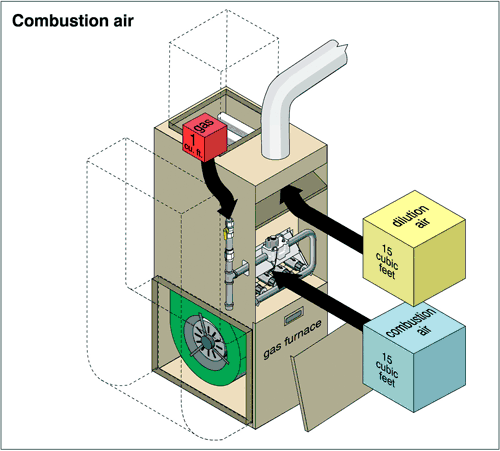
Combustion is a chemical reaction involving the burning of a substance in the presence of oxygen, producing energy in the form of heat and light.
Combustible materials
A combustible material is one that catches fire and burns easily. Combustion can occur in open places, such as campfires, or in closed systems, such as car engines.
Applications of combustion in real life
Combustion is applied in various areas, including:
| Area | Application |
|---|---|
| Industries |
|
| Domestic |
|
| Laboratory |
|
FIRE FIGHTING
Fire is the process in which ignited material combines with oxygen to produce light, heat, and flames.
Fire fighting refers to the methods and actions used to extinguish harmful fires.
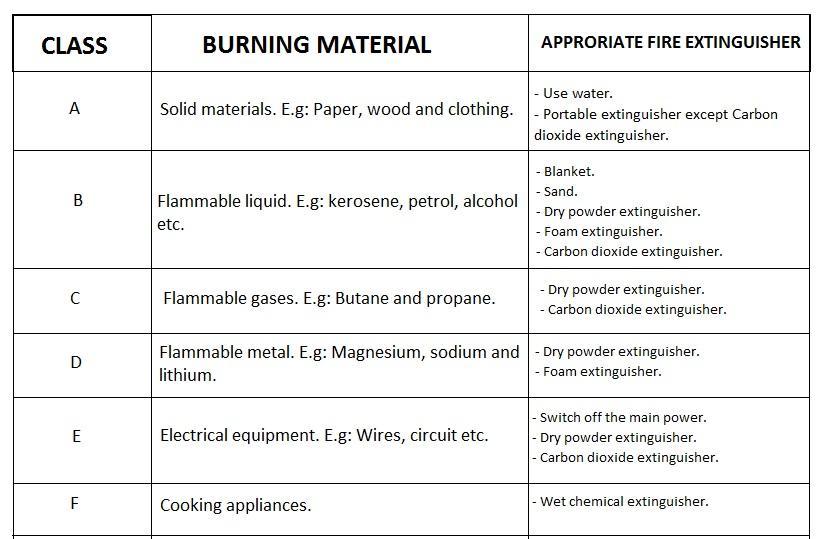
Classification of fire
Fires are classified according to the types of materials burning. Each type requires specific fighting techniques and equipment.
The table below shows the classification of fires and the appropriate extinguishers.
Components needed to start fire
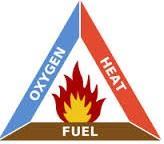
For a fire to burn, the following components are required in suitable proportions:
- Source of ignition heat
- Air (oxygen)
- Fuel
These three components form the fire triangle. If any one of them is missing, the fire will not continue burning.
Note: During fire fighting, at least one component is removed to extinguish the fire, often by cutting off the air supply.
FIRE EXTINGUISHERS
A fire extinguisher is an active fire protection device used to extinguish or control small fires, often in emergency situations.
Portable fire extinguisher refers to an extinguisher that can be easily moved from one place to another for quick response.
TYPES OF FIRE EXTINGUISHERS
There are four common types of portable fire extinguishers, namely:
- Dry powder extinguishers: Contain sodium bicarbonate powder pressurized by nitrogen. They extinguish fire by separating the fuel from oxygen or by removing the heat element of the fire triangle.
- Foam extinguishers: Contain proteins and fluoroproteins. They extinguish fire by removing the heat element and by separating oxygen from the fuel.
- Water extinguishers: Contain ordinary tap water pressurized by air. They extinguish fire by removing the heat element of the fire triangle.
- Carbon dioxide extinguishers: Contain CO2, a non-flammable gas, under high pressure. They extinguish fire by removing the oxygen element and by cooling the fire with very cold discharge.
Using fire extinguishers
Fire extinguishers should be used following the acronym PASS:
- PULL – Pull the safety pin from the handle. The pin is located at the top of the extinguisher. Removing it releases the locking mechanism, allowing discharge.
- AIM – Aim the extinguisher nozzle at the base of the fire, where the fuel source is. Keep yourself low to avoid smoke.
- SQUEEZE – Squeeze the handle slowly to discharge the extinguishing agent. Releasing the handle stops the discharge.
- SWEEP – Sweep the nozzle side to side over the fire until it is completely extinguished. Stand a few meters back for safety.
RUSTING
Rust is the reddish-brown oxide of iron formed by the action of moisture and oxygen on the metal surface. It mainly consists of hydrated iron (III) oxide (Fe2O3·H2O) and iron (III) hydroxide (Fe(OH)3).
Rusting is the chemical process in which iron turns into iron oxide due to exposure to air and moisture.
Rusting process steps are as follows:
(i) Fe → Fe2+ + 2e–
(ii) 2e– + ½O2 + H2O → 2OH–
The hydroxide ions react with iron (Fe2+) and dissolved oxygen to form iron (III) oxide, usually in hydrated form.
(iii) Fe2+ + 2OH– → Fe(OH)2
2Fe(OH)2 + ½O2 + xH2O → Fe2O3·xH2O + 2H2O
This chemical process results in a reddish-brown coating on iron or steel surfaces, weakening the metal over time.
Conditions for rusting
Three conditions are necessary for rusting to occur:
- Presence of iron or steel
- Presence of water or moisture
- Presence of air (oxygen)
Methods of preventing rusting
- Painting: Coating iron objects with special pigment paint to protect them from moisture and oxygen, thereby prolonging their lifespan.
- Oiling: Applying oil to iron surfaces, especially machine parts that cannot be painted, to prevent moisture contact.
- Tin plating: Coating iron with a thin layer of tin. For example, tin cans are made of steel coated inside with tin to make them suitable for storing food.
- Galvanization: Coating iron or steel with zinc, which protects the metal from rusting.
- Use of silica gel: Silica gel absorbs moisture. Small bags of silica gel are placed inside containers to absorb any moisture present and prevent rust.
- Use of plastics: Coating parts of machines or instruments with plastic to prevent exposure to moisture and air, thus preventing rust.
REVIEW QUESTIONS
- Define the following:
- (i) Rusting
- (ii) Rust
- (iii) Air
- (iv) Combustion
- (v) Fire
- (vi) Fire fighting
- Mention the components of air and their percentages.
- (a) Mention classes of fire, their burning materials, and appropriate fire extinguisher.
(b) What are the components needed to start fire?
(c) What are the conditions necessary for iron to rust? - (a) Classify the types of extinguishers according to the chemicals they contain.
(b) Explain with equations how rusting occurs.
(c) Mention the methods of preventing rusting.



9 Comments