


GENETICS
Genetics is the study of heredity and variation.
Heredity is the passage of characters from one generation to another.
Variation refers to differences among individuals of the same species.
GENETICS & VARIATION
HEREDITARY MATERIALS
Hereditary or genetic materials are chemical substances or units on the chromosome responsible for the passage of genetic information from one generation to another.
Characteristics of hereditary materials
The features that characterize hereditary materials include the following:
- Metabolic stability: Hereditary materials are metabolically very stable or chemically inert. If altered, imperfect copies would be made.
- Mutation: There is a close correlation between hereditary materials and mutation agents; when hereditary materials are exposed to mutagens, they undergo mutations.
- Self replication: Hereditary materials are capable of reproducing themselves.
- Constancy within the cell: The amount of hereditary materials remains constant within a cell or in the cells of organisms of the same species.
- Carriage of information: Hereditary materials carry genetic information from one generation to another.
- Linearity: Genetic materials are always arranged in a linear array. They are macromolecules.
SPECIES CONCEPT
There are several ways of defining what a species is:
(a) According to genetics: A species is a group of organisms that share a common gene pool and have the same number of chromosomes. The gene pool is the total genetic makeup in a given population.
(b) According to ecology: A species is a group of organisms that share a common ecological niche. No two species can share the same ecological niche.
(c) According to plant and animal breeding: A species is a group of organisms that can freely interbreed and produce fertile offspring.
Qn: How does a breeder define a species?
By the above definition, is a horse and donkey of the same species? Give reasons.
Soln: According to the breeder’s definition, a horse and a donkey are different species because although they interbreed freely producing a mule, a mule is non-fertile and cannot produce another mule.
Qn: In a research program at Kwamsisi Rodent Research Centre, cages of 159 rats from Usambara Mountains and 162 rats from Pugu Forest Reserve were studied. How would you identify those rats of the same species?
Soln: To identify those of the same species, the following should be done:
- Allow interbreeding: Rats of the same species will interbreed freely and produce fertile offspring. Rats of different species will either fail to interbreed or produce non-fertile offspring.
- Chromosome analysis: Rats of the same species will have the same number of chromosomes.
EXTRA OF HEREDITARY MATERIALS
Macromolecules
- They are universal but restricted within species.
- All are made due to phosphoric acid.
- All are comprised of pentose sugar, nitrogen base, and phosphate.
CHROMOSOMES AND THEIR STRUCTURE
Chromosomes carry the hereditary material DNA. They are also made up of protein and RNA. Individual chromosomes are not visible in a non-dividing (resting) cell, but the chromosomal material can be seen if stained. This material, called chromosomes, becomes visible only during the onset of cell division.
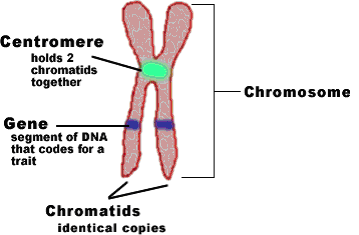
Each chromosome consists of two threads called chromatids joined at a point called the centromere. Chromosomes vary in shape and size both within and between species.
Homologous chromosomes are similar in structure.
Arrangement of homologous chromosomes in pairs is known as Karyogram, and the set of chromosomes is known as Karyotype.
Structure of chromosome:
THE NUCLEIC ACIDS, TYPES OF HEREDITARY MATERIALS
There are two types of nucleic acids:
(a) Ribonucleic acid (RNA).
(b) Deoxyribonucleic acid (DNA).
Chemical nature of nucleic acids:
Chemically, nucleic acids are composed of the following:
- Pentose sugar: This is a five-carbon sugar. In RNA, it is ribose sugar; in DNA, it is deoxyribose sugar.
- Nitrogenous (organic) bases: There are two groups of organic bases:
- Purine bases: adenine (A) and guanine (G).
- Pyrimidine bases: thymine (T), cytosine (C), and uracil (U).
Note: Thymine is a DNA pyrimidine, while uracil is an RNA pyrimidine. There is no uracil in DNA nor thymine in RNA.
3. Phosphate group: Derived from phosphoric acid, this group makes DNA and RNA acidic in nature.
The three components combine by condensation reactions to form a nucleotide. Similar condensation reactions form dinucleotides and polynucleotides. The main function of nucleotides is the formation of nucleic acids RNA and DNA, which have vital roles in protein synthesis and heredity.
Structure of a typical nucleotide:

- Chemical bonds:
- Phosphodiester bonds – hold nucleotides together.
- Hydrogen bonds – hold complementary base pairs in DNA and RNA.
Protein coat:
The DNA of eukaryotes has a histone protein coat over its surface.
(A) RIBONUCLEIC ACID (RNA)
Chemical nature:
Ribonucleic acid is chemically composed of:
- Pentose sugar: ribose (5-carbon sugar).
- Phosphate group: derived from phosphoric acid.
- Organic (nitrogenous) bases: purines adenine (A) and guanine (G); pyrimidines uracil (U) and cytosine (C).
- Chemical bonds:
- Phosphodiester bonds – hold nucleotides together.
- Hydrogen bonds – hold complementary base pairs in tRNA molecule.
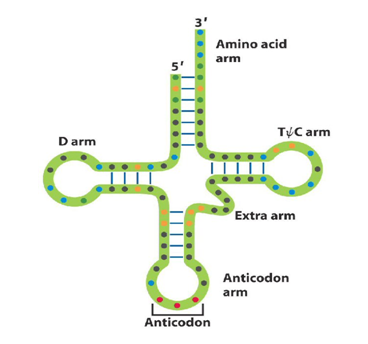
Diagram to show structure of RNA:

Role of RNA:
- In the presence of DNA, RNA collaborates with DNA to control heredity and protein synthesis.
- In the absence of DNA, RNA alone controls heredity and protein synthesis.
Types of RNA:
According to function and location in the cells, there are three types of RNA:
- (a) Messenger RNA (mRNA): formed from one strand of DNA during transcription. It carries genetic code from DNA in the nucleus to ribosomes in the cytoplasm, containing information about amino acid sequences for protein synthesis.
- (b) Ribosomal RNA (rRNA): constitutes about 80% of total RNA in the cell. Synthesized in the nucleolus, it forms the bulk of ribosomes and attracts mRNA and tRNA during protein synthesis.
- (c) Transfer RNA (tRNA): constitutes about 15% of total RNA. It is a cloverleaf-shaped molecule with four active sites: one recognizes amino acids, another the mRNA anticodon, another the ribosome, and another enzymes like aminoacyl-tRNA synthetase. It carries activated amino acids to the ribosome.
(B) DEOXYRIBONUCLEIC ACID (DNA)
Chemical nature:
DNA is chemically composed of:
- Deoxyribose sugar – a pentose (5-carbon) sugar.
- Organic or nitrogenous bases:
- Purine bases: adenine (A) and guanine (G).
- Pyrimidine bases: cytosine (C) and thymine (T).
- Phosphate group – derived from phosphoric acid.
- Protein – histone protein coat over the DNA surface.
- Chemical bonds:
- Phosphodiester bonds – hold nucleotides together.
- Hydrogen bonds – hold complementary base pairs together.
Base pairing rules:
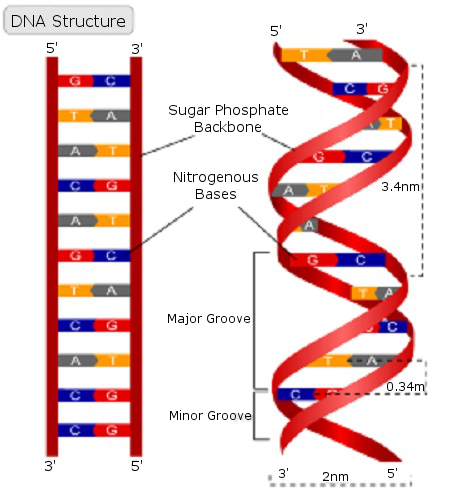
- DNA is double-stranded; bases on the two strands pair via hydrogen bonds.
- Strands run in opposite directions (antiparallel).
- According to Watson-Crick model, a purine pairs with a pyrimidine:
- Adenine pairs with thymine (two hydrogen bonds).
- Cytosine pairs with guanine (three hydrogen bonds).
Diagrammatic structure of DNA:
Role of DNA in protein synthesis:
DNA instructs the cell on the types of amino acids to be joined to form a protein molecule. The message contains information about the amino acid sequence.
Qn: One characteristic of DNA as hereditary material is its metabolic stability. State the features of DNA that account for this stability.
Answer: Features accounting for DNA’s metabolic stability include:
- Possession of a histone protein coat.
- Helical nature increases mechanical strength.
- Chemical bonds (hydrogen and phosphodiester) increase mechanical strength.
Evidence for the role of DNA in inheritance
It took many years to clarify whether DNA or protein was the genetic material. Protein was suspected due to its structural diversity.
Evidence from bacteria:
Before antibiotics, pneumonia was often fatal. Pneumococcus bacteria had two forms: capsulated (virulent) and non-capsulated (non-virulent). Griffith injected mice with these forms and observed transformation, concluding that something from heat-killed capsulated bacteria transformed non-capsulated bacteria into virulent forms.
| Injected form of pneumococcus | Effect |
|---|---|
| Live non-capsulated | Mice live |
| Live capsulated | Mice die |
| Heat-killed capsulated | Mice live |
| Heat-killed capsulated + live non-capsulated | Mice die |
Further analysis showed that DNA was the transforming principle, as treatment with DNase prevented transformation.
Evidence from viruses:
Experiments on bacteriophages concluded that DNA, not protein, is the hereditary material.
DNA REPLICATION
DNA replication is the process by which exact copies of DNA are produced from old DNA molecules.
Significance of DNA replication:
- Ensures all newly formed cells have the same amount of DNA.
- Maintains constancy of hereditary materials.
- Occasional mistakes cause genetic variation and evolution.
- Errors may cause RNA to be constructed instead of DNA if uracil is incorporated.
Mechanism of DNA replication:
The two strands of DNA unwind and separate, acting as templates for complementary nucleotides to attach by base pairing. DNA polymerase links free nucleotides to form complementary strands. Helicase controls unwinding. One strand is copied continuously; the other is copied discontinuously with gaps sealed by DNA ligase.
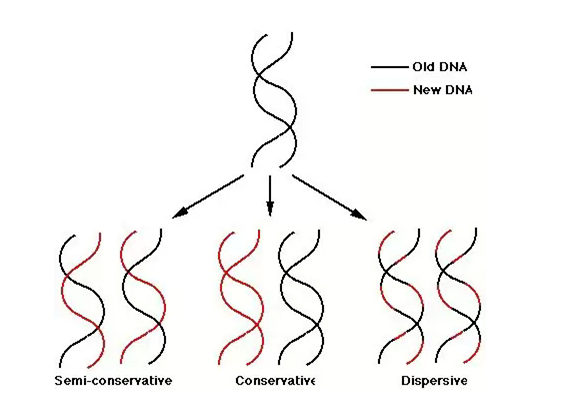
Semi-conservative replication:
- Each new double helix retains one original and one new strand.
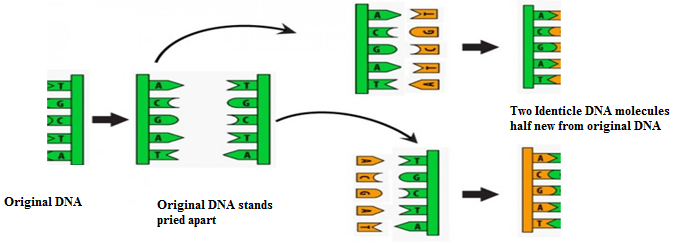
Three theories of DNA replication illustrated:
Differences between DNA and RNA:
| DNA | RNA | |
|---|---|---|
| Strands | Double stranded polynucleotide molecule | Single stranded polynucleotide molecule |
| Pentose sugar | Deoxyribose | Ribose |
| Pyrimidine base | Thymine | Uracil |
| Location | Found in molecules | Found in cytoplasm |
| Amount in cell | Constant | Variable |
| Stability | More stable | Less stable |
| Molecular mass | High molecular mass | Low molecular mass |
| Base ratios | Ratio of A to T and G to C is always 1 | Ratio of A to U and G to C is variable |
| Forms | Only one basic form with infinite variety | Three basic forms: messenger, transfer, and ribosomal RNA |
| Treatment | Stable | Exists temporarily for short period |
Study Questions:
(a) What is DNA replication?
(b) Describe the mechanism of DNA replication and explain why it is called semi-conservative.
(c) Summarize the structural differences between DNA and RNA.
- Summarize the structural differences between DNA and RNA.
The nature of genes:
Mendel defined a gene as a unit of inheritance. This definition is acceptable but does not describe the physical nature of a gene.
Ways to overcome this objection:
- A unit of recombination: A gene is the shortest segment of a chromosome separated from adjacent segments by crossing over. It is a specific region of a chromosome determining a distinct characteristic.
- A unit of function: Genes code for proteins; thus, a gene is the DNA code for a polypeptide. Some proteins are made of multiple polypeptide chains coded by more than one gene.
The genetic code
The genetic code is the relationship between nitrogenous bases on DNA and amino acids.
Genetic information passed from generation to generation controls cell activities and is stored in DNA sequences that code for protein sequences. This relationship is the genetic code.
In other words, the genetic code is how DNA controls the manufacture of specific proteins by cells.
The code is a triplet code.
There are four bases in DNA: adenine (A), guanine (G), thymine (T), and cytosine (C). Each base is part of a nucleotide arranged in a polynucleotide chain. The sequence of bases carries the code for synthesizing potentially infinite different proteins.
There are 20 common amino acids used to make proteins. If one base coded for one amino acid, only four amino acids could be specified. If pairs coded, 16 amino acids could be specified. Only a triplet code can specify all 20 amino acids.
The code is indeed a triplet code: three bases code for one amino acid.
Problems:
- Using bases A, G, T, and C, list the 16 possible pairs of bases.
- If four bases used singly code for 4 amino acids, pairs code for 16, and triplets code for 64 amino acids, deduce a mathematical expression to explain this.
Answer:
4 bases used once = 4¹ = 4
4 bases used twice = 4² = 16
4 bases used thrice = 4³ = 64
Mathematical expression: XY
Where:
X = Number of bases
Y = Number of bases used
Thus, the code is a combination of three nitrogenous bases, e.g., AGC, AUA, GCA.
Features (Characteristics) of the genetic code:
- It is a triplet code; three bases code for one amino acid.
- The genetic code is degenerate; a given amino acid can be coded by more than one codon.
- The genetic code is universal; the same triplet codes for the same amino acid in all organisms.
- The genetic code is punctuated; it has start and stop signals.
- The genetic code is non-overlapping; codons are read sequentially without overlap.
- The genetic code has no commas; bases are continuously sequenced.
Note: Degenerate code means the number of amino acids is less than the number of codons.
Nonsense codons: Codons that do not code for amino acids; they mark the end of polypeptide chains during translation (stop signals).
PROTEIN BIOSYNTHESIS: ‘DNA makes RNA and RNA makes Protein’
Protein synthesis is the mechanism by which proteins are constructed by joining amino acids with peptide bonds according to instructions in mRNA coded from DNA.
- Synthesis of amino acids.
- Transcription (formation of mRNA).
- Amino acid activation.
- Translation.
The site for protein synthesis is the ribosome.
Proteins synthesized may have structural roles (keratin, collagen) or functional roles (insulin, fibrinogen, enzymes). Enzymes control metabolism and determine cell type. DNA controls cell activities.
Instructions for enzyme and protein manufacture are in DNA, but actual synthesis occurs in ribosomes. Messenger RNA carries genetic information from nucleus to cytoplasm.
Adaptations of the ribosome to protein synthesis:
- Presence of enzymes catalyzing polypeptide bond synthesis.
- Receptor site for mRNA attachment.
- Presence of rRNA to attract other tRNAs.
- Ability to read and translate mRNA code.
Mechanism of protein synthesis:
Four main stages:
- Synthesis of amino acids: In plants, amino acids form in mitochondria and chloroplasts via absorption and reduction of nitrates, combination with carbohydrate skeletons, and transamination. Animals obtain amino acids from food but can synthesize some non-essential amino acids.
- Transcription (formation of mRNA): Base sequence of a DNA gene is converted into complementary mRNA sequence. RNA polymerase links free nucleotides according to base pairing rules. mRNA leaves nucleus to ribosomes.
- Amino acid activation: Amino acids combine with tRNA using ATP energy, forming aminoacyl-tRNA complexes under aminoacyl-tRNA synthetase enzyme.
- Translation: mRNA sequence is converted into amino acid sequence in polypeptide chain at ribosomes. Multiple ribosomes may attach to mRNA forming polyribosomes. Ribosome holds mRNA, tRNA, and enzymes until peptide bonds form. Ribosome moves along mRNA codons, adding amino acids until stop codon is reached.

Summary:
Polypeptides fold into secondary, tertiary, and quaternary structures. Proteins may enter the rough ER for transport.
Qn: (a) Describe how a single strand of mRNA is constructed from one DNA strand.
(b) If DNA strand sequence is AGTCCACCATAA, (i) what is the mRNA sequence? (ii) How many amino acids are coded?
Soln:
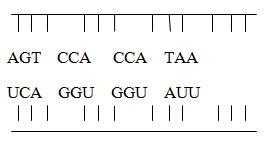
The mRNA sequence is UCAGGUGGUAAU.
There are four triplets, so four amino acids.
Introns and exons:
Eukaryotic DNA is longer than corresponding mRNA because non-coding sections (introns) are removed from mRNA before translation. Coding sections are exons.
Summary: Eukaryotic genes contain introns (non-coding) and exons (coding).
MENDELIAN GENETICS
Gregor Johan Mendel studied genetics using Pisum sativum (garden peas) to find laws governing inheritance.
Advantages of Pisum sativum:
- Several varieties with distinct characteristics.
- Easy to cultivate.
- Reproductive structures enclosed by petals, enabling self-pollination and pure breeding.
- Artificial cross-breeding possible, producing fertile hybrids.
Monohybrid inheritance and the principle of segregation:
Monohybrid inheritance involves two contrasting variations of one characteristic, e.g., tall vs short, red vs white, rough vs smooth.
Glossary of common genetic terms:
- Gene: Basic unit of inheritance for a characteristic.
- Allele: Alternative forms of the same gene determining contrasting traits, e.g., A or a.
- Locus: Position of an allele on a chromosome.
- Homozygous: Diploid condition with identical alleles at a locus, e.g., AA or aa.
- Heterozygous: Diploid condition with different alleles at a locus, e.g., Aa.
- Phenotype: Observable characteristics resulting from genotype and environment, e.g., red or blue.
- Genotype: Genetic constitution with respect to alleles, e.g., AA, Aa, or aa.
- Dominant: Allele influencing phenotype in presence of alternative allele, e.g., A.
- Recessive: Allele influencing phenotype only when homozygous, e.g., a.
- F1 generation: Offspring from crossing homozygous parents.
- F2 generation: Offspring from crossing two F1 organisms.
Basic Monohybrid ratio:
Phenotypic ratio in F2 generation from pure parents is 3:1.
Mendel’s experiment and the Monohybrid ratio:
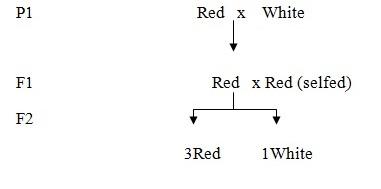
- Mendel crossed pure red flowered plants with pure white flowered plants; all F1 had red flowers.
- Selfing F1 produced F2 with red and white flowers in 3:1 ratio.
- This ratio is from crossing two heterozygous individuals.
Non-coding DNA:
About 95% of human DNA does not code for proteins or RNA.
- Factor for redness is dominant over whiteness.
- Whiteness factor present in F1 but not expressed.
- No intermediate color; traits remain unchanged.
- Characteristics controlled by pairs of factors segregating during gamete formation.
This observation led Mendel to formulate the law of segregation.
Assumptions:
- ‘R’ for redness, ‘r’ for whiteness.
- ‘R’ dominates ‘r’.
- Each character controlled by pair of factors segregating during gamete formation.
Example cross: Pure breeding red flower x pure breeding white flower.

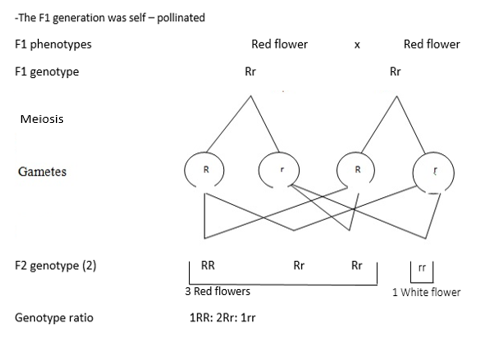
Phenotypic ratio: 3 Red : 1 White
Mendel’s 1st law of inheritance (Law of segregation):
Characteristics are determined by internal factors in pairs; only one factor of a pair is represented in a gamete.
Meiotic explanation:
- During meiosis, homologous chromosomes separate, so gametes receive one chromosome of each pair.
- Alleles occur in pairs on homologous chromosomes; their separation corresponds to allele segregation.
Mendel’s factors correspond to genes and meiosis produces gametes with one allele of each pair.
Methods to solve Mendelian problems:
- Algebraic method.
- Punnett square/chequerboard method.
- Mendelian crosses/genetics diagrams.
(A) Algebraic method:
Example: Cross between two heterozygous tall plants.

Symbols used in genetics:
- Any symbol can represent a characteristic if defined.
- Dominant traits often represented by uppercase first letter, recessive by lowercase.
- P1 = parents, F1 and F2 = filial generations 1 and 2.
Example: Dwarfism caused by dominant gene D; normal height allele d. Given genotype Dd for a man, work out genotype and phenotype ratios of offspring if he marries:
- A normal woman.
- A dwarf woman.
Solution:
D = dwarf allele, d = tall allele.
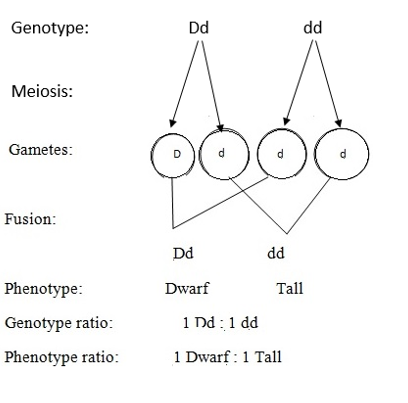
If he marries a homozygous tall woman, half offspring tall, half dwarf.
If he marries a homozygous dwarf woman, genotype ratio 1 DD : 1 Dd.
If he marries a heterozygous dwarf woman, genotype ratio 1 DD : 2 Dd : 1 dd; phenotype ratio 3 dwarf : 1 tall.
BACK CROSS AND TEST CROSS
- Back cross: cross between organism and one of its parents.
- Test cross: cross between organism with dominant phenotype and one with recessive phenotype to determine genotype.
Explanations:
Dominant phenotype may have two genotypes (homozygous or heterozygous). Test cross helps determine genotype.
Example: Round seeds could be RR or Rr; phenotype identical. Test cross with rr reveals genotype.


Questions:
- If pure brown-furred mice breed with pure grey-furred mice producing brown-furred offspring, and F1 interbreed to produce F2 with 3:1 brown to grey ratio, explain results and predict outcome of crossing a brown heterozygote with original grey parent.
Answer:
B = brown fur (dominant), b = grey fur (recessive).

F1 phenotype: all brown fur.
NON-MONOHYBRID INHERITANCE
Inheritance involving more than one character simultaneously.
Dihybrid inheritance and Mendel’s Law of Independent Assortment
Dihybrid inheritance involves two characters simultaneously, e.g., seed shape and seed color.
Mendel crossed round yellow seeds (dominant) with wrinkled green seeds (recessive). F1 all round yellow. F2 phenotypes in ratio 9:3:3:1.
- 315 round yellow
- 101 wrinkled yellow
- 108 round green
- 32 wrinkled green
Each characteristic behaves independently with 3:1 ratio.
Genetic representation:
R = round seed, r = wrinkled seed, G = yellow seed, g = green seed.
Parents: RRGG x rrgg

Punnett square for gamete fusion:
| Gametes | RG | Rg | rG | rg |
|---|---|---|---|---|
| RG | RRGG | RRGg | RrGG | RrGg |
| Rg | RRGg | RRgg | RrGg | Rrgg |
| rG | RrGG | RrGg | rrGG | rrGg |
| rg | RrGg | Rrgg | rrGg | rrgg |
Phenotypic ratio 9:3:3:1.
How to calculate genotype and phenotype ratios of dihybrid cross:
Two methods:
- Count boxes in Punnett square.
- Use probability principle: chance of independent events occurring together is product of individual chances.
Example: Probability of round (¾) and yellow (¾) = ¾ × ¾ = 9/16.
Mendel’s 2nd law of inheritance (Law of Independent Assortment):
During gamete formation, distribution of alleles of one gene is independent of alleles of another gene.
Meiotic explanation:
Random alignment and separation of homologous chromosomes during metaphase I and anaphase I leads to variety of alleles in gametes.
Examples:
In guinea pigs, black hair and short hair are dominant. Cross between pure-breeding short black and long white parents produces F1 short black. F2 phenotypes and ratios can be predicted.
Glossary of terms:
- Dominant alleles: B (black), S (short).
- Recessive alleles: b (white), s (long).
Sex determination:
Humans have 23 pairs of chromosomes; 22 pairs are autosomes, 23rd pair are sex chromosomes (XX female, XY male).
Females are homogametic (XX), males heterogametic (XY).
Y chromosome carries testicular determining gene causing gonads to develop into testes; absence leads to ovaries.

Sex determined by sperm chromosome type: X sperm + X egg = female (XX), Y sperm + X egg = male (XY).
Sex linkage:
Genes on sex chromosomes are sex-linked. X chromosome carries many genes; Y chromosome few.
Sex-linked traits like hemophilia and color blindness occur mostly in males; females are carriers.
Hemophilia:
Sex-linked recessive disorder causing inability of blood to clot.

Cross between carrier female and normal male produces 50% hemophiliac males; females phenotypically normal.
Genetic engineering (Recombinant DNA technology):
Manipulation of DNA from one organism (donor) and transfer into another (host) where it combines with host DNA.
To create new gene combinations, genetic engineers must:
- Locate specific gene in donor cell.
- Modify donor DNA selectively.
- Isolate located gene.
- Transfer modified DNA into host cell for expression.
Techniques used to manipulate DNA:
- Reverse transcriptase: synthesizes DNA from RNA.
- Restriction endonucleases: cut DNA at specific sequences.
- DNA ligase: joins donor and vector DNA to form recombinant DNA.
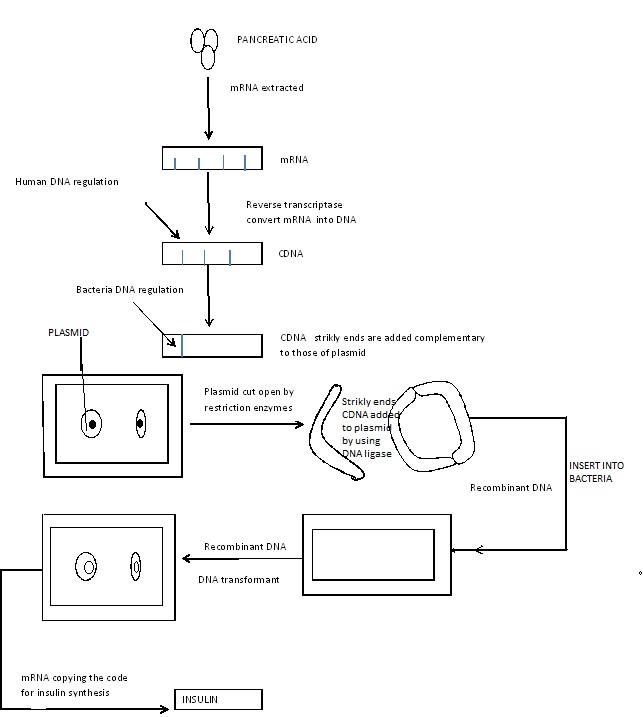
Steps in recombinant DNA technology:
- Cut DNA into smaller portions using restriction endonucleases.
- Copy required DNA using reverse transcriptase to form cDNA.
- Add gene to vector DNA.
- Form recombinant DNA molecule with vector.
- Join DNA portions using DNA ligase.
Application of genetics:
- Plant and animal breeding: crossing genetically dissimilar organisms produces hybrids with beneficial traits.
- Blood transfusion: matching blood groups and Rhesus factor to avoid agglutination.
- Genetic counseling: advising couples on hereditary disorder risks.
- Genetic disorders: prenatal diagnosis, carrier diagnosis, predictive diagnosis.
Examples of monohybrid inheritance:
- Rhesus factor: organism is positive or negative.
- Albinism: recessive homozygous individuals lack pigmentation.
- Maize seeds: dominant white or recessive colored.
How genetic engineering is done:
DNA section is transferred into bacterial plasmid using restriction enzymes and DNA ligase, forming recombinant DNA. Bacteria replicate, producing multiple copies of the gene (gene cloning).
Applications of genetic engineering:
- Medicine: production of insulin, growth hormones, blood clotting factors, vaccines.
- Biological warfare: cloning disease-causing microorganisms.
- Agriculture: nitrogen-fixing plants, waste breakdown, tissue culture propagation.
Genetic disorders:
- Down’s syndrome (trisomy 21): extra chromosome 21 due to non-disjunction.
- Klinefelter’s syndrome (XXY): male with extra X chromosome.
- Turner’s syndrome (XO): female with missing X chromosome.
- Sickle cell anemia: gene mutation causing abnormal hemoglobin.
- Phenylketonuria (PKU): recessive disorder due to enzyme deficiency.
Genetic screening and diagnosis:
- Prenatal diagnosis: detecting health problems in unborn baby.
- Carrier diagnosis: identifying asymptomatic carriers.
- Predictive diagnosis: predicting future disease risk.
- Chorionic villus sampling and amniocentesis used for prenatal diagnosis.


7 Comments