

REPRODUCTION -1
This is the process by which organisms produce new individuals of the same species.
This is one of the important features of living things. Reproduction results in the increase in numbers of organisms and the perpetuation of life on earth.
Importance of Reproduction
- It ensures the continuity of individual species. This is because newly born individuals replace the dead ones.
- Reproduction increases the number of populations of living organisms on earth.
Types of Reproduction
Basically, there are two ways in which living things reproduce:
- Sexual reproduction
- Asexual reproduction
I. ASEXUAL REPRODUCTION
It is the reproduction of offspring from a single organism without the use of sex cells (gametes).
It means that there is no fusion of gametes. Single-celled organisms like amoeba and bacteria use asexual reproduction as the only means of reproduction.
There are different forms/methods of asexual reproduction depending on the type of organisms. Asexual reproduction may be of different forms such as:
- Binary fission
- Fragmentation
- Multiple fission (sporulation)
- Budding
- Suckers
- Artificial/Vegetative propagation
1) BINARY FISSION (SPLITTING)
Is the process whereby an organism divides into two equally parts and each part then grows to attain the original size of the parent cell and becomes a separate and independent organism. Organisms such as amoeba, paramecium, euglena, and trypanosome practice binary fission.

Binary fission
2) FRAGMENTATION
Is the reproduction whereby an organism breaks physically into two or more parts with identical features to the parent.
Each of the parts grows to be a complete organism. Examples of organisms that practice fragmentation are flatworms.

3) MULTIPLE FISSION (SPORULATION)
This is the type of reproduction whereby organisms produce offspring by reproductive cells called spores.
Spores are small unicellular structures which contain reproductive cells. The spores develop from a single cell from a structure known as sporangium. When the sporangium is fully developed, it bursts to release the spores to the ground. When they land on a suitable environment, they germinate into new organisms.
Examples of organisms that reproduce by sporulation include fungi, mosses, ferns, and amoeba. In amoeba, multiple fission only occurs when environmental conditions do not favor binary fission such as drought.
Spores are produced in specialized structures known as sporangia, but in ferns are called sorus and in mosses are sometimes known as capsules.

Spore formation
4) BUDDING
Is a type of reproduction whereby a new organism arises asexually as an outgrowth on the older organism.
The bud finally separates from the parent’s body and grows to attain the size of the parent. Examples are yeast and hydra.
Yeast

Hydra

5) SUCKERS
These are lateral branches with terminal buds which grow from the base of an underground stem. These branches are called suckers. Example: banana.
6) ARTIFICIAL/VEGETATIVE PROPAGATION
This is a form of asexual reproduction found in plants in which a bud grows and develops into plants. In this type, a detached plant part, root, stem, or leaves grows and develops into an independent plant.
Forms of Artificial Propagation
(i) Propagation by cuttings
When a portion of a stem or root is cut off and put in moist soil, it produces roots and sprouts, and a new independent plant is produced.
- Plants propagated by stem cutting include sugar cane, sweet potato, and cassava.
- Plants propagated by root cutting include lemon and sweet potatoes.
(ii) Propagation by grafting
It involves the attachment of a part of a plant to an already rooted plant. This type of propagation can be carried out between plants of the same species (or related species), e.g., orange and lemon.
For grafting to be successful, the xylem and phloem of both plants must be in direct contact to ensure the easy movement of materials between the two plants.

Grafting
(iii) Propagation by layering
A branch of a plant is bent down until it touches the ground and covered with soil.
After some time, the portion of the branch under the soil grows roots. If the branch is cut off from the main plant, it develops into an independent plant. Example: sweet potato.

(iv) Propagation by budding
It is similar to propagation by grafting. Here buds are used instead of stems.


ADVANTAGES OF ASEXUAL REPRODUCTION
- It results in organisms with the same genetic components as their parents.
- They produce many offspring which mature faster than sexually produced organisms. This is beneficial to farmers who need fast-growing plants.
- Asexual reproduction does not waste time.
DISADVANTAGES OF ASEXUAL REPRODUCTION
- Organisms are at great risk to perish or get destroyed when environmental conditions are not favorable.
- Parents may pass undesirable characteristics to the offspring since organisms produced are genetically identical to the parents.
- Competition for resources such as food and shelter may occur due to the large number of organisms being produced.
II. SEXUAL REPRODUCTION
Sexual reproduction involves the fusion of two sex cells called gametes. The two gametes differ in form and function, and each is produced from a different organ.
In animals, gamete-producing organs are gonads (ovaries and testes). In flowering plants, structures for producing gametes are called anthers and ovaries.
When male and female reproductive structures are borne on different individuals, it is referred to as unisexual. When male and female reproductive structures are produced by the same individual, it is said to be bisexual/hermaphrodite.
Characteristics of Sexual Reproduction
- It always involves a female and male parent.
- The parents must form gametes by meiosis. In bryophytes and filicinophytes, formation of gametes does not involve meiosis.
- A new individual is formed only after a male gamete has fused with a female gamete.
NB
The organism is capable of sexual reproduction only when it is sexually mature. This is because in young organisms the reproductive organs are not fully developed or may be absent.
ADVANTAGES OF SEXUAL REPRODUCTION
- It results in perpetuation of life.
- Harmful genes of the parent will not necessarily be handed to the offspring.
DISADVANTAGES OF SEXUAL REPRODUCTION
- Sexual reproduction may produce individuals with undesired qualities, e.g., diseases like hemophilia, sickle cell anemia.
- Time and energy are consumed as it needs two organisms.
- In cases when certain organisms are isolated from others, it becomes difficult for sexual reproduction to take place.
MEIOSIS AND REPRODUCTION (CELL DIVISION)
Cell division is the splitting of a cell into two or more parts where each rises into a new cell.
It involves three stages:
- Division of the nucleus
- The cytoplasm division
- Cell separation
Chromosomes are thread-like structures found in the nucleus which contain hereditary material (DNA).
Types of Cell Division
- Meiosis
- Mitosis
1. MEIOSIS
Meiosis is a type of cell division which occurs in reproductive organs to produce sex cells (gametes).
Meiosis reduces the number of chromosomes from the diploid state (pairs of chromosomes) to the haploid state (single chromosomes). It is also called reduction division.
Every cell of a multicellular organism contains the same number of chromosomes (46 in humans) and it stays constant, generation after generation.
A human develops from a zygote which is the result of fusion of a male and female gamete. If the gamete had 46 chromosomes, the resulting zygote would have 92 chromosomes.
To avoid doubling chromosomes, a special type of division takes place to halve the chromosome number during gamete formation, which is meiosis.
Meiosis involves a number of processes. There are two meiotic divisions:
- First meiotic division
- Second meiotic division
I. FIRST MEIOTIC DIVISION
This division involves the following stages:
- Prophase I
- Metaphase I
- Anaphase I
- Telophase I
1. INTERPHASE (RESTING STAGE)
Cell grows and carries out normal life functions. The cell is prepared for division.

1. Prophase I
It is the longest phase of meiosis. During prophase I, DNA is exchanged between homologous chromosomes in a process called homologous recombination. This often results in chromosomal crossover. The new combinations of DNA created during crossover are a significant source of genetic variation and may result in beneficial new combinations of alleles. The paired and replicated chromosomes are called bivalents or tetrads, which have two chromosomes and four chromatids, with one chromosome coming from each parent. The process of pairing the homologous chromosomes is called synapsis. At this stage, non-sister chromatids may cross over at points called chiasmata (plural; singular chiasma) which result in exchange of chromatid parts.

2. METAPHASE I
- The bivalent of homologous chromosomes move to the equator of the spindle.
- The homologous chromosomes become arranged with the centromeres of the homologous pair pointing toward opposite poles.

3. Anaphase I
Kinetochores (bipolar spindle) microtubules shorten, severing the recombination nodules and pulling homologous chromosomes apart. Since each chromosome has only one functional unit of a pair of kinetochores, whole chromosomes are pulled toward opposing poles, forming two haploid sets. Each chromosome still contains a pair of sister chromatids. During this time disjunction occurs, which is one of the processes leading to genetic diversity as each chromosome can end up in either of the daughter cells. Nonkinetochore microtubules lengthen, pushing the centrioles farther apart. The cell elongates in preparation for division down the center.

4. Telophase I
The first meiotic division effectively ends when the chromosomes arrive at the poles. Each daughter cell now has half the number of chromosomes but each chromosome consists of a pair of chromatids. The microtubules that make up the spindle network disappear, and a new nuclear membrane surrounds each haploid set. The chromosomes uncoil back into chromatin. Cytokinesis, the pinching of the cell membrane in animal cells or the formation of the cell wall in plant cells, occurs, completing the creation of two daughter cells. Sister chromatids remain attached during telophase I.

II. SECOND MEIOTIC DIVISION
Meiosis II is the second part of the meiotic process, also known as equational division. Mechanically, the process is similar to mitosis, though its genetic results are fundamentally different. The end result is production of four haploid cells (23 chromosomes, N in humans) from the two haploid cells (23 chromosomes, each consisting of two sister chromatids) produced in meiosis I. The four main steps of Meiosis II are: Prophase II, Metaphase II, Anaphase II, and Telophase II.
1. Prophase II
We see the disappearance of the nucleoli and the nuclear envelope again as well as the shortening and thickening of the chromatids. Centrioles move to the polar regions and arrange spindle fibers for the second meiotic division.

2. Metaphase II
The centromeres contain two kinetochores that attach to spindle fibers from the centrosomes (centrioles) at each pole. The new equatorial metaphase plate is rotated by 90 degrees when compared to meiosis I, perpendicular to the previous plate.

3. Anaphase II
Where the centromeres are cleaved, allowing microtubules attached to the kinetochores to pull the sister chromatids apart. The sister chromatids by convention are now called sister chromosomes as they move toward opposing poles.

4. Telophase II
This is similar to telophase I, and is marked by uncoiling and lengthening of the chromosomes and the disappearance of the spindle. Nuclear envelopes reform and cleavage or cell wall formation eventually produces a total of four daughter cells, each with a haploid set of chromosomes.
Meiosis is now complete and ends up with four new daughter cells.

IMPORTANCE OF MEIOSIS
- It ensures a constant number of chromosomes in all species by reducing the doubling number of chromosomes which would result in different species.
- It involves the possibility of exchange of pieces of genetic information/materials between the paternal and maternal chromosomes leading to new combinations of characteristics in the gamete.
- It provides variation when the members of each pair of chromosomes are separated from each other independently.
REPRODUCTION IN FLOWERING PLANTS
Flowering plants or angiosperms reproduce sexually. Flowering plants have specialized structures called flowers, which are used for the reproduction process.

A flower comprises different parts:
- PEDUNCLE
It is a flower stalk attached to the plant. It is where the flower develops. If it is branched so as to bear many flowers, each branch is called radical.
- RECEPTACLE
It is the top of the flower stalk/peduncle to which other parts are attached.
- CALYX/SEPAL
It is the outermost ring of floral leaves. They are usually green and protect the inner floral structure when the flower is not open.
Some species of plants have flowers with rings of sepals. The outermost ring is called the epicalyx.
- COROLLA
This is a ring of petals on a flower. In some plants, the petals are brightly coloured. They may fuse to form a corolla tube. Corolla and calyx together constitute the perianth.
- STAMEN
This is the male reproductive organ. It consists of a filament with a head called anther.
The anther contains pollen grains inside. In the hibiscus flower, there are many stamens and filaments which join to form a stamina tube, which is connected to the receptacle.
- CARPEL
This is the female reproductive organ. It consists of three parts called ovary, style, and stigma.
- Ovary contains eggs.
- Style is a tube connected to the ovary.
- Stigma is a knob-like structure at the top of the style. It receives pollen grains during pollination. It usually has five branches.
Types of Flowers
Bisexual flower is a flower which has both female and male organs – examples are hibiscus flower, sunflower, tomato, and flamboyant.
Unisexual flower is a flower which has either female or male organs. Examples are maize and some pawpaw flowers.
NOTE
- If both male and female flowers are found on the same plant, it is said to be Monoecious (e.g., maize).
- When the male and female flowers are borne on separate plants, it is called dioecious (e.g., pawpaw).
POLLINATION
Pollination is the transfer of pollen grains from the anther to the stigma. It follows that the male’s gametes must move from an anther to the carpel (female gametes).
When the anthers are ripe, they split open and are exposed, ready to be transferred to the carpel. For a successful fusion of gametes, the pollen grains must land on the stigma.
Types of Pollination
I. SELF POLLINATION
This is the transfer of pollen grains from the anther to the stigma of the same flower. It may also occur if the different flowers are of the same plant. Examples are garden peas and dandelion.
II. CROSS POLLINATION
This is the transfer of pollen grains from the anther of a flower of one plant to the stigma of another flower and plant. It involves plants of the same species. Examples are maize and sorghum.
AGENTS OF POLLINATION
Pollen grains produced from an anther are carried to the stigma by different agents. Such agents are:
- Wind
- Water
- Insects
- Bats
- Birds
Flowers according to mode of pollination are divided into two groups:
- Wind pollinated flowers
- Insect pollinated flowers
WIND POLLINATED FLOWERS
Flowers may use wind as a pollination agent. When the grains are exposed and their grains are light, air currents easily blow them from anthers.
As pollen floats in the air, it is easily trapped by feathery sticky stigma of other flowers. (Example: maize and grasses).
Characteristics of Wind Pollinated Flowers
- Are not brightly coloured (are dull coloured)
- Pollen grains are small and light
- The flower structure is simple
- They have no scent
- They do not have nectar
- Stigma is large and feathery, hanging outside to trap pollen
INSECT/BIRD POLLINATED FLOWERS
Insects may be the pollination agent. When insects and birds visit the flower to feed, the pollen grains stick to their body. As they move from flower to flower, some pollen (stuck pollens) are transferred and deposited or stick on the stigma of a different flower.
Characteristics of Insect Pollinated Flowers
- The flower is brightly coloured
- They produce a sweet fluid (nectar) which is food to most birds
- The pollen grains are large and sticky, covered with spiky hairs which enable pollen to stick to the bodies of insects
FERTILIZATION IN FLOWERING PLANTS
Fertilization is the fusion of male and female gametes. It is followed after pollination when one sperm nucleus of pollen grains combines with an egg cell to form a zygote.
Fertilization in plants takes place in the embryo sac.
Types of Fertilization
- Self fertilization
- Cross fertilization
I. SELF FERTILIZATION
It is when gametes of the same plant are involved.
II. CROSS-FERTILIZATION
It is when gametes involved are of different plants of the same species.
The fertilized ovule develops into a seed, protected by the ovary wall which develops into the fruit wall. In some plants, the receptacle becomes part of the fruit such as pineapple.
DISPERSAL OF FRUIT AND SEEDS
Dispersal of fruits and seeds is of paramount importance because it reduces congestion of plants in a certain habitat. Seeds and fruits are dispersed and scattered to other places. Dispersal reduces overcrowding and competition for light, nutrients, and space. Competition between the offspring and parent plant may lower the survival rate to an extent that the plant may become extinct.
Since a plant is not motile, the dispersal of fruits and seeds is carried by physical agents and explosive mechanisms. Depending on the agent of dispersal, fruits and seeds have different adaptive features.
Methods of Seeds and Fruits Dispersal
1. Wind Dispersal
Seeds and fruits dispersed by wind have the following adaptive features:
- Are small and light
- Have wing-like structures
- Have feather-like projections
One or combinations of the above adaptive features enable the seeds and fruits to be carried by wind. Examples include Nandi flame, jacaranda, cotton seeds, etc.
2. Water Dispersal
Seeds and fruits dispersed by water have the following adaptations:
- Have fibrous mesocarp
- Have air pockets
- Have waterproof coats (e.g., coconut)
3. Animal Dispersal
Fruits and seeds dispersed by animals have the following adaptations:
- Are sticky
- Have hooks
- Are succulent and palatable
4. Self Dispersal
This is the sudden splitting open (dehiscence) of the dry pod. The seeds are hurled away from the parent plant.
REPRODUCTION IN MAMMALS
Sexual reproduction occurs in almost all mammals by fusion of male and female gametes. The gametes produced by a male animal are sperms while those produced by female animals are ova.
Mammals and other animals reproduce sexually, involving the fusion of gametes. In most animals, both fertilization and development occur internally and such animals are called viviparous.
Most fish shed gametes directly into water where fertilization occurs externally. In amphibians, the tendency of returning to water for fertilization (mating) is observed.
Reptiles and birds lay eggs, which hatch and develop into an adult reptile or bird after a number of processes.
Mammals, like other animals, have specialized structures called reproductive organs (gonads) which are responsible for production of gametes.
GAMETE FORMATION
Gametes are haploid cells which fuse to form a zygote in sexual reproduction.
Both male and female humans produce gametes. The process of production of gametes is known as gametogenesis.
There are two types of gametogenesis:
- Spermatogenesis
- Oogenesis
SPERMATOGENESIS
This is the production of sperms in mammals. It occurs in the testes. The production of sperms starts when males reach puberty.
OOGENESIS
This is the production of eggs in the ovary. Production of ova is not continuous throughout one’s lifetime. The production of egg cells (primary ova) occurs during the fetus development. But only 400 – 500 primary ova develop to maturity during the active reproductive age of the female.
STRUCTURE OF SPERM AND OVA
- SPERM CELL: Is an extremely small cell. It has three distinct regions:
- Head
- Middle piece
- Tail

The head
The head is flat and oval in shape. It contains the nucleus which contains hereditary materials (DNA).
The middle piece
Has many mitochondria which are concerned with energy production.
The tail
The tail is like flagella in structure for propulsion.
Adaptation of sperm to its function
- It has a tail which helps to move the sperm.
- The presence of mitochondria enables the sperm to produce energy needed during movement.
- It has an acrosome enzyme which helps penetrate the egg cell at fertilization.
- They are produced in large numbers for survival.
OVA CELL
It is oval in shape; the egg cell contains a nucleus which contains the hereditary material (genetic). It also contains cytoplasm and granules.

REPRODUCTIVE SYSTEM IN MAMMALS
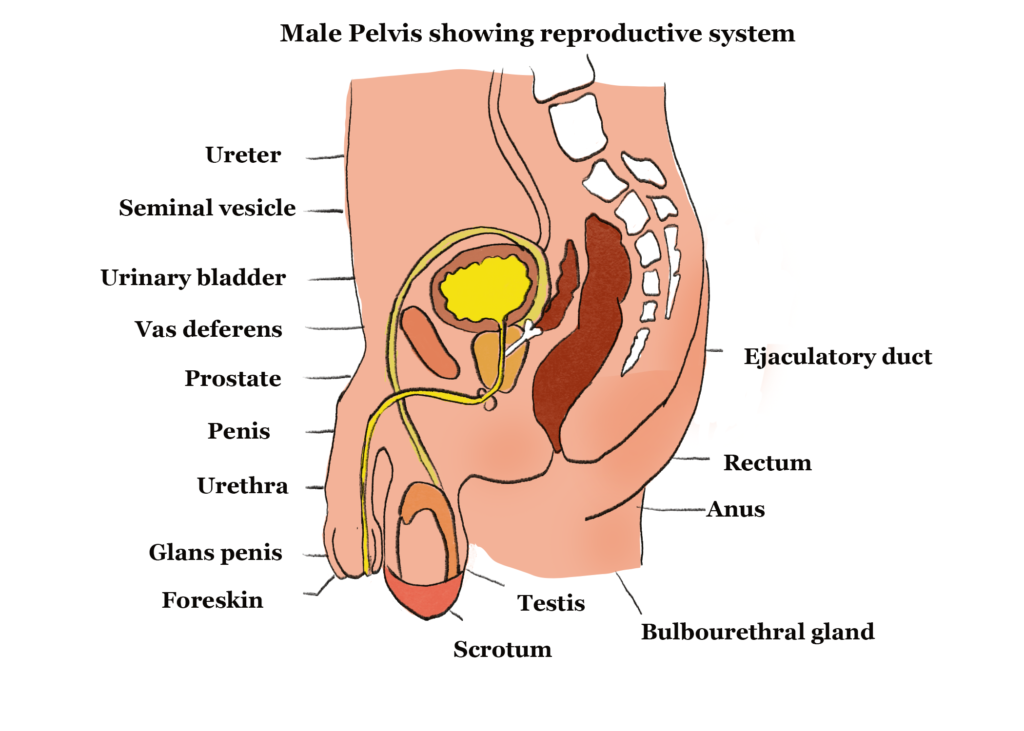
- IN MAN/MALE REPRODUCTIVE SYSTEM
The male reproductive system is composed of the following parts:

PENIS
The penis is the copulatory organ which is used to introduce sperms into the vagina.
TESTES
Testes are two oval-shaped structures lying behind and below the penis. They are covered in a sac called scrotum.
Testes produce:
- Sperm cells
- Male sex hormone (testosterone)
– That hormone is responsible for secondary sexual characteristics.
– Testes are suspended outside for a good environment for the production of sperms which needs lower temperature.
Testes are attached to a coiled structure called epididymis which is a temporary storage organ for sperms.
SEMINAL VESICLES
Seminal vesicles store sperms until nourishment takes place. They are located just below the urinary bladder.
PROSTATE GLANDS
This gland together with seminal vesicles secretes a fluid which mixes with sperm as nourishment and protection to the sperm.
The sperm together with fluid are called semen.
VAS EFFERENTIA
These are ducts which collect sperms from inside the testes and transfer them to epididymis.
SPERM DUCT
This is a straight tube which carries sperms to the urethra.
PENIS
Is the copulatory organ which carries sperm from sperm duct to the vagina during copulation. Also takes part in the excretion process.
FEMALE REPRODUCTIVE SYSTEM
The female reproductive organs are located inside the body, within the pelvis region.

OVARIES
These are oval-shaped structures near each kidney.
Ovaries produce:
- Ova
- Oestrogen
- Progesterone
THE OVIDUCT (FALLOPIAN TUBE)
This is the tube with a funnel-shaped opening extending from the ovary to the uterus. The oviduct carries eggs from the ovaries to the uterus. It is where fertilization takes place.
THE UTERUS (WOMB)
This is the muscular thick-walled organ within which the zygote implants and develops. As an embryo develops, an organ called placenta is formed. It brings uterine tissues into close contact with the tissue of the developing embryo.
Placenta also passes nutrients and oxygen from the maternal blood to the embryo, and waste products of metabolism are passed from the embryo’s blood to the maternal blood.
Progesterone maintains pregnancy by preventing the production of ova and contractions of uterine walls.
VAGINA
This is the muscular passage from the vulva to the uterus. It is in this region that sperms are deposited during sexual intercourse. The vagina is both a birth canal and a copulatory organ.
CERVIX
This is the narrow opening to the uterus from the vagina. It is made of a muscular ring. It is the entrance from the vagina to the uterus.
VULVA
These are external genitals of the female reproductive system.
The urethra opens to outside through these structures.
OVULATION AND MENSTRUATION
Ovulation
This is the process of releasing an egg from the ovary. The egg reaches maturity approximately once every 28 days. This releasing of eggs alternates between two ovaries.
The developing ovum is surrounded by a group of cells called follicle. The mature egg is then released from the ovary. Ovulation is controlled by luteinizing hormones.
Before and after the process of ovulation, an ovary continues to secrete oestrogen and progesterone, which cause thickening of uterus, making it suitable to receive a fertilized ovum. This occurs when the egg passes from the oviduct to the uterus. If the ovum isn’t fertilized, the uterus lining cells gradually disintegrate, discharging blood and tissue debris from the uterus through the vagina.
MENSTRUATION
This is the discharge of mucus, epithelial cells, and blood through the vagina and the discharge is called menstrual flow.
A period between one menstruation and the next is called menstrual cycle. Menstrual cycle usually occurs on average every 28 days and menstruation lasts for 3 – 7 days.
After ovulation, the follicle enlarges and a yellow pigment accumulates in them to form a corpus luteum. When the follicle corpus luteum is developing, the walls of uterus prepare itself for receiving an ovum. The inner layer becomes thickened and surrounded with many blood vessels and glands.
If fertilization does not occur, the unfertilized egg never implants and the thickened lining of uterus disintegrates as well as the corpus luteum, then are discharged through the vagina as blood. After menstruation, the uterus begins to prepare itself for the next ovulation.
COPULATION
Copulation is the process of inserting the erect penis into the vagina. When a man is sexually stimulated, the penis is filled with blood and becomes erect. The erect penis is inserted into the vagina and moved back and forth, stimulating sense organs in the penis and ejaculation occurs.
Ejaculation is the release or discharge of semen. Once the sperm is deposited in the vagina, they start swimming towards the oviduct.
The climax of sexual excitement in humans is known as orgasm, it is accompanied by a feeling of extreme pleasure.
FERTILIZATION AND IMPLANTATION
Fertilization is the process whereby sperm nuclei and ovum nuclei fuse to form a diploid cell called zygote. If ejaculation occurs when an ovum is in the oviduct, fertilization is likely to occur.
Sperm takes less than an hour to reach the uterus. At least half the number of sperm dies due to acidic condition of the vagina, and uterus is not their final destination. They have to move to reach the oviduct in order for fertilization to occur; only a few sperms reach the oviduct and can survive for about 72 hours.
The time when fertilization is likely to occur is called the fertile period of a woman. Counting from the first day of menstruation, ovulation is likely to take place on the 14th day, but it can also be on the 13th or 15th day.
Thus the probable time for pregnancy to occur is when the copulation takes place between the 11th day and the 17th day.
Only one sperm enters an ovum and others are prevented from entering due to formation of a tough membrane around the ovum.

Soon after the zygote has been formed, it starts to divide so that a ball of cells is produced. Here the zygote is called embryo.
While the zygote is dividing, it travels along the oviduct towards the uterus. It takes 3 to 5 days for the zygote to reach the uterus. When the embryo reaches the uterus, it attaches itself to the uterine wall. This process is called implantation. Within 4 or 5 days, the embryo becomes firmly attached to the uterus.
When implantation is complete, the embryo forms two membranes:
- Chorion (outer)
- Amnion (inner)
The amnion is filled with a liquid called amniotic fluid where the embryo is suspended.
- Acts as a shock absorber.
- Protects the embryo from mechanical damage.
The chorion is a thin membrane but it has a thick portion that forms finger-like projections called villi. Villi together with the thick portion of chorion form the placenta.
The developing embryo is connected to the placenta by a cord called umbilical cord. It carries two arteries and a vein of the embryo’s circulatory system.
Function of Placenta
- Nutrients and oxygen from maternal circulatory system diffuse to the embryo through placental membrane.
- Waste products of metabolism from embryo diffuse in the opposite direction.
At about three weeks, the embryo will have formed the body characteristic of a human. From then onwards, the embryo is referred to as foetus.

The foetus remains in the uterus for 9 months (280 days). After that time, it is expelled by birth. From the time the ovum is implanted in the uterus up to the time of birth, the female is said to be pregnant. This period is called gestation or the incubation period.
BIRTH
This is the process by which the baby is expelled from the uterus. It starts by a sudden fall in levels of oestrogen and progesterone which results in periodic contractions of the muscular wall of the uterus, causing labour pains.
As the contractions get stronger, they force the foetus into the lower part of the uterus at the same time causing the cervix to dilate.
As this continues, the amniotic sac ruptures and the amniotic fluid escapes through the vagina.
When contractions become more frequent and more powerful, the foetus is forced through the cervix and vagina usually head first, and is delivered.
The umbilical cord is still attached to the baby but is always cut and tied. The final stage of birth involves the removal of placenta through the vagina and is accompanied by some loss of blood because the maternal blood vessels which were supplying the placenta are ruptured.
Immediately after birth, the baby must start breathing to survive. The concentration of carbon dioxide in the baby’s blood increases when the umbilical cord is cut; lower temperature of the environment stimulates the breathing centre in the medulla oblongata.
FACTORS WHICH MAY HINDER PREGNANCY
Any factor that prevents sperms from reaching ova prevents fertilization. This can happen naturally or artificially.
Factors which can hinder pregnancy in females are:
- Ova are not released in the normal monthly cycle.
- The fallopian tubes may be blocked or twisted.
- The uterus may not allow an embryo to implant due to an imbalance of hormones.
- The woman may make antibodies that destroy the sperm.
- Immature ova.
Factors that affect sperm production in males are:
- Very few sperms are produced in one ejaculation.
- A high proportion of sperms produced are abnormal.
- Sperm duct/vas deferens may be blocked.
- Immature sperms.
CAESAREAN DELIVERY
This is the removal of the baby by surgical means through the abdominal and uterine walls.
- This becomes necessary when the baby is so big that it cannot pass through the mother’s cervix.
- It can also be caused by the mother’s pelvis being too small to accommodate the normal sized baby.
WAYS TO OVERCOME HINDRANCE OF PREGNANCY
1. IN-VITRO FERTILIZATION
Women whose oviducts are blocked can overcome this by a method called in-vitro fertilization.
- Several ova are taken from a woman’s ovaries and put into a dish containing sperm from her partner and kept warm for a few hours; the ova are fertilized in the dish.
- One or more embryos are inserted in the woman’s uterus where one will implant and develop into a baby.
2. FERTILITY DRUGS
Some women are sterile because their ovaries fail to develop ova. This can be because the hormone responsible for ova production is not present.
Ovaries are stimulated to produce ova by injecting drugs called fertility drugs, which contain the hormone responsible for stimulating production of ova.
3. ARTIFICIAL INSEMINATION (AI)
This is the artificial introduction of semen into the female oviduct by syringe during ovulation for the purpose of fertilization.
Semen can be rapidly frozen by using liquid nitrogen and then stored in sperm banks without losing its fertile condition.
Advantages of AI
- Semen can be transported to far distances even where there are no males.
- Many females can use semen from one male.
- Semen can be stored and hence used in the future.
Importance of AI
- It makes it possible for couples in which a husband is unable to have a baby by semen donated by another man.
- The woman can choose the father of her child because she can select semen from different men.
TECHNOLOGICAL ADVANCES IN REPRODUCTION
- EMBRYO TRANSPLANTS
Nowadays it is possible to remove a developing embryo from an animal before it has implanted into the wall of the uterus. Such an embryo can be kept for a number of days. When it is placed in the uterus of a different animal, it can implant and develop in a normal way.
2. TEST TUBE BABIES
An ovum is sucked from a woman’s ovaries. The ovum is placed in a dish containing sperms from her partner and kept warm for a few hours. The ovum is fertilized.
The embryo is then inserted into the woman’s uterus where it will implant and develop into a baby.
This method is best for women whose oviducts are blocked thus preventing ova from being fertilized. Such women are therefore unable to have or bear children.
3. FERTILE DRUGS
These are drugs containing a hormone responsible for stimulating ovaries to produce ova. Some women are sterile because their ovaries fail to develop ova. This happens because the hormone responsible for ova production is not present. Such women are injected with a fertility drug to stimulate ova production.
4. ARTIFICIAL INSEMINATION
Semen is sucked from men and frozen by using liquid nitrogen and then stored in sperm banks for several years without losing its fertile condition.
Then it can be introduced into the uterus. If it is introduced at the time of ovulation, fertilization can take place.
MULTIPLE PREGNANCIES
If a woman has two babies at once, she has twins. This is called multiple pregnancies. Sometimes more than one ovum is released into the reproductive tract of a female. It is possible for more than one ovum to be fertilized and several viable embryos may enter the uterus. They are implanted and develop.
TWINS
- These are babies born at the same time one after another by the same mother.
Types of Twins
Normally there are two types of twins:
- Fraternal twins (Dizygotic)
- Identical twins (Monozygotic)
FRATERNAL TWINS
These are twins that occur as a result of simultaneous release of two ova which both become fertilized and develop.
They may be of the same or different sexes. The twins are genetically different but have a diagram of resemblance.

IDENTICAL TWINS
These are twins that occur as a result of one ovum being fertilized and developing into a zygote which then splits into two and develops into foetuses. Such twins are genetically identical and so much alike; they are the same in every respect.
DISORDERS OF THE REPRODUCTIVE SYSTEM IN FEMALES
- CANCER
Cancer can affect various parts including cervical and ovarian cancer in women. If diagnosed early, they can be treated with radiotherapy and chemotherapy.
- OVARIAN CYST
It is a benign tumor in the ovary. In younger women, a follicle may develop into a cyst.
Cysts can be caused by imbalance of hormones produced by pituitary glands.
They don’t show any symptoms unless they grow so large to cause visible swelling of the abdomen.
They can be removed surgically.
- FIBROIDS
Fibroids are tumors that grow on the uterus. They are made up of muscle fibres.
They are caused when an area of the muscle fails to shrink with the rest of the womb tissue at the onset of menstruation.
They can be removed by surgery and complete removal of uterus (hysterectomy).
DISORDERS OF THE REPRODUCTIVE SYSTEM IN MALES
- IMPOTENCE
Impotence is a failure to maintain an erect penis, restricting copulation. The causes are often psychological such as depression and anxiety, also by diabetes and alcoholism.
Its treatment depends on the cause.
- PREMATURE EJACULATION
This is when a man can’t delay ejaculation enough to satisfy the woman.
- PROSTATE PROBLEMS
The prostate glands may become enlarged due to infection.
Infections can be treated by antibiotics.
COMPLICATIONS OF THE REPRODUCTIVE SYSTEM
- BREECH BIRTH
This is the situation whereby a baby is born feet and bottom first. In this case, the baby fails to turn so as to be born head first. Breech births are difficult to deliver. This complication requires Caesarean section.
- MISCARRIAGE
Is a loss of a developing embryo before the 28th week of pregnancy.
The causes/reasons may be:
- Development of a deformed embryo.
- Failure of proper implantation of embryo on womb.
- Failure of placenta to develop a sufficient supply.
- STILL BIRTH
This is giving birth to a dead baby/foetus.
This may be caused by:
- Poisonous chemicals.
- Shock.
- Prolonged period of delivery.
- ECTOPIC PREGNANCY
This is the pregnancy that results when the zygote fails to move to the uterus after fertilization. The embryo is implanted in the fallopian tube.
It may be caused by infection in the fallopian tube. Such pregnancy rarely lasts for more than two months as the fallopian tube usually bursts.
- ABORTION
This is the removal of the foetus before it can survive independently (before 28 weeks).
Types of Abortion
- Spontaneous abortion
- Induced abortion
1. Spontaneous abortion
This is a type of abortion which occurs naturally without induction.
2. Induced abortion
This is the deliberate ending of pregnancy due to medical reasons. It may be recommended by the doctor if tests show a genetic abnormality in the foetus.
Criminal abortion
This is the killing or destroying of the unborn baby as a result of irresponsible behaviors. This is to get rid of unwanted pregnancies.
- PREMATURE BIRTH
This is giving birth after six months are over but before the end of nine months.
The foetus is never fully developed, so it is put in an incubator for growth to continue.
SEXUALITY AND SEXUAL BEHAVIOURS
Sexuality is about “maleness” and “femaleness”.
To be aware of one’s sexuality is to be aware of how one is attractive to the opposite sex.
SEXUAL PRACTICES
ACCEPTABLE SEXUAL (BEHAVIOUR) PRACTICE
1. HETEROSEXUALITY (VAGINAL SEX)
This is the sexual practice between members of opposite sex.
UNACCEPTABLE SEXUAL BEHAVIOUR / DEVIATIONS
2. HOMOSEXUALITY
This is the practice where people are sexually attracted towards members of the same sex. They are known as homosexuals.
- Male is known as gays.
- Female is known as lesbians.
3. BISEXUALITY
This is the practice where people are sexually attracted towards members of the same sex as well as members of the opposite sex.
4. ORAL SEX
This is the practice where the mouth (lips and tongue) is used to stimulate genitals of the partner.
5. ANAL SEX
This is the sexual practice whereby the erect penis is penetrated into the anus. It is also known as sodomy.
6. MASTURBATION
This is the sexual practice by the stimulation of one’s own genitals.
7. RAPE
This is the forceful sexual intercourse without the consent of the partner. It is a crime and is punishable by law.
8. PROSTITUTION
This is an irresponsible behavior practiced by people who allow other people to use their bodies for sexual intercourse for income.
Causes of irresponsible sexual behavior
- Poverty
- Lack of proper counseling and guidance service
- Peer pressure and influence
- Marriage breakdown
Consequences of irresponsible sexual behavior
- Family and marriage breakdown
- Transmission of sexually transmitted diseases
- Unwanted/unplanned pregnancy
- Psychological trauma
- Death
- Reproductive disorders such as sterility


14 Comments