

535/1 2¼ hours | UGANDA NATIONAL EXAMINATION BOARD Uganda Certificate of Education PHYSICS Paper 1 Time: 2¼ hours |
SECTION A: (40 MARKS)
Answer all the questions in this section.
(2007 Q.1) The three basic quantities of measurement are
A. mass, frequency and power.
B. time, density and pressure.
C. area, electric current and volume.
D. length, mass and time.
(2007 Q.2). A concave mirror may be used as
- a magnifying mirror.
- a torch reflector.
(iii) a driving mirror.
A. (i) only
B. (ii) and (ii) only.
C. (ii) and (iii) only.
D. (i), (ii) and (iii).
(2007 Q.3). The force that gives a body of mass 1 kg an acceleration of 1 ms-2 is called
A. weight
B. newton.
C. gravity.
D. friction.
(2007 Q.4). What is the potential difference across a load, if the energy needed to maintain a current of 0.8 A in the load for 10 s is 40 J?
A. 0.2 V.
B. 3.2 V.
C. 5.0 V.
D. 320 V.
(2007 Q.5). The particles that are emitted from a hot metal surface are called
A. electrons.
B. neutrons.
C. protons.
D. alpha.
(2007 Q.6). During the power stroke of a four stroke petrol engine
(i) the plug sparks.
(ii) the piston moves up.
(iii) both valves remain closed.
(iv) the piston moves downwards.
A. (i) and (ii) only
B. (i) and (ii) only.
C. (i), (ii) and (iii) only.
D. (i), (iii) and (iv) only.
(2007 Q.7). The rate at which distance covered by a body in a particular direction changes with time is called
A. speed.
B. velocity.
C. acceleration.
D. displacement.
(2007 Q.8). A mass of 800 g of molten metal at 1200 °C gives out 4 x 10⁵ J of heat on solidification. Find the specific latent heat of fusion of the metal.
A. 3.3 x 10² Jkg-1
B. 2.7 x 10⁵ Jkg-1
C. 5.0 x 10⁵ Jkg-1
D. 6.0 x 10⁵ Jkg-1
(2007 Q.9). The velocity-time graph in Figure 1 above shows the motion of an object moving with
A. a decreasing acceleration.
B. a constant acceleration.
C. an increasing acceleration.
D. a constant velocity.
(2007 Q.10). The size of the image formed in a lens camera can be increased by
(i) increasing the object distance.
(ii) using a lens of shorter focal length.
(iii) decreasing the object distance.
A. (i) only
B. (ii) only.
C. (i) and (ii) only.
D. (ii) and (iii) only.
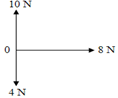
(2007 Q.11). Forces of 10N, 8N and 4N act on object O as shown in fig. 2. Find the magnitude of the resultant on O.
A. 10.0 N
B. 16.1 N
C. 22.0 N
D. 100. N
(2007 Q.12). The resistance of a wire increases when it
A. length is increased.
B. length is decreased.
C. temperature is reduced.
D. cross-sectional area is doubled.
(2007 Q.13). Which one of the following electromagnetic waves lies between ultraviolet radiation and infrared?
A. Gamma rays.
B. Visible radiation.
C. X-ray.
D. Microwave radiation.
(2007 Q.14). The initial and final meter reading after one month of electricity supplied is 21000 kWh and 21800 kWh respectively. Calculate the cost of the power consumed, if each unit costs Shs. 175.
A. 800/175
B. 42800/175
C. 800 x 175
D. 42800 x 175
(2007 Q.15).

When two equal forces F act at the end of a body at rest as shown in figure 3, the body will be in
A. shear.
B. motion.
C. tension.
D. compression.
(2007 Q.16). Diffuse reflection occurs when
A. a parallel beam of light is reflected in all directions.
B. a parallel beam of light falls on a highly polished surface.
C. a parallel beam of light is reflected as a parallel beam.
D. the angles of incidence of rays of the beam are equal to the angles of reflection.
(2007 Q.17). Forces of 40N, 20N and 50N are applied on a meter rule supported on a knife edge as shown in figure 4.
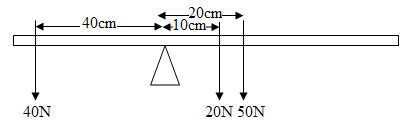
The meter rule will
A. balance.
B. oscillate.
C. turn in a clockwise direction.
D. turn in anti-clockwise direction.
(2007 Q.18). Which of the following is a non-metallic electrical conductor?
A. Brass.
B. Copper.
C. Graphite.
D. Platinum.
(2007 Q.19).
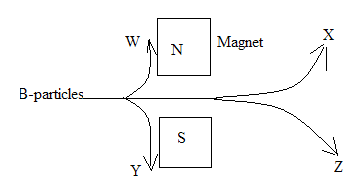
When a beam of β-particles is directed between poles of a magnet as shown in fig. 5, it will be deflected in the direction
A. W.
B. X.
C. Y.
D. Z.
(2007 Q.20). and are isotopes of an element. Find the number of neutrons in the nucleus of
A. 144.
B. 140.
C. 92.
D. 4.
(2007 Q.21). A man lifts a mass of 300 kg through a vertical height of 10 m in 12 s. What power does he expend?
A. 250 W.
B. 360 W.
C. 2500 W.
D. 36000 W.
(2007 Q.22).
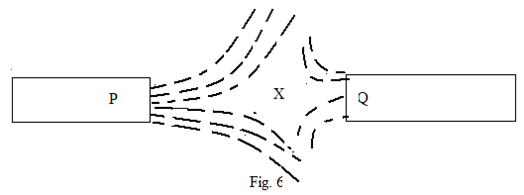
Figure 6 shows a pattern of iron fillings between two magnetic poles P and Q. Which one of the following is true?
(i) P and Q are like poles.
(ii) Pole P is stronger than pole Q.
(iii) X is a neutral point.
A. (i) only.
B. (i) and (ii) only.
C. (ii) and (iii) only.
D. (i), (ii) and (iii).
(2007 Q.23). The sound wave produced by a vibrating tuning fork is longitudinal because the air vibrates in
A. the same direction as that in which the prongs vibrate.
B. a direction opposite to that in which the wave is travelling.
C. the same direction as that in which the wave is travelling.
D. the opposite direction to that in which the prongs vibrate.
(2007 Q.24). A change in momentum occurs when a
(i) body always changes its position.
(ii) body experiences a net force of zero.
(iii) body accelerates.
A. (ii) and (iii) only.
B. (i) and (ii) only.
C. (iii) only.
D. (ii) only.
(2007 Q.25). Blotting paper is used to dry ink spilt on a surface by a process called
A. osmosis
B. diffusion.
C. surface tension.
D. capillarity.
(2007 Q.26). Which of the following appliances consumes 5 kWh of electric energy?
A. A 100 W lamp left on for 50 hours.
B. A 250 W drill used for 2 minutes.
C. A 500 W motor used for 10 minutes.
D. A 250 W television left on for 20 minutes.
(2007 Q.27). In the crushing can experiment, the can collapses because
(i) the can contracts on cooling
(ii) pressure outside is greater than pressure inside
(iii) the steam condenses to produce water and water vapour at high pressure
A. (ii) only
B. (iii) only
C. (ii) and (iii) only
D. (i), (ii) and (iii)
(2007 Q.28). The specific heat capacity of a substance is the quantity of heat
A. needed to change 1 kg mass from solid to liquid.
B. needed to change 1 kg mass from liquid to gas.
C. needed to change the temperature of 1 kg mass by 1 K.
D. given out when 1 kg mass changes from solid to liquid.
(2007 Q.29). Local action in simple cells is caused by action of
A. zinc amalgam coating on zinc plate.
B. manganese(IV) oxide round the copper plate.
C. hydrogen bubbles on the copper plate.
D. impurities in zinc.
(2007 Q.30). A hydraulic brake works on the principle of
A. transmission of pressure in a liquid.
B. distribution of force in a liquid.
C. existence of viscosity in a liquid.
D. high density of a liquid.
(2007 Q.31). A voltage of 440 V is applied to the primary of a transformer of 2000 turns. If the voltage across the secondary is 11 kV, what is the number of turns in the secondary coil?
A. 50
B. 80
C. 5.00 x 10⁴
D. 8.00 x 10⁴
(2007 Q.32). When a negatively charged body is brought near the cap of a positively charged electroscope, the gold leaf
A. remains unchanged.
B. decreases in divergence.
C. increases in divergence.
D. gains a positive charge.
(2007 Q.33). When a force F acts on a body, its kinetic energy increases by 800 J over a distance of 2 m. What is the value of the force?
A. 1600 N
B. 80 N
C. 400 N
D. 2.5 x 10⁻³ N
(2007 Q.34).
Figure 7 shows a decay curve for a radioactive element. What is the half-life of this element?
A. 15 minutes
B. 30 minutes
C. 45 minutes
D. 60 minutes
(2007 Q.35). Which of the following occurs when a wave passes through a small opening?
A. Refraction.
B. Reflection.
C. Diffraction.
D. Interference.
(2007 Q.36). Light coloured clothes are more comfortable to wear on a hot day than dark ones because
(i) light-coloured clothes are good reflectors of radiation.
(ii) light-coloured clothes are better absorbers of radiation.
(iii) dark-coloured clothes are better absorbers of radiation.
A. (i) only
B. (ii) only
C. (i) and (iii) only
D. (i), (ii) and (iii)
(2007 Q.37). A force of 70 N acts on a body and produces an acceleration of 1.4 ms-2. What is the mass of the body?
A. 98.0 kg
B. 50.0 kg
C. 7.0 kg
D. 0.02 kg
(2007 Q.38). What is the function of the grid in a cathode ray oscilloscope?
A. It regulates the number of electrons in the beam.
B. It produces electrons by thermionic emission.
C. It causes the beam of electrons to be deflected vertically.
D. It converts the kinetic energy of the electrons into light.
(2007 Q.39). Water waves of frequency 6 Hz travel 24 m in 10 s. The wavelength of the waves is
A. 0.4 m
B. 2.5 m
C. 14.4 m
D. 40.0 m
(2007 Q.40).
Figure 8 shows a structure supporting a load, M. Which of the girders can be replaced by springs?
A. TS, QS, PQ
B. PQ, QR, PS
C. QR, SR, QS
D. PS, TS, TR
SECTION B (40 MARKS)
41. (a)
A metal can with holes A, B, C is filled with water as shown in figure 9.
(i) Show on the diagram the initial paths taken by water out of the holes (1½ marks)
(ii) Explain what happens after some time (2½ marks)
42. (a) What is a magnetic field? (01 mark)
(b)
Figure 10 shows current flowing in a solenoid
(i) Sketch the magnetic field around the solenoid, clearly indicating the polarities
(03 marks)
43. (a) Sketch a graph of volume against absolute temperature for a gas which obeys Charles’ law. (01 mark)
(b) The volume of a gas is 58 cm3 at a temperature of 290 K and a pressure 8.0 x 10⁴ Pa. Find the volume of the gas at STP [standard pressure = 1.01 x 10⁵ Pa] (03 marks)
44. (a) What is a progressive wave? (01 mark)
(b) What is meant by antinodes as applied to a stationary wave? (01 mark)
(c) The distance between two successive antinodes on a stationary wave is 4 cm. Find the wavelength (02 marks)
45. (a) State Newton’s second law of motion (01 mark)
Figure 11 shows the variation of force acting on a body with time.
Identify the points between which the body is
(i) accelerating (01 mark)
(ii) decelerating (01 mark)
(iii) moving with constant velocity (01 mark)
46. (a)
A piece of paper and thin sheet of aluminium are placed near a radioactive source as shown in figure 12. If three different types of radiations are emitted, identify the radiations in
(i) region I (01 mark)
(ii) region II (01 mark)
(iii) region III (01 mark)
(b) What would be the effect of an electric field on radiations in region III (01 mark)
47. (a) What is a crystal? (01 mark)
(b) A potassium permanganate crystal is carefully placed at the bottom of a beaker containing clear water as shown in figure 13. Explain what is observed (03 marks)
48. (a) Define the coulomb as a unit of charge (01 mark)
(b) A charge of 180 C flows through a lamp for 2 minutes. Find the electric current flowing through the lamp (02 marks)
(c) What is the voltmeter in an electric circuit? (01 mark)
49. (a)
Figure 14 shows straight water waves approaching a concave surface. Complete the diagram to show how it will be reflected. (02 marks)
(b) State what would happen to the waves if the concave surface was removed and depth of water reduced (02 marks)
50. (a) State the law of conservation of energy (01 mark)
(b) An arrow of mass 25 g is released from the bow with kinetic energy of 31.25 J. The energy transferred from the bow to the arrow is 60% of the energy stored in the stretched bow. Find
(i) the initial velocity of the arrow (02 marks)
(ii) the energy stored in the stretched bow (01 mark)
**********


