


SECTION 1 (65 MKS)
1. a) A test tube of uniform cross-section loaded so that it can float upright in water. With the aid of a labeled diagram, describe how the test tube may be calibrated to measure the density of liquid .
.
b) In an experiment to determine the density of a liquid, a uniform metal cylinder of cross-section area 6.2 cm2 was hung from a spring balance and lowered gradually into the liquid. The upthrust was determined for various submerged lengths. The results obtained are shown on the graph in Fig 1.

Using the graph, determine:
- (i) The value of the upthrust when the cylinder is fully submerged
- (ii) The density of the liquid
In an experiment to determine the power of an electric heater, melting ice was placed in a container with an outlet and the heater placed in the ice as shown in Fig. 2. The melted ice was collected.

i) Other than the current and voltage, state the measurement that would be taken to determine the quantity of heat absorbed by the melted ice in unit time.
ii) If the latent heat of fusion of ice is L, show how the measurement in (i) above would be used in determining the power P of the heater.
iii) It is found that the power determined in this experiment is lower than the manufacturer’s value indicated on the heater.
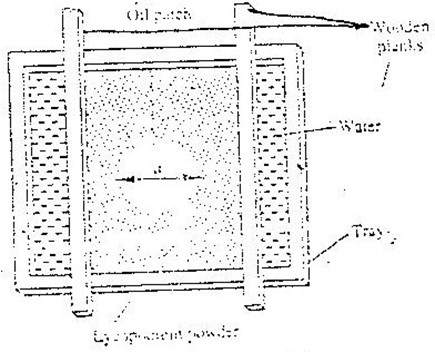 b) Fig 3 shows part of an experimental setup for estimating the diameter of an oil molecule.
i) Describe how the oil patch is formed.
ii) In an experiment, the diameter a of the patch was measured to be 200 mm for an oil drop of radius 0.25 mm. Determine the diameter of the molecule of the oil.
Chamber used to detect radiation from radioactive sources.

a) i) State one function of each of the following:
- Alcohol
- Solid CO2
ii) When radiation from the source enters the chamber, some white traces are observed. Explain how these traces are formed and state how the radiation is identified.
iii) A leaf electroscope can also be used as a detector of radiation. State two advantages of the diffusion cloud chamber over the leaf electroscope as a detector.
 b) i) Two samples of the same radioactive material have initial masses M and 2M respectively. On the axes provided, sketch the graph of activity versus time for each sample. Label the graph for each sample.
ii) A radioactive sample of half-life 130 days initially has 1.0 x 10²⁰ radioactive atoms. Determine the number of radioactive atoms that have decayed after 390 days.

Determine for the wave the:
- i) Amplitude
- ii) Period
- iii) Frequency
- iv) Wavelength
b) i) In the space provided below, sketch a labeled diagram to show how a pinhole camera forms an image of a vertical object placed in front of the pinhole.
ii) A building standing 200 m from a pinhole camera produces on the screen of the camera an image 2.5 cm high 5.0 cm behind the pinhole. Determine the actual height of the building.
5. a) Fig 6 shows a simple generator. The coils are rotated in the anticlockwise direction as shown.

i) Indicate using an arrow on the figure, the direction of the induced current as the coil passes the position shown.
ii) State two ways of increasing the magnitude of the induced current in this type of generator.
iii) On the axes provided, sketch the graph of the induced e.m.f with time.
iv) The section marked XY is cut off and a diode inserted. On the axes provided, sketch the graph of p.d across the resistor R against time.

 b) Fig 7 shows pendulum A and pendulum B freely suspended between the poles of identical magnets. Pendulum A is made of thick copper plate while B is made of a copper plate with slots.
When the two are set to swing, it is observed that A slows down faster than B. Explain this observation.
c) An alternating current source has a root-mean-square potential difference of 12 V. Determine the peak value of this potential difference.
SECTION II (15 MKS)
Answer ONE question from this section on the spaces provided at the end of question seven.
6. a) You are provided with two identical tuning forks and some plasticine. Describe how you would demonstrate beats in sound.
 b) Fig 8 shows a setup that was used in an experiment to determine the speed of sound in air.
Turning forks of different frequencies were sounded near the mouth of the open tube and by lowering the reservoir, the last two resonant lengths L1 and L2 were ensured for each frequency.
Table 1 shows the results obtained.
| Frequency, f (Hz) | 256 | 288 | 341 | 427 | 480 | 512 |
|---|---|---|---|---|---|---|
| L1 (cm) | 30.8 | 27.2 | 22.8 | 17.9 | 15.8 | 14.7 |
| L2 (cm) | 95.5 | 84.5 | 71.2 | 56.6 | 50.2 | 46.9 |
| 1/f (Hz-1) | ||||||
| L2 – L1 (m) |
(i) Complete the table. On the grid provided, plot the graph of L2 – L1 (y-axis) against 1/f.
(ii) From the graph determine the speed V of sound in air given that L2 – L1 = v/2f. Therefore V = 2f(L2 – L1).
(iii) Explain how resonance is attained in this setup.
7. a) i) What is photoelectric effect?
ii) You are provided with the following: a photocell, a source of UV light, a rheostat, a source of e.m.f, a milliammeter, a voltmeter, and connecting wires. Draw a circuit diagram to show how photoelectric effect may be demonstrated in the laboratory.
b) In a photoelectric effect experiment, a certain surface was illuminated with radiation of different frequencies and the stopping potential determined for each frequency.
Table 2 shows the results obtained.
| Frequency, f (x1014 Hz) | 7.95 | 7.41 | 6.88 | 6.10 | 5.49 |
|---|---|---|---|---|---|
| Stopping Potential, Vs (V) | 1.35 | 1.15 | 0.93 | 0.62 | 0.36 |
(i) Plot the graph of stopping potential (y-axis) against frequency.
(ii) Determine Planck’s constant, h, and the work function, φ, of the surface given that
eVs = hf – hf0
where e = 1.6 x 10⁻¹⁹ coulombs and hf = φ.
f0 is the lowest frequency that can cause photoelectric effect.
c) A surface whose work function φ = 6.4 x 10⁻¹⁹ joules is illuminated with light of frequency 3.0 x 10¹⁵ Hz.
Find the maximum kinetic energy of the emitted photoelectrons (Use the value of h obtained in b(ii)).
PHYSICS PAPER 232/1 K.C.S.E 2005 QUESTIONS
1. Figure 1 shows the reading on a burette after 55 drops of a liquid have been used.

Figure 1
If the initial reading was at zero mark, determine the volume of one drop. (2 mks)
 2. Fig 2 shows a solid cylinder standing on a horizontal surface. The cylinder is in stable equilibrium.
Fig 2
On the horizontal space provided, sketch the cylinder in neutral equilibrium. (1 mk)
 3. The light uniform bar in Fig 3 is in equilibrium. The two beakers A and B contain water at the same temperature. The two blocks are made of the same material.
If the temperature of the water in beaker A is now raised, explain why the beam tips to side A. Assume the solid does not expand.
State the reason why the maximum distance of the jet, d2, is greater than d1. (1 mk)
5. In a vacuum flask the walls enclosing the vacuum are silvered on the inside. State the reason for this. (1 mk)
 6. Fig 5 shows an arrangement of a source of light, an opaque object, and a screen.
Using A, B, and C as point sources, sketch on the same figure a labeled ray diagram to show what is observed on the screen. (2 mks)
7. Two identical tubes A and B held horizontally contain air and water respectively. A small quantity of coloured gas is introduced at one end of A while a small quantity of coloured water is introduced at one end of B. State with reason the tube in which the colour will reach the other end faster.
8. Sketch the electrostatic field pattern due to the arrangement of the charges shown in Fig 6.

Fig 6
Fig 7 shows the features of a dry cell (Leclanché). Use the information in the figure to answer questions 9 and 10.

Fig 7
State the polarities of the parts labeled A and B. (1 mk)
A……………..
B……………..
10. Name the chemical substance in the parts labeled C and D. (2 mks)
C……………..
D……………..
 11. Fig 8 shows water drops on two surfaces. In 8 (a) the glass surface is smeared with wax while in 8 (b) the glass surface is clean.
a) b)
Fig
Explain the difference in the shapes of the drops. (2 mks)
 12. Fig 9 shows a current-carrying coil in a magnetic field. The direction of the current and the resulting force are shown. Study the figure and answer questions 12 and 13.
Fig 9
Label the poles of the magnets. (1 mk)
13. Explain the purpose of the split ring commutator in the principle of the D.C motor shown in the diagram. (2 mks)
14. A bullet is fired horizontally from a platform 15 m high. If the initial speed is 300 m/s, determine the maximum horizontal distance covered by the bullet. (3 mks)
15. A certain machine uses an effort of 400 N to raise a load of 600 N. If the efficiency of the machine is 75%, determine its velocity ratio. (3 mks)
 16. Fig 10 represents a transverse wave of frequency 5 Hz traveling in the x direction.
Fig 10
Determine the speed of the wave. (3 mks)
17. An electronic siren producing sound continuously at a certain frequency is dropped from the top to a deep hole. State and explain what is observed about the pitch of the sound reaching the observer at the top. (3 mks)
18. A student wishes to investigate the relationship between current and voltage for a certain device X. In the space provided, draw a circuit diagram including two cells, rheostat, ammeter, voltmeter, and the device X that would be suitable in obtaining the desired results. (1 mk)
19. A hair drier is rated 2500 W, 240 V. Determine its resistance. (3 mks)
 Fig 11 shows the variation of temperature, θ, with time t, when an immersion heater is used to heat a certain liquid. Study the figure and answer questions 20 and 21.
Fig 11
20. State the reason for the shape of the graph in the section labeled BC. (1 mk)
21. Sketch on the same axes the graph for another liquid of the same mass but higher specific heat capacity when heated from the same temperature. (1 mk)
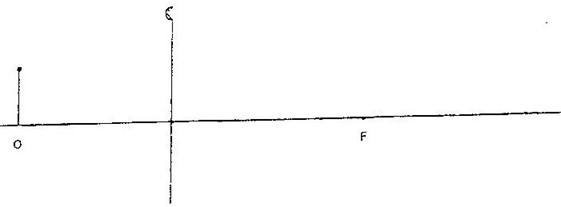 22. Fig. 12 shows a vertical object, O, placed in front of a convex mirror.
Fig 12
On the same diagram draw the appropriate rays and locate the image formed. (3 mks)
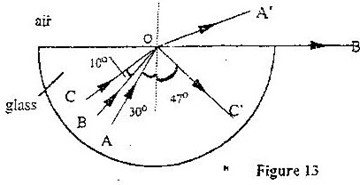 23. Fig 13 shows rays of light AO, BO, and CO incident on a glass-air interface. OA’, OB’, and OC’ are the corresponding emergent rays. Study and answer questions 23 and 24.
Determine the critical angle of the glass material.
24. Determine the refractive index of the glass material. (3 mks)
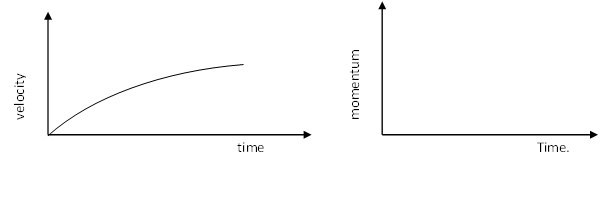 25. Fig 14 shows the velocity-time graph for a small metal sphere falling through a viscous fluid.
Fig 14
On the axes provided, sketch the graph of momentum against time for the same mass. (1 mk)
26. State Bernoulli’s principle. (1 mk)
27. The melting point of oxygen is given as -281.30C. Convert this temperature to Kelvin (K). (1 mk)
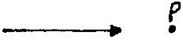 28. Fig 15 shows an arrow which indicates the direction of travel of a wave in a medium. P is a particle of the medium that is in the path of the wave.
Fig 15
In the space provided sketch a diagram to show how the particle P moves when the wave is:
- (i) A transverse wave
- (ii) A longitudinal wave
(1 mk)
29. A car of mass 800 kg moves on a circular track of radius 20 m. The force of friction between the tyres and the tarmac is 4800 N. Determine the maximum speed at which the car can be driven on the track without skidding.
30. An illuminated vertical object is initially placed on the principal axis of a converging lens and 32 cm from it. The focal length of the lens is 15 cm. The object is now placed at a point 12 cm from the lens and on the same side. State two changes other than magnification that are observed on the image formed due to this change.
31. Explain how an “excited” hydrogen atom is able to emit radiations of different wavelengths.
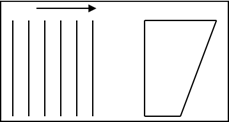 32. Fig 16 shows wave fronts in a ripple tank approaching a shallow region in the tank.
Figure 16
Complete the diagram to show the wave fronts as they pass over the shallow region and after leaving the region. (1 mk)
33. The target of an X-ray tube is made of melting point. Give a reason for this. (1 mk)
34. Explain why a drop of methylated spirit on the back of the hand feels colder than a drop of water at the same temperature.
35. Draw appropriate symbols for the circuit diagram of a junction diode in reverse bias. (1 mk)
 Identify m, n, and X.
m
n
X
37. In the setup Fig 17 the metal rod is made up of steel and iron pieces joined end to end. You are provided with two iron nails.
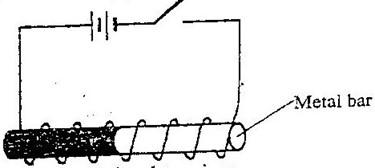
Explain how you would use the two nails provided to determine which side is iron. (2 mks)
38. Fig 18 shows two spherical materials, one an insulator conductor, the other a conductor. Negative charges are introduced at point A in each case.
On the same figure indicate the final position of the charges. Explain your answer. (2 mks)


