


Answer all the questions in this paper. Mathematical tables to be used.
Take: Density of mercury = 1.36 x 10⁴ kg/m3
Speed of sound = 340 m/s
Speed of light = 3.0 x 10⁸ m/s
g = 10 m/s2
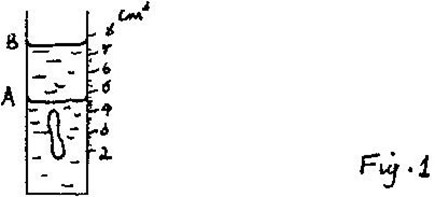 1. Figure 1 shows a measuring cylinder, which contains water initially at level A. A solid of mass 11 g is immersed in the water, the level rises to
Determine the density of the solid. (Give your answer to 1 decimal place)
- Figure 2 shows a rigid body acted upon by a set of forces. The magnitudes of the forces are as follows:
F1 = 3 N, F2 = 6 N, F3 = 3 N, F4 = 4 N, F5 = 3 N and F6 = 3 N
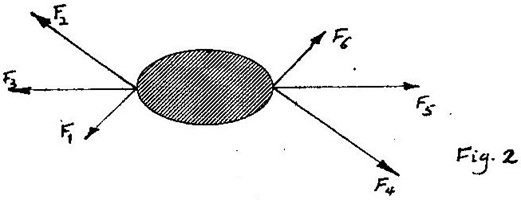
Identify the couple among these forces.
- Give a reason why the weight of the body varies from place to place.
- A butcher has a beam balance and masses 0.5 kg and 2 kg. How would he measure 1.5 kg of meat on the balance at once?
- The height of the mercury column in a barometer at a place is 64 cm. What would be the height of a column of paraffin in a barometer at the same place? (Density of paraffin = 8.0 x 10² kg/m3)
- The number of molecules in 18 cm3 of a liquid is 6 x 10²³. Assuming that the diameter of the molecules is equivalent to the side of a cube having the same volume as the molecule, determine the diameter of the molecule.
- Explain why a glass container with thick walls is more likely to crack than one with thin walls when a very hot liquid is poured into them.
- State the reason why water spilled on a glass surface wets the surface.
- Figure 3 shows two aluminium containers, A and B, placed on a wooden table. A and B have equal volumes of hot water initially at the same temperature.

- Figure 4 shows two point objects A and B placed in front of a mirror M.
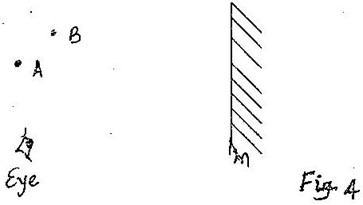
Sketch a ray diagram to show the positions of their images as seen by the eye.
 Figure 5 shows two charged identical conducting spheres on insulating stands. Each cross represents a charge. The spheres are briefly brought into contact and then separated.
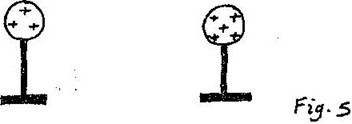 Figure 5 shows two charged identical conducting spheres on insulating stands. Each cross represents a charge. The spheres are briefly brought into contact and then separated.
Sketch in the space provided the diagrams of the spheres showing charge distribution after separation.
- Name a device used to convert light energy directly into electrical energy.
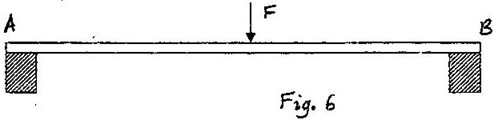
- Figure 6 shows a beam AB supported at points A and B. A large force F is applied on the beam as shown. Mark on the diagram the position X where a notch is likely to appear.
- Distinguish between soft and hard magnetic materials.
- A current of 0.5 A flows in a circuit. Determine the quantity of charge that crosses a point in 4 minutes.
- Figure 7 shows an incomplete circuit of an electromagnet. Complete the circuit between X and Y by drawing the windings on the two arms of the core such that A and B are both North poles when switch S is closed. Indicate the direction of the current on the windings drawn.
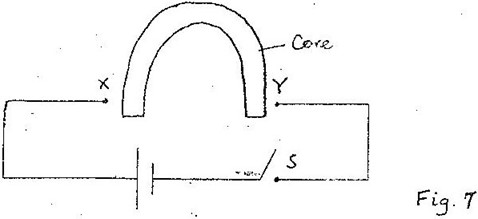 Figure 7 shows an incomplete circuit of an electromagnet. Complete the circuit
 - An observer watching a fireworks display sees the light from an explosion and hears the sound 2 seconds later. How far was the explosion from the observer?
- Water flows in a horizontal smooth pipe. State the changes that would be observed in the nature of the flow if the speed of the water is steadily increased from low to high value.
- A transformer in a welding machine supplies 6 volts from a 240 V main supply. If the current used in the welding is 30 A, determine the current in at the mains.
- An object dropped from a height h attains a velocity of 6 m/s just before hitting the ground. Find the value of h.
- Calculate the wavelength of the KBC FM radio wave transmitted at a frequency of 95.6 Mega Hertz.
Using the information in figure 8 answer questions 22 and 23.
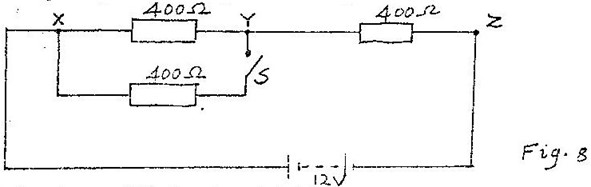
- What is the p.d across YZ when the switch S is open?
- Determine the p.d across YZ when the switch S is closed.
- How many 1000 W electric irons could be safely connected to a 240 V main circuit fitted with a 13 A fuse?
- Ice changes to water at 0°C. Equal masses of the ice and water at 0°C are each heated to 1°C. Give a reason why more heat energy is required to heat ice.
- Figure 9 shows two parallel rays incident on a concave mirror. F is the focal point of the mirror.
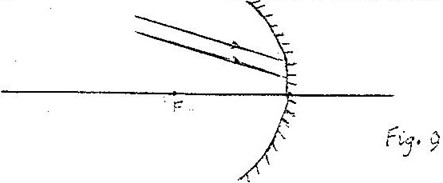 Figure 9 shows two parallel rays incident on a concave mirror. F is the focal point of the mirror.
Sketch on the same diagram the path of the rays after striking the mirror.
- Figure 10 shows the apparent position of a fly in air as seen by a fish in water.
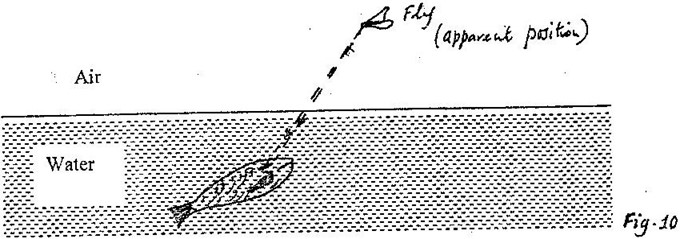 Figure 10 shows the apparent position of a fly in air as seen by a fish in water.
Sketch on the same diagram rays to show the actual position of the fly.
- A trolley is moving at constant speed on a friction-compensated track. Some plasticine is dropped on the trolley and sticks on it. State with a reason what is observed about the motion of the trolley.
- Figure 11 shows part of a circuit containing three capacitors.
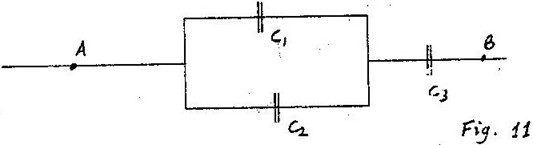
Write an expression for CT, the effective capacitance between A and B.
- What is the value of -20°C on the absolute temperature scale?
- Figure 12 shows an experimental arrangement. S1, S2, and S are narrow slits.
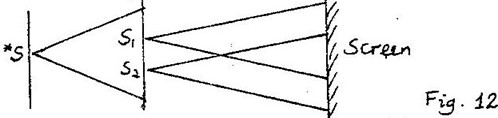 Figure 12 shows an experimental arrangement. S1, S2, and S are narrow slits.
State what is observed on the screen when the source is:
(a) Monochromatic (b) White light
- Two tuning forks are sounded together. What is the condition for the beats to be heard?
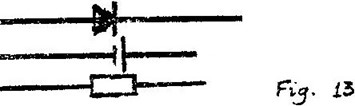
- Using the component symbols shown in figure 14, sketch a series circuit diagram for a forward biased diode.
- State how eddy currents are reduced in a transformer.
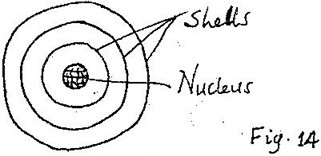
- A lithium atom has 3 protons in its nucleus. Complete the diagram in figure 14 by marking X in the appropriate shells to show the electron distribution when the atom is not excited.
- In a sample there are 5.12 x 10²⁰ atoms of krypton-92 initially. If the half-life of krypton-92 is 3.0 s, determine the number of atoms that will have decayed after 6 s.


