

LEARNING OBJECTIVES
By the end of this chapter you should be able to:
1. State: Archimedes’s Principle.
2. Describe an experiment to verify the principle.
3. State: Applications of Archimedes’s Principle.
4. Solve problems involving Archimedes’s Principle.
5. State: The law of Flotation.
6. Describe an experiment to verify the law of Flotation.
7. State: Applications of the law of Flotation.
8. Solve problems involving the law of Flotation.
9. Define: Terminal Velocity.
10. (a) Describe what happens to a body released to fall in a liquid in a tall measuring cylinder until it hits the bottom.
(b) Sketch a velocity-time graph for a body falling in a fluid.
10.1 Archimedes’ Principle
Archimedes’ Principle states that:
When a body is wholly or partially immersed in a fluid, it experiences an upthrust equal to the weight of fluid displaced.
Terms Used
Upthrust: a force in a fluid that acts upwards.
Apparent weight: weight of an object in liquid.
Experiment 10.1 To verify Archimedes’s Principle
Apparatus/Requirements:
Displacement can, water, light and thin string, spring balance, a suitable solid.
Procedure:
- Fill a displacement can with water until water flows through the spout and wait until the water stops dripping.
- Suspend a solid object using a light string from a spring balance and weigh it in air.
- Place a beaker of known weight under the spout of the displacement can.
- Immerse the solid object into the water in the displacement can and wait until water stops dripping into the beaker.
- Read and record the apparent weight.
- Reweigh the beaker and the displaced water.
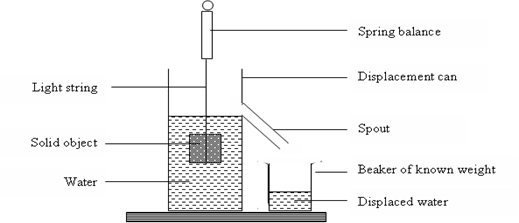
Figure 10.1
Results:
Let:
- Weight of solid object in air = Wa N
- Weight of solid object in water (Apparent weight) = Ww N
- Weight of empty beaker = Wb N
- Weight of empty beaker + displaced water = W(b + w) N
Calculation:
Upthrust (Loss in weight of object) = Wa – Ww N
Weight of water displaced = W(b + w) – Wb N
Conclusion:
If Wa – Ww = W(b + w) – Wb, i.e., Upthrust = Weight of fluid displaced, then Archimedes’s principle is verified.
10.2 Application of Archimedes’s Principle
Archimedes’s Principle is applied in the measurement of relative density of solid and liquid substances.
Experiment 10.2 To measure the Relative Density of Solid
Apparatus/Requirements:
A beaker, water, light and thin string, spring balance, and suitable solid.
Procedure:
- Suspend the solid whose relative density is to be determined from a spring balance by means of light string in air and record its weight.
- Immerse the solid wholly in water and record its apparent weight.
Results:
Let:
- Weight of solid object in air = Wa N
- Weight of solid object in water (Apparent weight) = Ww N
Calculation:
Upthrust (Loss in weight of object) = Weight of water displaced = Wa – Ww N
But Volume of water displaced = Volume of the solid immersed
From Relative Density = 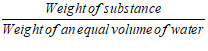
= 
Relative Density = 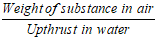
Examples
1. A glass stopper weighs 44 N in air and 24 N when completely immersed in water. Calculate the relative density of glass.
Solution
Weight of solid object in air = 44 N
Weight of solid object in water (Apparent weight) = 24 N
Weight of water displaced = Upthrust in water = 44 – 24 N = 20 N
Relative Density = 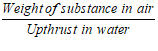 =
=  = 2.2
= 2.2
Experiment 10.3 To measure the Relative Density of Liquid
Apparatus/Requirements:
A beaker, water, light and thin string, spring balance, and the liquid.
Procedure
- Suspend a solid from a spring balance by means of light string in air and record its weight.
- Immerse the solid wholly in water and record its apparent weight.
- Wipe the surface of the solid with a dry cloth and immerse it wholly in the liquid whose relative density is to be found.
- Read and record its weight.
Results:
Let:
- Weight of solid object in air = Wa N
- Weight of solid object in water (Apparent weight) = Ww N
- Weight of solid object in liquid (Apparent weight) = Wl N
Calculation:
Weight of water displaced = Upthrust in water = Wa – Ww N
Weight of liquid displaced = Upthrust in liquid = Wa – Wl N
But in each case, the solid displaces its own volume of liquid.
Volume of water displaced = Volume of the solid immersed = Volume of the liquid displaced.
From Relative Density = 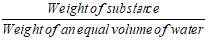
= 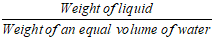
= 
Relative Density = 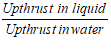
Worked Example
1. A piece of iron weighs 145 N in air. When completely immersed in water, it weighs 120 N and weighs 125 N when completely immersed in alcohol. Calculate the relative density of alcohol.
Solution:
Weight of solid object in air = 145 N
Weight of solid object in water (Apparent weight) = 120 N
Weight of solid object in liquid (Apparent weight) = 125 N
Calculation:
Weight of water displaced = Upthrust in water = 145 – 120 N = 25 N
Weight of alcohol displaced = Upthrust in liquid = 145 – 125 N = 20 N
Relative Density = 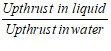 =
=  = 0.8
= 0.8
10.3 Flotation
A body floats in a liquid if its density is less than the density of the liquid. A floating body sinks deeper in liquids of less density than in liquids whose densities are high. This is seen when ships move from fresh water to sea or ocean water. The depth to which the ship sinks is shown by lines called plimsoll line marked on the side of the ship.
The law of Flotation
The law of flotation states that:
A floating body displaces its own weight of fluid in which it floats.
(a) Facts about a floating body
- The weight of the floating body = the weight of the fluid displaced.
- The weight of the fluid displaced = Upthrust (Archimedes’s Principle).
- Therefore, the Upthrust = the weight of the floating body.
- The mass of the floating body = the mass of the fluid displaced.
Experiment 10.4 To verify the Law of Flotation
Apparatus: Beaker, water, light string, spring balance, a suitable solid.
Procedure:
- Fill a beaker with water.
- Suspend a solid object in air using a light string from a spring balance and record its weight.
- Immerse the solid object completely into the water in the beaker.
- Read and record the apparent weight (weight when the solid object is in liquid).
Observation: The string becomes slack (loose).
Results:
Let:
- Weight of solid object in air = Wa N
- Weight of solid object in water = 0.0 N
Calculation:
Weight of water displaced = Upthrust in water = Wa – 0.0 N
Conclusion:
If Wa – 0.0 = Wa, i.e., Upthrust = Weight of fluid displaced, then law of flotation is verified.
(b) Relationship between the Density of floating body, Density of liquid and the Fraction submerged
The density of a floating body is related to the density of the liquid and the fraction submerged by the formula:
Density of floating body = Density of liquid × Fraction submerged
Derivation of the formula
Points to note:
- A floating body is supported by the upthrust of the liquid.
- Therefore, in equilibrium, the upthrust = the weight of the floating body.
- The mass of the floating body = the mass of the fluid displaced.
- The fraction submerged = the volume of the liquid displaced.
Now let:
- The mass of the body floating = mb g
- The mass of the liquid displaced = The mass of the floating body (Law of flotation) = mb g
- The density of the floating body = ρb g/cm3
- The density of the liquid = ρl g/cm3
- The volume of the body above the liquid surface = vx cm3
- The volume of the body below the liquid surface = vy cm3
- The volume of the body floating, v = (vx + vy) cm3
The fraction submerged = 
The density of the floating body, ρb =  g/cm3
g/cm3
mb = ρb(vx + vy) ……………………. 1
The density of the liquid, ρl =  g/cm3 but ml = mb
ρl =  g/cm3
g/cm3
mb = ρl vy ……………………. 2
Equating equation (1) to (2) we have:
ρb(vx + vy) = ρl vy


ρb = ρl × 
Density of floating body = Density of liquid × Fraction submerged
Note that  = Fraction of the floating body submerged.
Rearranging the equation, we have:

Fraction submerged = 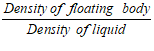
Worked Examples
1. A piece of wood of volume floats with  of its volume under a liquid of density 800 kg/m3. Find the density of the wood in kg/m3.
Solution:
Fraction submerged =  , Density of the liquid = 800 kg/m3
Using the formula
Density of floating body = Fraction submerged × Density of liquid
We have: =  × 800 =
  = 640 kg/m3
2. A piece of wood of volume 240 cm3 floats with three quarters of its volume under water. Calculate the density of the wood if the density of water is 1000 kg/m3.
Solution:
Fraction submerged = ¾, Density of the water = 1000 kg/m3
Density of floating body = Fraction submerged × Density of liquid
= ¾ × 1000 =  = 750 kg/m3
10.4 Application of the law of flotation
The practical application of the law of flotation is seen in the following:
(i) Ships
Ships are able to float on water although they are made of metal. This is because their average densities are less than the density of water.
Ships float deeper in fresh water than in salty (sea) water. This is because the density of fresh water is less than the density of salty water.
(ii) Submarines
These are ships that float submerged in water. They are equipped with periscopes for viewing and tanks which can be filled with air or water to alter the density of the submarine, thus making the submarine float afloat, awash, or submerged.
(iii) Balloons
Balloons are airships used for recording meteorological measurements.
The balloon is filled with a light gas, e.g., hydrogen gas, until it displaces a weight of air greater than its own weight. The greater upthrust then pushes the balloon upwards.
It continues to rise until the upthrust on it is equal to the weight of the balloon plus its contents and then floats sideways.
 = Upthrust –
Example
1. A balloon has a capacity of 10 m3 and is filled with hydrogen. The balloon’s fabric and the container have a mass of 1.25 kg. Calculate the maximum mass load the balloon can lift. (Density of hydrogen = 0.089 kg/m3 and of air = 1.29 kg/m3, gravity, g = 10 m/s2).
Solution:
Volume of balloon, v = 10 m3, Density of hydrogen, ρh = 0.089 kg/m3,
Density of air, ρa = 1.29 kg/m3, g = 10 m/s2,
Volume of air displaced, va = volume of balloon = 10 m3
Volume of hydrogen, vh = volume of balloon = 10 m3.
Mass of (balloon + container) = 1.25 kg
Let the mass of the load = x kg
Total mass = Mass of balloon + Mass of Hydrogen + Mass of the load
= 1.25 + vh ρh + x
= 1.25 + 10 × 0.089 + x
= (1.25 + 0.89 + x) kg
Weight of balloon = Total mass × gravity
= (2.14 + x) g N
Weight of displaced air = mg
= v ρ g
= 10 × 1.29 × g
= 12.9 g N
For the balloon just to rise, upward force must be equal to the downward force i.e.
Upthrust = Weight of the load
12.9 g = (2.14 + x) g
x = 12.9 – 2.14
x = 10.76 kg
10.5 Hydrometer
A hydrometer is an instrument used to measure relative density of liquids. It consists of three main parts, as shown in the diagram below.
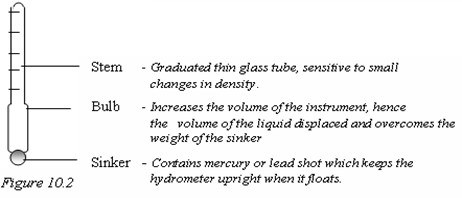
The hydrometer is placed in the liquid whose relative density is to be measured and the scale read at the level of the liquid surface.
NB:
- Sensitivity of the hydrometer is increased by making the stem very thin.
- The buoyancy is increased by making the bulb large.
- The smaller scales are at the top and the bigger scales are at the bottom. This is because the hydrometer floats deeper in lighter liquids than in denser liquids.
Common examples of hydrometers are:
- Car hydrometer (battery tester) – Used to test the state of the charge of a car battery.
- Lactometer – Used to test the purity of milk.
10.6 Terminal Velocity
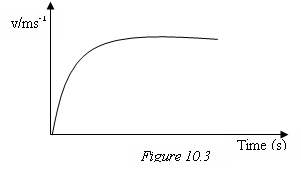
Terminal velocity is the constant velocity attained by a body falling through a fluid.
Facts about a body falling in a fluid
- The body first accelerates, i.e., its velocity increases with time.
- After some time, it attains a constant velocity called terminal velocity and falls with this velocity until it hits the bottom of the cylinder.
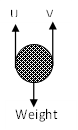
A diagram showing a ball bearing falling through a liquid

Where:
- U = Upthrust
- V = Viscosity (fluid friction)
Explanation
As the ball bearing falls through the liquid, the liquid resistance (viscosity) exerts an upward force opposing gravity. Since viscosity in fluids increases with velocity (i.e., the higher the velocity the greater the viscosity), the viscous drag increases with velocity. Eventually, the combined upward force of upthrust and viscosity equals the weight (force of gravity) on the ball bearing. At this point, the resultant force on the ball bearing is zero and it has no acceleration, but it acquires a constant velocity called terminal velocity.
When the values of velocity are plotted against time, the shape of the graph below is obtained:
The graph of velocity against time for a body falling through a fluid
Self-Check 10.0
- A block of metal (density 2700 kg/m3) has volume 0.09 m3. Calculate the upthrust force when it is completely immersed in brine (density 1200 kg/m3).
A. 600 N B. 1080 N C. 180 N D. 1200 N - An iron box of mass 90 g and density 0.9 g/cm3 floats on brine (density 1200 kg/m3). What is the volume immersed in the brine?
A. 40 cm3 B. 60 cm3 C. 90 cm3 D. 75 cm3 - The envelope of a hot air balloon contains 1500 m3 of hot air of density 0.8 kg/m3. The mass of the balloon (not including the hot air) is 420 kg. The density of surrounding air is 1.3 kg/m3. What is the lifting force?
A. 3300 N B. 4400 N C. 5500 N D. 6600 N - What fraction of a wooden cube of one side 10 cm will be below the water level if the cube is floating in water? (dwater = 1 g/cm3, dwood = 0.6 g/cm3)
A. 3/5 B. 2/5 C. 1/5 D. 1/10 - An ice cube of volume 600 cm3 floats in water. What is the volume of the part above the water level? (dice = 0.9 g/cm3, dw = 1 g/cm3)
A. 60 cm3 B. 80 cm3 C. 520 cm3 D. 540 cm3 - A cubical brass block floats in mercury. What fraction of the block lies above the mercury surface? (The densities of brass and mercury are 8600 kg/m3 and 13600 kg/m3 respectively)
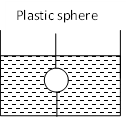
A. 86/136 B. 50/86 C. 136/86 D. 50/136 - A large, hollow plastic sphere is held below the surface of a fresh water pool by a cable attached to the bottom of the pool. The sphere has a volume of 0.400 m3.

Calculate the buoyancy force exerted by the water on the sphere.
A. 4000 N B. 800 N C. 3200 N D. 4800 N - A lead sphere has a total mass of 45.2 kg. If it is put into water, what will be the upthrust force on it? (Density of lead is 11300 kg/m3)
A. 10 N B. 20 N C. 30 N D. 40 N - A block of wood of volume 80 cm3 and density 0.5 g/cm3 floats in water. What is the volume immersed in water (density of water = 1 g/cm3)?
A. 50 cm3 B. 40 cm3 C. 30 cm3 D. 20 cm3 -
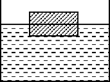
Figure 2 shows a block of volume 40 cm3 floating in water with only half of its volume submerged. If the density of water is 1000 kg/m3, determine the mass of the wood.
A. 40 × 1000 kg B. 20 × 1000 kg C. 40 × 10-6 × 500 kg D. 20 × 10-6 × 500 kg
SECTION B
- (a) State Archimedes’s Principle.
(b) Describe an experiment to verify Archimedes’s Principle.
(c) A piece of iron weighs 355 N in air. When completely immersed in water, it weighs 305 N and weighs 315 N when completely immersed in methylated spirit. Calculate the relative density of methylated spirit.
(d) State the application of Archimedes’s principle. - (a) State the law of flotation.
(b) Describe an experiment to verify the law of flotation.
(c) A piece of wood of volume 40 cm3 floats with only half of its volume submerged. If the density of water is 1000 kg/m3, calculate the density of wood. - A balloon has a capacity of 20 m3 and is filled with hydrogen. The balloon’s fabric and the container have a mass of 2.5 kg. Calculate the maximum mass load the balloon can lift. (Density of hydrogen = 0.089 kg/m3 and of air = 1.29 kg/m3, gravity, g = 10 m/s2).
- (a) Define terminal velocity.
(b) Explain with the help of a velocity-time graph what happens to a USA soldier parachuted from a war plane flying at a high altitude in an area free of enemies in Iraq from the time he leaves the plane till he lands on the ground.


