


LEARNING OBJECTIVES By the end of this chapter, you should be able to: 1. (a) Define the following terms and state their SI units: – Work and Power (b) Describe an experiment to measure human power (c) Solve numerical problems involving Work done and Power 2. (a) Define the term Energy and state its S.I unit. (b) State: (i) the Law of Conservation of energy (ii) the forms and sources of energy 3. (a) Define Potential and Kinetic Energy (b) Describe the Interchange between P.E and K.E. (c) Solve numerical problems involving P.E and K.E 4. (a) State the components of Internal-Combustion Engine. (b) Describe the mechanism of Four-stroke and Two-stroke Engines (c) State the factors that limit the efficiency of Internal-Combustion engines (d) Explain how to improve the efficiency of Internal-Combustion engines. |
7.10 WORK
(a) Introduction
The word “work” in everyday life describes any activity which requires muscular or mental effort. But in Physics, work has a special meaning. In the scientific sense, work involves motion and work is done when a force changes the position or speed of an object.
Definition: Work is the product of a force applied to a body and the displacement of the body in the direction of the applied force.
Mathematically, it is expressed as:
Work done = Force (F) × Distance (s) moved in the direction of the force
Work done = Fs
Note:
- Work is only said to be done when a force moves its point of application along the direction of its line of action.
- If a force acts on a body and there is no motion, then there is no work done.
- The distance must be in metres.
While work is done on a body, there is a transfer of energy to the body, and so work can be said to be energy in transit.
(b) Factors which determine the amount of work done
From the formula of work, we can see that the amount of work done depends on:
- The magnitude (size) of the force applied.
- The distance moved.
The S.I unit of work is joule (J).
A joule is defined as the work done when a force of one Newton (1 N) moves through a distance of one metre (1 m).
Larger units are:
- the kilojoule (kJ)
- the megajoule (MJ)
1 kJ = 1,000 J (103 J)
1 MJ = 1,000,000 J (106 J)
Work is also done in moving against some opposing force such as gravity and any form of resistance to the motion of the force.
For example:
- When a crane is lifting a heavy load, work is done against the force of gravity. Or when a person lifts a load to a given height.
- When a nail is driven into a wooden block by hammering, work is done against the resistance of the wood.
Worked Examples
1. Calculate work done by an engine which exerts a force of 9000 N over a distance of 6 m.
Solution: Force, F = 9000 N, Distance, s = 6 m, Work done = ?
Work done = Force × Distance
= F × s
= 9000 × 6
Work done = 54,000 J or 54 kJ
2. A man lifts a box of mass 3 kg vertically upwards through 2 m. If the gravitational field, g, is 10 m/s2, calculate the work done by the man in lifting the box.
Solution: Mass of box = 3 kg, gravitational field, g = 10 m/s2, Force, F = mg, Distance, s = 2 m, Work done = ?
Work done = Force × Distance
= mg × s
= 3 × 10 × 2
Work done = 60 J
In the diagram below, a force of 10 N acts on a block of weight 30 N placed on a rough table as shown in figure 7.1 below. Given that μ is 0.2 and the block moves through a distance of 3 m.

Calculate: (a) the useful work,
(b) the useless work done if the block moves 3 m along the direction of the 10 N and the coefficient of friction is 0.2.
Solution: Method I
(a) Force applied, F = 10 N, s = 3 m, μ = 0.2, Weight, W = R = 30 N
Useful work done = Resultant force × Distance moved
= (Force applied – Frictional force) × s
= (10 – μR) × 3
Where: μR = Frictional force and
R = Weight of the object
= (10 – 6) × 3 = 4 × 3 N
Useful work done = 12 J
Method II
Step I: First calculate the frictional force
Frictional force = μR
= 0.2 × 30
= 6 N
Step II: Calculate the Resultant Force
Resultant Force = Force applied – Frictional force
= 10 – 6
= 4 N
Step III: Calculate the useful work done from the formula:
Work done = Resultant force × Distance
= 4 × 3
Useful work done = 12 J

7.2 POWER
Power is defined as the rate of doing work. Or
Power is the rate of performing work or transferring energy.
Power measures how quickly work is done.
Mathematically speaking, power is equal to the work done divided by the time interval over which the work is performed.
Power = 
In the sense of power being defined as rate of transfer of energy, we can also mathematically express power as:
Power = 
S.I unit of power
The S.I unit of power is the Watt (W).
The watt is defined as the rate of doing work at one joule per second.
1 Watt = 1 Joule per second.
i.e. 1 W = 1 J/s
Larger units of power are:
- The Kilowatt (kW)
- Megawatt (MW)
1 kW = 1000 W (103 W)
1 MW = 1,000,000 W (106 W)
1 MW = 1000 kW
NB:
- Engine power is sometimes measured in horsepower (hp).
- 1 hp = 746 W ≈ ¾ kW
- From Work done = Force × Distance
Power =  = F ×
= F ×  But Velocity =
Power = Force × Velocity
Worked Examples
1. Calculate the power of a water pump which can fill a water tank 10 m high with 3000 kg of water in 20 s. (Assume g = 10 m/s2).
Solution: m = 3000 kg, h = 10 m, g = 10 m/s2, P = ?
We can solve this problem by using any one of the methods below.
Method I
Step I: First calculate the work done.
Work done = Force × Distance
= mg × s
= 3000 × 10 × 10
Work done = 300,000 J or 3 × 10⁵ J
Step II: Now calculate the power from the formula:
Power = 
= 
Power = 15,000 W
Method II Substitute the values in the data collected directly as shown below.
Power = 
= 
= 
= 
= 
Power = 15,000 W
2. A man lifts a box of mass 10 kg through a vertical height of 2 m in 4 seconds. Calculate the power he developed.
Solution: m = 10 kg, h = 2 m, t = 4 s, g = 10 m/s2, P = ?
Using the formula Power = 
= 
= 
= 50 W
7.21 Measurement of Human Power
The rate of working of a person is at its highest when he or she is running up a hill or up stairs lifting his or her own weight. So human power can be measured by measuring the total vertical height of a stairway and the time taken to run up the vertical height.
Experiment
Apparatus: Stopwatch, weighing scale, a long flight of steps.
Procedure
- Run up a long flight of steps while someone times you using a stopwatch.
- Make three attempts, each time the person records the time taken.
- Weigh yourself on a weighing machine to get your mass.
Calculations
Calculating the Vertical height
Measure the height of one step and count the number of steps you climbed.
Find the total vertical height from the formula:
Vertical height = Height of one step × Number of steps
Average time taken
Find the average time taken from the formula:
Average time taken = 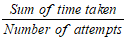
For the case above, Average time taken, t = 
Where  are the times taken in seconds in the three attempts.
- The Power
The power can then be calculated using any one of the following methods.
Method I
Step I: First calculate work done:
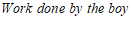 = Force overcome × Vertical distance climbed
= mg h
Where h = Height of 1 step × Number of steps in metres
 = mg × Height of 1 step × Number of steps
Step II: Now calculate the power developed from the formula:
Power = 
=  h = as defined in step I above.
Power =  ×
× 
Method II
Simply calculate the power from the formula
Power =  ×
× 
Example
1. A boy of mass 60 kg runs up a flight of 60 steps in 10 seconds. If the height of one step is 20 cm, calculate the power he developed.
Solution
When collecting the data, always remember that the height must be in metres.
m = 60 kg, t = 10 s, height of 1 step = 20 cm =  = 0.2 m
Method I
Step I: First calculate work done:
 = Force overcome × Vertical distance climbed
= mgh
= mg × Height of 1 step × Number of steps
= 60 × 0.2 × 60
Work done by the boy = 720 J
Step II: Now calculate the power developed from the formula:
Power = 
= 
Power = 72 W
Method II
Simply calculate the power from the formula
Power =  ×
× 
= 
Power = 72 W
7.3 ENERGY
Energy is defined as the capacity of matter to perform work. Or Energy is the ability to work.
(a) The S.I unit of energy
Like work, the SI unit of energy is joule (J).
Energy exists in various forms, including:
- Mechanical, thermal, chemical, electrical, radiant, and atomic.
All forms of energy are interconvertible by appropriate processes. In the process of transformation, either kinetic or potential energy may be lost or gained, but the sum total of the two remains always the same. This is in accordance with the Law of Conservation of Energy.
(b) The Law of Conservation of Energy
The law states that: Energy can neither be created nor destroyed, but only changes from one form to another; thus the sum total always remains the same.
7.31 Forms of energy
Energy exists in various forms. The various forms are shown in the table below.
| Form of energy | Example | |
|---|---|---|
Mechanical energy – Potential (gravitational) – Potential (elastic) – Kinetic energy | Is the type of energy possessed by a body by reason of its position at rest or in motion. | – Energy stored in a book resting on a table. – A stretched spring or catapult – A shot fired from a gun. |
| Chemical energy | The type of energy released during a chemical reaction. | – Energy stored in fuels and energy-giving foods that become active when oxidized by oxygen. – Energy stored in battery cells. |
| Nuclear (atomic) energy | Is the energy released by nuclei of heavy atoms of disintegrating radioactive elements. | – Energy stored in the nucleus of an atom |
| Electrical energy | The type of energy produced by electric cells, generators, etc. | – Energy produced in electric appliances such as cooker, filament lamp, etc. |
| Radiant energy (heat and light) | – Infra-red rays. | |
| Sound energy | Type of energy produced by vibrating objects. | – Vibrational energy. |
Table 7.1
7.32 Sources of Energy
Sources of energy are the raw materials for production of energy. They can be classified into two main categories namely:
- Renewable energy sources
- Non-renewable energy sources
(a) Renewable energy sources
These are energy sources which cannot be exhausted.
Examples of renewable sources of energy include:
- Solar energy – energy tapped from the sun using solar panels.
- Hydroelectric energy – electric energy produced from falling water which rotates turbines connected to a generator which in turn produces electricity.
- Wind energy – electric energy produced from moving air which rotates turbines connected to a generator which in turn produces electricity.
(b) Non-renewable energy sources
These are energy sources which once used cannot be replaced.
Examples of non-renewable sources of energy include:
- Fossil fuels (oil, coal, and natural gas). Fossil fuels are formed from remains of plants and animals which have accumulated over millions of years.
- Nuclear energy.
7.33 Mechanical Energy
In mechanics, energy is divided into two kinds, namely:
- Potential energy
- Kinetic energy
(a) Potential energy (p.e)
Potential energy is the form of energy possessed by a body as a result of its position at rest.
For example, a body lifted to a height, h, above the surface of the earth is said to possess potential energy.
When something is lifted vertically upwards, work is done against the gravitational force acting on the body (i.e., its weight) and this work is stored in the body as gravitational potential energy.
Another example of potential energy is the elastic potential energy stored in a stretched spring or catapult.
Formula of Potential Energy
Suppose a body of mass m kg is raised to a height of h metres at a place where the acceleration due to gravity is g m/s2.
Then Force overcome (Weight), F = mg … (1)
Work done on the body = F × s … (2)
Substituting equation (1) in equation (2), i.e., replacing F in equation (2) with mg in equation (1), we have,
Work done on the body = mg × s
But the work done = gravitational potential energy (p.e) and s = h,
P.E = mgh
Recall that:
- m = mass of the body in kg.
- g = acceleration due to gravity (m/s2).
- h = height in metres.
Example
1. A box of mass 5 kg is raised to a height of 2 metres above the ground. Calculate the potential energy stored in the box (take g = 10 m/s2).
Solution: Mass of box = 5 kg, gravitational field, g = 10 m/s2, Height, h = 2 m.
Applying P.E = mgh
= 5 × 10 × 2
P.E = 100 J or 0.1 kJ
2. A man has raised a load of 25 kg on a platform 160 cm vertically above the ground. If the value of gravity is 10 m/s2, calculate the potential energy gained by the box when it is on the platform.
Solution: Mass of box = 25 kg, gravitational field, g = 10 m/s2
Height, h = 160 cm =  = 1.6 m, P.E = ?
P.E = mgh
= 25 × 10 × 1.6
P.E = 400 J or 0.4 kJ
(b) Kinetic energy (k.e)
Kinetic energy is the energy possessed by a moving body.
Examples of kinetic energy include:
– Moving bullet, moving car, etc.
A body possessing kinetic energy does work by overcoming resistance force when it strikes something.
Formula of Kinetic energy (k.e)
Kinetic energy can be calculated from the formula:
K.E = ½ mv2 where m = mass (kg), v = velocity (m/s).
Note: Kinetic energy is directly proportional to the square of the velocity of a body. Therefore, the faster the body moves, the more kinetic energy it has.
The derivation of the formula K.E = ½ mv2 (Not important at ‘O’ Level)
Consider a body of mass m, moving with an initial velocity u from rest and acted upon by a force F. The force gives the body an acceleration a, and it acquires a final velocity v after covering a distance s in metres.
These quantities are related by the equation of linear motion (See chapter 11):
v2 = u2 + 2as
Since u = 0, then v2 = 2as, so a = v2 / 2s … (1)
Now, Work done = Force × Distance
= F × s
But F = ma (Newton’s second law of motion)
Substituting for F, we have:
Work done = mas … (2)
Substituting equation (1) into equation (2), i.e., substituting for a in equation (2), we obtain:
Work done = m × (v2 / 2s) × s
= ½ mv2
By the law of conservation of energy, the work done by the force F in pushing the body through the distance s will all be converted into kinetic energy of the body.
K.E = ½ mv2
Worked Examples
- Calculate the kinetic energy of a bullet of mass 0.05 kg moving with velocity of 500 m/s.
Solution: m = 0.05 kg, v = 500 m/s, k.e = ?
Kinetic Energy = ½ m v2 = ½ × 0.05 × 5002 = 6,250 J or 6.25 kJ
- A 10 g bullet traveling at 400 m/s penetrates 20 cm into a wooden block. Calculate the average force exerted by the bullet.
Solution: m = 10 g =  kg, v = 400 m/s, distance = 20 cm =
  m, k.e = ?
Note: This question seems to be difficult and quite different.
Hint: The work done in penetrating the block is related to the average force by the formula:
Work Done = Fs, so find the work done first and then use the above formula to find F.
Kinetic Energy = ½ × m × v2 =  =
=  = 5 × 40 × 4 = 800 J
This kinetic energy is converted into work in penetrating the wooden block.
Applying Work done = Force × Distance
800 = F × 
20 F = 800 × 100
F = 
F = 4,000 N
7.34 The Law of Conservation of Energy
The law states that: Energy can neither be created nor destroyed, but only changes from one form to another.
Interchange of Energy between P.E and K.E
Energy is interchangeable between potential energy and kinetic energy depending on the body’s present state. This interchange is seen in the following:
- Simple pendulum.
- Falling object e.g. stone.
- Simple pendulum
In a swinging pendulum bob, the energy of the bob can be either potential energy or kinetic energy or both. This is explained in the diagram below.

Facts about a swinging pendulum
- At the extreme ends (A and C) of the swing, the energy is all potential energy and maximum since height is maximum at A and C.
- When passing through the rest position (i.e., B), it is all kinetic energy and maximum. This is because at B, velocity is maximum and height is zero. Since height = 0, potential energy = 0.
- While at the intermediate points (i.e., between AB and BC) the energy is partly kinetic and partly potential.
(b) Falling object e.g. stone
Consider a piece of stone raised to a certain height above the ground level and let to fall.
At the maximum height, it possesses potential energy and no kinetic energy.
As the stone falls, its velocity increases. Since kinetic energy is directly proportional to the square of the velocity, the kinetic energy of the stone increases at the expense of the potential energy (i.e., at any particular moment, the stone possesses both potential and kinetic energy).
Ignoring the energy losses due to air resistance, the loss in potential energy is equal to the gain in kinetic energy in accordance with the Law of Conservation of Energy.
Consider the diagram below

Note that: Potential energy decreases from maximum to zero and the kinetic energy increases to maximum. This is because as the height value decreases to zero, the velocity increases to maximum.
(c) Energy Transformations
By means of suitable mechanisms and apparatus, energy can be transformed from one form to another. This is shown in table 7.2 below.
| Activity | Energy Transformation |
|---|---|
| 1. A boy running up a staircase | Chemical energy in the muscles is converted to kinetic energy and then to potential energy. (C.E → K.E → P.E) |
| 2. Running water at a hydroelectric power station (water turning turbine which finally drives a generator) | Potential energy is converted to kinetic energy and then electrical energy. (P.E → K.E → E.E) |
| 3. A stone dropped from rest at a certain height until it hits the ground. | Potential energy is converted to kinetic energy then to heat and sound energy. (P.E → K.E → H.E → S.E) |
| 4. A moving car | Chemical energy due to the burning of fuel in the engine is converted to heat energy which is converted by pistons to kinetic energy. (C.E → H.E → K.E) |
| 5. A coal-fired engine drives a dynamo which lights a bulb. | Chemical energy is converted to heat energy, kinetic energy, electrical energy and lastly to light energy. (C.E → H.E → K.E → E.E → L.E) |
| 6. A torch bulb flashing. | Chemical energy is converted to electrical energy, light energy and heat energy. (C.E → E.E → L.E → H.E) |
Figure 7.2
7.4 ENGINES
An engine is a machine for converting energy into motion or mechanical work. The energy is usually supplied in the form of a chemical fuel, such as oil or gasoline, steam, or electricity, and the mechanical work is most commonly delivered in the form of rotary motion of a shaft.
(a) Classification of Engines
Engines are usually classified according to the following:
(i) The form of energy they utilize, as:
– Steam, compressed air, and gasoline
(ii) The type of motion of their principal parts, as:
- Reciprocating and rotary
(iii) The place where the exchange from chemical to heat energy takes place, as:
- Internal-combustion and external combustion
(iv) The method by which the engine is cooled, as:
– Air-cooled or Water-cooled
(v) The position of the cylinders of the engine, as:
– V, in-line, and radial
- The number of strokes of the piston for a complete cycle, as:
- Two-stroke and Four-stroke
(vii) The type of cycle, as:
- Otto (in ordinary gasoline engines) and diesel
- The use for which the engine is intended, as:
- Automobile
- Airplane engines
NB: Engines are often called motors, although the term motor is sometimes restricted to engines that transform electrical energy into mechanical energy. Other specialized engines are the windmill, gas turbine, steam turbine, and rocket and jet engines.
(b) Internal Combustion Engine (Heat Engines)
A heat engine is a machine which changes heat energy (obtained by burning fuel) to kinetic energy. The common heat engines are:
- Petrol Engine
- Diesel Engine
In internal combustion engines, e.g., petrol engine or diesel engine, fuel is burnt in the cylinder where the energy change occurs.
(c) The Components of Internal-Combustion Engine
The basic components of an internal-combustion engine are:
(i) The engine block – made of cast iron or aluminum alloy and houses the cylinders, pistons, and crankshaft.
(ii) Cylinder head – This is the upper part of the engine. It is bolted to the top of the block and seals the tops of the cylinders.
(iii) Cylinders – This refers to the cylindrical space in which the piston reciprocates (i.e., moves freely up and down).
(iv) Pistons – These are cylindrical metals fitted with rings for tight fitting. They move up and down thus compressing the mixture of air and fuel against the cylinder head prior to ignition. The top of the piston forms the floor of the combustion chamber.
(v) Valves – An engine valve is a metal shaft with a disk at one end fitted to block the opening. The other end of the shaft is mechanically linked to the camshaft. There are two valves:
– Inlet valve – Controls the entry of fuel vapour into the combustion engine.
– Outlet valve – Controls the exit of exhaust gases out of the combustion chamber.
(vi) Crankshaft – This is the part of the engine which transforms the reciprocating motion of the piston into rotary motion.
It rotates at speeds ranging from about 600 to thousands of revolutions per minute (rpm), depending on how much fuel is delivered to the cylinders, thus allowing the up and down movement of the piston.
(vii) Camshaft – This is a round rod with odd-shaped lobes located inside the engine block or in the cylinder head.
7.41 Petrol (Otto-cycle) engine (Four-stroke engine)
The ordinary Otto-cycle engine is a four-stroke engine; that is, in a complete power cycle, its pistons make four strokes, two toward the head (closed head) of the cylinder and two away from the head. In a gasoline engine, a volatile mixture of fuel and air is ignited within a cylinder causing a sudden expansion of gases. The expanding gases push down on a piston which turns the crankshaft.
A stroke is one movement of the piston either up or down. Most cars use a four-stroke cycle. The piston moves four strokes and then repeats the action continuously.

Figure 7.5
Mechanism of a four-stroke engine
The mechanism of the four-stroke engine is divided into:
- Intake stroke, Compression stroke, Power stroke, and Exhaust stroke.
What happens in every stroke is illustrated in the diagrams below.

Figure 7.6
1. Intake
During intake (the first stroke of the cycle), the piston moves down (i.e., away from the cylinder head), the intake valve opens. A quantity of a fuel and air mixture is drawn into the combustion chamber.
2. Compression stroke
During the compression stroke, the valve closes, piston moves up and the fuel-air mixture is compressed.
3. Power stroke
In the power stroke, both valves close and the volume of the combustion chamber is at a minimum, the spark plug produces electric spark, the fuel mixture ignites and burns. The expanding gaseous products exert pressure on the piston and force it down.
4. Exhaust stroke
During the final stroke (exhaust stroke), the exhaust valve opens and the piston moves up, driving the exhaust gases out of the combustion chamber and leaving the cylinder ready to repeat the cycle.
7.42 Diesel Engine
A Diesel Engine is a type of internal-combustion engine in which heat caused by air compression ignites the fuel.
The essential parts of diesel engines are similar to gasoline internal-combustion engines. But they differ in the following ways:
- They do not use spark plugs for igniting the air-fuel mixture.
- Diesel engines compress air inside the cylinders with greater force than a gasoline engine does, producing temperatures hot enough to ignite the diesel fuel on contact.
- Combustion takes place at constant volume rather than at constant pressure.
- During the intake stroke, only air is drawn.
Like petrol engines, most diesel engines are four-stroke engines but they operate differently than the four-stroke Otto-cycle engines.
Mechanism of Four stroke Diesel Engines
1. Intake stroke During the intake stroke, the inlet valve opens; air is drawn into the combustion chamber.
2. Compression stroke On the second, or compression, stroke the air is compressed to a small fraction of its former volume and is heated to approximately 440° C by this compression.
3. Power stroke At the end of the compression stroke, vaporized fuel is injected into the combustion chamber and burns instantly because of the high temperature of the air in the chamber. This combustion forces the piston down.
4. Exhaust stroke During the final stroke (exhaust stroke), the exhaust valve opens and the piston moves up, driving the exhaust gases out of the combustion chamber and leaving the cylinder ready to repeat the cycle.
Facts about Diesel Engines
- Diesel engines are, in general, slow-speed engines with crankshaft speeds of 100 to 750 revolutions per minute (rpm) as compared to 2500 to 5000 rpm for typical Otto-cycle engines.
- Some types of diesel engine, however, have speeds up to 2000 rpm. Because they use compression ratios of 14 or more to 1, they are generally more heavily built than petrol engines, but this disadvantage is counterbalanced by their greater efficiency and the fact that they can be operated on less expensive fuel oils.
- They are commonly used in large trucks or buses and machinery.
Advantages of diesel engines over petrol engines
- Diesel engines are more efficient than petrol engines.
- They consume less fuel and therefore, they are less expensive to operate than gasoline-powered engines, partly because diesel fuel costs less.
- Diesel engines emit fewer waste products than petrol engines.
Disadvantage of diesel engines
Diesel engines produce sooty and smelly smoke.
Two-Stroke Engines
Mechanism of two-stroke diesel engine
- In the two-stroke cycle, the fuel mixture or air is introduced through the intake port when the piston is fully withdrawn from the cylinder.
- The compression stroke follows, and the charge is ignited when the piston reaches the end of this stroke.
- The piston then moves outward on the power stroke, uncovering the exhaust port and permitting the gases to escape from the combustion chamber.
NB:
- The power of a two-stroke engine is usually double that of a four-stroke engine of comparable size.
- The general principle of the two-stroke engine is to shorten the periods in which fuel is introduced to the combustion chamber and in which the spent gases are exhausted to a small fraction of the duration of a stroke instead of allowing each of these operations to occupy a full stroke.
7.44 Carburetor and Fuel-Injection System
(a) Carburetor A carburetor is a device that mixes fuel and air for burning in an internal-combustion engine. It atomizes (converts into a vapor of tiny droplets) liquid gasoline. An air-flow carries the atomized gasoline to the engine’s cylinders, where the gas is ignited.
(b) Fuel-Injection System
A fuel-injection system is a system of delivering fuel to an internal-combustion engine. In a fuel-injection system, electronically controlled fuel injectors spray measured amounts of fuel into each of the engine’s cylinders where the fuel is burned to power the engine.
The fuel-injection system replaces the carburetor in most new vehicles. Its advantage over carburetor is that it provides a more efficient fuel delivery system.
(c) Factors limiting the efficiency of heat engines
The efficiency of a modern Otto-cycle engine is limited by a number of factors. These include energy losses: (i) By cooling and (ii) Friction.
(d) Improving the efficiency of heat engines
The efficiency of heat engines is increased by equipping all engines with:
(i) Cooling system and (ii) Lubricating system.

Cooling System
Cooling in engines is achieved by circulating water. A water pump circulates engine coolant, a mixture of water and antifreeze, through the non-moving parts of the engine to absorb heat. The coolant routes through tubes in the radiator, where heat passes through the tubes into the metal fins. A fan blows air through the fins to increase the rate of cooling. In addition to this, the radiator is painted black in order to increase the rate of cooling since black colour is a good emitter of heat energy.
Lubricating System
In the lubricating system, a pump circulates motor oil, the main lubricant in an automobile engine called galleries. It is circulated to all the moving parts of the engine. The lubricating system reduces the friction produced by the engine’s moving parts, which rub against each other thousands of times per minute.
NB: Before the oil circulates, it passes through an oil filter which strains particles from the oil.
Self-Check 7.0
1. A crane raises a mass of 500 kg vertically upwards at a speed of 10 m/s. Find the power developed.
A. 5.0 × 100 B. 5.0 × 101 C. 5.0 × 10² D. 5.0 × 10⁴
2. A girl whose mass is 50 kg runs up a staircase 25 m high in 4 s. Find the power she develops.
A. B.
B. C.
C. D.
D.
3. A train traveling at a constant speed of 20 m/s overcomes a resistive force of 8 kN. The power of the train is
A. (8 × 20) W B. (8 × 10 × 20) W C. (8 × 100 × 20) W D. (8 × 1000 × 20) W
4. A pump is rated at 400 W. How many kilograms of water can it raise in one hour through a height of 72 m?
A. 0.8 kg B. 5.6 kg C. 33.3 kg D. 2000 kg
5. A boy carrying a load of 6 kg runs upstairs. If the work that the boy does is 300 J, find the height of the stairs.
A. 3 m B. 5 m C. 6 m D. 10 m
6. Tony can pull a box 2 m in 5 sec. Ever (Tony’s sister) can pull the same box in 10 sec. Assuming both apply the same force, what is the ratio of Tony’s power to the sister’s power?
A. 1 B. 2 C. ½ D. 4
7. An engine exerts a force of 2000 N at a speed of 15 m/s. Find the power developed by the engine in kW.
A. 30,000 B. 3,000 C. 300 D. 30
8. A constant force of 5 N acts on a body and moves it through a distance of 20 m in 10 seconds. Calculate its power.
A. 2.5 W B. 10 W C. 40 W D. 100 W
9. A mouse of mass 0.03 kg climbs through a distance of 2 m up a wall in 4 s. The power expended in watts is
A. 0.03 × 2 × 4 × 10 B. C.
C.  D.
D.
10. A bullet of mass 0.02 kg is fired with a speed of 40 m/s. Calculate its kinetic energy.
A. 0.4 J B. 0.8 J C. 16 J D. 32 J
11. Which of the following statements is true about an electric motor? It changes
A. Kinetic energy to electric energy B. Electrical energy to light energy
C. Electrical energy to kinetic energy D. Chemical energy to electrical energy
12. A body pulls a block of wood with a force of 30 N through a distance of 300 m in 2 minutes. Find the power he develops, if he pulls the block at a constant speed.
A.  B.
B.  C.
C.  D.
D. 
13. A ball of 1 kg bounces off the ground to a height of 2 m after falling from a height of 5 m, find the energy lost.
A. 5 J B. 20 J C. 30 J D. 50 J
14. A man weighing 800 N climbs a vertical distance of 15 m in 30 s. What is the average power output?
A. 80/3 W B. 800/15 W C. 400 W D. 5 kW
15. In which action(s) below is there work done?
I. Pushing a wall without moving it. II. Taking a book from a table to a higher shelf.
III. Walking on a bridge for 50 m
A. I only B. II only C. III only D. II and III only
16. A bullet of mass 5 g is fired at a speed of 400 m/s. How much energy does it have?
A. ½ × 5 × 102 × 400 J B. ½ × 5 × 103 × 400 J
C. ½ × 5 × 10-3 × 400 × 400 J D. ½ × 5 × 102 × 400 × 400 J
17. Which of the following forms mechanical energy?
A. Electrical energy and kinetic energy B. Potential energy and nuclear energy
C. Nuclear energy and kinetic energy D. Potential energy and kinetic energy
18. An object of mass 2 kg, dropped from the top of a building hits the ground with kinetic energy of 900 J. The height of the building is
A. 30 m B. 45 m C. 90 m D. 180 m
19. A mass attached to the end of a string moves up and down to maximum and minimum points X and Y as shown in figure 7.1 below. When the mass is at X the

A. kinetic energy is maximum, potential energy is minimum
B. kinetic energy is zero, potential energy is maximum
C. kinetic energy is equal to potential energy
D. kinetic energy and potential energy are both zero
20. An electric motor of power 500 watts lifts an object of 100 kg. How high can the object be raised in 20 sec?
A. 40 m B. 30 m C. 20 m D. 10 m
21. A motor can pull a 400 kg box up to a height of 10 m in 4 sec. What is the power of the motor in kW?
A. 10 B. 20 C. 30 D. 40
22. The diagram in figure 3 shows an oscillating pendulum bob. Which of the following statements is true about its motion?

A. The kinetic energy at B is equal to the kinetic energy at A
B. The kinetic energy at B is less than the potential energy at A
C. The kinetic energy at B is equal to the potential energy at A
D. The kinetic energy at B is greater than the potential energy at Z
23. A toy car is pulled with a force of 10 N for 5 m. If the friction force between the block and the surface is 5 N, what is the net work done on the toy car?

A. 50 J B. 100 J C. 200 J D. 25 J
24. The energy changes that take place when a stone falls freely from rest to the ground can be orderly arranged as:
A. Kinetic energy → Potential energy → Sound energy → Heat.
B. Sound energy → Potential energy → Kinetic energy → Heat.
C. Potential energy → Sound energy → Kinetic energy → Heat.
D. Potential energy → Kinetic energy → Heat energy → Sound.
25. Ali and Veli move identical boxes equal distances in a horizontal direction. Since Ali is a weak child, the time needed for him to carry his box is two times longer than for Veli. Which of the following is true for Ali and Veli?
A. Ali does less work than Veli B. Veli does less work than Ali
C. Each does the same work D. Neither Ali nor Veli do any work


