


BIOLOGY PAPER 231/2 K.C.S.E 1999
PRACTICAL MARKING SCHEME
1. Confidential requirement: Specimen S- Mango fruit, mature but not ripe, Specimen T- Leguminous pod (bean fruit) any legume.
You are provided with specimens labeled S and T. draw a plan diagram of the cut surface of specimen S. label it.
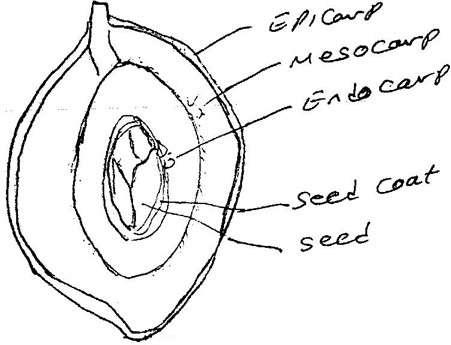
S- One seed – Meso-carp/ epicarp and endocarp separated | T – Several seeds/ many, two – ten – Mesocarp fused with epicarp and endocarp |
|
|
|
|
- With reasons in each case state the type of fruit and method of dispersal for specimen S and T
Specimen S
Type of fruit – Drupe
Reason – One seed/ hard endocarp/ fibrous endocarp/owwte
Method of dispersal – Animal/ Man
Reason – Fleshy mesocarp/ scented/ juicy/succulent/ brightly
Coloured. Rej. Edible
Specimen T.
Type of fruit – legume pod/ leguminous fruit
Reason – two sutures/ lines of weakness
Method of dispersal- Mechanical ( self) explosive mechanism
Reason – lines of dehiscence(two) lines of weakness.
2. You are provided with specimen labeled X, Y and Z
(a) Identify the specimens
X – Ulna
Y- Humerus Rej. Humerous
Z- Radius
(b) Name the part of the mammalian body from which the specimens were obtained.
- Forelimb/arm/legs/ humerus/ upper arm/ ulna and radius lower arm
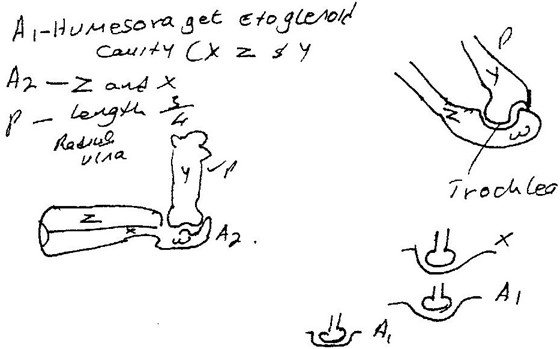 (c) Make a drawing to show how X, Y, and Z are articulated
State the magnification of your drawing X ¼ – X1
(d) With reasons name the type of joint formed at the proximal and distal ends of
Specimen Y
Proximal end- Ball and socket
Reason- Head shaped like a ball/ ball like/ rounded head/ round head/ allow movement.
Distal end- Hinge joint
Reason – allow movement in only one plane/ presence of a groove/ presence of condy/ troches which articulates with sigmoid notch.
(e) What is the significance of the part labelled W
Attachment of muscles/ tendons; formation of hinge joint; with adjacent bone) Prevent overstretching of forearm backwards; allows movements in only plane/ 180 degrees.
You are provided with a specimen labeled R. Examine it
(f) Name the observable features that adapt the specimen to:
Forward movement
– Trail/ tail fin/tail muscles/candal fin
Balancing
– Pectoral fins; pelvic fins
Staying upright
– Dorsal fins; anal fins/ventral fins
Fast movement
– Streamlined body
– backward facing scales,
– Slimy/ Mucoid surface
3. You are provided test for the food substances in the suspension in the table below.
(a) Using reagents provided test for the food substances in the suspension. In the table below, record the food tested, your procedures, observations and conclusions.
Food Substance | Procedure | Observation | Conclusion |
Starch | Add a drop of iodine on M on a white tile | Brown colour/ retain colour of iodine/ yellow/ reddish Acc. No colour change Rej. Red/No change alone | Starch absent |
Reducing sugar | Add a few drops of benedict’s solution and warm/ heat/ boil | Blue colour of benedict’s solution/ colour change to purple/ violet Rej. No change alone | Reducing sugar absent/ monosachariaple sugar absent/ Rej specific names of sugars e.g glucose |
No reducing sugar | Add a few drops of HCl and heat; (cool), add sodium bicarbonate; add benedict’s solution and heat Note – stop heating if step is omitted. | Fizzing/ effervescence/bubbling; Red precipitate/ colour changed from blue to green, yellow orange/ brown/ red; order of colour must be correct. Acc. Final colour change. E.g green, yellow, orange brown | Non- reducing sugar; presence of reducing sugar after hydrolysis. |
Protein | Add 1% CuSO4 Sulphate and then sodium hydroxide – If formula is used must be correct. Order does not matter | Colour change to purple/violet | Protein present |
- If food substance is omitted or wrong, procedure, observation and conclusion wrong
- If cooling absent in non- reducing sugars stop marking
(b) Name two enzymes that may be required to digest suspension M in the
alimentary canal in human beings.
- Pepsin/ trysin/ erepsin /sucrose/ invertase
(c) State the role of hydrochloric acid and sodium hydrogen carbonate in the
experiment.
– HCl hydrolyze/breakdown/ digest/convert/ change; non- reducing
sugars/disaccharides/ complex sugars/(rej sucrose) for reducing sugars/simple sugars/ monosaccharides


