


CHEMICAL KINETICS, EQUILIBRIUM AND ENERGETICS
RATE OF REACTION EQUILIBRIUM AND ENERGETICS
1. RATE OF CHEMICAL REACTION
This is the speed at which a reaction proceeds per unit time.
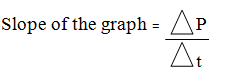
The rate will be positive because the product concentration is increasing. The slope of the graph gives the rate of reaction.
The SI unit is mol dm-3 s-1.
If the plot is reactant concentration against time, the slope will be negative.
Note: The units of rate depend on the units of reactants or products used.
Example: In an experiment to determine rate, the following volumes of gas in the syringe were recorded every 10 seconds.
| Time (sec) | 0 | 10 | 20 | 30 | 40 | 50 | 60 | 70 | 80 |
|---|---|---|---|---|---|---|---|---|---|
| Volume (cm3) | 0 | 18 | 30 | 40 | 48 | 53 | 57 | 58 | 58 |
a) Plot a graph of the volume shown on the syringe against time.
b) Determine the rate of reaction.
2. FACTORS AFFECTING RATE OF REACTION
- Temperature
- Concentration
- Catalyst
- Surface area
- Pressure (gases)
- Light
A) TEMPERATURE
An increase in temperature increases the rate of chemical reaction. This is because particles acquire more kinetic energy and move faster.
Therefore, the collision frequency of reacting particles also increases.
For every 10°C rise, the reaction rate doubles.
B) CONCENTRATION
The reaction occurs when reacting substances come into contact. The rate depends on collision frequency, which depends on how crowded (concentrated) the particles are.
C) SURFACE AREA
The size of particles in heterogeneous reactions influences the rate. Smaller particles have a larger surface area, leading to a faster rate of reaction.
Example: Lumps of marble chips (CaCO3) react slowly with dilute hydrochloric acid, while powdered CaCO3 reacts faster.
Aluminium foil reacts slowly with aqueous NaOH when warmed compared to aluminium powder.
D) LIGHT
Light energizes some reacting molecules. In such reactions, molecules absorb energy as light rather than heat; these are called photochemical reactions.
Examples include:
- Decomposition of silver halides on exposure to light
- Photography
Silver bromide (AgBr) is used in photographic film. It decomposes on exposure to light as shown:

When light falls on the film, it causes decomposition of AgBr. The extent depends on the brightness of sunlight.
Different amounts of light reflected from dark and light surfaces darken the AgBr film to different degrees, producing a photograph.
E) CATALYST
A catalyst can either slow down or speed up the rate of reaction.
HOW DO CATALYSTS SPEED UP THE RATE OF REACTION?
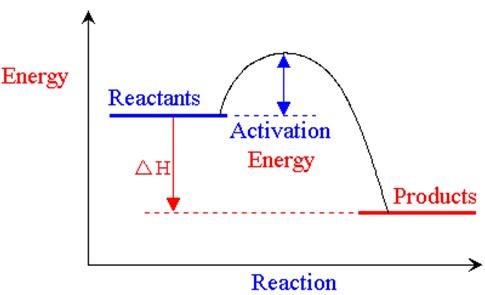
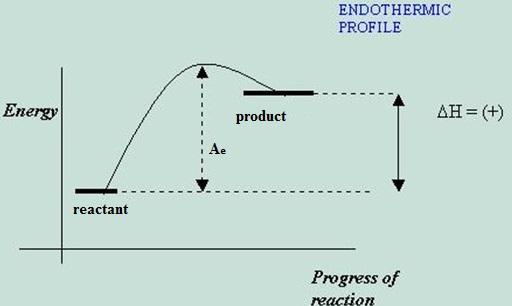
For substances to react, they must overcome the energy barrier (Activation energy, EA).
If EA is too great, substances cannot react at room temperature because particles lack enough energy to surmount the barrier. Supplying energy as heat enables the reaction to proceed.

1. Exothermic reactions – release heat to the surroundings.
2. Endothermic reactions – absorb heat from the surroundings.
EXPLANATIONS
1. The energy relationship between reactants and products of a chemical reaction.
A catalyst increases the reaction rate by lowering the activation energy, which is an “energy hump,” providing an easier path from reactants to products.
2. PRESSURE
(For reactants in gaseous phase)
Increasing pressure brings gaseous particles closer together, increasing collision frequency and thus the rate of reaction.
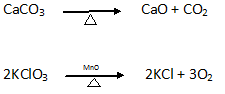
REVERSIBLE AND IRREVERSIBLE REACTIONS
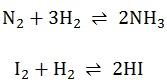
Reversible reactions
Reactions that proceed in both directions.
Irreversible reactions
Reactions that proceed only in the forward direction regardless of conditions applied.
4. CHEMICAL EQUILIBRIUM
Chemical equilibrium
is the state at which the forward and backward reactions proceed at the same rate.
There is a balance between reactants and products.
Chemical equilibrium occurs in a CLOSED SYSTEM.
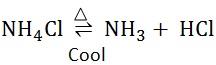
Consider the analogous system of compounds in the same phase:

As soon as a little C and D are formed, a reverse reaction begins. Initially, the forward reaction predominates, but as C and D accumulate, the reverse reaction builds up until equilibrium is reached (forward and reverse reactions proceed at the same rate).
The point at which the rate of forward reaction equals the rate of backward reaction is called the equilibrium point or position.
Le Chatelier’s principle:
States that: “If a chemical system in equilibrium is disturbed by changing one of the factors involved, the equilibrium will shift so as to minimize the effect of the change.”
FACTORS AFFECTING CHEMICAL EQUILIBRIUM
A. TEMPERATURE
The effect of temperature on chemical equilibrium depends on whether the reaction is exothermic or endothermic.

In exothermic reactions:

When heat is supplied, the equilibrium shifts to the direction that requires more heat (i.e., backward reaction) to minimize the effect of heat.
In endothermic reactions:

The increase in temperature stresses the backward reaction (LHS). To minimize the effect, the equilibrium shifts to the forward reaction.
B. PRESSURE
Pressure affects the equilibrium of reversible reactions involving gases. Increasing pressure causes the equilibrium to shift to produce substances occupying less volume (fewer moles).
Example:
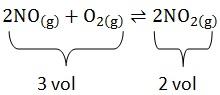
Increase in pressure favors the forward reaction (equilibrium shifts right) as it decreases volume. Decrease in pressure favors the backward reaction (equilibrium shifts left).
For gaseous reactions with no change in volume, pressure has no effect on equilibrium position.
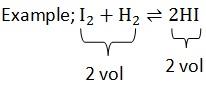
Hence, if pressure is increased, equilibrium shifts to reduce the number of moles present. The pressure exerted by gases is directly proportional to the number of moles present.
C. CONCENTRATION
If the concentration of one substance is increased, the reaction moves in a direction to use up the substance whose concentration increased.

What will be the effect of adding more steam to the position of equilibrium (POE) of this reaction?
Adding more steam affects the backward reaction equilibrium. To minimize the effect, the reaction proceeds forward, shifting the POE to the right-hand side (RHS).
Note: A reaction in which a gas is evolved and allowed to escape or in which a precipitate is formed will proceed in one direction only, even if a reversible reaction might be expected.

S (s) precipitate is almost completely removed from the system. The backward reaction is then not possible.
There is complete conversion of reactants to products.

H+ ions are removed as H2 (g). Thus water dissociation keeps going on.
The forward reactions continue without backward reactions; thus equilibrium is affected.
D. CATALYST
A catalyst doesn’t upset the equilibrium of the system because both forward and backward reactions proceed at a faster rate.
A catalyst doesn’t affect the position of equilibrium (POE).
- Define the following:
- i) Exothermic reaction
- ii) Endothermic reaction
b) State Le Chatelier’s principle.
c) The equation for dissociation of calcium carbonate is:

What will be the effect on the proportion of calcium carbonate in the equilibrium mixture if:
- i) Temperature is increased
- ii) Pressure is increased
What are the necessary conditions for manufacture of calcium oxide from calcium carbonate on a large scale?
- Increase in temperature: The forward reaction is favored; CaCO3 splits to form CaO and CO2. The proportion of CaCO3 in equilibrium decreases.
- Increase in pressure: Pressure affects only gaseous substances. CaCO3 and CaO have zero volume and do not react with pressure, but CO2 reacts with pressure. Therefore, the backward reaction is favored, increasing the proportion of CaCO3.
Conditions:
- High temperature
- Low pressure
- Large surface area (CaCO3 should be powdered)
- Concentration
By removing CO2 from the reaction, the concentration of CaO on the product side favors a quicker forward reaction to replace the lost CO2, thus more CaO will be manufactured.
2. Define the following:
- i) Reversible reaction
- ii) Rate of chemical reaction
- iii) Catalyst
b) Bahati attempted to prepare hydrogen gas by reacting Zn metal with H2SO4. In this experiment, Zn metal of about 0.5 cm diameter was used and 0.2 moles of acid. The rate of formation of hydrogen gas was slow. Explain 3 ways to increase the rate of formation of hydrogen.
c) If Bahati wanted 36 dm3 of hydrogen at S.T.P., what amount of zinc would be required if 0.2 moles of acid were used?
The equation for the reaction is:

b) Answer:
- i. Decrease the diameter of zinc to increase surface area. A large diameter (0.5 cm) yields less hydrogen; reducing diameter increases hydrogen production.
- ii. Introduce a catalyst.
- iii. Increase concentration of H2SO4 for a faster reaction rate.
- iv. Increase temperature to increase kinetic energy of particles and speed up the reaction.
5. ENDOTHERMIC AND EXOTHERMIC REACTIONS
Exothermic and endothermic reactions involve internal energy changes related to the external energy of the surroundings.
A coldness or hotness in the environment after stopping a reaction results from internal energy changes as reactants convert to products.
Internal Energy
Internal energy is the energy stored by molecules of chemical substances. Chemical reactions involve energy changes: internal energy decreases when energy is released and increases when energy is absorbed.
EXOTHERMIC
An exothermic reaction liberates heat to the surroundings.
Example: Combustion reactions.
The heat change is represented by ΔH. A negative ΔH indicates internal energy decreases (exothermic reaction).
Examples:
- i. H2(g) + ½ O2(g) → H2O(l); ΔH = -286 kJ mol-1
- ii. C(s) + O2(g) → CO2(g); ΔH = -406 kJ mol-1
ENDOTHERMIC
An endothermic reaction absorbs heat from the surroundings.
Example: Formation of liquid carbon disulphide used to manufacture acetylene gas for welding cylinders.
A positive ΔH indicates increasing internal energy (endothermic reaction).
Examples:
- i. ½ N2(g) + ½ O2(g) → NO(g); ΔH = +90.3 kJ mol-1
- ii. C(s) + 2 S(s) → CS2(l); ΔH = +117 kJ mol-1
ENERGY LEVEL DIAGRAMS
i. EXOTHERMIC
ii. ENDOTHERMIC
Where Ea = Activation energy.


6 Comments