

ECONOMIC GROWTH AND DEVELOPMENT
- Economic growth is the quantitative increase in national income produced in an economy, or the increase in the market value of goods and services produced by an economy over time. It is conventionally measured as the percent rate of increase of real gross domestic product, or real GDP.
- Economic growth concerns the increase in size of national income or growth of National Product (GNP). Therefore, economic growth focuses on the increase in output produced in an economy without considering social and political aspects.
DETERMINANTS OF ECONOMIC GROWTH
The level of economic growth may be determined by various factors, including:
- Availability of Natural Resources (Natural endowment)
Natural resources include soil, forests, mineral resources, climatic conditions, and so on. If a country is endowed with these resources and uses them well in production, output will increase, leading to economic growth. Lack of these resources may cause low economic growth.
- Human factor / availability of quantity and quality labor force
A country with a large and skilled labor force can engage effectively in production activities and utilize natural resources efficiently, leading to high economic growth. Lack of skilled and unskilled labor causes a low rate of economic growth.
- Technological progress / state of technology
Improvements in technology enable the use of modern tools in production, increasing output and economic growth. Low technology levels may lead to lower economic growth.
- Availability of capital and capital accumulation
Countries with high capital levels and the ability to accumulate capital can produce more goods and services, while those with less capital produce less, resulting in low economic growth.
- Political situation
Political and social stability create a conducive environment for investment and production, leading to high economic growth. Instability discourages investment and production, causing low economic growth.
- Investment and economic policies of government
Conducive policies such as low taxes, increased subsidies, and simplified investment procedures encourage investment and economic growth. Poor policies hinder growth. Economic policies also include improved infrastructure and stabilization policies.
- Availability of entrepreneurs and entrepreneurial ability
A country with many entrepreneurs and entrepreneurial ability can establish and run successful businesses, producing more goods and services and achieving high economic growth. Fewer entrepreneurs reduce investment and growth.
EFFECTS OF ECONOMIC GROWTH IN AN ECONOMY
Economic growth in a country like Tanzania may have both positive and negative effects.
POSITIVE EFFECTS OF ECONOMIC GROWTH
- Increase in per capita income
Economic growth increases output and national income (GNP), which may raise per capita income and improve living standards.
- High level of employment
Increased production raises demand for factors of production, leading to higher employment levels.
- Rapid industrialization
Economic growth increases demand for industrial goods, boosting industrial activities.
- Improvement in economic infrastructure
Governments and the private sector may improve roads, railways, airways, and communication systems due to economic growth.
- Diversification of an economy
Economic growth may lead to a diversified economy with many equally developed sectors.
- Increase in utilization of resources
High economic growth means resources are well utilized in production.
- Growth of towns / urbanization
Economic activities such as industrial and trading activities may cause urban growth.
NEGATIVE EFFECTS OF ECONOMIC GROWTH
Economic growth may also have negative effects, including:
- Environmental degradation
Rapid growth and industrialization may cause pollution, deforestation, and soil erosion.
- Overexploitation and wasteful utilization of resources
Excessive demand for resources like soil and minerals can lead to overexploitation and exhaustion.
- Income inequality and unequal development
Economic growth does not address income distribution or unequal regional development.
- Rural–urban migration
Increased urban economic activities attract people from rural areas, reducing rural economic activity.
ECONOMIC DEVELOPMENT
Economic development is the quantitative and qualitative improvement in an economy, including improvements in people’s welfare.
Definitions by different economists:
According to Higgins
“Economic development is a permanent rise in total and per capita income of a country, widely diffused throughout occupational income groups, continuing at least for two generations and becoming cumulative.”
According to Adleman (broad definition)
“The process by which an economy is transformed from one with a small or negative rate of growth of per capita income to one with a significant self-sustained rate of increase of per capita income as a permanent long-run feature.”
Economic development is measured by changes in national income and per capita income over a long period.
INDICATORS OF ECONOMIC DEVELOPMENT
Indicators include:
- High per capita income
Developed countries produce more goods relative to population growth, resulting in high per capita income.
- Equal income distribution and development
Equal regional development and fair income distribution are essential for development.
- Low or absence of economic instability
Developed countries have stable prices, budgets, and favorable balance of payments.
- Social and political stability
Developed countries lack social unrest and political instability and have improved social services.
- Decrease in illiteracy rate and increase in supply of efficient labor
- Low death rate and high life expectancy
Improved food supply and health services lead to low death rates and higher life expectancy.
- Urbanization and improved infrastructure
- High level of investment and rapid industrialization
INDICATORS OF DEVELOPING COUNTRIES
Indicators of developing countries like Tanzania include:
- Low per capita income
Developing countries have low but growing per capita income due to high population growth relative to national income growth.
- Population pressure and backward population
High population pressure and low literacy rates characterize developing countries.
- Low technology and industrial development
Limited technological advancement reduces production efficiency and industrial development.
- Unfavorable terms of trade and balance of payments
- Increase in level of dependency
These countries depend on others to achieve development goals.
- Increase in burden of debts
Many developing countries have high debts due to dependence on foreign aid and sectoral development.
- Underutilization of resources and labor unemployment
- Low level of national income (GNP) and living standards
THEORIES OF ECONOMIC DEVELOPMENT
THEORY
Theories are reasoned statements based on facts intended to explain particular events. Theories of social and economic development explain the development process.
We study five main economic development theories:
ROSTOW’S STAGES DEVELOPMENT THEORY
Developed by W.W. Rostow in 1960, this theory explains economic development through identifiable stages.
Rostow states it is possible to classify societies according to development stages based on productive capacity, technology, capital accumulation, saving, investment, and trade.
All countries must pass through these stages during development:
Five main stages:
(i) Traditional society
(ii) Preconditions for takeoff (Transitional stage)
(iii) Takeoff
(iv) Drive to maturity
- The age of high mass consumption
Stage 1: THE TRADITIONAL SOCIETY
Economy dominated by subsistence activities; output is produced and consumed by producers. Trade is barter-based. Limited technology and labor-intensive agriculture dominate. Social organization is based on tradition, family, and clan with limited change.
Stage 2: THE PRECONDITIONS FOR TAKEOFF (Transitional stage)
Society begins to adopt change, moving away from tradition. Attitudes shift toward controlling economic situations systematically. Features include increased specialization, transport infrastructure, income growth, emergence of entrepreneurs, and international trade focused on primary products. Industrialization begins.
Stage 3: TAKEOFF STAGE
Investment and industrialization rates increase. Shift from agriculture to industry occurs, with growth concentrated in certain regions.
Three main conditions:
(i) Investment rate rises from 5% to 10% or more of GNP, leading to self-sustaining growth.
- Substantial manufacturing sectors with high growth rates.
- Political and institutional frameworks supporting expansion and ongoing growth.
Stage 4: THE DRIVE TO MATURITY
Economy diversifies and grows technologically. New industries emerge, investment reaches up to 20% of national income, and the country reduces reliance on imports by producing previously imported goods.
Stage 5: THE AGE OF HIGH MASS CONSUMPTION
Economy focuses on mass consumption, with sectors shifting toward durable consumer goods and services. Productivity increases, satisfying society’s demands. Countries like the USA, France, Japan, Germany, and Russia have reached this stage.
CRITICISMS OF ROSTOW’S THEORY
Critics argue:
- Difficulty distinguishing stages clearly, especially transitional and takeoff stages.
- Lack of empirical testing and quantitative evidence.
- Use of unscientific methods based on observation and hypothesis.
- Neglect of natural resources and limited explanation of development causes.
- Model developed with Western cultures in mind, not applicable to many LDCs like Tanzania.
However, Rostow provides valuable insights into development and useful background for understanding development processes in various countries.
ROSTOW’S THEORY ON UNDERDEVELOPMENT
Rostow assumes all countries pass through his stages, but many African countries do not fit this linear model. Africa’s development is often backward or zigzag, influenced by exploitation through colonialism and imperialism.
Rostow’s model does not account for historical exploitation and dependency, limiting its applicability to underdeveloped countries.
Despite limitations, Rostow’s theory offers useful insights into economic development.
MARXIST THEORY OF DEVELOPMENT
Named after Karl Marx, this theory developed during early industrialization in Europe. It focuses on class conflict between owners of production means and workers, emphasizing exploitation and social change.
Marx argued that history is the history of class struggles, with ownership determining wealth, power, and ideas. He believed socialism is the necessary stage after capitalism.
Two main elements:
1. Class struggle drives social and political changes.
2. Materialist approach: development of productive forces through class struggle.
Marx categorized social development into five stages:
- Primitive communalism
- Feudalism
- Capitalism
- Socialism
- Communalism / communism
PRIMITIVE COMMUNALISM
Early human society with communal ownership, collective production, low productivity, no surplus, no classes, and no state. People lived in clans or families.
FEUDALISM
Based on land ownership by landlords exploiting serfs. Classes existed, and serfs struggled for freedom. Agriculture developed, towns grew, and landowners had political and military autonomy.
CAPITALISM
Result of the industrial revolution; capital replaced land, wage labor replaced serfs. Exploitative relations between owners and workers. Contradictions led to capitalism’s downfall.
SOCIALISM
Established after capitalism’s overthrow; working class controls production means. Non-exploitative production relations. Seen as the logical stage after mature capitalism.
COMMUNALISM / COMMUNISM
Highest social development stage with no exploitation. Investment and consumption are planned nationally. Development is emancipation from nature and control by others.
CRITICISM OF MARXIST THEORY
- Focuses too much on conflict and class struggle, less on social stability.
- Does not analyze Africa’s unique class structures and struggles adequately.
- Criticized for ideological bias, though conflicts and class struggles are evident.
Despite criticisms, Marxist theory remains significant for highlighting exploitation and class conflicts relevant to many African countries.
- Highlights capitalist exploitation and class conflicts.
- Provides descriptive and predictive social analysis.
- Analyzes social relations in production and development.
MODERN THEORIES OF ECONOMIC DEVELOPMENT
These theories summarize modern social transformations, focusing on internal factors for development. They assume traditional countries can develop similarly to modern ones.
Modernization theorists emphasize markets, resources, infrastructure, organization, entrepreneurship, and investment as interconnected factors. Development is gradual through progressive changes.
Examples include Rostow’s stage model, Regner Nurkse’s vicious circle of poverty, and J. Schumpeter’s theory of motive force, process, and goal.
VICIOUS CIRCLE OF POVERTY THEORY
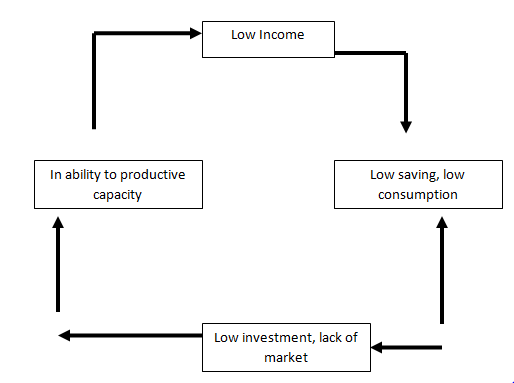
Regner Nurkse examined capital formation problems in underdeveloped countries, describing a circular relationship affecting demand and supply of capital.
According to Nurkse: “A society is poor because it is poor.”
Low income leads to low saving and consumption, limiting markets and investment, which restricts productive capacity and perpetuates poverty.
Nurkse argued that backward countries fail to benefit from manufacturing due to limited markets, not foreign capitalists’ weakness.
The solution is to enlarge markets and apply capital across industries, promoting balanced growth.
In 1953, Nurkse emphasized massive and balanced investment programs for growth in underdeveloped economies.
NURKSE’S VICIOUS CIRCLE OF POVERTY
THE RELEVANCE OF NURKSE’S VICIOUS CIRCLE THEORY
While many third world countries are trapped in poverty cycles, Nurkse’s theory overlooks dependent economies that hinder massive investment and balanced growth.
He emphasized domestic saving and state roles over foreign aid for balanced growth.
The theory highlights poverty extent but offers limited understanding of its causes.
SCHUMPETER’S THEORY OF MOTIVE FORCE, PROCESS AND GOAL
J. Schumpeter emphasized entrepreneurs as the driving force of development through innovation, which triggers industrial progress and profit.
Development involves motive force (entrepreneurs), process (innovation), and goal (wealth and power for entrepreneurs).
THE RELEVANCE OF SCHUMPETER’S THEORY
The theory does not fully apply to less developed countries where entrepreneurship and innovation are limited, and private enrichment is not the dominant goal.
It neglects other development factors like consumption, saving, foreign aid, and technology assistance.
Its strength lies in showing development as internally generated by society members and the role of entrepreneurship.
HARROD – DOMAR GROWTH MODEL / THEORY
Developed by Sir Roy Harrod and E.V. Domar, this theory states investment level determines economic growth, which depends on saving and capital productivity.
Growth rate of GDP depends directly on national saving ratio (s) and inversely on capital/output ratio (K). More saving and investment lead to faster growth.
GROWTH CONCEPTS ACCORDING TO THEORY
Warranted growth – Output growth rate where firms have optimal capital and do not change investment.
Natural rate of growth – Rate of labor force expansion.
Actual growth – Actual change in aggregate output.
Problems arise when actual growth differs from warranted growth, causing economic instability.
Factors affecting growth include saving rate, capital productivity, and depreciation.
CLASSICAL THEORIES OF DEVELOPMENT
Developed by Adam Smith, David Ricardo, Thomas Malthus, and John Stuart Mill, classical theory emphasizes production factors as determinants of growth.
Adam Smith identified land, labor, and capital as main production factors and described the market as an ‘invisible hand’ guiding self-interest to societal benefit.
Smith adopted physiocrats’ ideas like Laissez-faire but rejected the notion that only agriculture is productive.
Ricardo focused on income distribution conflicts among landowners, workers, and capitalists, noting population and capital growth push rents up and wages down.
Malthus explained diminishing returns and low wages due to population growth outpacing food production.
Mill distinguished between efficient resource allocation by markets and the need for societal intervention in income distribution.
GROWTH POLICIES OF TANZANIA
Growth policies are strategies adopted by Tanzania to accelerate economic growth and development.
These include:
- Poverty eradication policies / National development strategies – Policies like MKUKUTA, MKURABITA, monetary and fiscal policies, external borrowing, employment, and youth empowerment to accelerate growth.
- Sectorial policies
Focus on improving sectors like agriculture through productivity improvements, District Agricultural Development Plans (DADPs), and KILIMO KWANZA, including subsidies for other sectors.
- Creation of sustainable development
Use of resources for current development without harming future use. Policies include biodiversity protection, sustainable production, and the Environmental Management Act.
- Social justice and inclusion policy
Promotes youth development, gender equality, women empowerment, and poverty reduction.
- Development cooperation and global partnership for development
Includes bilateral cooperation, debt management, aid relationships, and economic integration to support growth.
- Social progress policies
Improvement of social services such as health, education, housing, water, and sanitation.
THE ROLES OF INTERNATIONAL TRADE AND FOREIGN AID IN ECONOMIC DEVELOPMENT
International trade involves exchange among nations, while foreign aid is assistance from developed countries and organizations like IMF and World Bank.
Their roles include:
- Facilitating technology improvement for resource utilization and production.
- Encouraging competition within domestic industries, boosting output and quality.
- Expanding markets for industries, enabling optimal resource exploitation.
- Increasing revenue and income through taxes and financial aid for investment.
- Supporting social services like education and health for national development.
- Improving economic infrastructure to create a conducive environment for growth.
- Helping finance government budgets to allocate expenditure for development.


3 Comments