


KAKAMEGA EAST DISTRICT PHYSICS PRACTICAL QUESTIONS
1. You are provided with:
- Mass M
- One 100g mass
- Metre rule
- Cotton thread (3 –pieces each about 30cm long)
- Retort stand and clamp
- 250cm3 glass beaker
- 200cm3 of water
- (i) The loops of thread on solid M and the 100g mass
(ii) Suspend the metre rule on the clamp from the 50cm mark
(iii) Hang mass m from the mark. Balance the metre rule using the 100g mass (see fig. 1 below)
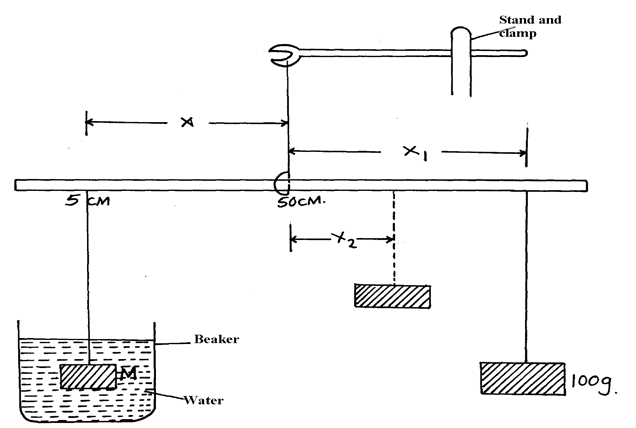
(iv) Measure the distance X and X1 from the 50cm mark
(v) Repeat the procedures for the values of X indicated in the able below:
X(cm) | X1(cm) | X2(cm) | X1 –X2 (cm) |
45 | |||
40 | |||
35 | |||
30 | |||
25 | |||
20 |
(b) (i) Repeat steps (a) (iii) to (a) (iv) above, but this time, keep mass M totally immersed in water.
Record distance X2 required to balance the 100g mass in the table above.
(ii) Complete the table for the values of (X1– X2)
(c) (i) Plot a graph of X1 (Vertical axis) against (X1-X2) on the grid provided
(ii) Determine the slope S of your graph
(iii) What physical property does the slope, S represent?
(iv) Given that the density of water is 1000kg/m3, determine the density of mass, M
(d) (i) Using the apparatus you were given, determine the mass of your metre rule
(ii) Draw a diagram of the set-up of the apparatus you have used to work out (d) (i) above
2. You are provided with the following:-
- Two dry cells (size D)
- 1M long nichrome wire (S.W.G 28) labelled AB
- Ten connecting wires, one of length 70cm having a jockey
- A micrometer screw gauge
- A torch bulb
- An ammeter (0 10A)
- A voltmeter (0 – 3V)
- Switch
Proceed as follows:-
(a) (i) Set-up the circuit below:
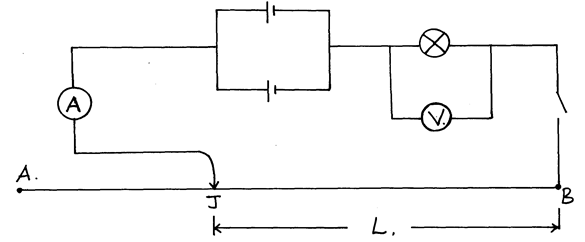
fig 2
(ii) With the jockey (J) at X i.e L = 100cm, record the voltmeter reading, and the ammeter reading I.
Repeat the readings for L = 80, 60, 40, 20, and 0cm and enter your results in the table below:
L(cm) | 100 | 80 | 60 | 40 | 20 | 0 |
P.d V(Volts) | ||||||
Current I (A) |
(b) (i) Plot a graph of p.d V (y-axis) against the ammeter reading , I
(ii) Determine the slope of your graph when V = 0.5volts
(iii) What physical quantity does the slope in (ii) above represent?
(c) (i) Given the apparatus above, draw a diagram of the circuit you would use to determine
the current through the resistance wire, AB and the p.d across it when the cells are now
in series
(ii) Set-up the circuit you have just drawn and record the current I and p.d V when L = 100cm
(iii)Using the micrometer screw gauge, measure the diameter d of the wire, AB
d = ___________________________mm
(iv) Calculate the quantity, S, given that:
S = Vd2
4I L (Take = 3.14)
Give the units of S
KAKAMEGA EAST DISTRICT PHYSICS PRACTICAL ANSWERS
Xcm | X1 C(cm) | X2 (cm) | X1 – X2 (cm) |
45 40 35 30 25 20 | 22.5 20.0 17.5 15.0 12.5 10.5 | 19.25 17.75 15.35 13.10 11.00 9.50 | 3.25 2.25 2.20 2.00 1.25 1.00 |
½ mk each Max mk – 3 At least 1 d.p | ½ each 1.0 Max mk -3 At least – 1d.p | Correct subtraction from candidates’ results 5-6 correct -1mk3-4 correct – ½mk <3correct - 0 |
(c) (i) Graph : Labelled axes with units……………………….1mk
: Simple and uniform scale …………………….1mk
: Plotting (4 correctly plotted pts ………. ½mk max 2mk
: Line (through any 3 of 4 correctly plotted)…1mk
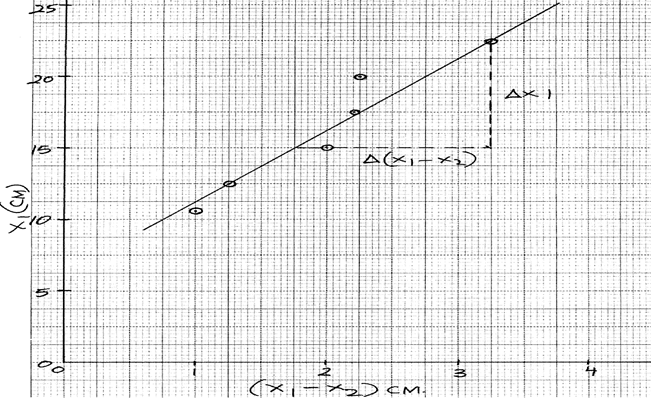 ……………..Total 5mks)
question 2
- (ii)
L(cm) | 100 | 80 | 60 | 40 | 20 | 0 | |
P.d, V(volts) | 0.13 | 0.15 | 0.20 | 0.25 | 0.45 | 0.70 | 0.02 ½ mk each max 3mks atleast 1d.p |
Current, I(A) | 0.07 | 0.10 | 0.11 | 0.13 | 0.15 | 0.17 | 0.02 ½ mk each max 3mks atleast 1d.p |
(b) (i) Axes – labelled with units … . 1mk
Scale – simple and uniform …. 1mk
Plotting – 5-6 correctly plotted …..2mks
3-4 – correctly plotted ..1mk
< 3 correctly plotted …….0mk
total 5mks
(ii) Gradient S = V
I
(52 – 25) x 10-2V
(16 – 14)
= 13.0
2
(iii) Resistance…………1mk
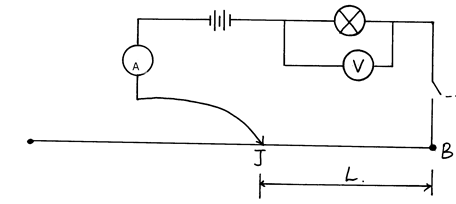
(c) (i)
(ii) Gradient S
(c) (ii) I = 0.09 A 0.01 ……….. ½ mk
V = 0.80V 0.01 ½ mk
(iii) d = 0.4 0.02mm ……1mk
(iv) S =3.142 x 0.80 x (4.4 x 10-1)2
4 x 0.09 x 100
Answer either in m or cm


