


Sound II Questions
1. The human ear can distinguish two sounds as separate only if they need it at least 0.1 seconds
apart. How far from a wall must an observer be in order to hear an echo when he shouts.
(Speed of sound = 330m/s)
2. A girl standing 220m from the foot of a high wall claps her hands and the echo reaches her
1.29 seconds later. Calculate the velocity of sound in air using this observation
3. A boy standing in front of a cliff blows a whistle and hears the echo after 0.5 seconds. He then
moves 17m further away form the cliff and blows the whistle again. He now hears the echo after
0.6seconds. Determine the speed of the sound
4. Sound tends to travel over longer distance at night. Explain
5. You are given two tubes T1 and T2, a clock and a hard wall. Explain how you can use the
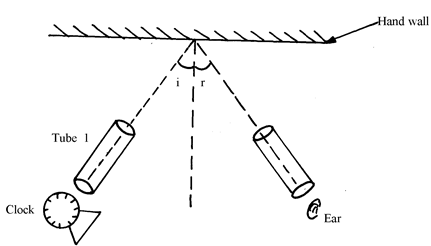 apparatus to demonstrate reflection of sound

6. State two conditions necessary for total internal reflection to occur
7. A student carrying out an experiment discovered that it took 2 seconds for sound wave
traveling through a telephone line to cover a distance d metres and 20 seconds for the same
sound traveling through air to cover a similar distance. Determine the ratio of the speed of
sound in air to that in the wire.
8. State one factor that affects the velocity of sound in air
Sound II Answers
1. 2d = s x t T = 0.1s
d = s x t
1 OR f = 1 = 10Hz
2 0.1
= 330 x 0.1
1 c = f
2
= 330 = x 10
= 16.5 m 1 x = 33
But d = = 33
d = 33 = 16.5
2
 2. Velocity = s
t
 = 220 x 2
 1.29
1.29
= 341.085m/s
 3. Difference in time between the two points = 0.3 – 0.25 = 0.05secs.
Speed = D
T
 = 17m
= 17m
 0.5sec
= 340m/s
 4. At night, the mages of air close to the ground are cooler than those higher above. Sound
get refracted towards the earth
 5. – Place a clock near the end of one tube and point one open end towards a hard surface (wall) at an angle
 – With the ear close to the end of second tube, open tube T2, listen to the reflection of the sound from the wall at different angles of r and note where the sound is loudest
 -It will be observed that maximum (loudest) sound is heard when = r
6. – Light must travel from optically dense to less dense medium
– The angle of incidence must exceed the critical angle


