


Floating and sinking Questions
1. (a). State Archimedes’s Principle .
b). A during bell of weight 60,000N and volume 2m3 is to be raised from the bottom of
the sea. If the density of sea water is 1024kg/m3, calculate:
(i) the mass of sea-water displaced by the bell.
(ii) The force a crane must first exert to just lift the bell from the sea-bed.
(c). The figure below shows a bock of wood of dimension 16cm x 8cm 2cm floating with
¾ of its size submerged in a liquid.
During the experiment with the following set-up above, the following results were obtained.
-Initial reading of the Toppan balance with empty beaker = 22g.
-Final reading of the top pan balance = 176g.
Use the above results to determine:
(i). the density of the block
(ii). The density of the liquid.
2. (a) A piece of sealing wax weighs 3N in air and 0.22N when immersed in water. Calculate:
(i) Its relative density.
(ii) Its apparent weight ,in a liquid of density 800 kgm-3.
(b) The figure below shows a uniform beam one metre long and weighing 2N kept in
horizontal position by a body of weight 10N immersed in a liquid.
Determine the upthrust on the load.
3. A bubble of air has a diameter of 2.0 mm when it is 0.5m below the water surface of a boiler.
Calculate the diameter of the bubble as it reaches the surface, assuming that the temperature
remains constant.
(Take g = 10Nkg-1 density of water = 103kgm-3 and atmospheric pressure = 105Mn-2
4. (a) State the Archimedes principle
(b) The figure below shows a block of mass 25g and density 200kg/m3 submerged beam by
means of a thread. A mass of 2g if suspended form the beam as shown in the figure below

(i) Determine the up thrust force acting on the block
(ii) Calculate the density of the liquid
(c) A rectangular block of dimensions 4m x 3m x 2m is tethered to the sea bed by a wire. If the
density of the material making the block is 0.67g/cm3 and density of water is 1.1g/cm3, calculate: (i) Up thrust force on the block
(ii) Tension on the wire
5. Explain why a needle can be carefully made to float in pure water but sinks if a detergent is
added.
6. (i) State the law of floatation.
(ii) The fig. below shows a floating object of volume 40,000 cm3 and mass 10g. It is held as
shown in water of density 1.25g/cm3 by a light cable at the bottom so that ¾ of the volume
of the object is below the water surface. (Assume that up thrust due to air is negligible)

(iii) (I) Calculate the volume of the object under water.
(II) State the volume of water displaced by the object.
(III) Calculate the weight of water displaced.
(iv) Determine the tension in the cable
(v) Calculate the density of the object.
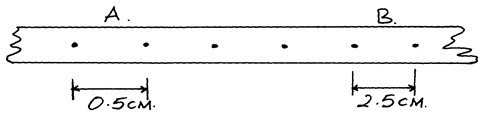 7. (a) A trolley is being pulled horizontally from a ticker-tape timer. The figure below shows part
of the ticker-tape.

(i) Find the average velocity, u, at the section marked A.
(ii) Find the average velocity, V at the section marked B.
(iii) Find the acceleration of the trolley between A and B.
(b) If the mass of the trolley is 500g, determine the resultant force which acted on the trolley
that caused the acceleration.
8. (a) State Archimedes’ principle
(b) (i) Draw a clearly labelled diagram of common hydrometer which is suitable for measuring
the densities of liquids varying between 1.0 and 1.2 g/cm3. Show clearly the marks indicating
1.0, 1.1 and 1.2 g/cm3.
(ii) State the principle upon which the instrument’s use depends
(c) A concrete block of volume V is totally immersed in sea water of density .Write an
expression for the upthrust on the block
9. (a) Define the term relative density
(b) The diagram below shows a wooden log 12m long, density 800kg/m3 and cross-sectional
area 0.06m2 floating upright in sea water of density 1.03g/cm3, such that a third of it is
covered by water.
(i) Determine the weight of the block
(ii) The up-thrust on the block
(iii) The minimum weight that can be placed on the block to just make it fully submerged
(c) The following set-up was then used by a student to determine the relative density of a cork
During the experiment, the following measurements were taken:-
– Weight of sinker in water = w1
– Weight of sinker in water and cork in air = w2
– Weight of sinker and cork in water = w3
(i) Write an expression for the up thrust on cork
(ii) Write an expression for the relative density of the cork
10. (a) State the law of floatation
(b) The diagram figure 11 below shows a block of wood floating on water in a beaker. The set-up
is at  room temperature:-
fig. 11
The water in the beaker is warmed with the block still floating on it. State and explain the
changes that are likely to occur in depth x
(c) The diagram figure 12 below shows a balloon which is filled with hot air to a volume of
200m3 .  The weight of the balloon and its contents is 2200N.
fig. 12
(i) Determine the upthrust on the balloon (density of air 0.0012g/cm3)
(ii) The balloon is to be balanced by hanging small rats each of mass 200g on the lower end of
the rope. Determine the least number of rats that will just make the lower end of the rope touch
the ground.
11. (a) State Archimedes’s principle
(b) A rectangular brick of mass 10kg is suspended from the lower end of a spring balance
and gradually lowered into water until its upper end is some distance below the surface
(i) State and explain the changes observed in the spring balance during the process
(ii) If the spring reads 80N when the brick is totally immersed, determine the volume of
the brick. (Take density of water = 1000kgm-3)
(c) The figure below shows a hydrometer
Explain:
(i) Why the stem is made narrow
(ii) Why the bulb is made wide
(iii) Why the lead-shots are placed at the bottom
12. (a) State the law of floatation
(b) The diagram below shows a wooden block of dimensions 50cm by 40cm by 20 cm held in
position by a string attached to the bottom of a swimming pool. The density of the block
is 600kgm-3

(i) Calculate the pressure in the bottom surface of the block
(ii) State the three forces acting on the block and write an equation linking them when the
block is stationary
(iii) Calculate the tension on the string
13. A block of glass of mass 250g floats in mercury. What volume of glass lies under the surface
of Mercury? Density of mercury is 13.6 x 10³ Kg/m3
14. a) State the law of floatation
b) A balloon of negligible weight and capacity 80m3 is filled with helium of density 0.18Kgm-3.
Calculate the lifting force of the balloon given that the density of air = 1.2Kgm-3
c) A piece of glass has a mass of 52g in air, 32g when completely immersed in water and 18g
when completely immersed in an acid. (Take: density of water = 1g/cm3)
Calculate:
i) Density of glass
ii) Density of the acid
Floating and sinking Answers
1. a)(i) R.d. = Weight of solid
Upthrust in water
= 3N
(3 – 0.22)N 1
= 3 = 1.079
2.78
= 1.079 1
(ii) Its apparent weight in a liquid of density 800 kgm-3. R.d of the liquid = Upthrust in the
liquid Upthrust in water
R.d of the liquid = 800 kgm-3 = 0.8 1
1000 kgm-3
0.8 = u1
2.78 N
u = 2.78 x 0.8
= 2.224
Upthrust u = 2.224N 1
Apparent weight of liquid = weight in air – upthrust in liquid
= 3.0-u – 2.224N = 0.776N 1
2. P1VI= P2P2. 1
 P1 = A + hƍg = 100 000NM-2 + (0.5m x 1000 kgm-3 x 10N/Kg ) 1
P1 = 105000NM-2
P2 = 100 000NM-2 i.e only Atmospheric pressure
∵ Volume is density proportional to R3.
 ∵ P1r3 = P2R3
R3 = P1r3 = 105000pcx (1x 10-3)
P2 100 000 pa 1
R3 = 1.05 x 10⁻⁹ m
R =∛1.05 x 10-9 = 1.0164 x 10⁻³m
D = 2.0328 x 10⁻³m or 2.0328 mm 1 mk
3. (a) When a body is wholly or partially inversed in a fluid , it experiences an upthrust force
equal to the weight of fluid displaced
(b) (i) Clockwise moments = anticlockwise moments
0.02N x 0.3 = F x 0.4
F = 0.02 x 0.3 = 0.015N
0.4
Upthrust = weight –F
=(90.25 – 0.015)N = 0.235N
(ii) Upthrust = weight of liquid displaced
= 0.235N
Mass of liquid = weight
g
= 0.235 = 0.0235kg
10
Vol. of liquid = vol. of solid = mass
Density
= 0.025 = 1.25 x 10⁻⁴kgm-3
200
Density of liquid = Mass of liquid = 0.0235
Vol. of liquid 1.25 x 10-4
= 1880kgm-3
(ii) tension = upthrust – weight
Weight = mass x gravitational
= density x volume x gravitational force
= 0.167 x 1000x 24 x 10 = 40080
Tension = 264000 – 40080 = 223920N
4. Needle floats in water due to surface tension. Needle sinks when detergent is added because it reduces surface tension
5. c (ii) Volume under water = ¾ x 40,000
 = 30,000cm3
6. (a) (i) T = 1/f = 1/100 = 0.01sec;
average Vol. u = 0.5 = 50cm/s;
0.01
(ii) Average Vol. V = 2.5 = 250cm/s;
0.01
(iii) a = v-u
t
= 250 – 50
0.01 x 4
= 5000cm/s2
(b) F = ma
= 0.5 x 50 N = 25N;
7. (a) When a body is wholly or partially inmmersed in a fluid, it experience and upthrust equal to
the weight of the fluid displaced;
(b) (i) Shape;
– Space between 1.0 and 1.1 is larger than that between 1.1 and 1.2
(ii) – Law of floatation which states that floating object displaces its own weight.
(c) Upthrust = Weight of fluid
= Volume of fluid x density x density x g
= Vlg;
8. (a) It is the number of times a substance is denser than an equal amount of water
(b) (i) Weight = mass x gravity weight of water displaced
p = M
V
M = p x V
= (800 x 12 x 0.06)
W = Mg = 576Kg x 10
= 5760N
(ii) Upthrust = Weight of liquid displaced
= p2 x Vl x g
= 1.03 x 103 x 0.06 x 4 x 10 =2472 N
(iii) 5760 – 2472 = 3288N
c (i) (W2 – W3)
(ii) R.d = weight of cork in air
weight of equal vol. of water
= W2 – W1
W2 – W3
9. (a) A floating body displaces its own weight of the fluid in which it floats
(b) The length (x) of block in water increases (block sinks more) . Warm water is lighter; hence
the blocks must displace more water in order to balance the same weight of the block
(c) (i) Upthrust – weight of air displaced
 Volume of air = 200
 Mass of air = (200 x 1.2)
 Weight of air displaced = 200 x 1.2 x 10)
= 2400N

(ii) Resultant upward force= (2400 – 2200)
= 200N
wt of 1 rat = 200 x 14 = 2N
1000
 (2 x n) = 200
 n = 200 = 100 rats
2
10. a) When a body is partially or fully/ wholly immersed in a fluid, it experiences on up thrust
which is equal to the weight of the fluid displaced 1 1 Mk
b) i) The measurement of weight registered reduces as the brick is lowered into the water
Because of increase in up thrust 1
ii) Up thrust = weight in air – weight in water (apparent weight)
= (100 – 80) N
= 20N 1
From Archimedes principle
20 = V X S X g 1
V = 20
1000 X 10
V = 2 X 10⁻³m3 1
c) i) To increase sensitivity
ii) It displaces more liquid that provides an up thrust to make the hydrometer float
iii) To keep the hydrometer upright
11. (a) A floating body displaces its own weight of fluid in which it floats(1mk)
(b) (i) p = hpg
= 90 x 1000 x 10
100
= 9000Pa or 900N/M2
(ii) – Upthrust force
- Weight
– tension on the string( for alteast 2 correct)
Upthrust = weight + tension on the string
(iii) Upthrust = weight + tension
Tension = Upthrust – weight
= (50 x 40 x 20 x 1000 x 10 ) – ( 50 x 40 x 20 x 600 x 10)
1000000 1000000
= 400 – 240= 160N
12. Weight of glass = weight of mercury displaced
0.25 x g = V x 13.6 x 10³ x g
V = 0.25
13.6 x 103
= 1.838 x 10⁻⁵ m3(18.4cm3
13. a) A floating object displaces its own weight of the fluid in which it falls√ 1
b) Up thrust on balloon = weight of air displaced
= mg = Pvg
= 80m3 x 1.2 Kg/m3 x 10N/Kg
= 960N√ 1
Lifting force = Up thrust – weight of helium
= 960 – (80 x 0.18 x 10) √ 1
= 960 – 144
= 816N√ 1
c) i) Mass of water displaced by glass = 52 – 32 = 20g√ 1
Volume of water displaced = Volume of glass = 20g/1gKm3 = 20cm3 √ 1
ii) Mass of acid displaced by glass = 52 – 18 = 34g√ 1
Volume of acid displaced by glass = 20cm3√ 1
Density of acid = 34g/20cm3 = 1.7g/cm3√ 1


