

4. Nutrition in (a) plants (b) animals Questions
 1. The chemical equation below represents a physiological process that takes place in living
organisms:
C6H12O6 + C6H12O6 C12H22O11 + Q
(a) Name the process R
 (b) Name the substance Q
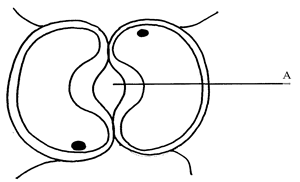
2. The diagram below shows cells in plants:-
(a) Identify the cells shown above
(b) Explain how the cells are adapted to their function
(c) Explain how accumulation of carbon (IV) Oxide in the cells above would lead to the closure
of structure A
3. (a) A leaf of a potted plant kept in darkness for 48hours was smeared with Vaseline jelly then
exposed to sunlight for 8hours. Explain why the test for starch in the leaf was negative
(b) Name two other processes that were interfered with in the plant
4. List two functional differences between plants and animals.
5. Explain how the guard cells are adapted to perform their function.
A and B which are controlled by enzymes x and y
respectively.
(a) Name: (i) Reaction A.
(ii) Enzyme y
7. What are the two functions of bile salts during the process of digestion?
8. State three adaptations of aquatic plants to photosynthesis
9. A biological washing detergent contains enzymes which remove stains like mucus and oils
from clothes which are soaked in water with the detergent:-
(a) Name two groups of enzymes that are present in detergent
(b) Explain why stains would be removed faster with the detergent in water at 35oC rather
than at 15oC
10. Name the diseases caused by deficiency of : (a) Iodine
(b) Vitamin C
11. Name two enzymes and one metal ion that are needed in the blood clotting process
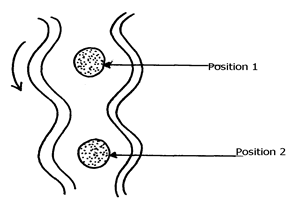 12. The diagram below shows how food boles move along the human oesophogus and the
Intestine
(a) Identify the process illustrated in the diagram
(b) Briefly state how the movement of food boles from position 1 to position 2 is achieved
(c) Name one component of a persons diet that assists in the movement of food described in
(b) above
13. State two adaptations of herbivores which enable them to digest cellulose
14. State two factors that affect the rate of osmosis
15. A certain organ K was surgically removed from a rat, later drastic increase in glucose level in the
blood was reported but when substance Q was injected into the animal the whole process was
reversed.
Identify: (i) Organ K
(ii) Substance Q
16. a) Name the component of a persons diet that is essential for peristalisis
b) Give two groups of food which are reabsorbed along the mammalion digestive system
without undergoing digestion
17. State three roles of light in photosynthesis
18. State two ways in which the guard cells differ their adjacent epidermal cells
19. One of the components of bile is a chemical left over from destruction of red blood cells
i) Identify the chemical substance
ii) What is the role of bile in digestion
20. (a) What is peristalsis?
(b) Explain how the process above is brought about.
21. The following reaction may occur in a forward and backward direction.
Water + Carbon (IV) Oxide Glucose + Oxygen + Energy
- Name the organelle where the reaction occurs in:
(i) Forward direction
(ii) Backward direction
(b) Give one difference and one similarity for the two organelles named in (a) above
22. A solution of sugar cane was boiled with hydrochloric acid and sodium hydrogen carbonate was
added to the solution, which was then boiled with benedicts solution. An orange precipitate was
formed.
(a) Why was the solution boiled with hydrochloric acid and then sodium hydrogen carbonate
added in it
(b) To which class of carbohydrates does sugar cane belong?
(c) State the form in which carbohydrates are:
(i) Transported in animals
(ii) Transported in plants
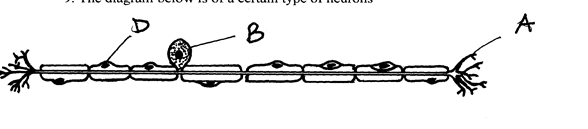 23. The diagram below is of a certain type of neurons
(a) Identify the type of neuron
(b) Give a reason for your answer in (a) above
(c) Give the functions of the parts labeled A, B, and D
24. a) The mitochondria organelle has cristae structure on the inner membrane. State the function of
the cristae
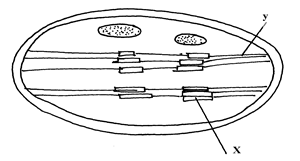 b) The diagram below represents a cell organelle
i) Name the part labeled Y
ii) State the function of the part labeled X
25. a) State the role of emulsification in the digestion of fats in the alimentary canal
b) What is the function of hydrochloric acid in the alimentary canal
26. Briefly explain the effect of poisoning the roots hair on the uptake of nitrate by plants
27. Briefly explain the symbiotic relationship in the root nodule of a leguminous plant
28. Explain how saliva is important in digestion
29. What is the fate of excess glucose in plants?
30. State two ways in which guard cells differ from other epidermal cells
31. Briefly explain the fate of the following products from the light stage of the process of
Photosynthesis: (a) Oxygen (b) Hydrogen (c) ATP
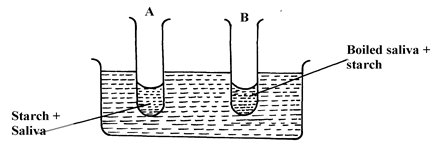 32. In an experiment to investigate on aspect of digestion, two test tubes A and B were set-up as
shown in the diagram below;
The test tubes were left in the bath for 30minutes.The content of each test tube was then tested for
starch using iodine solution:-
(a) What was the aim of the experiment?
(b) What results were expected in test-tube A and B
(c) Account of the results you have given in (b) above in test tube A and B
33. Below is a process that takes place along the mammalian digestive system:
(a) Name the processes represented by A and B
(b) Name part of the alimentary canal where the process B takes place
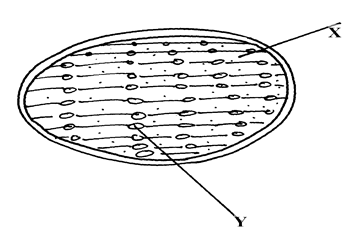 34. The diagram below represents a cell organelle
(i) Name the part labeled y
(ii) State the function of the part labeled X
(ii) State the function of the vitamin named in (i) above
36. (a) Name the disease caused by schistosoma parasites in man.
(b) How is schistosome adapted to its parasitic mode of life?
37. The table below shows three enzymes A, B and C and their respective optimum pH.
Enzyme | Optimum pH |
A | 6.8 |
B | 2.0 |
C | 8.0 |
(a) (i) Name the most likely region of the alimentary canal of a mammal where enzyme
B would be found.
(ii) Give a reason for your answer in (a) (i) above
38. In an experiment to investigate an aspect of digestion, two tubes A and B were set up as shown
in the diagram below.
The test tubes were left in the water bath for 30 minutes. The content of each tube was then tested
for starch using iodine solution.
(a) What was the aim of the experiment?
(b) Explain the expected in the tube.
39. (a) Name the specific part of the chloroplast where the following processes occur.
(i) Carbon IV oxide fixation
(ii) Photolysis
(b) State one way in which the dark reactions of photosynthesis depends on light reaction.
40. The concentration of carbon IV oxide in a tropical forest was measured during the course of 24
hour period from mid-night. The graph below shows the results obtained.
Account for the results obtained at: (i) Midnight. (ii) At 12.00 noon.
41. State three ways by which the rate of enzyme controlled reactions can be increased.
42. Study the dental formula given below:
I 0 C 0 PM 3 M 2
4 0 3 3
(a) Identify with reasons the mode of feeding of the animals whose dental formula is
given above
(b) Calculate the total number of teeth in the mouth of the above animal
43. Explain why small mammals such as moles feed more frequently than larger ones such
as elephants
44. State three ways by which plants compensate for lack of the ability to move from one place
to another
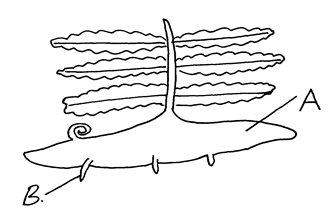 45. Study the diagram below and answer the questions that follow
(a) Label the parts A and B
(b) State one observable difference between the structure above and the liverwort
46. What is glycolysis?
47. (a) State two difference between monosaccharide and polysaccharides
(b) Name the bond found in proteins
48. Name two products of light reaction used in the dark reaction
49. State two functions of the large intestine in humans.
50. The diagram below shows a leaf of a growing plant partly covered with aluminium foil.
The plant was placed in the sun from morning to midday and then tested for starch.
(a) What was the aim of the experiment?
(b) State the observation made when the leaf was tested for starch
51. The figure shows the effect of temperature on an enzyme catalyzed reaction.
(a) Explain what happens between A and B
(b) What is X?
52. Name two mineral elements that are necessary in the synthesis of chlorophyll.

 53. The figure below is a diagram of the anterior portion of the tapeworm. Taenia
solium.
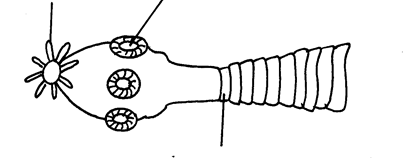

(a) Name the parts labeled A, B, and C
(b) What is the intermediate host of Taenia Solium?
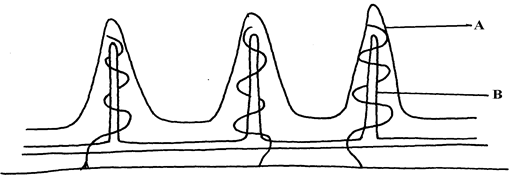 54. The diagram below represents a longitudinal section through the ileum wall
a) Identify the structure labeled A and B
b) State one function of A and B
c) State two functions of the ileum
d) Explain the role of the liver in digestion
e) State the endocrine role of the pancreas in a mammal
55. The chart below shows the relationship between concentration of CO2 around the plant and the
rate of photosynthesis
(a) Account for the rate of photosynthesis between D-E
(b) Account for the rate of photosynthesis between F-G
(c) Briefly describe the reactions during the light stage of photosynthesis
56. The diagram below shows the effect of varying light intensity on the exchange of carbon IV
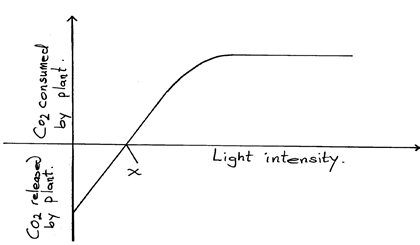 oxide between the leaves of a green plant and the atmosphere.

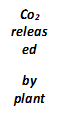
a) What is the name given to the point marked x?
b) i) With reference to carbon IV oxide exchange state what happens at point x.
ii) Explain how the effect observed at point x occurs.
c) Explain why there is a net uptake of carbon IV oxide at light intensity above x.
d) What would happen to the plant if light intensity falling on it were maintained at x
throughout?
e) What can you say about the exchange of oxygen between the plant and the surrounding air at
intensities below x?
57. The following diagram of a leaf shows what happens in a pant leaf during photosynthesis:-

(a) Give two ways in which leaves are adapted to absorb light
(b) Name the gases labelled X and Y
(c) Name the tissue that transports water into the leaf and sugars out of the leaf
(d) Explain why it’s an advantage for the plant to store carbohydrates as starch rather than as
sugars
58. (a) What is meant by digestion?
(b) Describe how mammalian small intestine is adapted to its function
59. Form one students from Inungo school arranged their apparatus as shown below, to investigate a
certain phenomenon. The set up was placed in light.
(a) State the likely aim of the set up
(b) State the role of the syringe in the set-up above
. (c) (i) Name gas X
(ii) Write an equation to show how gas X was formed in the set-up
(d) State three factors that increase the rate of enzyme activity
(e) Give a reason why the test tube is immersed in a beaker of water
60. A student was culturing E. coli (a bacterium) in a Petri-dish. He placed the Petri-dish in an
incubator at 30oC.He removed it from the incubator the following day and found that five
colonies of bacteria had grown. He decided to return it into the incubator to give it more time.
When he removed it fourteen days later, he could not observe any colony.
a) Why was there no colony on the fourteenth day?
b) Explain how bacteria cause spoilage of stored food in warm moist conditions.
c) Name other organisms which also cause food spoilage.
d) State their economic importance to nature.
61. The table below shows the results of an experiment carried out to determine the rate of photosynthesis at different light intensities and varying Carbon (IV) oxide concentrations. The rate was determined by counting the number of bubbles per minute. The temperature was kept constant
Light intensity in lux | % carbon(IV)oxide concentration | ||||||
0.0% | 0.3% | 0.6% | 0.9% | 1.2% | 1.5% | 1.8% | |
1500 | 0 | 16 | 30 | 38 | 40 | 40 | 40 |
6000 | 0 | 52 | 80 | 96 | 100 | 98 | 100 |
10000 | 0 | 80 | 100 | 115 | 120 | 122 | 120 |
a) On a graph paper provided, draw a graph for each of the light intensities. All the three graphs
should be plotted on the same axis (rate of photosynthesis on vertical axis and carbon (IV)
oxide concentration on horizontal axis b) What is the effect of an increase in carbon (IV) oxide concentrations and light intensities
c) Briefly explain how aquatic green plants meet light intensities and carbon (IV) oxide
requirement
d) Using the data provided in the table state two factors required by the green plants for food
production
62. Explain how the mammalian intestines are adapted to perform their function.
63. A healthy plant was kept in the dark for 24hours following which two of its leaves were enclosed
in glass flasks as shown below. The set up was the exposed to sunlight for a number of hours.
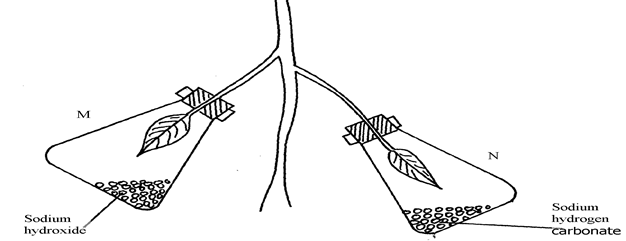


(a) Why was it necessary to keep the plant in the dark for 24 hours?
(b) Give the function of each of the following in the experiment
(i) Sodium hydroxide
(ii) Sodium hydrogen corbonate
(c) Explain the expected results in leaf.
(i) M when tested for starch
(ii) N when tested for starch?
(d) Suggest a suitable control for this experiment
64. The diagram below shows an experiment that was carried out to measure how fast a were
plant such as Elodea photosynthesizes
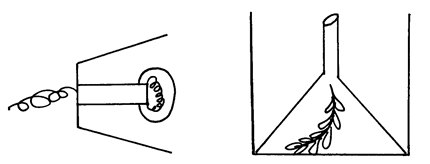
The shoot was exposed to different light intensities and the rate of photosynthesis estimated by counting the number of bubbles of gas leaving the shoot in a given time. the results are given below;
Number of bubbles per minute | 7 | 14 | 20 | 24 | 26 | 27 | 27 | 27 |
Light intensity (Arbitrary units) | 1 | 2 | 3 | 4 | 5 | 6 | 7 | 8 |
a) Plot these data on apiece of graph paper provided
b) At what light intensity did the shoot produce
i) 18 bubbles per minute
ii) 25 bubbles per minute
c) Give two better ways of measuring the rate of photosynthesis than counting bubbles
d) What is the role of light intensity in photosynthesis
e) Account for the expected results of doing this experience at the following temperature;
i) 4ºC
ii) 34ºC
iii) 60ºC
f) Other than light intensity and temperature, name other factors that affect the rate of
photosynthesis
65. In an experiment, a leaf from a plant which had been kept in the dark overnight was boiled in water for a minute. It was then boiled in alcohol and washed in warm water. Iodine solution was then added onto the leaf:
(a) Why was the loaf boiled in;- (i) Water
(ii) alcohol
(b) (i) What observation was made on the leaf after adding iodine solution
(ii) Give a reason for your answer in (b) above
(c) What was the aim of the experiment
(d) Why was it necessary to wash the leaf in warm water
(e) What is a variegated leaf?
(f) Write a word equation for the process of photosynthesis
4. Nutrition in (a) plants (b) animals Answers
1. a) Condensation;
b) water;
2. (a) Guard cells;
(b) Cells walls are thicker on the inner side then the outer side; which enables them to pull
inwards when the cells are turgid; contains chloroplasts that are able to phosynthesize
and produce sugars which enable them to absorb water; (any two points)
(c) Accumulation of carbon (IV) oxide in the leaf forms a weak carbonic acid; lowering the pH
which favours conversion of sugar to starch; causing the guard wells to lose turgidity; and
close;
3. (a) Stomata on the epidermic were blocked; thus no carbon (IV) oxide entered the heat;
therefore photosynthesis did not take place;
(b) Respiration; Excretion/ transpitation;
4. (a)
Etiolated plant | Normal plant |
– Yellow leaves/stems – small leaves – long inter-nodes and thin stems – weak stem/feeble stem | – green leaves/stems; – large leaves; – short internodes and thick stem; – strong /firm stem; |
(b) Enables plants to grow faster towards light for photosynthesis;
5.
PLANTS | ANIMALS |
– Make their own food through the process of photosynthesis | – Depend on plants and other animals for food; |
– They do not move from one place to another | – They move from one place to another; |
– Respond slowly to stimuli | – Respond faster /quickly to stimuli; |
6. They have thick inner membrane and thin outer membrane to allow them to bulge
outwards when turgid to open stomata; Have numerous chloroplasts, to carryout photosynthesis, forming sugars to control opening and closing of stomata;
7. Reaction A – condensation;
Enzyme Y – Sucrose;
8. – To emulsify fats;
– To provide an alkaline condition for enzyme activities;
– To provide an alkaline condition for enzyme activities;
9. Have stomata on upper surface;
– Large leaf surface to increase surface are for absorption of light;
– Presence of aerenchyma tissues, allows them to float on water hence accessing sunlight;
10. (a) – Protease;
– Lipase
(b) At 35oC optimum temperature for enzyme to act; at 15oC enzymes in active since
temperature is low;
11. a) Goiter;
b) Scurvy;
12. Enzymes – Thrombin; Thromboplastin/ Thrombokinase;
Metal ion – Calcium ions;
13. a) Peristalsis;
b) Circular and longitudinal muscles on the wall of oesophagus and intestines contract
alternately;
c) Roughage;
14. Long gut / many chambers to provide large surface area for digestion; bacteria in rumen has
enzyme cellulase which digest cellulose (to glucose/ sugars).
15. Concentrated of the solutions separated by a semi-permeable membrane; existence of
concentration gradient; temperature of the solution;
16. i) Pancreas; ii) Insulin;
17. a) Roughage; b) Water, vitamins, mineral salts;
18. Photolysis – Splitting water into H+ and oxygen gas;
– Synthesis of ATP to be used during dark stage;
– Synthesis of chlorophyll necessary for photosynthesis;
19.
Guard cells | Other epidermal cells |
– Have chloroplasts/photosynthesize – Have thick inner walls/thin outer walls Bean shaped |
block shaped (any correct pair ) |
20. (i) Biliverdin ; Bilirubin
(ii) Emulsify fats;
21. a) Involuntary movement of food along the alimentary canal
b) Rhythmic contraction and relaxation of the circular and longitudinal muscles along the gut;
22 . a) i) Chloroplast;
ii) Mitochondrion;
b) Similarity — Both have a double membrane;
Difference Chloroplast Mitochondrion;
– Grana Cristae;
– Stroma Matrix;
23. a) HCl — to hydrolyse complex sugar to simple sugar
NaHCO3 — To neutralize the HC1
b) Disaccharides;
c) i) Glucose;
ii) Sucrose;
24. a) Sensory neuron;
b) Cell body is off the axon;
c) A — Conduct coming signals / Receives impulses;
B — Receives impulses rough dendrites / coordinates the nerve cell;
D — produce myclin sheath that protects and insulates the axon;
25. a) Increases surface area for attachment of respiratory enzymes;
b) i) Intergrana;
ii) Accept site 4 photolysis; contains chlorophyll pigment absorbs light;
26. a) Increases surface area of fats for purpose of digestion;
b) Accept any two correct
– Destroys any ingested pathogens;
– Provides acidic media for protein digesting enzymes (pepsin);
– Converts/ activates pepsinogen inactive form to pepsin;
27. Poison acts as competitive inhibitor for active site of respiratory enzymes; energy production
for active transport of nitrates is impaired;
28. Rhizobium bacteria benefits by getting Shelter & carbohydrates;
– Leguminous plant obtains nitrates fixed by the bacteria;
29. – Enzymes amylase digests starch to maltose
– Mucus lubricates food
30. They are converted to starch; then stored in organs and tissues;
31. -Guard cells have chloroplast;
-They are bean shaped;
32. Oxygen-releases to the atmosphere or used by plants for respiration;
Hydrogen-enter dark stage, where it combines with CO2 to form simple sugar;
ATP- provide energy during the combination of hydrogen a toms with CO2in dark stage;
33. a) to investigate the effect of boiled saliva on starch/to show the effect boiled/denature
enzyme amylase has on starch;
b) A-brown colour/colour of iodine persists;
B- blue black/blue/dark colouration;
c) A-starch has been digested/starch has been broken down/amylase hydrolyses starch hence
no colour changes;
B-enzymes/amylase denatured hence no starch digested;
34. a)A-condensation;
B-hydrolysis;
b)Duodenum; (any correct Rj .wrong spelling)
-ileum;
35 i)stroma
ii)side of light reaction of photosynthesis /site of water photosynthesis and adenosine
triphosphare production (ATP)
36. (i) (Vitamin D/calciferol;
(ii) Prevents rickets/Osteomalacia;
37. a) Schistosomiasis/ Bilharzia:
b) -Has suckers for attachment to the host:
- Has secondary host/snail to increase its chances of survival:/increase chances of transfer to several hosts;
- Its larvae/Eggs produces lytic enzyme to soften the hosts tissues hence allow prevention into the host:
- Larva covered with cysts to remain dormant for a long time;
- Goes through various forms of lifecycle/miracidia. cercariae and redia to make it difficult to eradicate/increase chance of survival/transmission;
- Adult produces chemical substances to cover the body to protect it against hosts defence mechanism;
- Separate sexes to ensure dispersed eggs are fertilized before shed into blood vessels.
38. (a) (i) Stomach
(ii) Presence of hydrochloric acid to provide acid conditions
39 (a) To investigate the effect of heat on salivary amylase.
(b) A – The brown colour of iodine was retained because the starch was digested by enzyme
amylase in the saliva; 1.
B – The colour changed to blue black/black; because amylase in the saliva was denatured
by heat;
40. (a) (i) stroma;
(ii) Granum;
(b) – Provide energy – ATP;
– Provide H+ – ves H2 GAS /atoms;
41. Midnight – There was no photosynthesis at night; and carbon IV oxide was not used hence the
high concentration;
Noon – Carbon IV oxide was used in photosynthesis and therefore CO2 concentration dropped.
42. – By increasing the enzyme /substrate concentration;
– By increasing the temperature below the optimum upto the optimum temperature;
– Providing suitable /favourable /optimum pH.
43. (a) – Mode of feeding is herbivorous. Reject Herbivore
– Absence of upper incisors but have hony pad
(b) 30
44. Small mammals have large surface area to volume ratio; hence lose heat quickly to environment; to replace the heat , lost, their metabolism is high making them to feed more frequently
45. – Plants are able to synthetize their own food
– Plants are able to use pollination rather rhan moving to seek mating partners
– Use seed and fruits dispersal to colonize new habitats (3×1=3mks)
46. a) A- Rhizome
B- Adventitious roots
(b) The liverwort body form is thalloid while the fern has 3body parts, roots, stem and leaves
47. The break down of glucose into pyruvic acid
48. (a)
Monosaccharide | Polysaccharides |
– Are soluble in water | – Are insoluble in water |
– Form sweet tasting solution | – Do not have a sweet taste |
– Reduce Copper(II) ions in benedicts solution to Copper (I) ions when heated together | – They do not reduce |
– Are crystalizable | – Are not crystallizable |
(b) Peptide
49. H+/H atom; rej H2/Hydrogen gas
– ATP/energy
50. Absorption of water; accept absorption of salts/ calcium/ iron; secretion of mucus;
51. a) To show that light is necessary for photosynthesis;
b) Only the uncovered areas turned blue- black with iodine; the part covered with aluminum
foil did not receive light and thus could not carry out photosynthesis;
52. a) As the temperature increases, the rate of the reaction also increases; this happens because
an increase in temperature increases molecular movement, thus increasing the chances of
collision between the enzyme and substrate molecules;
b) X – is the optimum temperature/ It is the temperature at which the reaction proceeds
53. Nitrogen;
Magnesium;
Iron;
54. a) A- Hook;
B – Sucker;
C – Youngest proglottid;
b) Intermediate host – pig;
55. a) A – Villus
B- Lacteal
b) A __ Increases surface area for maximum digestion and absorption;
B – Absorption of fatty acid and glycerol;
c) – Final digestion of undigested foods;
– Absorption of soluble end products of digestion;
d) Produces bile juice which contains bile salts that emulcify fat;
e) Produces insulin and glucagons hormones;
Reject if only one hormone is mentioned
56. (a) Rapid increase (in water of photosynthesis) due to increase in concentration of CO2
(b) Constant rate/no increase rate and no decrease, other factors /light/temperature water
become limiting/inadequate.
(c) chlorophyll traps energy.
Light energy react water into hydrogen ions and oxygen/photolysis.
Hydrogen is picked by hydrogen.
Acceptor/NAD/NADP (and becomes reduce, * ACCEPT NADPH,NADPH
ATP adenosine triphosysbate formed.
57. (a) Compensation point
(b) (i) There is no net uptake or release of Carbon (VI) oxide by the plant;
(ii) The rate of respiration and photosynthesis in the plants are equal; therefore all the
Carbon (VI) Oxide released during respiration is used in photosynthesis;
(c) At light intensity beyond/above X, the rate of photosynthesis is higher than the rate of
respiration; and this requires a net uptake of Carbon (IV) Oxide (to sustain the increasing
rate of photosynthesis);
(d) Growth would cease because all the products of photosynthesis would be utilized in
respiration;
(e) The plant will take up oxygen from the surrounding air since the rate of respiration is
higher than the rate of photosynthesis;
58. (a) Broad and flat to absorb maximum light
Have chloroplast with chlorophyll to trap light.
Transparent cuticle to allow light to pass through
(b) X – Carbon (IV) Oxide
Y – Oxygen
(c) Xylem – Transports water
Phloem – Sugars out of the leaf
(d) Starch is insoluble in water, hence osmotically inactive; This reduces effect on absorption of
water.
59. a) breakdown of complex food, substance; into simple diffusible substances; b)intestines relatively long/coiled /folded this allows food enough time for absorption.
Intestines long /have villi; to increase the surface area for absorption and digestion
The walls have glands which secrete enzymes for digestion;(examples of correct enzymes
e.g. Maltose, sucrose lactose etc).some glands /goblet cells also produce mucus; which protects
The intestinal wall from autodigestion/being digested; and reduce friction;
Intestines have opening of ducts which allows bile pancreatic juice into the lumen;
The intestines have circular and longitudinal muscle, whose contraction and relaxation/peristalsis;
Leads to mixing of food with enzymes/juice; facilitating rapid digestion and help push food along the gut; the intestines are well supplied with blood vessels to supply oxygen/ remove digested food from an efficient absorption and transporting system to move the food away from the small intestines;
Have lacteal vessels for transport of fat/lipid; have thin epithelial lining; to facilitating fast absorption /diffusion;
Note. Allow increases in surface are for absorption only once
60. (a) To investigate the rate of photosynthesis;
(b) It is used to draw the bubbles of gas through the apparatus;
 (c) (i) Oxygen gas;
 (ii) 6 CO2 + 6H2O C6H12O6 + 6O2
Acc. Either word or chemical equation
 If chemical, must be balanced, symbols capital.
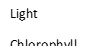
or Carbon (IV) Oxide + water Glucose + Oxygen;
- – Optimum
– Optimum PH
– Absence of inhibitors.
– Presence of co-factors or co-enzymes.
– Low substrate concentration.
(e) – To minimize temperature changes.
61. a) A- Rhizome
B- Adventitious roots
(b) The liverwort body form is thalloid while the fern has 3body parts, roots, stem and leaves
62. The break down of glucose into pyruvic acid
63. (a)
Monosaccharide | Polysaccharides |
– Are soluble in water | – Are insoluble in water |
– Form sweet tasting solution | – Do not have a sweet taste |
– Reduce Copper(II) ions in benedicts solution to Copper (I) ions when heated together | – They do not reduce |
– Are crystalizable | – Are not crystallizable |
(b) Peptide
64. H+/H atom; rej H2/Hydrogen gas
– ATP/energy
65. Absorption of water; accept absorption of salts/ calcium/ iron; secretion of mucus;
66. a) To show that light is necessary for photosynthesis;
b) Only the uncovered areas turned blue- black with iodine; the part covered with aluminum
foil did not receive light and thus could not carry out photosynthesis;
67. a) As the temperature increases, the rate of the reaction also increases; this happens because
an increase in temperature increases molecular movement, thus increasing the chances of
collision between the enzyme and substrate molecules;
b) X – is the optimum temperature/ It is the temperature at which the reaction proceeds
68. Nitrogen;
Magnesium;
Iron;
69. a) A- Hook;
B – Sucker;
C – Youngest proglottid;
b) Intermediate host – pig;
70. a) A – Villus
B- Lacteal
b) A __ Increases surface area for maximum digestion and absorption;
B – Absorption of fatty acid and glycerol;
c) – Final digestion of undigested foods;
– Absorption of soluble end products of digestion;
d) Produces bile juice which contains bile salts that emulcify fat;
e) Produces insulin and glucagons hormones; Reject if only one hormone is mentioned
71. (a) Rapid increase (in water of photosynthesis) due to increase in concentration of CO2
(b) Constant rate/no increase rate and no decrease, other factors /light/temperature water
become limiting/inadequate.
(c) chlorophyll traps energy.
Light energy react water into hydrogen ions and oxygen/photolysis.
Hydrogen is picked by hydrogen.
Acceptor/NAD/NADP (and becomes reduce, * Accept NADPH, NADPH
ATP adenosine triphosysbate formed.
72. (a) Compensation point
(b) (i) There is no net uptake or release of Carbon (VI) oxide by the plant;
(ii) The rate of respiration and photosynthesis in the plants are equal; therefore all the
Carbon (VI) Oxide released during respiration is used in photosynthesis;
(c) At light intensity beyond/above X, the rate of photosynthesis is higher than the rate of
respiration; and this requires a net uptake of Carbon (IV) Oxide (to sustain the increasing
rate of photosynthesis);
(d) Growth would cease because all the products of photosynthesis would be utilized in
respiration;
(e) The plant will take up oxygen from the surrounding air since the rate of respiration is
higher than the rate of photosynthesis;
73. (a) Broad and flat to absorb maximum light
Have chloroplast with chlorophyll to trap light.
Transparent cuticle to allow light to pass through
(b) X – Carbon (IV) Oxide
Y – Oxygen
(c) Xylem – Transports water
Phloem – Sugars out of the leaf
(d) Starch is insoluble in water, hence osmotically inactive; This reduces effect on absorption of
water.
74. a) breakdown of complex food, substance; into simple diffusible substances; b)intestines relatively long/coiled /folded this allows food enough time for absorption.
Intestines long /have villi; to increase the surface area for absorption and digestion
The walls have glands which secrete enzymes for digestion;(examples of correct enzymes
e.g. Maltose, sucrose lactose etc).some glands /goblet cells also produce mucus; which protects
The intestinal wall from autodigestion/being digested; and reduce friction;
Intestines have opening of ducts which allows bile pancreatic juice into the lumen;
The intestines have circular and longitudinal muscle, whose contraction and relaxation/peristalsis;
Leads to mixing of food with enzymes/juice; facilitating rapid digestion and help push food along the gut; the intestines are well supplied with blood vessels to supply oxygen/ remove digested food from an efficient absorption and transporting system to move the food away from the small intestines;
Have lacteal vessels for transport of fat/lipid; have thin epithelial lining; to facilitating fast absorption /diffusion;
Note. Allow increases in surface are for absorption only once
75. (a) To investigate the rate of photosynthesis;
(b) It is used to draw the bubbles of gas through the apparatus;
 (c) (i) Oxygen gas;
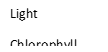
 (ii) 6 CO2 + 6H2O C6H12O6 + 6O2
Acc. Either word or chemical equation
 If chemical, must be balanced, symbols capital.
or Carbon (IV) Oxide + water Glucose + Oxygen;
- – Optimum
– Optimum PH
– Absence of inhibitors.
– Presence of co-factors or co-enzymes.
(e) – To minimize temperature changes.
76. (a) The bacteria ad exhausted the available food materials and they died;
(b) They multiply very fast as they feed on the substances; release toxic waste on food then die
there causing food spoilage
(c) fungi;
(d) – Speed up recycling of matter in the ecosystem;
– Breaks down /decompose dead complex organic matter
77. (a) Graph:
title -1mk
labelled axes) –
plotting –)
curve – (free hand) ( Continuous not dotted – Rej. curve if joined with a ruler
(b) As carbon dioxide concentration increase rate of photosynthesis also increases up to a limit
beyond which there is no increase even of CO2 concentration is increased.
– Increase in light intensity increased also rate of photosynthesis up to a limit
(c) – Have a darker colour/ light sensitive chlorophyll which to maximumly absorb any light
rays penetrating water
– They either float next to water surface to be exposed /closer to light or floats on water surface.
– Have thin or no cuticle to allow easier diffusion of dissolved CO2
(d) – Carbon (IV)- Oxide concentration;
– Light intensity ;
78.
- Is relatively long/ cooled/ folded to allow food (enough) time/ increase surface area for absorption of digested food and for digestion
- Lumen has projection called villi; villi has projections called microvilli; to increase surface area for absorption
- Walls have glands which secret enzymes for digestion; e.g. maltase/ sucrose/ lactase/ enterokinase/ peptidases
- Some glands/ goblet cells produce mucus; which protects the intestinal wall from being digested and also reduce friction
- Have openings of ducts which allow bile/ pancreatic juice into the lumen
- The intestines have circular and longitudinal muscles; whose contraction and relaxation/ peristalsis leads to mixing of food with enzymes/ juices; facilitating rapid digestion; and helps push food along the gut
- Intestines are well supplied with blood vessels/ highly vascullarized; to supply oxygen/ remove digested food
- Lacteal vessels; transport fats/ lipids
- They have thin epithelia; to facilitate fast/ rapid absorption/ diffusion
79. (a) To destarch the plant leaves;
(b) (i) To absorb carbon (iv) oxide in the flask;
(ii) To enrich the air in the flask with carbon(iv) oxide;
(c) (i) leaf M – Sodium Hydroxide absorbed Carbon (IV) oxide in the flask;
– No photosynthesis occurred and so the leaf retained the brown colour of Iodine;
(ii) Leaf N – Sodium hydrogen carbonate enriched the flask with carbon (IV) oxide;
- Photosynthesis occurred and starch formed reacted with iodine to give the leaf the characteristic blue-black colour;
(d) Conical flask covered with aluminium foil and no sodium hydroxide or sodium hydrogen
carbonate;
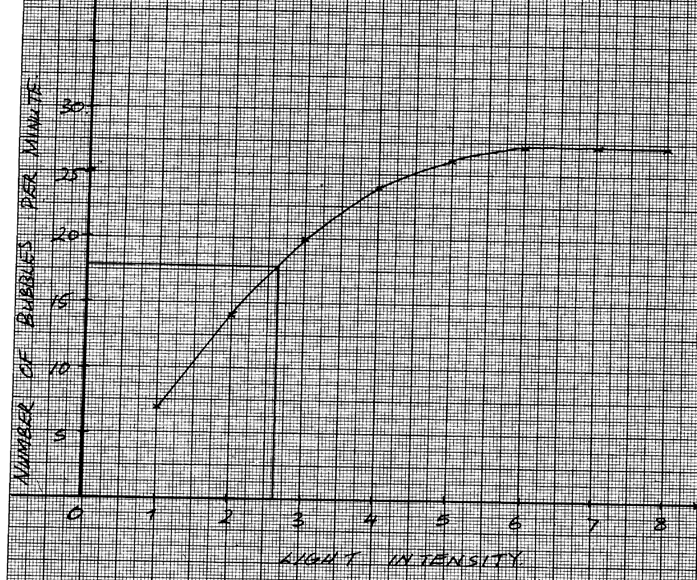
80. a)Graph
b) i) 2.5 – 2.7; i.e. 2.6 + 0.1
ii) 4.5 + 0.1
c) – Volume of CO2 consumed/ volume of O2 liberated
– Change in dry mass (due to photosynthesis);
d) – Photolysis of water
ATP synthesis
e) i) Rate of photosynthesis very low
Enzymes inactivated
ii) Rapid rate of photosynthesis
Optimum temperature for enzyme reaction
iii) Very low rate of photosynthesis
Enzymes denatured
f) Chlorophyll concentration (in leaves)
CO2 concentration
Water availability


79. a) i) to kill cells/expose starch graduals/stop biology processes;
ii) to decolourise the leaf/to dissolve chlorophyll;
b)i) leaf retained brown colour of iodine;
ii) starch was absent (since no photosynthesis had taken place);
c) to investigate the necessity of light in the process of photosynthesis;
d) to soften the leaf and wash off alcohol;
e) leaf with some parts/patches looking chlorophyll;
f) water + carbon(iv)oxide light Glucose +oxygen;
chlorophyll (carbohydrate)


