


Acids, bases and salts Questions
1. Study the reaction below and answer the questions that follow
NH3
(g) + H2O (l) NH4+ (aq) + OH–(aq)
(a) Define the term acid
(b) Identify an acid in the above reaction
(c) Explain your answers in (b) above
2. A student mixed equal volumes of Ethanol and butanoic acid. He added a few drops of
concentrated Sulphuric (VI) acid and warmed the mixture
(i) Name and write the formula of the main products
Name………………………………….
Formula……………………………………..
(ii) Which homologous series does the product named in (i) above belong?
3. A sample of water from a village in Trans Mara East District was divided into equal portions
and each mixed with equal volume of soap solution. The observations made are tabulated below:
Sample of water | Treatment before adding soap | Observations made on shaking with soap |
I | Boiled | Lather form immediately |
II | No treatment | Slight lather form slowly |
III | Treatment with washing soda | Lather formed immediately |
(a) What type of hardness is present in water from the village. Explain
(b) State one advantage of hard water
4. The solubility of Iron (II) Sulphate crystals are 22oC is 15.65g per 100g of water. Calculate
the mass of iron(II) sulphate crystals in 45g of saturated solution at the sae temperature
5. Hardness of water may be removed by either boiling or addition of chemicals:
(a) Write an equation to show how boiling removes hardness of water
(b) Name two chemicals that are used to remove hardness of water
6. State one advantage of drinking hard water rather than soft water.
7 Given this reaction;
RNH2 + H2O RNH3+ +OH–
a) Identify the acid in the forward reaction .Explain
b) Dilute nitric acid can react with a solution of sodium carbonate. Write an ionic equation
for the reaction
8. Magnesium hydrogen carbonate is responsible for the temporary hardness of water.
This type of hardness can be removed by addition of ammonia solution
(a) Describe how temporarily hard water is formed
b) Write an equation to show the softening of temporarily hard water by the addition
of aqueous ammonium solution
9. When 2M potassium hydroxide solution was added to solution R, a white precipitate T was
formed which dissolved in excess potassium hydroxide solution to form solution L. solution
R forms a white precipitate with sodium chloride solution:
(a) Identify the cation in solution R …………………………………………………………….
(b) Name precipitate T ……………………………………………………………………
(c) Write the molecular formula of the compound in solution L
10. Below is a table showing the solubilities of salts Q and R at different temperatures.
Temperature oC | 0 | 10 | 20 | 30 | 40 | 50 | |
Solubilities in grammes per 100g of water | Salt Q | 3.0 | 5.0 | 7.4 | 10.0 | 14.0 | 19.0 |
Salt R | 15.0 | 17.0 | 20.7 | 25.7 | 28.7 | 33.0 |
(a) Define the term “Solubility of salt”
(b) If both salts Q and R are present in 100cm3 of saturated solution at 50oC, what will
be the total mass of crystals formed if the solution was cooled to 20oC?
11. The following results were obtained during an experiment to determine the solubility of potassium
chlorate(V)in water at 30ºC.
Mass of evaporating dish =15.86g
Mass of evaporating dish + saturated solution at 30ºC = 26.8g
Mass of evaporation dish +solid potassium chlorate (v) after evaporation to dryness=16.86g
Calculate the mass of the saturated solution containing 60.0g of water at 30ºC
12. (a) What is meant by the term solubility of salts?
(b) Calculate the solubility of salt given that 15g of the salt can saturate 25cm3 of water
(c) The table below gives the solubility of salt X in grams per 100g of water at different
temperatures
Temp oC | 10 | 20 | 30 | 40 | 50 | 60 | 70 | 80 | 90 | 100 |
Solubility (g/100g) water | 5.0 | 7.5 | 10.5 | 14.0 | 18.5 | 24.0 | 30.0 | 38.0 | 46.0 | 50.1 |
(i) Plot a solubility curve for salt X (solubility in g /100g water Y- axis) (temp oC (X –axis)
(ii) What is meant by the points plotted in (i) above?…………………………………………………………
(iii) From your graph determine the solubility of salt X at the following temperatures
I 44oC ………………………………………….
II 62oC ………………………………………. .
(iv) What mass of crystals of the salt will be formed if the solution was cooled from
62oC to 44oC
(v) Name two areas where knowledge of solubility curves is applied
13. You are given a mixture of Lead (II) Chloride, Iodine, ammonium chloride and sodium chloride.
Explain how you would separate all the four solids using methylbenzene, a source of heat and
water
14. (a) The table below shows the solubility of potassium chlorate at different temperatures
Temperature (oC ) | 10o | 20o | 30o | 40o | 50o | 60o | 70o |
Solubility g/100g water | 27 | 30 | 36 | 55 | 80 | 110 | 140 |
(i) Plot a graph of solubilities of potassium chlorate against temperature
(ii) Using your graph:
(I) Determine the solubility of potassium chlorate at 47oC
(II) Determine the concentration in moles per litre of potassium chlorate at 47oC
(K= 39, Cl = 35.5, O= 16) density of solution = 1g/cm3
(III) Determine the mass of potassium chlorate that would crystallize if the solution
is cooled from 62oC to 45oC
(b) In an experiment to determine the solubility of sodium hydroxide, 25cm3 of a saturated
solution of sodium hydroxide weighing 28g was diluted in a volumetric flask and the
volume made to 250cm3 mark. 20cm3 of this reacted completely with 25cm3 of 0.2M
hydrochloric acid according to the equation.
NaOH(aq) + HCl(aq) NaCl(aq) + H2O(l)
Calculate:
(i) The number of moles of hyrdrochloric acid used
(ii) The number of moles of sodium hydroxide in 20cm3
(iii) The moles of sodium hydroxide in 250cm3 of solution
(iv) The mass in grams of sodium hydroxide in 250cm3 of solution
(v) The solubility of sodium hydroxide in g/100g water
15. a) Define the term solubility of a substance
b) The table below shows the solubilities of two salts L and M at different temperatures.
Temperature(ºC) | 10 | 20 | 30 | 40 | 50 | |
Solubility in g/100g of water. | L | 11.0 | 14.0 | 20.1 | 28.0 | 36.0 |
M | 15.0 | 17.0 | 19.0 | 21.2 | 25.0 | |
i) Name the method that can be used to separate the two salts
ii) Plot on the same axes a graph of solubilities of L and M against temperature
iii) From the graph determine:-
The temperature at which solubilities are equal
The solubility at the temperature mentioned above
iv) If the relative formula mass of M is 132, determine the concentration of M in moles per litre
in (iii) II above
16. The graph below shows the changes in conductivity when 50cm3 of 0.1M Nitric (V) acid
is titrated with potassium hydroxide (curve I) and when 50cm3 of 0.1M methanoic acid is
reacted with the same potassium hydroxide solution (curve II)


(a) (i) Explain the changes in conductivity in the regions:
AB…………… BC………………………………………………….
(ii) Using curve (I), explain why the conductivity does not have a value of zero
at end-point
(iii) Calculate the concentration of KOH with reference to curve II
(iv) Explain why the two curves shows different trends in conductivity
(b) 50cm3 of 0.1M methanoic acid was reacted with 20cm3 of a solution of sodium
carbonate of unknown concentration. Work out the concentration of the carbonate
17. The flow charts below show an analysis of a mixture R that contains two salts. Study the
analysis and answer the questions that follow:-
 (a)
(a)


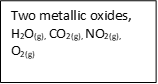
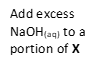


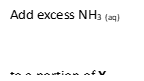


(i) State:-
(I) The condition in step I
(II) The process in step II
(ii) A small portion of mixture R is added to dilute nitric (V) acid in a test-tube. What would be
observed?
(iii) Write an equation for the reaction between the cation in filtrate X and sodium hydroxide
solution
(iv) Explain how water vapour in step I could be identified
(b)
(i) State and explain the conclusion that can be made from step IV only
(ii) Name the anion present in residue U. Explain
(iii) From the flow chart in (a) and (b);
(I) Write the formulae of cations present in mixture R
18. a) Define the term solubility of a substance.
b) The table below shows the solubilities of two salts L and M at different temperatures.
Temperature (oC) | Type of salt | 10 | 20 | 30 | 40 | 50 |
Solubility g/100g of water | L | 11.0 | 14.0 | 20.1 | 28.0 | 36.0 |
M | 15.0 | 17.0 | 19.0 | 21.2 | 25.0 |
(i) Name the method that can be used to separate the two salts.
(ii) Plot on the same axes a graph of solubilities of L and M against temperature
(iii) From the graph, determine:
I. The temperatures at which solubilities are equal
II. The solubility at the temperature mentioned above (iv) If the relative formula mass of M is 132, determine the concentration of
M in moles per litre in (iii) II above.
v) A solution contains 38g of L and 22g of M at 50°C. Calculate the total mass of crystals
obtained in cooling this solution to 30°C.
19. a) Define:
(i) A saturated solution.
(ii) Solubility of a solute.
b) In an experiment to determine solubility of sodium chloride, 10.0 cm3 of a saturated solution of
sodium chloride weighing 10.70g were placed in a volumetric flask and diluted to a total of 500
cm3. 25.0 cm3 of the diluted solution of sodium chloride reacted completely with 24.0 cm3 of
0.1M silver nitrate solution. The equation for the reaction is
AgNO3(aq) + NaCl (aq) AgCl (s) + NaNO3 (aq)
I. Calculate;
(i) Moles of silver nitrate in 24.0 cm3 of solution.
(ii) Moles of NaCl in 25.0 cm3 of solution.
(iii) Moles of NaCl in 500 cm3 of solution.
(iv) Mass of NaCl in 10.0 cm3 of saturated sodium chloride (Na = 23, Cl = 35.5)
(v) Mass of water in 10.0cm3 of saturated solution.
(vi) The solubility of NaCl in g/100g of waters.
20. Describe how you would prepare a dry sample of crystals of potassium sulphate starting with
100cm3 of 1M sulphuric (VI) acid.
21. The table shows solubility of potassium chlorate V
Temp (oC) | 45oC | 80o |
Solubility | 39 | 63 |
(a) Calculate the mass of solute and solvent in 90g of the saturated solution of the salt at 45oC
(b) A solution of the salt in 100g water contains 63g at 95oC. At what temperature will the
solution start forming crystals when cooled
22. Two samples of hard water C and D were boiled. When tested with drops of soap, sample
D formed lather easily while C did not:-
(a) Name the possible salt that caused hardness in sample D
(b) Explain how distillation can remove hardness in sample C
(c) Give one advantage of hard water
23. A student attempted to prepare a gas using the set-up below. She could not collect any gas
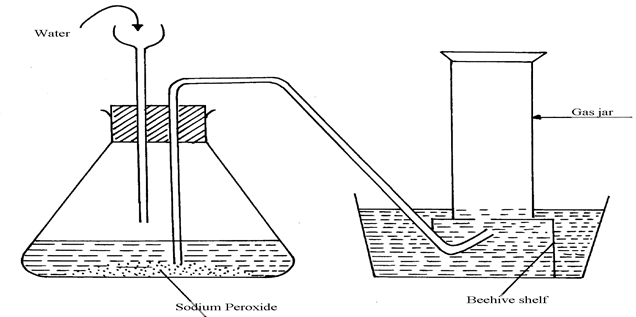
(a) Give two reasons why no gas was collected
(b) Which gas did the student intend to prepare?
24. Water from a town in Kenya is suspected to contain chloride ions but not sulphate ions.
(a) Describe how the presence of chloride ions in the water can be shown
(b) State one advantage of drinking hard water rather than soft water
25. Study the following tests and observation and answer the questions that follow:-
TEST | OBSERVATION | |
I | – Add few drops of acqueous ammonia to copper (II) nitrate solution | – Light blue precipitate is formed |
II | – Add excess of ammonia to copper (II) nitrate | – Deep blue solution |
III | – Add cold dilute hydrochloric acid to substance E1 and warm gently | – Gas evolved, smells of rotten eggs and blackens lead acetate paper |
Identify:-
(a) Substance responsible for:
I. Light blue precipitate…………………………………………………………………
II. Deep blue solution …………………………………………………………….
(b) Gas evolved in test III above …………………………………………………………
26. (i) What is meant by the term solubility of salts?
(ii) Calculate the solubility of a salt given that 15g of the salt can saturate 25cm3 of water.
27. (a) Draw a well labeled diagram to show how to prepare an acqueous solution of hydrogen
chloride gas
(b) Name one other gas whose aqueous solution can be prepared in the same way
28. In an experiment to determine the solubility of solid Y in water at 30oC the following results
were obtained; *MAT
Mass of empty evaporating dish = 26.2g
Mass of evaporating dish + saturated solution = 42.4g
Mass of evaporating dish + dry solid Y = 30.4g
(a) Use the data to calculate the solubility of solid Y at 30oC
(b) State one application of solubility curves and values
29. Study the table below showing the solubility of substance K at various temperatures
Temperature (oC ) | Solubility (g/100g water) |
0 30 70 100 | 30 24 19 14 |
(a) What would happen if a sample of a saturated solution of the substance at 30oC is
heated to 70oC. Explain.
(b) What is the most likely state of substance K…………………………………………………………
30. In the equilibrium given below:-
Fe3+(aq) + SCN(aq) [Fe(SCN)]2+
(aq)
Brown Red
What would be observed when Iron (III) Chloride is added to the equilibrium mixture. Explain
31. Sodium Carbonate Decahydrate crystals were left exposed on a watch glass for two days.
a) State the observations made on the crystals after two days.
b) Name the property of salts investigated in the above experiment
32. The label on a bottle of mineral; water had the information below.
Ions present | Concentration (g/litre) |
Ca2+ Mg2+ Na+
HCO3 | 0.10 0.20 0.01 0.01 0.14 0.26 |


(a) Name the compound that causes temporary hardness in the mineral water.
(b) Using an equation, describe how the water can be made soft by adding sodium
carbonate solution.
(c) Give one advantage of drinking mineral water such as the one above
33. A solution of hydrogen chloride gas in methylbenzene has no effect on calcium carbonate.
A solution of hydrogen chloride in water reacts with calcium carbonate to produce a gas. Explain
34 (i) Is concentrated sulphuric acid a weak acid or a strong acid?
(ii) Explain your answer in (i) above.
35. When water reacts with potassium metal the hydrogen produced ignites explosively
on the surface of water.
(i) What causes this ignition?
(ii) Write an equation to show how this ignition occurs
36. In an experiment, soap solution was added to three samples of water. The results below
show the volume of soap solution required to lather with 500cm3 of each water sample
before and after boiling
Sample 1 | Sample 2 | Sample3 | |
Volume of soap used before water boiled | 26.0 | 14.0 | 4.0 |
Volume of soap after water boiled | 26.0 | 4.0 | 4.0 |
(i) Which water samples are likely to be soft?
(ii) Explain the change in volume of soap solution used in sample 2

37. How does the pH value of 0.25M KOH(aq) compare with that of 0.25M ammonia solution
Acids, bases and salts Answers Answers
1. (a) Proton donor/electron acceptor/a substance which when dissolved in water
dissociates/break to  hydrogen ions as the only positive ion.
( b) Water/ H2O
(c) It is a proton donor/electron acceptor
2. (i) Ethylbutanoate
(ii) CH3CH2CH2
(iii) Esters
3. (a) Temporary water hardness . This is because hardness is removed by boiling
(b) – Provide Ca2+ ions needed in formation of strong teeth and bones
– Hard water form a layer of carbonate of lead which prevent water coming in contact with
lead  which cause poisoning (award 1mk for any one)
 4. Let x be the mass of FeSO4 crystals in saturated solution
 Mass of water = 45 – x
X g of FeSO4 dissolves in (45-x)g of water
100x of FeSO4 dissolves in 100g of water
45 – x
 So, solubility is 100x = 15.65
45 – x
100x = 15.56 (45 – x)
100x + 15.65x = 15.65 x 45
 115.65x = 15.65 x 45
x = 15.65 x 45
115.65
= 6.0895
So solubility = 6.09g of FeSO4 in 100g of water
5 . (a) Ca(HCO3)2(aq) CaCO3(s) + CO2 + H2O(l)
or:- Mg(HCO3)
MgCO3(s) + CO2(g) + H2O(s) (award 1mk for any)
(b) – Addition of Na2CO3(s)
– Addition of Ca(OH)2(s)
– Addition of aqueous ammonia (award 1mk each for any two; Total =2mks)
6. – Provides essential minerals e.g. Ca2+ for strong bornes and teeth 1
– It has a better taste
7. a) The acid is water H2O
Reason H2O has donated a proton (H+)
b) 2H+(g) + CO32-(aq) ___________ CO2(g) + H2O(l)
8. Magnesium carbonate reacts w ith rain water
- Containing caborn (iv) oxide dissolved.
- Forming magnesuin hydrogencarbonate
- Or MgCO3(s) + CO2(g) + H2O(l) + Mg (HCO3) 2 (aq)
 9. (a) Lead ions

 (b) Lead (II) hydroxide
(c) [Pb(OH)4]2-
10. a) Solubility of a salt is mass of a salt that dissolves in 100g of water at a given temperature. √1
b) Mass of Q that crystallizes out = 19.0 – 7.4 √½ = 11.6 g.
Mass of R that crystallizes out = 33 – 20.7√½ = 12.3g.
Total mass of crystals = 12.3 + 11.6√½ = 23.9g √½
11. Mass of dry salt = 16.86 – 15.86 √ ½
= 1.00g √ ½
Mass of water = 26.86 – 16.86 = 10g√ ½
Mass of salt in 60g of water = 60×1 = 6 g √ ½
10
12. (a) This is the maximum mass of a salt that will dissolve in 100g of water of a given
temperature
(b) 15g dissolve in 25cm3 water
? dissolve in 2100cm3 water
= 15 x 100 = 60g/100gwater
25
(c) (i) in graph paper
(ii) Every point on the solubility curve is a saturated point of a solution which contains a
maximum amount of salt X at a graph temperature

 (iii) I 16g
 II 25g
(iv) 25 – 16 = 9g/100g water
 (v) – Extraction of Na2co3 from Lake Magadi
– Extraction of Nacl from sea water
13. Add Methyl benzene to the mixture and stir to dissolve iodine. Filter and crystallize the
filtrate to obtain sodium chloride crystals.
14. (a) (ii) 72g /100g water 1.0
(iii) 100cm3 dissolve 72g
 1000cm3 dissolve = (1000 x 72)
100
 = 720g/l
 KClO3 = 39 + 35.5 + 3 x 16 = 122.5
molarity = 720g/l
 122.5gmol-1
= 5.878mol/l


 (iv) Mass dissolved at 62o = 116g
Mass dissolved at 42o= 66g
mass crystallized out = 50g

(b) (i) (25 x 0.2M) = 0.005mol
1000
(ii) 0.005mol (mole ration Acid: Base = 1:1)
 (iii) 20cm3 contain 0.005mol
 25cm3 contain = (250cm3 x 0.005mol)
20cm3
= 0.0625mol

(iv) Mass = (0.0625x 4ogmol-1) = 2.5g


(v) Mass of solvent = 28g – 2.5g = 25.5g
 solubility = (100 x 2.5)
 25.5
25.5
= 9.804g/100g water
15. a) Solubility refers to the maximum mass of solute dissolving in a 100g of a solvent at a
particular temperature
b) i) Fractional crystallization
ii) Scale = 1 mk
Plotting = 1 mk
Curve L = 1 mk
Curve M = 1 mk
iii) I = Actual value from students curve + 1C
II = Actual value from students curve + 1
iv) Mass per litre = 1000 X Actual value in iii (II)
100
Concentration = Above answer
132
= _________ M
16. (a) (i) Conductivity decreases wince H+ ions form he acid are neutralized by OH–ions
from the base. This reduces the concentration of ions available for conductivity.
(ii) Conductivity increases since the OH– ions accumulate after complete neutralization of the
acid OH– increases conductivity.
(iii) Neutralization leads to the formation of a slat. The ions in the salt are responsible for
conducting of electricity.
(iv) They yield different concentration of H+ ions
For HNO3 – dissociates completely hence more H+ ions
HCOOH – dissociates partially hence less H+ ions
(b) 2HCOOH(aq) + Na2CO3(aq) 2HCOONa(aq) + H2O(l) + CO2(g)
moles of HCOOH = 50 x 0.1
1000
= 0.005moles
mole ration acid : base
2 : 1
moles of Na2CO3 = 0.005
2
= 0.0025
Molarity of Na2CO3 = 0.0025 x 1000
20
= 0.125M
17. a) i) I) Heating √1
II) Filtration. √1
ii) Effervescence √1 / Bubles.
iii) Zn2+(aq) + 2OH–(aq) Zn(OH)2(s) √1
iv) Pass the water vapour over white anhydrous√1 Copper (II) suplhate. It turns blue. √½
b) i) R is a mixture of sulphur √½ and insoluble√½ salt. It forms √1 a filtrate and residue in
filtration of mixture
ii) Carbonate √1 / CO32-
√1
It produces CO2 on reaction with H+
iii) Zn2+√1 Al 3+ √1
18. a) The quantity of a substance in grammes that can dissolve in 100g of water at a given
temperature
b) i) Fractioned crystallization
ii)
iii)
I 26C
II 18g
iv) 1 mole of salt M _______ 132g
18×1/132 = 0.13863636 moles
Concentration = 1000 x 0.13863636
100
= 1.386M
v) L = 20g M= 19g
38-20=18
22-19= 3+
Total 21 g
19. (a) (i) A saturated solution is one which cannot dissolve more solute at that particular temperature.
1 (1 mk)
(ii) Solubility of a soluble is the amount of grams of solute present in 100g of water at that
particular temperature. 1 (1 mk)
(b) (i) Mole = M x V
1000
0.1 x 24
1 = 0.0024 moles1 (2 mks)
1000
(ii) Moles of NaCl in 25cm3
Mole ratio is 1 : 1
Moles of NaCl = 0.0024 moles1 (1 mk)
(iii) Moles of NaCl in 500 cm3
If 25cm3 = 0.0024 moles
∴ 500 cm3 = ?
= 500 cm3
1 x 0.0024 moles
25 cm3
= 0.048 moles 1 (2 mks)
(iv) Mass of NaCl in 10cm3
Mass = moles x R.F.M.
= 0.048 x 58.5 = 2.808g
(v) Mass of water = mass of solution – mass of NaCl
= (10.70 – 2.808)g 1
= 7.892 g 1 (2 mks)
(vi) If 7.892 of H2O
2.808g 1
100g of H2O ?
100g x 2.808 1
7.892g
= 35.6g /100g of H2O1
20. Add 100cm3 of 2M √ potassium hydroxide or 200cm3 of 1M potassium hydroxide to the acid.
Heat the solution until it is saturated and cool to obtain crystals. Dry the crystals between
filter papers
21. (a) 139g of solution contains 39g solute
90kg of solution contains 39 x 90 = 25.25g
139
Mass of solvent = 90 – 25= 64.75g
(b) 80oC
22. (a) Calcium hydrogen carbonate/Magnesium hydrogen carbonate;
(b) Water boils off and is condensed leaving the salt;
(c) Provides minerals used to strengthen bones
23. (a) Delivery tube should not dip into solution
– Thistle funnel should did into the solution
– Gas jar was no water/ little water in trough ( 1 each max 2)
(b) Oxygen
24. a) acidity water with Nitric add aqueous lead nitrate or
– silver nitrate formation of white precipitates shows presence
penalize fully for uric acid 1 ½ mk of chloride ions
b) provide essentials minerals e.g. Ca2+ ions
25. a) I- Cu (OH)2 or copper (II)hydroxide√1
b) Cu(NH3)4
2+√1
c)Hydrogen sulphide or H2Sg√1
26. i)this is the maximum mass of a salt that will dissolve in 100g of water at a given temperature √1
ii)15g dissolve in 25cm³ water
xg dissolve in (15×100)g√1
25
= 60g/100g√1
27. (a) Diagrammatical presentation on how to prepare an aqueous solution of hydrogen
chloride gas
(b) Ammonia gas *MAT
28. Mass of saturated soln. = 42.4 – 26.2 = 16.2
Mass of dry solid Y = 30.4 – 26.2 = 4.2g/12.0
Solubility of Y = 4.2 x 100
12.0
35g per 100g of water
(b) – Used is fractional crystallization of salt mixture.
29. (a) 24 -19 = 5g of substance K will be produced
 Reason: Solubility decreases with increase in temperature
(b) Gaseous state
 30. Deep red solution will be formed. Equilibrium shifts to the right/forward reaction is favoured since Fe3+ ions favours forward reaction.
31. a) They became a white powder
b) Efflorescency
32. a) calcium hydrogen carbonate/ magnesium hydrogen carbonate
b) Ca(LHCO3) 2(aq) + Na2CO3(aq) ________ CaCO3(g) + 2NaHCO3(aq)
Mg(HCO3)2(aq) + Na2CO3(aq) ________ CaCO3(g) + 2NaHCO3(a)
c) Contains Ca2+ ions needed to harden teeth and bones
33. HCl g in water ionizes to produce H+
aq and Cl –
aq
HCl (g) in methylbenzene remain as moles hence no H+ ion
34. (i) Weak acid 1
(ii) Has few free H+ (Hydrogen) ions
35. (i) The reaction is too exothermic that alot of heat is produced causing ignition of
hydrogen in presence of oxygen
(ii) K(s) + H2O(g) KOH(aq) + H2(g)
H2(g) + O2(g) H2O(g)
 36. (i) Sample 1 and 2
(ii) Sample 2 contained ions that caused temporary hardness therefore required
large ( volume of soap solution before boiling, but after boiling the temporary hardness
was removed, hence requiring very little volume ( ½mk) of soap solution to lather.
 37.- KOH has higher pH value than ammonia
 – KOH is a stronger base; dissociates fully
– Ammonia solution is a weak base; dissociates partially


1 Comment