

Structure and bonding Questions
1. Ethanol is a liquid at room temperature but does not conduct electricity. Explain.
2. a) Distinguish between a covalent bond and a co-ordinate bond.
b) Draw a diagram to show bonding in an ammonium ion. (N = 7, H = 1)
3. a) Explain why the metals magnesium and aluminium are good conductors of electricity.
b) Other than cost, give two reasons why aluminium is used for making electric cables while
magnesium is not.
4. Explain why the boiling point of ethanol is higher than that of hexane.
(Relative molecular mass of ethanol is 46 while that of hexane is 86).
5. a) What is meant by dative covalent bond?
6. Sodium and Magnesium belong to the same period on the periodic table and both are metals.
Explain why magnesium is a better conductor of electricity than sodium.
7. Using dots and crosses to represent electrons, draw the structures of the following:
(a) Phosphorous chloride (PCl3)
(b) Hydroxonium ion (H3O+)
8. Between aluminium and copper which one is a better conductor? Explain
9. Water has a boiling point of 100oC while hydrogen chloride has a boiling point of -115oC. Explain
10. Explain why luminous flame is capable of giving out light and soot
11. When blue litmus paper is dipped in a solution of aluminium chloride it turns red. Explain
12. Carbon and Silicon are in the same group of the periodic table. Silicon (IV) Oxide melts
at 2440oC while solid Carbon (IV) Oxide sublimes at -70oC. In terms of structure and
bonding, explain this difference
13. Element A has an atomic number of 6 and b has an atomic number of 9:
(i) Write the electron arrangements for elements A and B
(ii) Using dot () and cross (X )diagram, show how A and B combine to form a compound
14. (a) Explain why aluminium is a better conductor of electricity than magnesium
(b) Other than cost and ability to conduct, give a reason why aluminium is used for making
cables while magnesium is not
15. Explain how electrical conductivity can be used to distinguish between magnesium oxide and
silicon (IV) oxide
16. a) The diagram below represents part of the structure of sodium chloride crystal
The position of one of the sodium ions in the crystal is shown as;
i) On the diagram, mark the positions of the other three sodium ions
ii) The melting and boiling points of sodium chloride are 801C and 1413C respectively. Explain
why sodium chloride does not conduct electricity at 25C, but does not at temperatures
between 801C and 1413C
b) Give a reason why ammonia gas is highly soluble in water
c) The structure of ammonium ion is shown below;
Name the type of bond represented in the diagram by N H
d) Carbon exists in different crystalline forms. Some of these forms were recently discovered
in soot and are called fullerenes
i) What name is given to different crystalline forms of the same element
ii) Fullerenes dissolve in methylbenzene while the other forms of carbon do not. Given that soot is
a mixture of fullerenes and other solid forms of carbon, describe how crystals of fullerenes can
be obtained from soot
iii) The relative molecular mass of one of the fullerenes is 720. What is the molecular mass of
this fullerene
17. (a) Explain the following observations:-
(i) NaCl allows electric current to pass through them in molten state
(ii) Graphite is a non-metal yet it is a conductor of electricity
18. Study the table below and answer the questions that follow:-
Substance Melting Point (oC ) Boiling point (oC) | A | B | C | D | E | F | |
801 | 113 119 | -39 | 5 | -101 | 1356 | ||
1410 | 445 | 457 | 54 | -36 | 2860 | ||
Electrical Conductivity | Solid | Poor | Poor | Good | Poor | Poor | Poor |
liquid | Good | Poor | Good | Poor | Poor | Poor | |
I Identify with reasons the substances that:
(i) Have a metallic structure (1½mk)
(ii) Have a molecular structure and exist in the liquid state at room temperature and pressure(
(iii) Suggest a reason why substance B has two melting points
(iv) Substances A and C conduct electric current in the liquid state. State how the two substances
differ as conductors of electric current *
19. (I) Sodium metal tarnishes when exposed to the air where a white powder is formed on its
surface. A small piece of this sodium metal was dropped into 25g of ethanol and 1200cm3
of hydrogen gas was evolved at r.t.p. The unreacted ethanol was evaporated and a white
solid remained. (Na=23, molar gas volume at r.t.p = 24dm3, C=12, O =16, H=1)
(a) Write a chemical equation for the reaction between ethanol and sodium metal
(b) Determine the mass of sodium that reacted with ethanol
(c) What mass of ethanol evaporated?
(d) The ethanol was evaporated at 80oC, while the white solid remained unaffected at this
temperature. What is the difference in structure of ethanol and the white solid?
(II) (a) Name an inorganic liquid which liberates hydrogen gas with sodium metal
(b) What two differences would you observe if similar pieces of sodium were dropped
separately into small beakers containing equal amount of ethanol and the liquid
named in (II)(a) above respectively
(III) (a) Give the name of the white powder formed on the original piece of sodium metal
(b) Explain how the white powder named in (III)(a) is formed
20. The grid below represents part of the periodic table. The letters do not represent actual
symbols of the elements. Study it and answer the questions that follow:-
(a) What type of bond would you expect in the compound formed between H and F. Explain
(b) (i) Which of the elements J and M will have a greater atomic radius? Explain
(ii) Elements F and N are in the same group of periodic table. How do their atomic
radius compare? Explain
(c) An element W has atomic number 15. Indicate the position it would occupy in the table above
(d) What is the name given to elements X – Z?
(e) Why is J used in electric cables where Q is not
(f) P and J are termed as metalloids. What does the term metalloid mean?
(g) How would you expect the reactivity of H and M to compare? Explain
21. (a) Part of the periodic table is given below study it and answer the questions that follow.
The letters do not represent the actual elements
(i) What type of bond is formed when Y reacts with Z. Explain
(ii) Explain the difference in the atomic radii of element A and B
(iii) Explain the difference in the reactivity of Z and B
Study the information in the table below and answer the questions that follow:
(The letters do not represent the actual symbols of the elements)
Element | Electronic configuration | Ionization energy KJmol-1 |
P | 2:1 | 519 |
Q | 2:8:1 | 494 |
R | 2:8:8:1 | 418 |
(i) What is meant by ionization energy?
(ii) Element R has the lowest ionization energy. Explain
(iii) When a piece of element Q is placed on water it melts and a hissing sound is produced
as it moves on the water surface. Explain these observations
(iv) Write the equation for the reaction between element Q and water
22. The table below shows the elements in the third period, the oxides of the third period and their properties. The letters are not the actual symbols of the elements. Study the information and answer
the questions that follow:
Element | Atomic number | Atomic radius(nm) | Oxide | State at RT | oxide melting point ºC |
M | 11 | 0.191 | M2O | Solid | 1132 |
N | …………… | 0.160 | NO | Solid | 2852 |
P | 13 | 0.130 | ……… | Solid | 2072 |
Q | 14 | 0.118 | QO2 | ………. | 1610 |
R | ……… | 0.110 | ……… | Solid | 580 |
S | 16 | 0.102 | SO2 | ……… | -75 |
T | 17 | 0.099 | TO2 | Gas | -60 |
V | 18 | 0.095 | X | X | X |
a) i) Complete the table above
ii) Explain the trend in the atomic radius across the period
iii) Explain why the oxide of element V does not exist
b) Name the type of structure and bond in the following oxide
Oxide | Structure | Bond type |
NO |
| |
TO2 |
|
ii) Using dots and crosses to represent electrons. Show the bonding in the oxide, QO2
c) i)Explain why elements P conducts electricity but T does not
ii) The oxide of P reacts both acids and alkalis. Give the name of this kind of oxide
23. The table below gives information about elements A1, A2, A3 and A4
Element | Atomic number | Atomic radius (nm) | Ionic radius (nm) |
A1 | 3 | 0.134 | 0.74 |
A2 | 5 | 0.090 | 0.012 |
A3 | 13 | 0.143 | 0.050 |
A4 | 17 | 0.099 | 0.181 |
(i) In which period of the periodic table is element A2? Give a reason
(ii) Explain why the atomic radius of:
I. A1 is greater than that of A2
II. A4 is smaller than its ionic radius
III. Select the element which is in the same group as A3
IV.
Using dots () and cross (x) to represent outermost electrons, draw a diagram to show
the bonding in the compound formed when A1 reacts with A4
24. The atomic number of element P is 11 and that of Q is 8
a) Write down the possible formula of the compound formed between P and Q
b) Using dots (·) and crosses(x) to represent electrons draw a diagram to represent the
bonding in the compound in (a) above
25. Name the type of bonding and structure found in: –
(a) Ice
(b) Magnesium chloride
26. Name the type of bonding and structure found in: –
(a) Ice
(b) Magnesium chloride
27. Use the scheme to answer the questions that follow:
(a) Identify solid N ……………………………………………………………….
(b) Write a balanced equation for the formation of Q
(c) Write the formula of the complex ion formed when sodium hydroxide is added to
solution L in excess
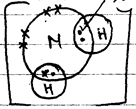
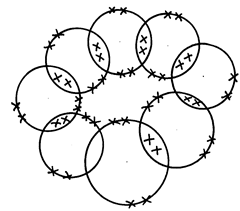
28. (a) Using dots () and crosses (x) to represent electrons show bonding in:
NH–2 ( N=7, H=1) S8 (S = 16)
(b) Show bonding in Carbon (II) Oxide by use of (__) or ( ) to represent bonds.
29. In terms of structure and bonding, explain why diamond is the hardest naturally occurring
Substance
30. Identify the bond types in the diagram
31. Elements A, B, C, and D are not actual symbols, have atomic numbers 19, 9, 12 and 10 respectively.
(a) Which two elements represent non-metals
(b) Write the formula of the compound formed between elements B and C and identity the
bond present in the compound
32. (a) Distinguish between a covalent and dative bond
(b) Explain why nitrogen gas reacts with oxygen at very high temperature
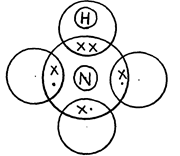
33. Draw a dot ( ) and cross (x) diagram to show bonding in:-
(i) Ammonium ion (NH4+
(N = 7.0, H= 1)
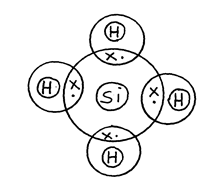
(ii) Silane (SiH4)
(Si= 14, H = 1)
34. Below is a table oxides of some period three elements
Oxides | Na2O | P4O6 | SO2 | Cl2O |
State at room temp | Solid | Solid | Gas | Gas |
(a) Give the systematic name of Cl2O
(b) Explain why Na2O exists as a solid whereas SO2 is a gas at room temperature
35. The table below shows properties of period three chlorides
Formular of compound | NaCl | MgCl2 | AlCl3 | SiCl4 |
Bp oC | 1470oC | 1420oC | 180oC | 60oC |
Explain why AlCl3 solid has a much lower boiling point than MgCl2 solid
Structure and bonding Answers
1. Ethanol contains molecules 1 which are not1 responsible for electrical conductivity
2. a) A covalent bond is formed by equal contribution of the shared electrons by the atom. 1
Co-ordinate bond is where the shared electrons are contributed by one of the atoms.1
OR
3. a) Have delocalized valency electrons 1
b) Aluminium is a better conductor/Aluminium has three delocalized electrons while
magnesium has 2. 1 It is resistant to corrosion.
4. In addition to vander waals forces, strong hydrogen bonds exist in ethanol. These bonds
require more energy to break.
5. a) Is a covalent bond in which the shared pair of electrons comes from the same atom
6. Magnesium has more delocalized electrons than sodium
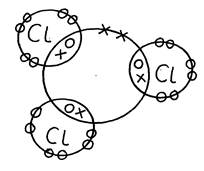 7. (a) Phsophorous chloride (PCl3)

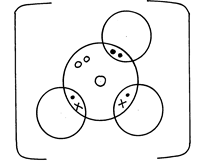
 (b) Hydroxonium ion (H3O+)


8. Aluminium – it has more delocalized (3) electrons than copper (2 e_)
9. Hydrogen chloride has got only Van der waal while water has H-bonds in
addition to Van der waal forces which are stronger
10. It contains white hoe carbon particles (½mk) that allow to give out light (½mk). When those
particles cool down (½mk) they turn black and settle down as soot.(½mk)
11. Aluminium chloride hdrolyses √1 in solution producing hydroxonium ions √½ which turn blue
litmus paper red. √½
12. Silicon (IV) oxide forms giant √1 atomic structure of strong covalent√½ bonds having high
melting point. Carbon (IV) oxide is simple molecular substance of weak intermolecular √½
attraction forces√1 9the Van der Walls’ forces) that have low melting point.
13. i)A: 2,4√ ½
B: 2,7√ ½
14. (a) Because aluminium √1 has more delocalized √1 electrons than magnesium.
(a) It does not corrode. √1
15. Magnesium oxide has a giant ionic √ ½ structure while silicon (iv) Oxide has a giant atomic
structure. Mg O in molten state √ ½ contains delocalized ions √ ½ which conduct electricity
while S1O2 has no ions present √
16. a) i)
ii) At 25C, sodium chloride is in solid form. Ions cannot move. Between 801 and
1413C sodium chloride is in liquid state, ions are mobile
b) Both ammonia and water are polar molecules and hydrogen bonds are formed
c) N _________ H // co-ordinate bond / Dative bond
d) i) Allotrope
ii) Add methylbenzene to soot in a beaker. Shake and filter. Warm the filtrate to
concentrate it. Allow the concentrate to cool for crystals to form. Filter to obtain
crystals of fullerene
iii) 720/12 = 60
17. (a) (i) NACl has mobile ions in molten state and in aqueous solution
(ii) Graphite has delocalized electrons in the structure which carry electric current
18. (i) I) C Reason:- Good conductor of electricity in both molten and solid state..
II) D-Its melting point is below room temp. and boiling point above room temp.
(ii) It exist in allotropic form.
(iii) A conducts electricity by use of mobile ions while C conducts by use of delocalized
electrons.
Both must be correct for the 1 mk.
19. I (a) 2Na(s) +2CH3CH2OH(l) 2CH3CHONa(aq) + H2(g)
(b) Mole ratio btn Na: H = 2:1
Mole of Holes H2 = 1200cm3
2400cm3
= 0.05moles
Moles of Na = 0.05 x 2
= 0.1moles
Mass of Na = 0.1 x 23
= 2.3g of sodium
(c) Mole ration C2H5OH:H2
Moles of C2H5OH = 0.05 x 2
= 0.1moles
mass of C2H5OH reacted = 0.1 x 46
= 4.6g
Mass evaporated = 50 – 4.6
= 45.4g of C2H5OH
(d) – Has molecular structure – with hydrogen bonds being molecules
While – C2H5ONa – has giant ionic structure with ionic bonds
(a) Water
(b) In ethanol – sinks in water and stream of bubbles observed /seen
While in water – floats on water and darts on water
– Hissing sound is heard (any two)
20. (a) ionic or electrovalent
F is metal and H is non metal.
b) (i) J atomic radius decrease a long a period from left to right nuclear change attraction
increase positive nuclear change increase due to increase in the number of protons.
(ii) F has a smaller atomic radius than N level down the grown.
c) W is group 5 period 3
d) Transition metals.
e) J has 3 valence electrons which and delocalizal whole Q has only 2 electron : hence J
has high electrical conductivity due to high number of decalized electron.
f) The reactions have both metallic and non metal properties
g) H is more reactive than M non metal reactivity increase up the group due to decrease
in electro negativity down the group.
21. (a) (i) Ionic bond
Y losses that is gained by Z
(ii) Atomic radius of A is larger than that of B has higher nuclear charge than A Electrons in B are drawn closer to the nucleus( ½mk)
(iii) Z is more reactive than B
Z has a smaller atomic radius so will readily attract extra electron
(b) (i) Energy needed to remove an electron from an atom in gaseous state
(ii) R has a largest atomic radius; (½mk)
Therefore the electron is easily lost
(iii) Reacts vigorously with water producing gas bubbles that give the hissing sound and
propels the metal
The metal floats on water as it is light
(iv) 2Q(s) + H2O(l) 2QOH(aq) + H2(g)
22. a) i)
Atomic number | Oxide formula | State at RT |
N-12 | P2O3 | Q – solid |
R- 15 | R2O5 | S- Gas |
ii) The atomic radius decreases across the period from M to V. Due to increasing
nuclear charge// increasing number of protons which pulls the outermost electrons
closer to the nucleus
iii) Element V is chemically stable// stable electronic configuration does not gain or
loss// share electrons with oxygen to form an oxide
b) i)
Oxide | Structure | Bond type |
No | Giant ionic | Ionic/ electro valent |
TO2 | Simple covalent/ molecular | Covalent |
( ½ mark each – total 2 marks)
c) i) P is a metal with valency electrons free to move but T is a non- metal// molecular has
no free valency electrons// molecules are electrically neutral
ii) Amphoteric oxide
23. (i) Period 2 its electronic arrangement is 2,3, or it has two energy levels.
– Accept shells or orbitals in place of energy levels
(ii) I- Across a period nuclear charge increases from, left to right exerting greater
pull/attraction on available electrons
II-A4 gains an electron and the incoming electron is repelled by other electrons or
electron cloud increases
(iii) A2
(iv)

24. a) P2Q √ reject QP2

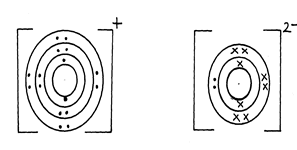
25. (i) Ice : Bonding : – Covalent √ ½ ½ mk
Structure : – Simple molecular √ ½ ½ mk 2
(ii) Magnesium chloride : Bonding : – Ionic √ ½ ½ mk
Structure: – Giant ionic ½ mk
26. (i) Ice : Bonding : – Covalent √ ½ ½ mk
Structure : – Simple molecular √ ½ ½ mk 2
(ii) Magnesium chloride : Bonding : – Ionic √ ½ ½ mk
Structure: – Giant ionic ½ mk
27. (a) Zinc oxide √1 ZnO (1 mk)
(b) ZnO(s) + H2SO4(aq) √1 ZnSO4(aq) + H2O (1 mk)
 3
3
(c)
 Zn (OH) √1 (1 mk)

 28. (a)



(b) C O
29. Diamond has giant atomic structure in each carbon atom√ ½ is bonded to four other √ ½
carbon atoms arranged in regular tetrahedron shape in all direction forming rigid (strong)√ ½
mass of atoms due to uniformity of covalent bonds between the atoms√ ½ (2mk)
30. 3 Covalent √1 bonds and one dative √1 bond
31. – CB2
– Ionic bond
32. (a) Covalent bond is bond between non-metal atoms where shared electrons are donated
equally by all the atoms involved.
 Dative bond is a bond in which shared electrons are donated by one atom.
(b) The presence of triple bond in nitrogen requires very high temperatures to break
 33. (i)


 34. (a) Chlorine (I) Oxide


(b) – Na2O has stronger ionic bond between ions in it, while SO2 has a weak Van der walls bond
between its molecule
 – Na2O requires more heat energy to weaken or break the ionic bonds than SO2 requires
breaking Van der walls bonds
35. ALCL3 has simple molecular structures with weak Vander waals between the molecules
MgCL2 has giant ionic structures with strong ionic bonds
Due to insoluble coating of aluminum oxide which prevents any reaction √1


