


KCSE 2008 BIOLOGY PAPER 1
QUESTIONS
1. Name the tissues in plants responsible for:
(a) Transport of water and mineral salts
- Transport of carbohydrates
- Primary growth (3 mks)
2. State the importance of the following processes that take place in the nephrons of a human kidney:
- Ultrafiltration (1 mk)
- Selective reabsorption (1 mk)
3. (a) Name a disease of the liver whose symptom is jaundice (1 mk)
(b) State the causative agent of:
(i) Cholera (1 mk)
(ii) Candidiasis (1 mk)
4. The diagrams below show a red blood cell that was subjected to a certain treatment
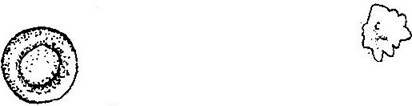
At start At the end of experiment
(a) Account for the shape of the cell at the end of the experiment (2 mks)
(b) Draw a diagram to illustrate how a plant cell would appear if subjected to the same treatment (1 mk)
5. (a) State two factors that affect enzymatic activities (2 mks)
(b) Explain how one of the factors stated in (a) above affects enzymatic activities (1 mk)
6. (a) What is meant by non-disjunction? (1 mk)
(b) Give two examples of continuous variation in humans (2 mks)
7. (a) What is a fossil? (1 mk)
(b) How does convergent evolution occur? (3 mks)
8. The diagram below shows a stage in mitosis in a plant cell

(a) Name the stage of mitosis (1 mk)
(b) Give two reasons for your answer in (a) above (2 mks)
(c) Name the part of the plant from which the cell used in preparation was obtained (1 mk)
9. Give three factors that determine the amount of energy a human being requires in a day (3 mks)
10. (a) Name the antigens that determine human blood groups (2 mks)
(b) State the adaptation that enables the red blood cells to move in blood capillaries (1 mk)
11. (a) What is homeostasis? (1 mk)
(b) Name three processes in the human body in which homeostasis is involved (3 mks)
12. State two functions of the endoplasmic reticulum (2 mks)
13. (a) Name the part of retina where image is formed (1 mk)
(b) State two characteristics of the image formed on the retina (2 mks)
14. Describe the three characteristics of a population (3 mks)
15. Explain what happens when there is oxygen debt in human muscles (2 mks)
16. The diagram below represents a setup that was used to investigate a certain process in a plant
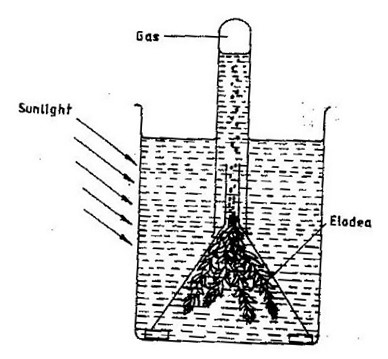
(a) State the process that was being investigated (1 mk)
(b) State a factor that would affect the process (1 mk)
- Account for the following phases of a sigmoid curve of growth of an organism:
(a) Lag phase (1 mk)
(b) Plateau phase (1 mk)
- How is the epidermis of a leaf of a green plant adapted to its function? (2 mks)
- The diagram below represents a tissue obtained from an animal

- Identify the tissue (1 mk)
- State the functions of the tissue named in (a) above (1 mk)
- (a) What is a single circulatory system? (1 mk)
- (b) Name an organism which has a single circulatory system (1 mk)
- (c) Name the opening to the chamber of the heart of an insect (1 mk)
- (a) What is seed dormancy? (1 mk)
- (b) Name a growth inhibitor in seeds (1 mk)
State two characteristics of aerenchyma tissue (1 mk)
 The diagram below shows a human tooth (2 mks)
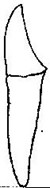 The diagram below shows a human tooth (2 mks)
(a) Identify the tooth (1 mk)
(b) How is the tooth adapted to its function? (1 mk)
(c) State the role of the following vitamins in the human body:
(i) C (1 mk)
(ii) K (1 mk)
- Name the sites where light and dark reactions of photosynthesis take place (2 mks)
- Giving a reason in each case, name the class to which each of the following organisms belong (4 mks)
Light reaction
Dark reaction
Bean plant
Reason
Bat
Reason
- The diagram below shows two fused bones of a mammal
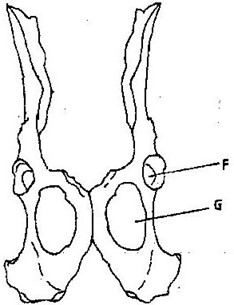 The diagram below shows two fused bones of a mammal
- Identify the fused bone (1 mk)
- Name the:
(i) Bone that articulates at the point labelled F (1 mk)
(ii) The hole labelled G (1 mk)
PAPER 2
SECTION A (40 MKS)
Answer all the questions in this section in the spaces provided
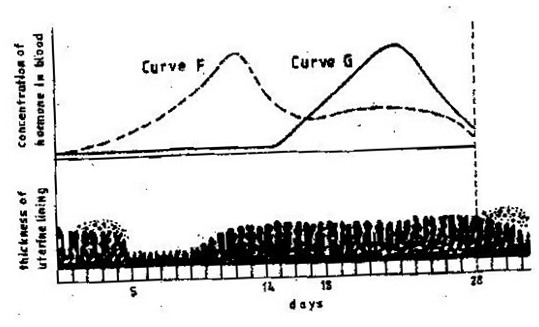
- Name the hormone whose concentrations are represented by curves F and G (2 mks)
- State the effects of the hormones named in (a) above on the lining of the uterus (2 mks)
- (i) Name the hormone which is released by the pituitary gland in high concentration on the 14th day of the menstrual cycle (1 mk)
- (ii) State two functions of the hormone named in (c)(i) above (2 mks)
- (d) State the fertile period during the menstrual cycle (1 mk)
2. A pea plant with round seeds was crossed with a pea plant that had wrinkled seeds. The gene for round seeds is dominant over that for wrinkled seeds.
Using letter R to represent the dominant gene state:
- The genotype of parents if plant with round seed was heterozygous (2 mks)
- The gametes produced by the round and wrinkled seed parents:
- The genotype and phenotype of F1 generation. Show your working (3 mks)
- What is a test-cross? (1 mk)
Round seed parent
Wrinkled seed parent
- The equation below represents a process that takes place in plants:
6CO2 + 6H2O → C6H12O6 + 6O2
- (a) Name the process (1 mk)
- (b) State two conditions necessary for the process to take place (2 mks)
- (c) State what happens to the end-products of the process (5 mks)
4. (a) Give three reasons in each case why support is necessary in:
(i) Plants (3 mks)
(ii) Animals (3 mks)
(b) Why is movement necessary in animals? (2 mks)
5. A freshly obtained dandelion stem measuring 5 cm long was split lengthwise to obtain two similar pieces.
The pieces were placed in solutions of different concentrations in Petri dishes for 20 minutes.
The appearance after 20 minutes is as shown:
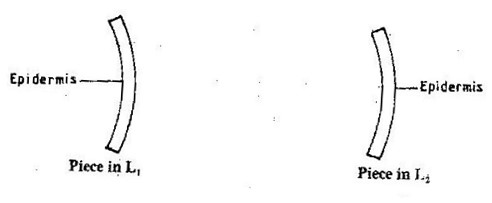
- Account for the appearance of the pieces in solutions L1 and L2 (6 mks)
- State the significance of the biological process involved in the experiment (2 mks)
SECTION B (40 Marks)
Answer question 6 (compulsory) and either questions 7 or 8 in the spaces provided after questions 8
- An experiment was carried out to investigate transpiration and absorption of water in sunflower plants in their natural environment with adequate supply of water. The amount of water was determined in two-hour intervals. The results are as shown in the table below:
| Time of day | Amounts of water in grammes | |
|---|---|---|
| Transpiration | Absorption | |
| 11:00 – 13:00 13:00 – 15:00 15:00 – 17:00 17:00 – 19:00 19:00 – 21:00 21:00 – 23:00 23:00 – 01:00 01:00 – 03:00 | 33 45 52 46 25 16 8 4 | 20 30 42 46 32 20 15 11 |
- Using the same axes, plot graphs to show transpiration and absorption of water in grammes against time of the day (7 mks)
- At what time of the day was the amount of water the same for transpiration and absorption? (1 mk)
- Account for the shape of graph of:
- Transpiration (3 mks)
- Absorption (3 mks)
- (a) State four characteristics of gaseous exchange surfaces (4 mks)
- (b) Describe the mechanism of gaseous exchange in a mammal (16 mks)


