


BIOLOGY PAPER 231/2 K.C.S.E 2004
PRACTICAL MARKING SCHEME.
1. You are provided with specimens labeled J1, J2, K1, and K2. Examine them.
a) With a reason, name the order to which specimens J1 and J2 and K1 and K2 belong. (4 mks)
J1 and J2: Rosales / Dicotyledonae
Reason: Net veined / Net venation / two cotyledons / reticulate / tap root system / petiole
K1 and K2: Parallel veined / parallel venation / one cotyledon / fibrous root system / sheath.
b) i) Name the curved part of specimen J1
Hypocotyl (correct spelling) (1 mk)
ii) What is the importance of the curvature? (1 mk)
Protects plumule / shoot tip / first foliage leaves / opens space through the soil for cotyledons to pass.
c) Explain how the curved part in J1 will straighten so that the stem will look like that of J2 (4 mks)
Exposure of curvature to light, auxins migrate to lower side/opposite side; faster growth of cells on lower side/opposite side; hence stem straightens; (Straightening tied to faster growth)
d) Name the part that protects the plumule in specimen K1 and K2 (1 mk)
Coleoptile (rejected: cover or coat)
e) i) Which of the two types of seedlings may form swelling on the roots later in its life?
ii) What is the name of the swelling? (1 mk)
Nodules / root nodules;
iii) Name the organisms that would be found in the swellings. (1 mk)
Rhizobium / Rhizobia / Rhizobium bacteria / nitrogen-fixing bacteria; rejected: bacterial nodules;
iv) Explain the relationship that exists between the named organisms and the plant.
f) i) Name the structures found on the stem just below the leaves of specimen J2 (1 mk)
Cotyledons / seed leaves
ii) State two functions of the structures named in (f)(i) above (2 mks)
Photosynthesis; stores food; rejected: provides food alone; according to marking scheme: provides for germinating seedling / young plants.
g) i) State the type of germination exhibited by specimen K1 and K2 (1 mk)
Hypogeal;
ii) Give a reason for your answer in (g)(i) above (1 mk)
Remains of fruit / grain / cotyledon underground / remains of endosperm;
h) Name the root system found in specimens J1 and J2 (1 mk)
Taproot system
K1 and K2
Fibrous root system
2. You are provided with specimens labeled M and N. Examine them.
a) Identify the specimens and in each case give two reasons for your answer. (6 mks)
i) Specimen M: Lumbar vertebra / vertebrae (rejected: lumbar alone / bone)
Reasons:
- Wide / large / broad centrum (rejected: thick)
- Long / broad transverse process; presence of metapophysis; anapophysis; broad / wide neural spine
ii) Specimen N: Cervical vertebra / cervical bone (rejected: cervical alone or cervical bone)
Reasons:
- Pointed / short / small neural spine;
- Presence of vertebraterial canals;
- Winged, forked / branched / divided transverse processes;
- Presence of cervical ribs.
b) State four ways in which specimen N is adapted to its functions (4 mks)
- Presence of neural canal for passage of spinal cord;
- Neural spine for attachment of muscles;
- Transverse process for attachment of muscles;
- Facets for articulation with other vertebrae;
- Vertebraterial canals for passage of blood vessels and nerves;
- Neural arch and centrum for protection of spinal cord (both indicated; first four accepted).
c) State four differences between specimens M and N.
| M | N |
|---|---|
| Canals absent | Vertebraterial canals present |
| Large / long / unforked transverse processes | Processes small / short / transverse |
| Presence of metapophysis / anapophysis | Absence of metapophysis / anapophysis |
| Cervical ribs absent | Cervical ribs present |
| Neural canal narrow | Neural canal wide |
d) Draw and label the anterior view of specimen.
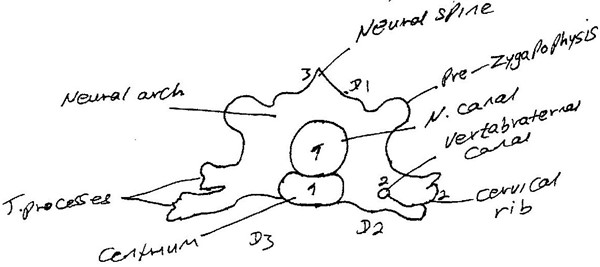
D1 Complete outline and proportionality – Centrum smaller than neural canal / No shading
D2 Transverse processes should be forked / Vertebraterial columns near centrum / fairly identical.
D3 Centrum and neural spine properly drawn.
a) i) What part of plant is specimen Q? (1 mk)
Stem tuber / stem;
ii) Presence of buds / presence of scale leaves; according to marking scheme: lateral buds / rejected: scaley leaves, swollen with food, lenticels.
b) State two roles played by specimen Q in the life cycle of the plant from which it was obtained. (2 mks)
Food reserve / storage organ / provide food during sprouting.
Rejected: provide food alone / Reproduction organ / parenting organ used for vegetative reproduction. (OWWTE)
c) Cut two equal cubes whose sides are about 1 cm from specimen Q. Place one of the cubes into a boiling tube labeled A. Crush the other using pestle and mortar. Place the crushed material in another boiling tube labeled B.
To each boiling tube add 4 ml of hydrogen peroxide.
i) Record your observations. (2 mks)
In A – Less / few bubbles / slow effervescence / fizzing / froth
In B – Rapid bubbling / effervescence / fizzing / froth / foam.
ii) Account for the results in (c)(i) above. (2 mks)
Large surface area in B than in A, for enzymatic activity in the test tube.
iii) Write an equation for the breakdown of hydrogen peroxide. (1 mk)
 2H2O2 → 2H2O + O2 (must be balanced)
With or without enzyme over water.
Bubbles because of enzymatic reaction.
d) Peel half of specimen Q and crush in a mortar. Use the reagents provided to test for the various food substances in the extract obtained from the crushed material.
Record the procedures, observations, and conclusions in the table below. (9 mks)
| Food substance | Procedure | Observations | Conclusion |
|---|---|---|---|
| Starch | Add a drop of iodine solution | Blue-black colour (brown to blue accepted) | Starch present |
| Reducing Sugars | Add Benedict’s solution & boil/heat/warm. Accepted: hot water bath. | (i) Green (colour) (ii) Yellow-orange (colour) Rejected: brown | Traces / little reducing sugar present. Reducing sugar present. |
| Protein | Add NaOH, followed by CuSO4 | No colour change / blue / colour remains Light purple / violet / purple | Proteins present |


