

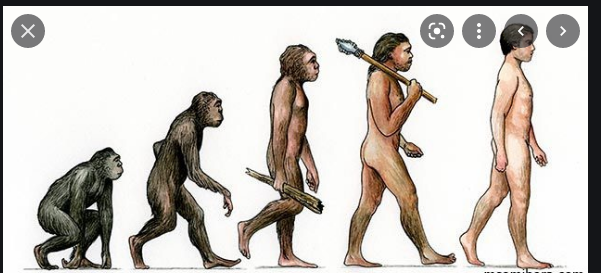
Evolution of Man, Technology and Environment
Evolution of Man
Evolution is the gradual development of plants and animals from simple forms to more complex ones. This change leads to the existence of plants and animals that differ from the original forms.
The Theory of Evolution of Man
The theory of evolution explains the origin of man by describing the changes our ancestors underwent until they became modern humans.
There are two main theories that attempt to explain the origin of man.
1st Theory of Creation
This theory states that a supernatural power created everything. This supernatural power is God. According to the Holy Bible and Qur’an, for example, the Bible (Genesis 1:26) says that God created man from soil; first a man, then a woman. These two beings established their relationship, marking the beginning of the human family.
2nd Theory of Evolution of Man
The theory of evolution of man was proposed by Charles Darwin (1809–1882). It states that man’s species has gradually changed from a lower stage to a higher stage due to environmental influences.
- Change is linked to improvements in methods of obtaining food, clothing, and shelter.
- The gradual change of man is called evolution. The first man belonged to the primate family, which includes apes, gorillas, monkeys, and chimpanzees.
- These animals lived in forests, walked on four limbs, and had bodies covered with hair.
- Due to environmental changes and diminishing forests, they started living in open grasslands.
- The environment forced them to adopt a new way of walking.
- The forelimbs, instead of being used for walking, became specialized for tool making and use.
- Forelimbs became free from walking.
- This type of walking is known as bipedalism.
Stages of Man’s Evolution
1. Primates (Ape, Gorilla, Monkey, Chimpanzee)
Characteristics
- Their bodies were covered with lots of hair.
- They walked on four limbs.
- They lived in dense forests.
- They had poor mental abilities.
- They depended entirely on nature, e.g., ate raw food.
2. Australopithecus African Family
This stage began about 12 million years ago (B.C.) when primates evolved into near-man forms. This stage is divided into two:
- Zinjanthropus
- Homo habilis
Zinjanthropus
- Forelimbs were free from walking.
- Hind limbs were used for standing and body balance.
- Man started to design, make, and use tools.
- Man became skillful.
Homo habilis
- Lived between 1,500,000 and 750,000 BC.
- Homo habilis became more skillful as a systematic tool maker.
- Homo habilis is believed to be the direct ancestor of modern man.
- He had a bigger brain and was a more systematic tool maker.
- Skulls of these creatures were discovered at Olduvai Gorge, Omo in Eastern Africa, and Rudolf in Kenya.
3rd Stage: Homo erectus
- Man was fully upright.
- He became a more skillful tool maker than Homo habilis.
- Fossils have been found in Olorgesaille and near Lake Turkana in Kenya, and Olduvai Gorge in Tanzania.
4th Stage: Homo sapiens
Characteristics
- He is the true man of today.
- Has a large brain size.
- Has less thick jaws.
- He was highly skillful.
- He made tools using stones and bones.
Note: The theory of evolution has been supported by archaeologists such as Dr. Leakey in Olduvai Gorge in 1959.
Basic Characteristics of Human Evolution
- Development of man’s ability to design, make, and use tools.
- Ability of man to walk on two limbs (bipedalism).
- Ability of man to think.
- Ability of man to domesticate plants and animals.
5th Stage: Homo sapiens sapiens
Homo sapiens sapiens is modern man. It is believed to have evolved about 50,000 years ago. This man has a large brain and great intelligence.

Stone Age
An age is a period defined by man’s economic activities and the type of tools used, e.g., Stone Age, Iron Age, Science and Technology Age, etc.
The Stone Age is a historical period in which man made and used stone tools.
The Stone Age is divided into three periods:
- Early or Old Stone Age
- Middle Stone Age
- Late or New Stone Age
Early or Old Stone Age
This is the first period of the Stone Age. It existed between 1,750,000 B.C. and 750,000 B.C.
Zinjanthropus was the only man existing in this period.
- The early stone tools were pebbles and chopping tools.
Man used these tools for:
- Killing and skinning animal flesh.
- Digging up roots.
- Cutting tree branches.
- Defense.
Man obtained his food by hunting and gathering.
In this period, man had low ability to control his environment.
Middle Stone Age Tools

Characteristics of Early or Old Stone Age
In East Africa, Stone Age sites are found at Olorgesaille, Nsongezi, and Olduvai.
- Man lived a primitive life depending on nature.
- Man made and used crude (poor) tools.
- Man lived by hunting and gathering.
- Man ate raw food, i.e., meat.
- Man walked upright.
- Man lived in caves.
- Man did not wear clothes.
Middle Stone Age
This stage covered the period between 750,000 BC and 50,000 BC.
During this period, man improved his stone tools.
Tools were smaller, sharper, and easier to handle.
Tools included spears, arrows, needles, stone picks, knives, etc.
These tools were used for:
- Digging up roots.
- Killing and skinning animals.
- Cutting and chopping.
New Stone Age Tools

The Discovery of Fire
How Man Discovered Fire
- Fire was discovered by man who was scratching pieces of wood using his hands.
- The more he scratched, the wood got heated, smoke appeared, and friction caused fire.
Importance of Fire to Man
- Man started to eat roasted food, i.e., meat.
- Man started to live in cold areas.
- Man used fire to clear bushes.
- Man used fire to provide light at night.
- Fire was used to kill small animals, e.g., rabbits.
- With fire, man increased working hours.
- Man used fire to attract prey.
- Man used fire for defense from dangerous animals like lions.
Man’s Ancestor Making Fire

General Characteristics of Middle Stone Age
- Man discovered fire.
- Man developed some religious beliefs.
- Man started to live a more complex life.
- Man’s main occupations were:
- Hunting and gathering.
- Sedentary or nomadic life.
The Late Stone Age (New Stone Age)
In East Africa, the Late Stone Age lasted from around 50,000 BC to the first millennium AD.
- In this stage, man used better tools compared to previous stone ages.
- Tools became sharper and smaller.
- Tools included stone axes, blades, spears, arrows, etc.
- Man started permanent settlements.
The tools were still largely made of stone but were far better than those of earlier periods.
This period marked the beginning of settled communities.
- In areas such as Kondoa Irangi, paintings and drawings in caves prove this fact.
- The paintings and drawings show the shape of tools used and animals hunted.
Characteristics of the Late Stone Age
- Man used better tools compared to previous ages.
- Man started to domesticate plants and animals.
- Man became a food producer.
- Population increased.
- It was the beginning of settled communities and villages.
- This period marked the beginning of division of labour.
Example: Women became child bearers and carers while men protected families and hunted.
Informal education started in this period.
The Late Stone Age Tools

Iron Age
- The Iron Age is believed to have started during the first millennium A.D.
- This was the period when man made and used iron tools.
- The discovery and use of iron improved man’s standard of living.
- Iron tools were discovered about 3,000 years ago.
- The first people to make and use iron tools in Africa were the people of Ethiopia and Egypt.
- Iron skills and knowledge were not uniform across Africa.
- The first important towns for iron smelting were:
- Meroe in Sudan
- Axum in Ethiopia
- Nok area in West Africa
- In East Africa, it is believed that man started to use iron from the first millennium A.D.
Examples of iron tools include iron spears, arrows, axes, hoes, etc.
Iron technology helped early African societies to:
- Produce and use iron tools.
- Produce better weapons for defense.
The Result of Using Iron Tools
- It led to an increase in food production as man could clear land for cultivation.
- Population increased due to more food.
- Specialization emerged, e.g., iron workers (blacksmiths) and food producers.
- It led to the emergence of complex villages and political organizations such as kingdoms and states.
- Tools were highly improved and more efficient.
- Trade relations expanded.
Diagram of Iron Tools

The Major Early Iron Centres in Africa


17 Comments