


DIFFERENTIATION
DERIVATIVES
Slope of a curve
A curve has different slopes at each point. Let A, B, and C be different points on a curve f(x).
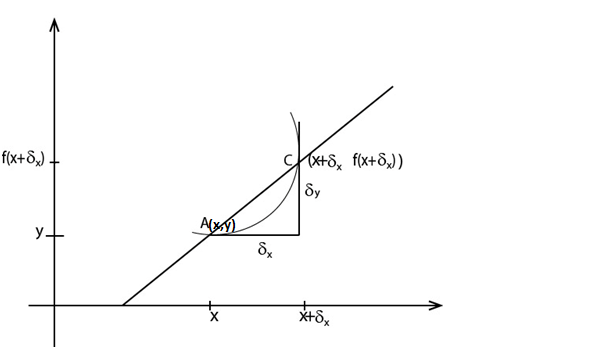
Where Δx is the small increase in x, and Δy is the small increase in y.
The slope of chord AC =  .
.
If C moves right up to A, the chord AC becomes the tangent to the curve at A, and the slope at A is the limiting value of .

Therefore,
The gradient at A is

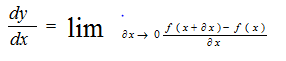
or
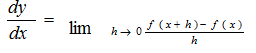
This is known as differentiating by first principle.
From the first principle
i) f(x) = x
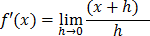
ii) f(x) = x2
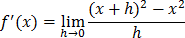
Therefore,

iii) f(x) = x3

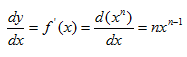
iv) f(x) = xn

By binomial series

In general,
If  then
then
Example
Differentiate the following with respect to x:
- y = x2 + 3x
Solution:
y = x2 + 3x

- y = 2x4 + 5
Solution:

Differentiation of product functions [product rule]
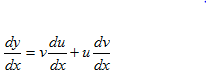
Let y = uv, where u and v are functions of x.
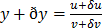
If x → x + Δx, then u → u + Δu and v → v + Δv, so y → y + Δy.
y = uv … (i)
Therefore,
y + Δy = (u + Δu)(v + Δv)
y + Δy = uv + uΔv + vΔu + ΔuΔv … (ii)
Subtract (i) from (ii):
Δy = uΔv + vΔu + ΔuΔv
Therefore,

Therefore, if y = uv,
Examples
Differentiate the following with respect to x:
- y = (x2 + 3x)(4x + 3)
- y = (x + 2)(x2 + 2)
Solution:
Let u = x2 + 3x, then

v = 4x + 3

Therefore,

Differentiation of a quotient [quotient rule]
Let y = u / v, where u and v are functions of x.

Then
Differentiation of a function [chain rule]
If y = f(u), where u = f(x), then

Parametric equations
Let y = f(t), and x = g(t).

Example
Find dy/dx if y = at2 and x = 2at.
Solution:

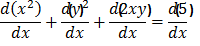
Implicit function
An implicit function is one where neither x nor y is the subject, e.g.
- x2 + y2 = 25
- x2 + y2 + 2xy = 5
One thing to remember is that y is a function of x.
Then

Differentiation of trigonometric functions
- Let y = sin x

Provided that x is measured in radians (small angle).
- Let y = cos x

- Let y = cot x

Differentiation of inverses
- Let y = sin-1 x, then x = sin y

- Let y = cos-1 x, then x = cos y
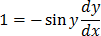
- Let y = tan-1 x, then x = tan y

Differentiation of logarithmic and exponential functions
- Let y = ln x

Differentiation of exponents
- Let y = ax
If a function is in exponential form, apply natural logarithms on both sides:
ln y = ln ax
ln y = x ln a

Application of differentiation
Differentiation is applied when finding rates of change, tangents of curves, maximum and minimum values, etc.
i) The rate of change
Example:
The side of a cube is increasing at the rate of 6 cm/s. Find the rate of increase of the volume when the length of a side is 9 cm.
Solution:

Tangents and normals
From a curve, we can find the equations of the tangent and the normal.

Example
Find the equations of the tangents to the curve y = 2x2 + x – 6 when x = 3.
Solution:
(x, y) = (3, 5) is the point of contact of the curve with the tangent.
Gradient of the tangent at the curve is

Slope of the tangent [m] = -3
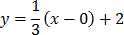
Equation of the tangent at (0, 2) is

Slope of the normal
From m1 m2 = -1, given m1 = -3, then

Equation of the normal is
Stationary points [turning points]
A stationary point is where dy/dx = 0. It involves:
- Minimum turning point
- Maximum turning point
- Point of inflection
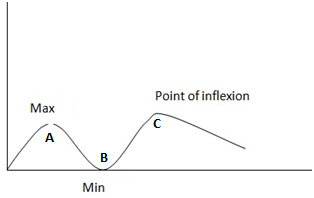
Nature of the curve of the function
At point A, a maximum value of a function occurs.
At point B, a minimum value of a function occurs.
At point C, a point of inflection occurs.
The point of inflection is a form of S bend.
Note that points A, B, and C are called turning points on the graph or stationary values of the function.
Investigating the nature of the turning point
Minimum points
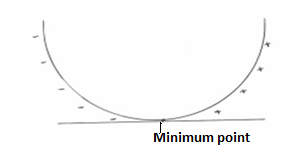
At turning points, the gradient dy/dx changes from negative to positive, i.e., increasing as x increases and is positive at the minimum point.
Maximum points
At maximum points, the gradient changes from positive to negative, i.e., decreases as x increases and is negative at the maximum value of the function.

Point of inflection

This is the change of the gradient from positive to positive or negative to negative, and the second derivative is zero at the point of inflection.
Examples
Find the stationary points and state the nature of these points for the following functions:
y = x4 + 4x3 – 6
Solution:

Stationary points at (0, -6) and (-3, -33).
At (0, -6) is a point of inflection.
At (-3, -33) is a minimum point.
Maclaurin’s series [from power series]
Let f(x) = a1 + a2x + a3x2 + a4x3 + a5x4 + a6x5 + …
To establish the series, find the values of the constants a1, a2, a3, a4, a5, a6, etc.
Put x = 0 in the series.

Example
Expand  in ascending powers of h up to the h3 term, taking 1.7321 and 5.50 as 0.09599c. Find the value of cos 54.5 to three decimal places.
Taylor’s series
Taylor’s series is an expansion useful for finding an approximation for f(x) when x is close to a.
By expanding f(x) as a series of ascending powers of (x – a):
f(x) = a0 + a1(x – a) + a2(x – a)2 + a3(x – a)3 + …
This becomes

Example
Expand  in ascending powers of x as far as the x3 term.
Introduction to partial derivative
Let f(x, y) be a differentiable function of two variables. If y is kept constant and f is differentiated with respect to x:

Keeping x constant and differentiating f with respect to y:

Example
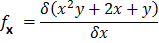
Find the partial derivatives of fx and fy if f(x, y) = x2y + 2x + y.
Solution:



5 Comments